
Himalayan yak chews, also called chhurpi dog chews, are hard, dried pet treats made primarily from yak milk, cow milk, or both, and processed into a dense traditional Himalayan cheese before being formed and dried for dogs. Commercial dairy-based dog chews may be subject to POAO and/or ABP controls; the applicable route, country approval, establishment approval, certificate, and inspection requirements must be confirmed for the exact product. Nepal’s current eligibility must be established before any shipment is planned. The first compliance question is whether the specific yak chew product, Nepalese exporting country, and manufacturing establishment are eligible for the applicable UK import route. Importers should verify the applicable country and establishment approval status with APHA before committing to a commercial shipment; written confirmation is advisable where eligibility is unclear.
The importer must establish the exact commodity route and confirm whether country and establishment approval, an EHC, an importer declaration, a commercial document, or an authorisation is required. This guide explains the complete process for UK pet-food importers, distributors, and commercial buyers, including the documents to obtain, processing and product records to maintain, customs and VAT costs, shipping considerations, BCP inspection procedures, common rejection triggers, and the pre-shipment checks that can prevent costly border holds, re-inspection, or destruction.
Can You Import Yak Chews From Nepal Into the UK Without Breaking UK Import Rules?
A commercial import should not be assumed to be permitted: the importer must check the current DEFRA/APHA country list and obtain APHA confirmation for the product’s exact commodity and route. The product’s regulatory classification determines which import route, which border authority, and which documentation set apply.
Because Nepal is a non-EU country, the importer must verify the applicable POAO/ABP category and whether Nepal is approved for that category before using the relevant import route.
Most import guides miss this entirely. They list documentation requirements without addressing whether the exporting country is eligible to supply the product in the first place. Country eligibility is confirmed with APHA before a purchase order is placed—not after goods arrive at the UK border.
Before shipment, confirm classification, country/establishment eligibility, required documents, the correct BCP, customs requirements, and any IPAFFS notification deadline. Missing eligibility, documents, notification, or customs information can delay or prevent clearance and may lead to charges or enforcement action, depending on the breach.
How Are Himalayan Yak Chews Classified for UK Import Purposes?
Himalayan yak chews are classified as dairy-derived animal by-products or manufactured complementary pet food, depending on how they are processed, presented, and declared at the UK border. The classification determines the applicable legislative framework, the required documentation, and the relevant Border Control Post category.
Do Dairy-Derived Dog Chews Fall Under Animal By-Product Controls?
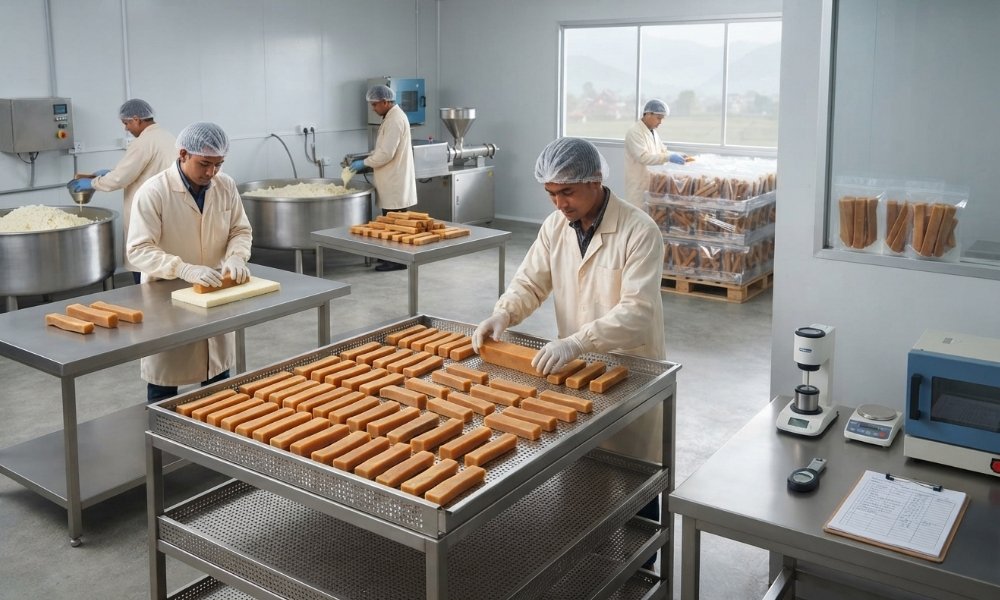
Himalayan yak chews are produced from chhurpi, a hard, dried cheese made from yak milk and cow milk, processed with lime juice and salt. Chhurpi is the foundational ingredient in the standard 4-ingredient recipe used by Nepalese manufacturers.
Milk-based pet products may be regulated under UK POAO, ABP, feed, or combined rules depending on the product and use; the exact legal instrument and route must be confirmed. Three factors determine the classification:
- Source material category: Whether dairy material is Category 3 must be determined under the applicable UK ABP definitions and conditions; veterinary inspection alone is not a sufficient universal test.
- Intended use: Dog-chew presentation is relevant to classification, but it does not by itself prove that the product is pet food made from Category 3 material or identify the required import document.
- Processing method: The applicable processing and certification conditions must be checked against the exact UK commodity rule and certificate model; do not infer them from generic pH or drying data.
Category 3 material processed into pet food must originate from establishments approved by the competent authority in the exporting country. The Nepalese issuing competent authority must be confirmed for the exact UK certificate model. If an EHC is required, it must be issued and signed by the authority and official authorized under the applicable certificate model; verify the Nepalese authority and establishment requirements with APHA.
Does the Product’s Processing Method Affect Its UK Import Requirements?
Yes. The processing method applied during Himalayan yak chew production directly affects which import classification applies and which processing standard APHA uses to assess the product.
Standard yak chew manufacturing involves 4 processing stages: milk boiling at 65–80°C during initial chhurpi preparation, approximately 4.0–4.5 hours, with “approximately 5.0–5.5” — consistent with published data on chhurpi and hard dairy fermentation chemistry. The exact pH of a specific manufacturer’s product should be verified against their own QC data. Extended mechanical pressing and forming, and a drying phase reducing water activity to ≤0.60. Some Nepalese manufacturers add a final hot-smoke treatment stage.
What most importers overlook: a manufacturer’s claim that the product is “dried” or “heat-treated” carries no regulatory weight at the UK border. APHA requires time-temperature records, pH test results, and water activity measurements from the manufacturer’s own quality control documentation to confirm which ABP processing standard the batch meets. Products without batch-level processing records cannot be assessed for classification compliance.
What Is the Step-by-Step Process for Importing Yak Chews From Nepal to the UK?
To import Himalayan yak chews from Nepal to the UK, complete 12 sequential steps spanning pre-purchase manufacturer verification through final UK warehouse delivery. Completing these steps in order prevents the 5 most common causes of shipment rejection at UK border points.
1. Verify the Nepalese Manufacturer and Yak Chew Product
Confirm that the Nepalese manufacturer operates a HACCP-certified facility with documented food safety management, DFTQC registration, and an export history to regulated markets. Request the manufacturer’s DFTQC registration number, ISO certification, facility audit records, and batch-level quality control data. Confirm the product’s 4-ingredient composition, processing parameters (pH, water activity, heat treatment records), and finished product specifications before requesting samples or issuing a purchase order.
2. Confirm UK Product Eligibility and Classification
Determine the correct commodity code using the UK Integrated Online Tariff commodity code lookup (GOV.UK Trade Tariff Service), which provides the applicable commodity codes, duty rates, VAT treatment, and import controls for goods entering the UK. Himalayan yak chews presented as dog treats typically fall under HS 2309.10 (dog or cat food, put up for retail sale) or HS 2309.90 (other preparations of a kind used in animal feeding). The commodity code determines the applicable import duty rate, VAT treatment, and the regulatory framework governing the import. If the correct classification remains uncertain, request a legally binding commodity code decision through HMRC’s Advance Tariff Ruling service. An Advance Tariff Ruling provides an official, legally binding classification decision that can help protect importers from subsequent customs duty disputes, subject to the ruling’s applicable conditions and validity period.
3. Check Country and Establishment Eligibility
Contact APHA’s imports team in writing to confirm whether Nepal holds approved third-country status for the commodity code identified. APHA maintains the approved third-country list and the establishment listing for each product category. Because Nepal is not currently listed on Great Britain’s approved third-country list for milk or dairy-derived animal by-products, commercial imports remain legally blocked until Defra completes a formal residue control plan and country-level equivalence evaluation. Confirm this before placing any financial commitment with the Nepalese supplier. At this pre-order stage, working with a reliable yak chew manufacturer that holds active DFTQC registration, documented audit records, and a proven export compliance history reduces the financial exposure created by sourcing from an establishment that does not yet qualify under the applicable UK import route.
4. Confirm APHA and Defra Requirements
APHA and Defra set the requirements for each import commodity, including whether a UK-approved Export Health Certificate (EHC) model exists for the product type, which processing standards the product must meet, and whether Nepal’s competent authority (DFTQC) is recognised to issue the required border health certificates. The applicable import requirements are confirmed via APHA’s imports team and Defra’s model health certificates published on GOV.UK.
5. Determine Whether a Health Certificate Is Required
A health or veterinary certificate is required for most animal-origin products entering the UK. For yak chews classified as pet food from Category 3 animal by-product material, a UK-approved Export Health Certificate (EHC) signed by an authorised official from Nepal’s Department of Livestock Services (DLS) is required. The APHA EHC Online system lists applicable model numbers by product type and country. Confirm the relevant EHC model number and instruct the Nepalese manufacturer to initiate DFTQC certification well before the planned shipment date—DFTQC inspection scheduling timelines vary. Importers should contact Nepal’s Department of Food Technology and Quality Control (DFTQC) directly through its official government portal to confirm current Export Health Certificate (EHC) processing and scheduling lead times before finalizing shipment dates. DFTQC operates Import Export Quality Certification Offices, including an office at Tribhuvan International Airport. Pairing this step with an established yak chew manufacturer in Nepal that already holds active DFTQC registration substantially reduces EHC scheduling lead times and lowers the risk of delays caused by incomplete facility certification records.
6. Check Whether IPAFFS Pre-Notification Applies
IPAFFS (Import of Products, Animals, Food and Feed System) is the UK’s mandatory pre-notification platform for products of animal origin, animal by-products, and high-risk food and feed. UK importers must register for and submit the required import pre-notifications through the Import of Products, Animals, Food and Feed System (IPAFFS) before the goods depart from the exporting country. Where applicable, the relevant Common Health Entry Document (CHED) must also be completed through IPAFFS. For animal-origin pet food and ABP categories imported from non-EU countries, IPAFFS pre-notification must be submitted at least 1 working day prior to arrival for sea freight, or at least 4 hours prior to arrival for air freight. The CHED reference number generated at submission must appear on the customs import declaration.
7. Confirm the Correct Border Control Post and Import Route
Not all UK ports are approved to handle all categories of animal products. Check the current APHA authorised UK Border Control Post (BCP) list before arranging freight, as each BCP is authorised to handle specific categories of animal products and related goods. Importers should confirm that their selected BCP is currently designated to process the relevant commodity. Sea freight from Nepal, transiting via Kolkata or Nhava Sheva, typically arrives at Felixstowe or Tilbury. Air freight from Kathmandu routes to Heathrow Airport, where animal product inspections are conducted at designated cargo-area BCPs: Heathrow Airport – PrimeFlight Cargo Ltd (Eurobip) and Heathrow Perishable Centre, not at Terminal 4. Shipments must arrive at a BCP designated for the commodity category. Arrival at a non-designated port triggers automatic referral, which adds 48–96 hours to the clearance timeline.
8. Prepare the Required Import and Commercial Documents
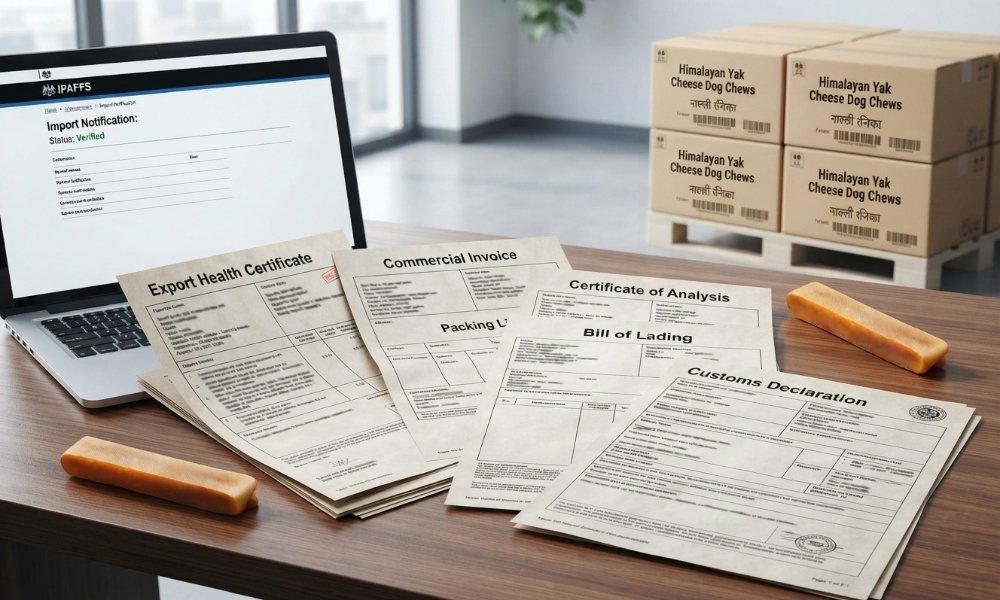
Compile the complete document set before the goods leave Nepal. The 7 core documents for a standard yak chew shipment are: the completed EHC signed by DFTQC, commercial invoice, packing list, bill of lading or air waybill, certificate of analysis from a DFTQC-recognised laboratory, the IPAFFS CHED reference number, and the customs commodity code declaration. A single missing document delays clearance regardless of the accuracy of all other records.
9. Complete Nepal Export and International Shipping Procedures
The Nepalese manufacturer arranges DFTQC inspection, batch sampling, and export certification. Manufacturers offering structured yak chew export services from Nepal coordinate batch sampling, EHC preparation, and DFTQC sign-off within a single pre-shipment workflow, reducing the risk of documentation gaps that trigger UK border delays. Nepal’s landlocked geography means goods transit through India — via Kolkata or Nhava Sheva — before international sea freight loads. Transit time from Kathmandu to a UK port averages 28–42 days by sea freight. Air freight from Tribhuvan International Airport to Heathrow typically takes 3–7 working days for commercial shipments, subject to cargo consolidation, airline schedules, and customs processing at both ends. The Incoterms agreed between the buyer and seller determine at which point the UK importer takes legal responsibility for the shipment.
10. Complete UK Customs and Border-Control Procedures
The UK importer or their appointed customs broker submits an import declaration via the Customs Declaration Service (CDS) at or before the shipment’s arrival. The declaration includes the commodity code, customs procedure code, IPAFFS CHED reference number, customs valuation (CIF: cost, insurance, freight), and country of origin (Nepal). UK importers need an Economic Operators Registration and Identification (EORI) number to handle customs procedures. Importers can apply for a free UK EORI number directly through HMRC’s EORI registration service on GOV.UK before arranging their first shipment. Most applications are processed immediately.
11. Complete Any Required Documentary, Identity, or Physical Checks
APHA Border Inspection Post officers conduct up to 3 check categories. Documentary checks verify that certificates are present, correctly completed, and within their validity. Identity checks confirm the physical consignment matches the documentation in terms of product type, package count, and net weight. Physical checks involve product sampling; for dairy-derived pet food, samples are tested for Salmonella, moisture content, water activity, and heavy metals (lead, cadmium, mercury, arsenic). Laboratory results typically return within 3–7 working days, during which the shipment remains held at BCP storage.
12. Obtain Shipment Release and Arrange Final UK Delivery
Following successful checks, border inspectors record a ‘Consignment Acceptable’ decision on the CHED-P (Common Health Entry Document for Products of Animal Origin and Animal By-Products). The customs broker submits the final import declaration referencing the CHED number, HMRC releases the goods, and applicable import duties and VAT are paid. The importer arranges collection or delivery from the port storage facility to their UK warehouse or distribution point.
What Documents Do You Need to Import Yak Chews From Nepal?
Importing yak chews from Nepal to the UK requires 5 document categories totalling at least 7 individual records. Each document serves a distinct compliance function within the UK animal health, customs, or food safety framework.
Official Health or Veterinary Certificate, Where Required
The UK EHC is a government-to-government document signed by an authorised DFTQC official in Nepal. The EHC model number is determined by the product category and must correspond to the APHA-approved model for that commodity. EHC validity windows vary by product category and applicable model certificate. Importers must confirm the specific validity period for the relevant APHA EHC model with DFTQC and APHA before scheduling shipment, as periods differ across commodity types. A single correction not initialled by the issuing official invalidates the certificate.
Commercial Invoice and Packing List
The commercial invoice states the buyer, seller, product description, quantity in kilograms, unit price, total value in GBP or USD, agreed Incoterms, and country of origin (Nepal). The packing list specifies the carton count, gross and net weight per carton, dimensions, and total pallet count. Both documents must correspond exactly to the container contents. Weight or carton count discrepancies—even minor ones—trigger identity check failures at the BCP.
Customs and Transport Documents
The bill of lading (sea freight) or air waybill (air freight) is the primary transport document referenced in the customs import declaration. A certificate of origin issued by the Nepal Chamber of Commerce confirms the product’s country of origin for tariff purposes. The customs import declaration submitted via the CDS references both the transport document number and the IPAFFS CHED reference.
Product Specification and Composition Records
The product specification sheet declares the full ingredient list (yak milk percentage, cow milk percentage, lime juice quantity, salt percentage), nutritional analysis, water activity measurement (≤0.60), pH value, shelf life, and storage conditions. The certificate of analysis from a DFTQC-accredited laboratory confirms Salmonella-free status, heavy metal compliance, moisture content, and crude protein, fat, fibre, and ash values. APHA officers review both documents during documentary checks.
IPAFFS and Border-Control Documentation, Where Applicable
The IPAFFS CHED reference number generated at pre-notification submission is entered on both the customs import declaration and the shipping documents. The CHED is endorsed by APHA officials at the BCP following inspection. The endorsed CHED constitutes the formal record of border clearance and must be retained by the UK importer for a minimum of 3 years.
What Must a UK Importer Verify Before Placing a Yak Chew Order?
Before placing a purchase order, UK importers must confirm 4 compliance areas. A failure in any one area after goods have been shipped creates both financial exposure and regulatory liability.
Importer and Customs Requirements
Register for an EORI number via HMRC if not already registered. Create an IPAFFS account at ipaffs.trade.gov.uk. Appoint a customs broker with documented experience in animal product imports—not a general freight forwarder without specific ABP or POAO knowledge. Register the importing business as a UK feed or pet food business operator with the relevant local authority if yak chews will be sold on the UK market as complementary pet food. Importers planning to distribute through UK retail channels should review the yak chew wholesale guide for pet stores to align minimum order quantities, product specifications, and labelling requirements with downstream pet retailer expectations before placing the first commercial order.
Product Classification and Eligibility
Confirm the commodity code before any commercial commitment. Use the UK Trade Tariff tool with the full product description, ingredient list, and intended use (dog chew / complementary pet food). A Tariff Classification ruling from HMRC, obtainable in writing, provides a legally binding classification that protects against post-import disputes over duty rates or inspection categories.
Country and Establishment Approval Status
Contact APHA’s imports team in writing, not by phone, and request confirmation of Nepal’s approval status for the specific commodity code identified. Ask APHA to confirm whether any Nepalese establishments are listed for that product category. APHA’s written response serves as the pre-import eligibility confirmation that protects the importer if the approval status changes between order placement and shipment arrival.
Border Entry and Shipping Requirements
Identify the correct UK BCP before booking freight. Confirm the BCP’s operating hours and advance booking requirements—some BCPs require 48-hour notice for physical inspection appointments. Confirm whether the sea freight transit route through India requires any additional transit country health certificates or administrative authorisations before the goods can be loaded onto an international vessel.
What Must a Nepalese Yak Chew Manufacturer Provide Before Shipment?
A Nepalese yak chew manufacturer exporting to the UK must supply 5 categories of pre-shipment information and documentation. Incomplete manufacturer documentation is the single most common cause of UK border rejection for yak chew consignments.
Product Composition and Processing Information
The manufacturer provides: a full ingredient declaration with percentage composition for each input (yak milk, cow milk, lime juice, salt), a process flow diagram covering each production stage, time-temperature records for all heat treatment steps, pH measurement records at key production stages, and a water activity report for the finished dried product showing ≤0.60.
Raw Material and Dairy Traceability
Traceability records identify the source farms or dairy cooperatives supplying yak and cow milk, the veterinary health status of the supplying animals in the 30-day period before milk collection, and the milk transport and reception records at the manufacturing facility. UK border authorities use raw-material traceability records to verify that source dairy material meets Category 3 criteria under the UK ABP Regulation.
Manufacturing and Quality-Control Records
HACCP plan documentation covering each critical control point in yak chew production, internal audit records for the preceding 12-month period, microbiological testing results (Salmonella, E. coli, Listeria) per batch, heavy metal analysis results (lead, cadmium, mercury, arsenic) per batch, and finished product moisture content and water activity records for each production batch included in the export consignment.
Export and Certification Documentation
DFTQC inspection report for the export batch, the completed and signed EHC prepared in advance of shipment within the applicable validity window, the DFTQC facility registration certificate showing the establishment number, and DFTQC export clearance documentation confirming the batch has passed Nepal’s competent authority pre-export inspection.
Packaging and Labeling Information
Packaging and labeling information requires analytical constituents expressed as percentage values (%), a country of origin declaration (Nepal), best-before dating, and an ingredient list in descending order by weight. UK importers distributing under their own brand should confirm early whether the manufacturer can supply private label yak chew production with UK-compliant labelling built into the product specification from the outset; retrofitting label compliance after the export agreement is signed adds significant time and cost to the clearance timeline.
What Happens When Yak Chews Arrive in the UK?
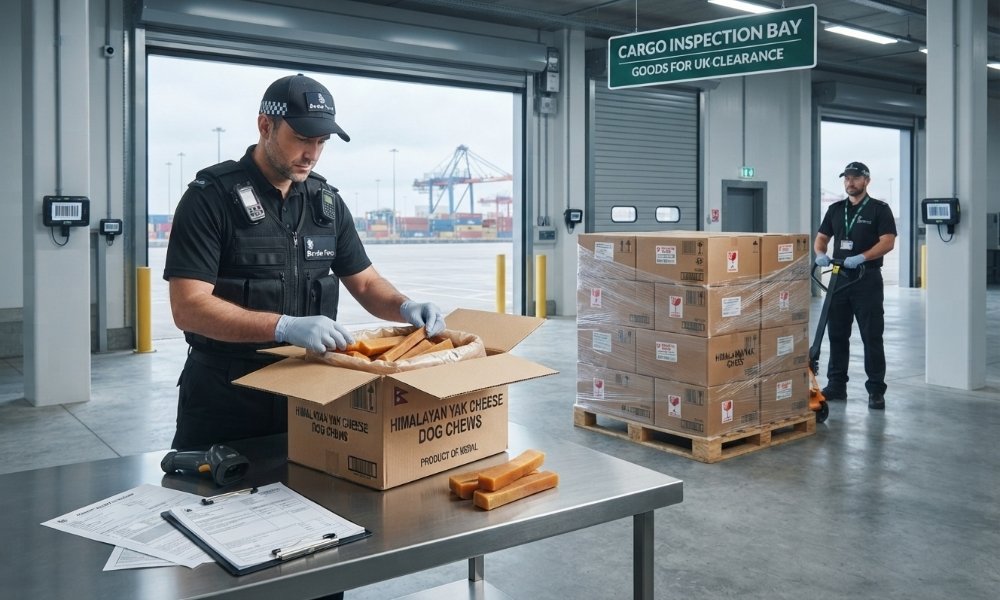
When a yak chew shipment from Nepal arrives at a designated UK Border Control Post, it enters a 3-stage inspection process managed by Port Health Authority (PHA) officers and Official Veterinarians. The shipment remains under customs control and cannot be released to the importer until all required checks are completed and the CHED records a “Release” decision.
What Happens at the Border Control Post, Where Applicable?
The shipping agent or customs broker presents transport documents and the IPAFFS CHED reference to BCP officers on arrival. APHA cross-references the CHED pre-notification against the arriving consignment. Failure to notify BCP of arrival within the required window—at least 1 working day before arrival for sea freight or 4 hours for air freight—triggers an automatic hold and administrative fees.
How Are Documentary, Identity, and Physical Checks Handled?
Documentary checks verify that all required certificates are present, correctly completed, and within their validity. Officers confirm that the EHC covers the correct product category, the exporting establishment number matches the APHA listing, the commodity code on the import declaration matches the product description, and the CHED pre-notification corresponds to the arriving shipment.
Identity checks physically confirm that the consignment matches the documentation. Officers verify the product species of origin, the number of packages, and the net weight against the packing list and EHC. A weight discrepancy of more than 5% between the declared and actual net weight triggers a documentary failure.
Physical checks involve product sampling. Samples are tested for Salmonella, moisture content, water activity, and heavy metals. For dairy-derived animal by-product pet food, APHA sets physical check frequencies based on the product category’s assigned risk rating. Laboratory results are returned within 3–7 working days, during which the consignment is held at BCP storage at the importer’s expense.
When Can the Shipment Be Released for Delivery?
The shipment is released when APHA records “Consignment Acceptable” on the CHED, and HMRC confirms customs clearance following import declaration acceptance. The customs broker arranges payment of applicable import duties and VAT before collection is authorised. The importer then arranges last-mile delivery from the port facility to their UK warehouse.
How Much Does It Cost to Import Yak Chews From Nepal to the UK?
Importing Himalayan yak chews from Nepal to the UK involves 4 cost categories beyond the product purchase price. Total landed cost per kilogram typically ranges from £3.50 to £8.00 depending on freight mode, shipment volume, and whether physical inspection is triggered.
What Freight and Shipping Costs Should You Budget For?
Sea freight LCL costs from Nepal (via Kolkata or Nhava Sheva) to UK ports typically range from approximately £250–£650 per cubic metre all-in, reflecting inland transport from Kathmandu plus ocean freight and destination handling. Importers should obtain live quotes from freight forwarders specialising in the India/Nepal–UK corridor. A 20-foot FCL (full container load) costs £1,800–£3,500 depending on the shipping line and transit route. Air freight from Kathmandu to Heathrow costs £5–£12 per kilogram, commercially viable for samples and urgent small orders but not for commercial volumes above 500 kg.
What Customs Duty and Import VAT May Apply?
Himalayan yak chews from Nepal may qualify for preferential or zero customs duty under the UK’s Developing Countries Trading Scheme (DCTS), subject to the correct commodity classification and applicable rules of origin. Nepal remains eligible for Comprehensive Preferences, under which 99.8% of product lines are tariff-free. The UK also provides a three-year DCTS transition period following Nepal’s planned graduation from UN Least Developed Country status, meaning Nepal is scheduled to remain under Comprehensive Preferences through 2029. Importers should verify the specific tariff treatment for the applicable commodity code using the GOV.UK DCTS tariff guidance before shipment. Import VAT at 20% applies to the customs value, calculated as the CIF value (product cost plus insurance plus freight). For a shipment with a CIF value of £5,000, import VAT is £1,000. VAT-registered UK businesses reclaim this through the standard VAT return process.
What Brokerage, Inspection, Handling, and Delivery Costs Can Arise?
The following table summarises typical variable costs for a standard yak chew import into the UK from Nepal.
| Cost Category | Typical Range (£) |
| Customs brokerage fee | £45–£500 per declaration |
| APHA BCP inspection fee (documentary) | £42–£120 |
| APHA BCP inspection fee (physical check) | £120–£250 |
| BCP port storage (held for lab results) | £80–£300 per day |
| UK last-mile delivery (port to warehouse) | £150–£600 |
| DFTQC EHC issuance fee (Nepal) | £30–£80 |
| Re-inspection fee (if the first check raises a query) | £150–£400 additional |
BCP storage costs during physical inspection hold periods represent the most significant variable expense. A 5-day laboratory hold on a 1,000 kg shipment adds £400–£1,500 in storage costs alone.
Why Can a Yak Chew Shipment From Nepal Be Delayed or Rejected?
Yak chew shipments from Nepal face 4 primary causes of delay and rejection at the UK border. Each cause has a specific prevention point earlier in the import process.
Missing or Incorrect Import Documentation
The EHC is the most frequently cited documentation failure in animal product border rejections. Common errors include: EHC signed outside its validity window, the exporting establishment number not matching APHA’s listing record, the commodity description using colloquial terms (“dog chew”) rather than the regulatory product category, and EHC corrections not initialled by the issuing DFTQC official. Commercial invoice and packing list discrepancies in net weight or carton count trigger identity check failures even when the EHC is valid.
Product or Establishment Eligibility Problems
Nepal’s absence from the APHA-approved third-country list for a specific product category means the shipment is refused entry regardless of documentation quality. An exporting establishment that is DFTQC-registered but not APHA-listed results in automatic rejection. Both country and establishment eligibility must be confirmed with APHA in writing before the purchase order is placed.
Customs Classification or Declaration Errors
An incorrect commodity code on the CDS import declaration changes the applicable duty rate, the VAT treatment, and the inspection authority responsible for the goods. A yak chew shipment declared under a human food code rather than an animal feed or pet food code is directed to the wrong inspection authority, creating delays of 48–96 hours while the declaration is corrected. Missing CHED references or incorrect procedure codes in the CDS declaration hold shipments at customs before APHA checks even begin.
Border-Control or Animal-Health Problems
Physical check failures, Salmonella detection, moisture content exceeding label specifications, or heavy metal levels above UK Maximum Residue Levels result in shipment rejection and destruction at the importer’s cost. APHA has the authority to issue a destruction order for any consignment that fails a physical check. BCP destruction costs are variable and depend on consignment weight, storage duration, and the specific BCP. Importers should budget for significant storage fees while awaiting re-testing (typically £60–£300/day depending on BCP and product type), plus destruction/disposal costs charged by the relevant operator.
How Can You Verify Compliance Before Shipping Your First Yak Chew Order?
Pre-shipment compliance verification covers 3 distinct verification stages targeting the UK importer’s readiness, the Nepalese manufacturer’s export readiness, and a final shipment-level document audit before the container is sealed.

What Should the UK Importer Confirm Before Shipment?
The UK importer confirms 6 pre-shipment compliance points:
- Written confirmation from APHA of Nepal’s approved-country status for the specific commodity code
- APHA confirmation that the Nepalese manufacturing establishment is listed or that a listing application is in progress
- The correct APHA EHC model number applicable to the product type
- IPAFFS account registration and a completed test pre-notification submission
- A customs broker appointed with documented animal product import experience
- The correct BCP is identified, contacted, and pre-booked where an advance appointment is required
What Should the Nepalese Manufacturer Verify Before Dispatch?
The Nepalese manufacturer verifies 5 export readiness points:
- DFTQC facility registration is current, and the establishment number matches the APHA listing record exactly
- The EHC is completed by a DFTQC-authorised official within the applicable validity window
- Batch-level certificates of analysis covering Salmonella, heavy metals, moisture content, and water activity are ready and reference the specific production batch being shipped
- Product labeling complies with UK Animal Feed Labelling Regulations, including analytical constituents per 100g
- The packing list, commercial invoice, and shipping documents align exactly with the EHC in product description, net weight, and package count
What Should Be Checked Against the Final Shipment?
Before the container is sealed in Nepal, a 3-point final audit confirms:
- The physical package count and net weight match all shipping and certification documents exactly
- The product batch numbers on the certificate of analysis correspond to the production batch being loaded
- The EHC reference number, establishment number, and commodity description match the IPAFFS CHED pre-notification submitted to the UK border authority
A discrepancy at any of these 3 points discovered at the BCP triggers a documentary check failure and shipment hold.
How Can Native Nepal Dog Chew Help UK Buyers Prepare a Yak Chew Import?
Native Nepal Dog Chew is a Kathmandu-based Himalayan yak chew manufacturer and exporter with over 10 years of international B2B export history, including documented shipments to buyers in the US, UK, EU, and Australia. The company holds FDA, ISO, and DUNS registration and manufactures chhurpi-based dog chews to HACCP and GMP-certified standards.
Can Native Nepal Dog Chew Provide the Product and Export Information UK Importers Need?
Yes. Native Nepal Dog Chew provides UK importers with the pre-shipment documentation set required for UK animal product import compliance, including:
- Product specification sheets with full ingredient declarations, processing parameters, and water activity measurements (≤0.60) for each product line
- Certificates of analysis from DFTQC-accredited laboratories covering Salmonella, E. coli, heavy metals, moisture content, and crude nutritional constituents per 100g
- HACCP and GMP records demonstrating manufacturing process compliance at each production stage
- DFTQC facility registration and export certification documentation confirming establishment number and current registration status
- UK-compliant labeling requires analytical constituents declared as percentages (%), a country of origin declaration (Nepal), best-before dating, and an ingredient list in descending order by weight.
UK importers working with Native Nepal Dog Chew receive a manufacturer-side compliance documentation pack that addresses the 5 most common causes of Nepalese yak chew shipment rejection at the UK border. For buyers importing Himalayan yak chews from Nepal for the first time, this pre-shipment documentation support reduces the risk of BCP documentary check failures caused by incomplete manufacturer-side records.
What Are the Key Steps for Importing Yak Chews From Nepal to the UK?
Importing Himalayan yak chews from Nepal to the UK requires completing 12 steps across 4 compliance domains: product classification, country and establishment eligibility, documentation preparation, and UK border clearance.
The 6 steps that most directly determine whether a first shipment clears the UK border successfully are:
- Confirm the commodity code via the UK Trade Tariff tool; this code determines every subsequent regulatory requirement, duty rate, and inspection authority
- Contact APHA in writing to verify Nepal’s approved-country status for the identified commodity code before any purchase order is placed
- Identify the applicable UK model health certificate via Defra/GOV.UK import guidance and confirm that the Nepalese manufacturer can obtain a signed EHC from DFTQC within the required validity window.
- Register on IPAFFS and complete a test pre-notification before the first live shipment is dispatched from Kathmandu
- Book the correct UK Border Control Post designated for the commodity type and the freight arrival route
- Run a pre-shipment document audit confirming the commercial invoice, packing list, EHC, and CHED pre-notification match exactly before the container is sealed
Himalayan yak chews from Nepal reach the UK market legally when importers complete all 12 steps in sequence, work with a Nepalese manufacturer who holds full DFTQC registration and batch-level quality control records, and appoint a customs broker with verified animal product import experience. Regulatory compliance at every step is what keeps the shipment out of BCP storage and into the UK supply chain.
One Response