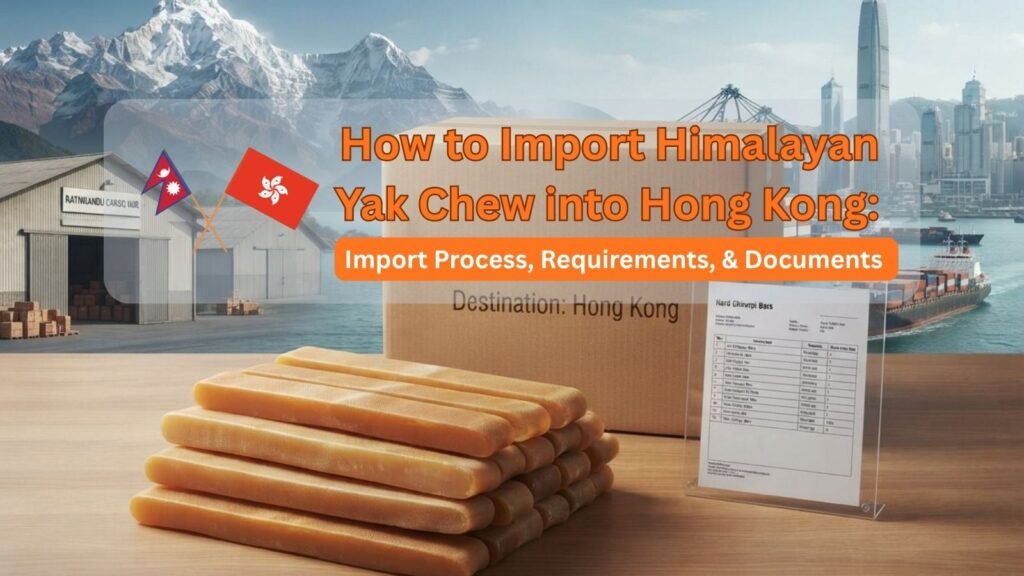
Himalayan yak chew, also known as chhurpi, is a hard-dried, shelf-stable dairy-based dog treat made from yak milk, cow milk, or a blend of both. For Hong Kong pet food importers, Nepalese yak chew offers a commercially viable sourcing opportunity, but its ruminant dairy origin creates specific veterinary and customs compliance requirements. Hong Kong generally does not require a standard import permit for processed commercial pet treats, as confirmed by the AFCD Import Circular on the Importation of Pet Food or Animal Feed. However, importers must arrange the appropriate veterinary health certificate from Nepal’s Department of Livestock Services (DLS) and ensure that product labeling, ingredient declarations, and shipment documentation comply with Agriculture, Fisheries and Conservation Department (AFCD) requirements. Understanding the distinction between processed dairy pet food and raw animal products is essential for selecting the correct import pathway.
Importing Himalayan yak chew from Nepal to Hong Kong requires coordinated product classification, supplier verification, export documentation, freight planning, and customs clearance. This guide explains the complete yak chew import process, including AFCD veterinary requirements, Hong Kong Customs declarations, HS code selection, commercial invoices, certificates of origin, DFTQC certification, batch-level laboratory reports, and packaging standards for commercial dog treats. It also covers freight costs, import duties, common shipment delays, and the documentation checks Hong Kong buyers should complete before placing an order. Whether you are sourcing traditional chhurpi bars, puffed yak chews, or dog chew nuggets, the following requirements and practical steps will help you prepare a compliant shipment from Nepal to Hong Kong.
Can Himalayan Yak Chew From Nepal Be Imported Into Hong Kong?
Yes. Himalayan yak chew from Nepal is importable into Hong Kong as a processed dairy-derived pet treat. Hong Kong operates as a free port and does not impose a blanket import permit requirement on commercial pet food. However, because yak is a ruminant animal, AFCD recommends a veterinary certificate from Nepal’s official veterinary authority for every consignment.
Chhurpi is produced by cooking yak or cow milk, or a blend of both, with lime juice, then pressing and smoke-drying the resulting curd into hard blocks. The finished product contains no raw animal tissue, no blood, and no unprocessed meat. Its classification as a processed dairy product distinguishes it from raw animal carcasses and raw meat products, which face a different, stricter regulatory pathway in Hong Kong.
According to data from Nepal’s Trade and Export Promotion Centre (TEPC), as cited by The Kathmandu Post, Nepal exported 2,733 tonnes of chhurpi worth NPR 4.29 billion across all international markets during the first 11 months of fiscal year 2025–26. The United States accounted for approximately 75% of the total volume, importing 2,042 tonnes valued at NPR 3.75 billion, while Hong Kong received 73 tonnes worth NPR 10.61 million during the same period. Hong Kong represents a smaller but commercially active destination, particularly for buyers who use Hong Kong as a regional distribution hub for broader Asia-Pacific markets under Hong Kong’s re-export framework.
What Does AFCD Require for Commercial Pet Food Imports?
AFCD does not issue import permits for commercial pet food. For pet food or animal feed containing materials of ruminant or poultry origin, AFCD strongly recommends that a veterinary certificate, issued or endorsed by the official veterinary authority of the exporting country, accompany the shipment. While AFCD does not impose a formal import permit requirement for processed pet food, a shipment arriving without the veterinary certificate may face inspection delays and complications — particularly if the consignment is intended for re-export to mainland China, which applies stricter requirements. In practice, every commercial yak chew shipment to Hong Kong should include the DLS veterinary certificate. Treat it as operationally mandatory even though AFCD’s published language is ‘recommended.
The Agriculture, Fisheries and Conservation Department (AFCD) governs the import of animals and animal products into Hong Kong under the Public Health (Animals and Birds) Ordinance Cap. 139 and the Rabies Ordinance Cap. 421. These ordinances primarily regulate live animals and animal products derived from dogs, cats, or rabies-susceptible animals. Processed dairy-based pet treats fall outside the direct scope of these permit-issuance provisions.
According to the AFCD Import Circular for Pet Food and Animal Feed, commercial pet food containing ruminant-origin materials, including yak milk, cow milk, and their derivatives, requires a supporting veterinary certificate issued by the competent official authority in the exporting country. In Nepal’s case, that authority is the Department of Livestock Services (DLS) — which, as of May 2026, operates under the Ministry of Agriculture, Forests and Environment following the dissolution and merger of the former Ministry of Agriculture and Livestock Development.
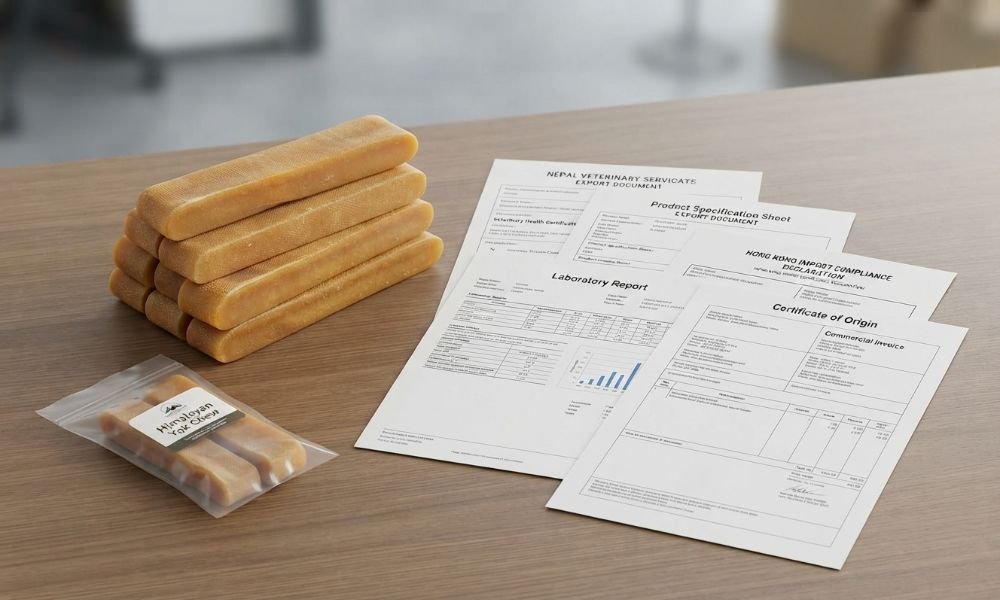
The veterinary certificate accompanying a shipment of ruminant-origin pet food must address nine specific attestation points, as set out in the AFCD Import Circular for Pet Food and Animal Feed for ruminant-origin pet food imports:
- The ruminant animals underwent ante-mortem examination, showed no clinical signs of any transmissible disease, and showed no clinical signs of generalized central nervous system disease.
- The feeding of ruminants with meat-and-bone meal and greaves derived from ruminants is banned in the country of production, and that ban is effectively enforced.
- The products were derived from animals slaughtered at licensed premises.
- The certified materials were not derived from donor animals.
- Any bovine-origin component was not derived from Specified Risk Materials from BSE-affected countries (including brain, skull, eyes, trigeminal ganglia, spinal cord, vertebral column, dorsal root ganglia of cattle 30 months or older, and tonsils and distal ileum of cattle of any age).
- The certified materials do not include any component of a carcass rejected during post-mortem examination as unfit for human consumption.
- If the product contains poultry-origin materials, they have been treated to destroy the Avian Influenza virus by one of three specified heat treatments.
- The packaging is clearly labeled ‘for pet food only,’ ‘dog food,’ ‘cat food,’ or ‘not for human consumption.’
- The product contains no prohibited chemicals; any specified agricultural or veterinary chemicals are fully disclosed on the packaging per Cap. 139N of Hong Kong law. Instruct your Nepal supplier’s DLS veterinary officer to prepare the certificate against all 9 points, not a subset.
Why Does the Dairy Origin of Yak Chew Matter?
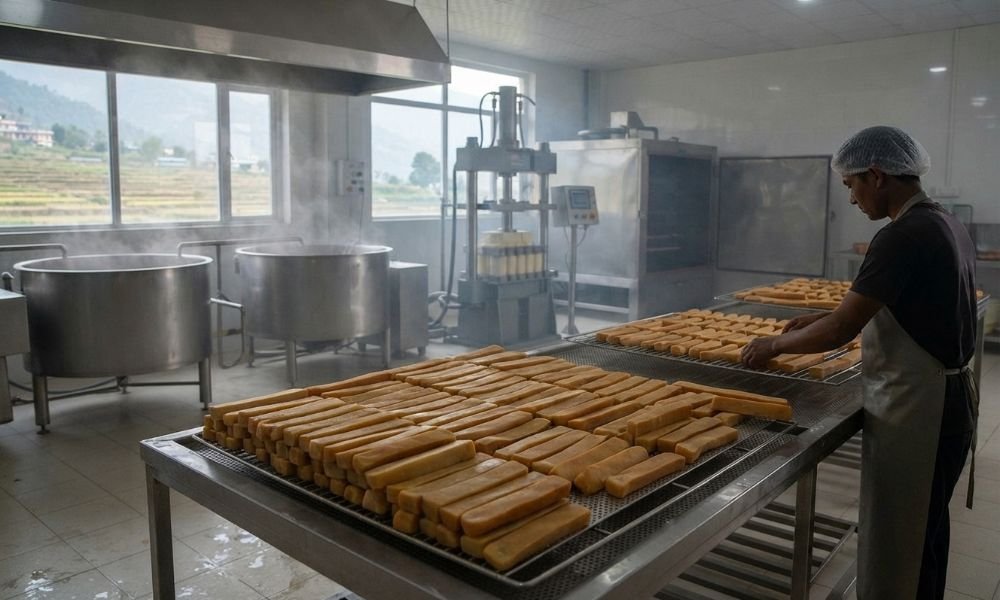
Yak is a ruminant animal, which places yak milk and all products derived from it within a regulated animal-origin category under Hong Kong’s veterinary health framework. AFCD applies heightened document requirements to ruminant-derived ingredients to prevent the entry of transmissible animal diseases, including bovine spongiform encephalopathy (BSE) and foot-and-mouth disease (FMD).
What most importers overlook is that the dairy origin classification applies even when the final product is fully processed, dry, and shelf-stable. A yak chew bar entering Hong Kong is not assessed by its texture or moisture level. It is assessed by its animal-origin input. Yak milk is ruminant-derived. That single fact triggers the veterinary certificate requirement regardless of how extensively the product has been cooked, pressed, or smoked.
This distinction matters operationally. A shipment that arrives without the correct veterinary documentation, even if the product itself is entirely compliant and safe, faces an immediate hold at the port of entry. AFCD can require re-export of the consignment at the importer’s expense. Processing time at the port is not used as a substitute for missing documents.
Nepal’s chhurpi standards were formalized in January 2026 when the Ministry of Agriculture and Livestock Development published mandatory quality requirements in the Nepal Gazette, as reported by The Kathmandu Post. The standards establish requirements covering chhurpi production, processing, packaging, handling, storage, and transportation, with provisions aligned with international food safety guidelines. Following the government’s May 2026 ministry restructuring, responsibility now falls under the successor Ministry of Agriculture, Forests and Environment. Suppliers operating under these standards generate documentation that directly supports Hong Kong’s veterinary certificate requirements.
When Should Importers Confirm Product-Specific Requirements?
Confirm product-specific requirements with AFCD directly before placing a purchase order, not after the shipment has been packed and dispatched. Requirements for animal-origin food and pet treat imports are subject to revision, and email confirmation from AFCD creates a contemporaneous record of the regulatory position at the time of import planning.
AFCD’s Permit and Certification Section operates from the Import & Export Division, 5/F, Cheung Sha Wan Government Offices, 303 Cheung Sha Wan Road, Kowloon, Hong Kong. Office hours are Monday to Friday, 8:30 a.m.–12:30 p.m. and 1:30 p.m.–5:45 p.m. The office is closed on Saturdays, Sundays, and Hong Kong Public Holidays.
Pre-import confirmation is particularly important for first-time importers, for buyers introducing new product formats (such as yak chew puffs or nuggets rather than standard bars), and for consignments intended for re-export from Hong Kong to mainland China, where additional Chinese customs requirements apply separately from Hong Kong’s framework.
How Do You Import Himalayan Yak Chew From Nepal to Hong Kong?
Importing Himalayan yak chew from Nepal to Hong Kong involves 7 sequential steps, from product eligibility confirmation through to customs release. Each step must be completed in order, as documentation errors in early stages create clearance failures at the final stage.
1. Confirm Product Eligibility and Classification
Classify the product under the correct Harmonized System (HS) code before preparing any documentation. Himalayan yak chew is typically classified under HS 2309 (preparations of a kind used in animal feeding) when it is sold and labeled as a pet treat. Some consignments may be classified under HS 0406 (cheese and curd) depending on the specific product formulation and labeling. The HS code determines which import declaration format applies and informs any secondary regulatory checks.
Confirm with your Hong Kong customs broker that the chosen HS code aligns with the product’s ingredient composition, manufacturing process, and intended end use as declared on the label.
2. Confirm Hong Kong and AFCD Requirements
Contact AFCD’s Import & Export Division to confirm the current documentation requirements for the specific product type and HS code. Request written confirmation by email. Confirm whether any additional approvals apply to re-export scenarios if the consignment is intended for onward shipment to mainland China or another market.
Review AFCD’s published veterinary certificate requirements for ruminant-origin pet food. Confirm the format and attestation language the certificate must include to be accepted at the port of entry.
3. Prepare Supplier and Shipment Documentation
Instruct your Himalayan yak chew manufacturer to prepare the full documentation package before the shipment departs. The document set includes a commercial invoice, a packing list, a certificate of origin, a veterinary health certificate from the Department of Livestock Services, DFTQC certification, a product specification sheet, batch-level laboratory test results, and the air waybill or bill of lading.
Do not allow the supplier to dispatch the shipment before the veterinary health certificate has been issued and physically obtained. The certificate cannot be obtained after the product has shipped.
4. Verify Packaging and Labeling
Confirm that all retail units and outer cartons carry the correct labeling before the shipment is packed. Every package must carry the statement “for pet food only” or “not for human consumption” in English. The label must also state the product name, the intended species (dog), the net weight, the ingredients list, and the name and contact details of the manufacturer or importer.
Labeling deficiencies are one of the 3 most common causes of shipment rejection at Hong Kong customs. Verify label compliance against AFCD’s requirements, not against the labeling standard of the supplier’s primary export market.
5. Complete Nepal Export and Freight Procedures
The supplier completes Nepal’s export procedures at Tribhuvan International Airport (TIA) in Kathmandu, the primary export point for air freight shipments of chhurpi. Procedures include Nepal Customs export declaration, DFTQC certificate issuance, DLS veterinary health certificate issuance, and Certificate of Origin from TEPC (Trade and Export Promotion Centre) or the Federation of Nepalese Chambers of Commerce and Industry (FNCCI).
Sea freight from Nepal transits through Kolkata Port in India before ocean routing to Hong Kong. Transit time via sea freight (Nepal to Kolkata by road, then sea to Hong Kong) is typically 18–28 days when all legs are accounted for: Nepal customs export clearance (1–2 days), road freight from Kathmandu to Kolkata (3–5 days), port dwell time in Kolkata waiting for vessel loading (3–7 days), ocean freight from Kolkata to Hong Kong (12–14 days), and Hong Kong terminal arrival handling (1–2 days). Importers should use 20–25 days as a baseline planning figure for sea freight. Road freight from Kathmandu to Kolkata takes 3–5 days by truck. Ocean transit from Kolkata to Hong Kong is 12–14 days on standard container services. Air freight from Kathmandu to Hong Kong International Airport (HKIA) takes 2–5 days.
6. Complete Hong Kong Import and Customs Procedures
On arrival at HKIA or Hong Kong’s Kwai Chung container port, the Hong Kong importer or appointed customs broker lodges a cargo declaration with the Hong Kong Customs and Excise Department. The declaration includes the HS code, the declared value, the country of origin (Nepal), and the shipper and consignee details.
Hong Kong Customs applies a risk-based assessment system. The importer must have the full documentation set available for inspection before or at the time of goods examination. Payment of any applicable charges, not import duty, which does not apply to yak chew, is required before release.

7. Complete Applicable Regulatory Checks and Obtain Release
Hong Kong Customs and AFCD may conduct a physical inspection or document verification of the consignment. Present the veterinary health certificate, the DFTQC certificate, the product specification sheet, and the batch test results upon request.
Once AFCD confirms document compliance and Customs completes the declaration process, the consignment is released. Store the full documentation set, including the customs clearance record, for at least 3 years as part of product traceability records.
What Hong Kong Import Requirements Apply to Himalayan Yak Chew?
3 regulatory frameworks govern the import of Himalayan yak chew into Hong Kong: AFCD’s veterinary health requirements for ruminant-origin pet food, Hong Kong Customs’ trade declaration and classification requirements, and the product’s HS code-driven classification under Hong Kong’s tariff schedule. No blanket import permit is required for processed dairy-derived pet treats.
AFCD Requirements for Processed Dairy-Derived Pet Treats
AFCD does not issue an import permit for commercially processed pet food, including yak chew. However, AFCD does require a veterinary certificate for pet food or animal feed containing ruminant-origin materials. The certificate must be issued or endorsed by the official veterinary authority of Nepal, the Department of Livestock Services, and must contain the 9 attestation points specified in AFCD’s published guidance for ruminant-origin consignments.
AFCD retains the authority to inspect consignments on arrival and to require re-export of any shipment that does not comply with applicable documentation or labeling requirements. This enforcement power applies whether or not a formal import permit was required for the product type.
Hong Kong Customs Requirements
Hong Kong Customs requires a trade declaration for all commercial imports. The declaration must state the HS code, the declared CIF (cost, insurance, and freight) value, the country of origin, the shipper, and the consignee. Declarations are lodged electronically through Hong Kong’s Customs and Excise Department’s import/export declaration system.
Hong Kong does not impose import duty, VAT, or GST on pet food or pet treats, as confirmed by the Hong Kong Customs and Excise Department Fact Sheet (September 2025). Under Hong Kong’s Dutiable Commodities Ordinance, excise duties apply only to four categories of goods: liquor, tobacco, hydrocarbon oils, and methyl alcohol. Yak chews do not fall within any of these dutiable categories.
Product Classification and Animal-Health Considerations
Yak chew classified under HS 2309 is treated as an animal feeding preparation, a processed food product intended for companion animals. This classification confirms that the product is not subject to the raw animal carcass and meat product controls that apply to unprocessed animal material.
The animal-health consideration that persists regardless of classification is the ruminant origin of the primary ingredient. Nepal’s yak population is concentrated in high-altitude regions of the Himalayas above 3,000 meters. Nepal does not currently have any WOAH-recognized FMD-free zone status, as confirmed by WOAH’s 92nd General Session Resolution 13 on FMD-free zone recognition. As of 2026, foot-and-mouth disease has been reported across all 77 districts of Nepal, with active test submissions from Nepal to the WOAH-FAO FMD Reference Laboratory during 2024–2025. This disease status affects the eligibility of Nepali dairy products for direct import into markets such as the EU and China. Nepal operates an active national FMD vaccination and surveillance program, and DLS veterinary certificates include relevant disease declarations. Importers should retain the disease-status declarations on the DLS certificate as part of their import compliance file and confirm Nepal’s current status with AFCD if certification language about disease-free zones is requested.
What Should Hong Kong Buyers Verify Before Ordering Yak Chew From Nepal?
Hong Kong buyers verify 4 categories of information before placing a purchase order: product ingredients and animal origin, manufacturing and processing records, supplier quality and export credentials, and packaging and label specifications. Verifying these before ordering prevents document failures and labeling rejections that occur after the consignment has shipped.
Product Ingredients and Animal Origin
Confirm whether the product is made from 100% yak milk, a yak-cow milk blend, or 100% cow milk. Each formulation is permitted, but the declaration on the veterinary health certificate must match the actual ingredients. Mismatches between the certificate attestation and the product ingredient list are a common source of AFCD document queries.
Confirm that no additives, preservatives, artificial flavors, or coloring agents are used. Hong Kong pet food buyers increasingly require additive-free formulations, and this attribute must be declared on the label. If the supplier uses lime juice as a coagulant (standard in traditional chhurpi production), confirm that it is declared in the ingredients list.
Manufacturing and Processing Records
Request the supplier’s most recent batch production records, showing milk sourcing, cooking temperatures, pressing duration, and smoke-drying time. These records support the ante-mortem and post-mortem attestation on the DLS veterinary certificate and confirm that the processing method is sufficient to eliminate microbial risk.
Request the batch-level laboratory test results for the specific production run included in your order. Tests should cover protein and fat content (for nutritional labeling), moisture content (which affects shelf life and mold risk), and microbial safety (absence of Salmonella, E. coli, Listeria, and mold counts within safe limits).
Supplier Quality and Export Credentials
Verify that the supplier holds valid, current certifications issued by Nepal’s Department of Food Technology and Quality Control (DFTQC), the country’s designated national Codex Contact Point and SPS Inquiry Point. DFTQC’s food export inspection and quality certification requirements are set out in the Directives on Food Export, Import Inspection and Quality Certification System in Nepal. Current DFTQC certification provides evidence that the production facility complies with applicable Nepalese food safety and quality requirements. For export-oriented suppliers, ISO 22000 or HACCP certification provides additional evidence of systematic food safety management. Finding a reliable yak chew manufacturer in Nepal also means confirming batch-level documentation capabilities and active DLS registration before placing a first order.
Confirm that the supplier is registered with Nepal’s Department of Livestock Services for the purpose of obtaining veterinary health certificates. A supplier without DLS registration cannot obtain the ruminant-origin veterinary certificate required for your Hong Kong shipment.
Verify the supplier’s export track record. Suppliers exporting to multiple regulated markets, including those meeting UK yak chew import requirements or EU and Japanese standards, typically maintain documentation systems that align with Hong Kong’s framework.
Packaging and Label Specifications
Confirm that the supplier’s packaging meets the labeling requirements specific to Hong Kong before your purchase order is finalized. Every unit must display the product name, the intended species (dog), the net weight, the ingredients in descending order by weight, the manufacturer’s name and address, and the “not for human consumption” or “for pet food only” statement in English.
Outer carton markings must include the country of origin (Nepal), the HS code, the gross and net weight, and the importer’s name and contact details.
What Documents Are Required for a Hong Kong Yak Chew Import?
A complete Hong Kong yak chew import requires 5 document categories: commercial and shipment documents, veterinary or health documentation, a certificate of origin, product specifications and safety records, and transport and customs declarations. Missing or incomplete documents in any category trigger a hold at the port of entry.
Commercial Invoice and Packing List
The commercial invoice must state the exporter’s and importer’s full legal names and addresses, the product description (including HS code), the quantity in kilograms and units, the unit price, the total CIF value, and the payment terms. The declared value must match the actual transaction value; undervaluation is a customs offense in Hong Kong even though no import duty applies.
The packing list must match the commercial invoice line by line and state the gross weight, net weight, and dimensions of each outer carton, the number of retail units per carton, and the total carton count in the shipment.
Veterinary or Health Documentation
The DLS veterinary health certificate is the most critical document in the set. It must be issued or endorsed by a DLS-authorized veterinary officer, carry an official government seal, be dated within the validity period acceptable to AFCD (confirm this directly with AFCD before each shipment), and contain the full 9-point attestation for ruminant-origin pet food.
The DFTQC certificate confirms that the product meets Nepal’s national food technology and quality standards. It is issued per batch and should reference the specific production run included in the shipment.
Certificate of Origin
The Certificate of Origin (CO) confirms that the yak chew was produced in Nepal. It is issued by the Trade and Export Promotion Centre (TEPC) or the Federation of Nepalese Chambers of Commerce and Industry (FNCCI). The CO is required for Hong Kong import declaration purposes to correctly declare the country of origin as Nepal.
Product Specifications and Safety Records
The product specification sheet provides a formal declaration of the product’s composition, nutritional profile, physical characteristics, shelf life, and storage conditions. It accompanies the commercial documents and provides context for any regulatory query raised by AFCD.
Batch-level laboratory test reports, conducted by an accredited testing laboratory in Nepal or a third-party laboratory acceptable to the buyer, confirm food safety parameters. These are not formally mandated by Hong Kong Customs for every shipment, but AFCD can request them during inspection. Having them pre-prepared avoids delays.
Transport and Customs Documents
The air waybill (for air freight) or bill of lading (for sea freight) issued by the carrier or freight forwarder is the primary transport document. It identifies the shipper, the consignee, the shipment’s origin and destination, and the cargo description. The cargo description on the transport document must match the commercial invoice and packing list exactly.
The importer’s Hong Kong customs declaration, submitted electronically before or at the time of cargo arrival, closes the import loop. The declaration references all supporting documents and assigns the import the correct HS code under Hong Kong’s tariff schedule.
What Does It Cost to Import Himalayan Yak Chew Into Hong Kong?
The total landed cost for a yak chew shipment from Nepal to Hong Kong comprises 3 variable cost categories: freight, brokerage, and clearance costs; duties, taxes, and other import charges; and inspection, storage, and delay costs. Import duty is zero. Freight and clearance are the primary cost variables.
Freight, Brokerage and Clearance Costs
Air freight from Kathmandu to Hong Kong International Airport costs approximately USD $3.50–$6.50 per kilogram for commercial consignments in 2025–26, depending on the airline (including direct services via Cathay Pacific or indirect transit routes) and the shipment volume. Minimum charge weight thresholds typically apply to shipments below 45 kilograms.
Sea freight from Nepal to Hong Kong routes through Kolkata Port. Nepal has no direct sea access. Road freight from Kathmandu to Kolkata adds 3–5 days to transit time and approximately USD $150–$400 per cubic meter, depending on the trucking operator. Ocean freight from Kolkata to Hong Kong adds 12–14 days. Total sea freight container costs for a 20-foot container from Nepal through Kolkata to Hong Kong range from USD $2,500–$6,000 in 2025–26 for standard dry containers. Yak chew is a shelf-stable product and does not require refrigerated container logistics.
Customs brokerage and clearance fees in Hong Kong typically range from HKD $1,500–$4,500 per shipment depending on the broker, the complexity of the declaration, and whether the cargo is subject to physical inspection.
Duties, Taxes, and Other Import Charges
Hong Kong imposes zero import duty on yak chew. There is no VAT, no GST, and no consumption tax. The U.S. Commercial Service, Swiss export authorities, and Hong Kong Customs and Excise Department all confirm that pet food and animal feeding preparations do not fall within Hong Kong’s four excise duty categories.
Terminal handling charges at HKIA or Kwai Chung container terminal are charged by the terminal operator and typically fall within HKD $400–$2,200 per consignment depending on cargo weight and terminal.
Inspection, Storage and Delay Costs
Physical inspection by AFCD or Customs can add 1–5 working days to the customs clearance timeline. Document-only review, where the physical cargo is not examined, is resolved faster. Storage charges at bonded warehouses adjacent to HKIA or Kwai Chung accrue at a daily rate, typically HKD $0.50–$1.50 per kilogram per day, from the day the cargo is available for collection.
The most costly delay scenario is not physical inspection. It is document rejection: a missing or non-conforming veterinary certificate, a labeling deficiency requiring re-labeling in a customs-supervised environment, or an HS code declaration mismatch. These scenarios add 5–20 working days to clearance and generate storage fees across that entire period at the importer’s cost.

Why Can a Himalayan Yak Chew Shipment Be Delayed or Rejected?
Himalayan yak chew shipments are delayed or rejected for 3 primary reasons: classification and declaration errors, missing or inconsistent documentation, and product, packaging, or labeling problems. All 3 are preventable with pre-shipment verification.
Classification and Declaration Errors
Declaring the product under an incorrect HS code is the most consequential error in the process. A yak chew bar declared under a cheese HS code (0406) rather than an animal feeding preparation code (2309), or vice versa, depending on the actual product type, triggers a classification query from Customs that can require re-declaration, examination, and delay.
Mismatch between the HS code on the commercial invoice and the HS code on the customs declaration creates an immediate flagging event in Customs’ risk-assessment system. Confirm the correct code with your Hong Kong broker and instruct the Nepal exporter to use the same code on all export documents.
Missing or Inconsistent Documentation
The 2 most common documentation failures are an absent or expired DLS veterinary health certificate and a mismatch between the certificate’s attestation language and AFCD’s published requirements. Suppliers who have not previously exported to Hong Kong may not be aware that the ruminant-origin attestation must meet a specific structure.
Inconsistencies between documents, a product description on the commercial invoice that does not match the DFTQC certificate, or a declared weight on the packing list that does not match the air waybill, also cause holds. Every document in the set must reference the same product, the same batch, and the same quantity.
Product, Packaging, or Labeling Problems
A shipment labeled exclusively for another market, with labeling compliant for the US, EU, or UK but without the “not for human consumption” statement in English, will fail AFCD’s labeling check. Labeling must meet Hong Kong’s requirements, not the requirements of the product’s primary export market.
Products arriving with physical deficiencies, visible mold, packaging damage, off-odors, or moisture ingress are subject to rejection on public health grounds regardless of documentation quality. Yak chew’s shelf life is typically 12–24 months when properly sealed. Confirm that packaging integrity, particularly for moisture barrier properties, meets the requirements for the transit conditions from Nepal to Hong Kong.
How Can Native Nepal Dog Chew Help Hong Kong Buyers Import Yak Chew?
Native Nepal Dog Chew is a Kathmandu-based yak chew manufacturer and exporter with more than 10 years of production experience and active export relationships across more than 20 countries, including regulated markets in the EU, the UK, and Japan. The company’s documentation infrastructure is structured to meet the veterinary health, quality, and labeling requirements of multiple international import regimes.
What Export and Product Support Can Native Nepal Dog Chew Provide?
Native Nepal Dog Chew produces 5 product formats: Dog Chew Bars, Puffed Chew Bars, Dog Chew Nuggets, Puffed Chew Nuggets, and Dog Cheese Protein Powder. This range allows Hong Kong buyers to build a multi-SKU product offering from a single verified source rather than managing documentation compliance across multiple suppliers. Buyers planning retail distribution can review this pet store yak chew sourcing guide for product format comparisons and volume purchasing structures.
The company’s export documentation package includes veterinary health and sanitary certificates, DFTQC certification, third-party laboratory test results, certificates of origin, and batch-level traceability records linking each consignment to its specific production run and milk sourcing. For Hong Kong shipments specifically, the veterinary health certificate from Nepal’s DLS is prepared with the ruminant-origin attestation language required under AFCD’s guidelines.
Native Nepal Dog Chew holds FDA registration (required for US-market exports), ISO certification, and HACCP compliance. These certifications reflect a food safety management system that generates the documentation types that Hong Kong import clearance requires.
What Should Buyers Verify Before Ordering From a Nepalese Manufacturer?
Verify 5 specific credentials before placing a first order with any Nepalese yak chew manufacturer:
- DFTQC certification: Current, not lapsed, covering the specific production facility, not a holding company or trading entity.
- DLS registration: Confirming that the manufacturer can legally obtain ruminant-origin veterinary health certificates for export consignments.
- Certificate of Origin issuing authority: Confirm the supplier can obtain a CO from TEPC or FNCCI in the format accepted for Hong Kong import declarations.
- Third-party lab test results: Request the most recent batch results for protein, fat, moisture, and microbiological safety, not a single annual test, but per-batch documentation.
- Sample labeling: Request mock-ups of the labels intended for your order before production begins, confirming that the “not for human consumption” statement and all required fields are present.
What Are the Key Takeaways About Importing Himalayan Yak Chew From Nepal to Hong Kong?
Importing Himalayan yak chew from Nepal to Hong Kong is commercially viable and operationally straightforward when the regulatory framework is understood and documentation is prepared correctly before the shipment departs.
The 6 most important points to carry forward from this guide are:
- Hong Kong imposes zero import duty, VAT, or GST; landed costs are driven solely by freight, terminal handling, and customs brokerage.
- AFCD does not issue an import permit for processed dairy-based pet treats. The regulatory requirement is a veterinary health certificate from Nepal’s Department of Livestock Services, confirming ruminant-origin ante-mortem clearance and product labeling compliance.
- The ruminant origin of yak milk triggers the veterinary certificate requirement regardless of how extensively the chhurpi has been processed. Classification as a processed dairy treat does not eliminate the requirement; it defines which authority must issue the certificate.
- Document consistency across all 5 document categories, commercial invoice, packing list, veterinary certificate, certificate of origin, and transport document, is the single most important operational control for avoiding clearance delays.
- Labeling must meet Hong Kong’s requirements specifically, not the labeling standards of the supplier’s primary export market. The “not for human consumption” or “for pet food only” statement in English is mandatory on all product units and outer cartons.
- Confirm product-specific requirements directly with AFCD before each first-time import and whenever the product formulation or format changes. Regulatory positions evolve, and written confirmation from AFCD at the time of import planning creates a contemporaneous compliance record.
Hong Kong buyers ready to source at commercial scale can explore wholesale yak chew supply services from Nepal’s certified exporters, including documentation support and volume pricing structures.
For Hong Kong buyers building a Himalayan yak chew product line or evaluating Nepal as a sourcing origin, Native Nepal Dog Chew offers a documented compliance framework and a multi-format product range that supports import programs at commercial scale. Contact the team at nativenepali.com to request product samples, documentation packs, and pricing for your specific import volume.