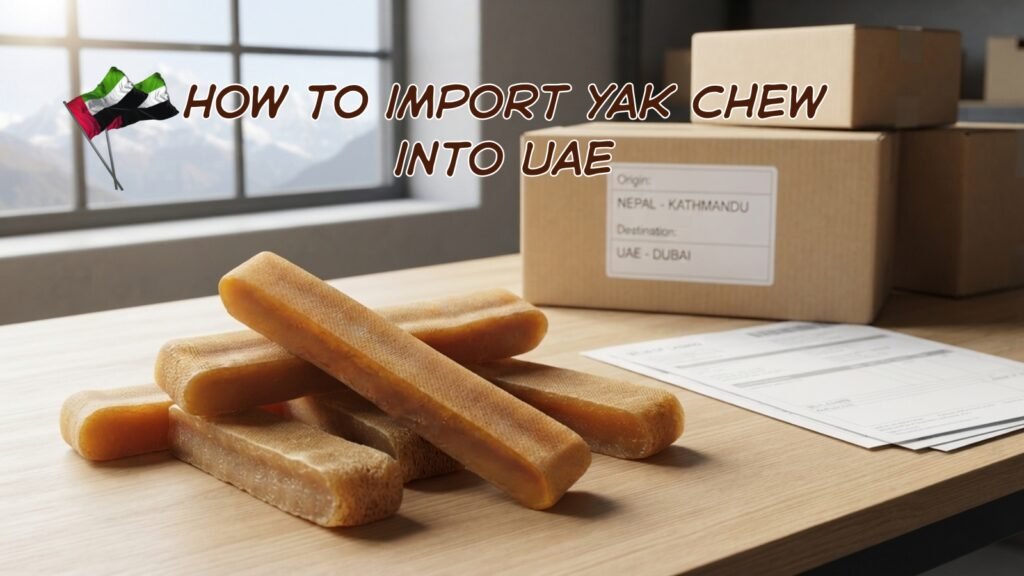
Yak chew is a natural dog treat made from hardened yak milk, and importing it from Nepal into the UAE requires compliance with pet food classification, product registration, veterinary certification, customs, and labeling requirements. UAE importers must establish the correct HS Code classification (typically 2309.10 for retail-packaged dog treats), complete MOCCAE product registration, obtain a Veterinary Health Certificate from Nepal’s Department of Livestock Services, prepare a Free Sale Certificate and Certificate of Analysis, and use Arabic-English packaging before commercial shipment. The import process also involves a UAE-licensed importer, a complete customs documentation package, and compliance with emirate-level requirements enforced by authorities such as Dubai Municipality and ADAFSA.
A compliant Nepal-to-UAE yak chew supply chain therefore begins before production or freight is arranged. Importers need to verify the Nepalese manufacturer’s export documentation, approve the bilingual product label, select air or sea freight, calculate the CIF value and the applicable 5% UAE customs duty and 5% VAT, and prepare for customs inspection and post-arrival storage. This guide explains the complete import workflow, including UAE regulatory requirements, HS classification, MOCCAE registration, Nepal export certificates, labeling standards, freight routes, customs clearance, landed cost calculation, supplier due diligence, and the documentation required to move Himalayan yak chews from Nepal into the UAE market.
What Are the UAE Requirements for Importing Yak Chew?

UAE requirements for importing yak chew cover 4 regulatory areas: product classification, authority registration, documentation compliance, and bilingual labeling standards. The Ministry of Climate Change and Environment (MOCCAE) is the UAE federal authority responsible for establishing and enforcing food safety regulations for animal-origin products, including pet food imports. The USDA Foreign Agricultural Service confirms MOCCAE’s role in UAE food import regulation in its UAE Food and Agricultural Import Regulations and Standards Report. Emirate-level authorities such as Dubai Municipality and ADAFSA may also have jurisdiction over local food safety, retail, and distribution requirements.
Yak chew is a natural dog treat made from hardened yak milk. It enters the UAE trade under the pet food and animal feeding preparations category. Importers confirm the HS code, register the product with MOCCAE before the first commercial shipment, and ensure the complete export documentation package arrives from the Nepalese manufacturer before freight is booked.
How Is Yak Chew Classified for UAE Import?
Yak chew intended for retail sale may fall under the HS 2309.10 category covering dog or cat food put up for retail sale, but importers should confirm the complete UAE tariff classification with a licensed customs broker before shipment. The USDA Foreign Agricultural Service identifies HS 2309.10 within the GCC tariff framework for dog or cat food put up for retail sale in its UAE import regulations report.
Because yak chew is manufactured from processed milk but marketed as an animal feed product, classification should be confirmed based on the finished product rather than its raw material alone. Importers should obtain the applicable UAE tariff classification before shipment to avoid customs declaration errors. Confirming the HS code with a UAE-licensed customs broker before shipment departure prevents this error and ensures the correct 5% duty rate applies from the start.
Which UAE Authorities Regulate Yak Chew Imports?
3 UAE authorities regulate yak chew imports at federal and emirate levels:
- MOCCAE (Ministry of Climate Change and Environment): MOCCAE is the UAE’s federal authority responsible for establishing and enforcing food safety regulations for animal-origin products, including pet food imports, as confirmed by the USDA Foreign Agricultural Service’s UAE Food and Agricultural Import Regulations and Standards Report.
- Dubai Municipality Food Safety Department: oversees retail compliance for products distributed within the Dubai Emirate; conducts market surveillance on labeled products
- ADAFSA (Abu Dhabi Agriculture and Food Safety Authority): regulates product safety, labeling, and distribution standards for the Abu Dhabi market
Importers distributing to Sharjah, Ajman, Ras Al Khaimah, Umm Al Quwain, or Fujairah work with respective municipal authorities, though MOCCAE federal registration is accepted as the baseline compliance credential across all emirate markets.
Do You Need an Import Permit or Product Registration?
Yak chew importers require one-time MOCCAE product registration before any commercial quantity clears UAE customs. Registration is completed through MOCCAE’s digital services portal (moccae.gov.ae) using the complete documentation package from the Nepalese manufacturer. A registration number is issued after approval and used for all subsequent shipments without reapplication.
A per-shipment import permit is mandatory for every consignment of yak chew. While the registered product number is a prerequisite for applying, it does not replace the requirement to obtain an individual import permit for each recurring shipment. MOCCAE registration processing takes 15 to 30 working days. Importers planning a launch timeline work backward from this processing window to avoid stock delays.
What Documents Are Required to Import Yak Chew Into the UAE?
Importing yak chew from Nepal into the UAE requires 8 core documents. A missing or expired document in any 1 of these 8 categories triggers an automatic customs hold. The most frequently absent document among first-time importers is the Free Sale Certificate; many Nepalese manufacturers are unfamiliar with this specific UAE registration requirement.
The 8 required documents are:
- Commercial Invoice
- Packing List
- Bill of Lading (sea) or Airway Bill (air)
- Certificate of Origin (COO)
- Veterinary Health Certificate (VHC)
- Free Sale Certificate (FSC)
- Product Composition Report / Certificate of Analysis from an ISO-accredited laboratory
- MOCCAE product registration confirmation number
Which Documents Should the Nepalese Manufacturer Provide?
The Nepalese manufacturer provides 4 export documents that form the foundation of the UAE registration and customs clearance package:
- Veterinary Health Certificate: issued by Nepal’s Department of Livestock Services through the designated veterinary authority for qualifying animal-origin exports. Nepal’s Animal Health and Livestock Services Rules provide the legal framework for issuing health or sanitary certificates for animal-origin products intended for animal feeding or industrial use.
- Free Sale Certificate: issued by Nepal’s Trade and Export Promotion Centre (TEPC) or Department of Commerce, Export and Supply Management; confirms the product is legally manufactured and sold in Nepal without commercial restriction
- Certificate of Analysis (Product Composition Report): from an ISO-accredited testing laboratory; lists protein percentage, moisture content, fat content, ash content, and microbial safety results by batch
- Commercial Invoice: includes the correct HS code (e.g., 2309.10 for retail-ready dog treats), unit price per kg, total shipment value, Incoterms, and full details of both buyer and seller
Do You Need a Certificate of Origin?
A Certificate of Origin (COO) is mandatory for every yak chew shipment from Nepal to the UAE. The Federation of Nepalese Chambers of Commerce and Industry (FNCCI) or the Nepal Chamber of Commerce (NCC) issues the COO. UAE customs uses this document to verify the country of origin and apply the correct tariff classification.
Nepal is a member of the South Asian Free Trade Area (SAFTA), whose contracting states are SAARC members. The UAE is not a SAFTA member, so SAFTA does not provide preferential tariff treatment for Nepal-origin exports to the UAE. The SAFTA Agreement text sets out the agreement’s membership and scope. Nepal-origin yak chew should therefore not be assumed to qualify for SAFTA tariff preferences in the UAE.
Is a Health or Veterinary Certificate Required?
A Veterinary Health Certificate (VHC) is required for every individual yak chew shipment into the UAE, regardless of import frequency. Nepal’s Department of Livestock Services issues the applicable veterinary health or sanitary certificate for qualifying animal-origin export consignments. The certificate provides the veterinary certification required for the exported animal-origin product under Nepal’s animal health framework. Importers should ensure that the certificate wording and format match the requirements specified by the UAE authorities for the shipment.
UAE customs inspectors verify the VHC against MOCCAE records upon arrival. While physical certificates must carry the original ink signature and official stamp, UAE Customs and MOCCAE also accept digitally endorsed and verified electronic veterinary health certificates as part of the country’s paperless trade initiatives. Every shipment requires a fresh original VHC, even when importing from the same supplier under the same product registration.
Do You Need a Free Sale Certificate?
A Free Sale Certificate (FSC) is required by MOCCAE for product registration and is resubmitted when the certificate lapses. TEPC or Nepal’s Department of Commerce, Export and Supply Management issues the FSC. The document confirms the product is manufactured legally in Nepal and sold commercially without government restriction.
The FSC carries a validity of 12 months from the issue date. UAE importers track the FSC expiry date alongside the MOCCAE registration renewal calendar. An expired FSC submitted to MOCCAE results in automatic registration rejection, requiring a new FSC from Nepal before re-submission.
How to Import Yak Chew From Nepal to the UAE Step by Step?
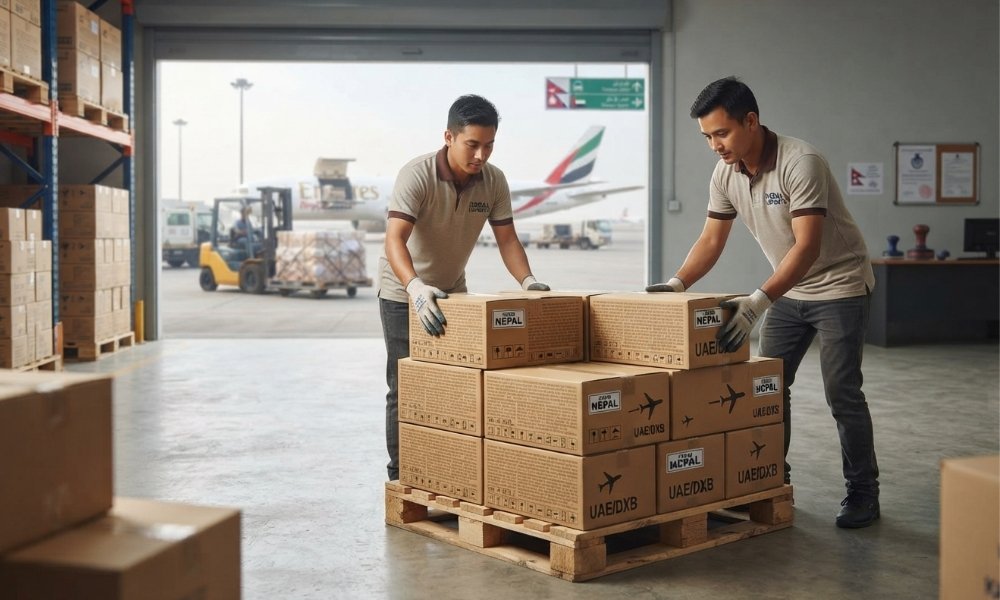
Importing yak chew from Nepal to the UAE follows 9 sequential steps across 4 operational phases: pre-shipment compliance, commercial agreement, freight and logistics, and UAE customs clearance. Completing steps 1 through 3 before placing any production order with the manufacturer eliminates the most common causes of shipment rejection at UAE customs.
1. Find a Licensed UAE Importer
UAE commercial regulations require all imported goods to arrive through a UAE-registered business entity holding a valid import license with the appropriate trading activity classification. A foreign buyer without a UAE legal entity appoints a licensed UAE importer of record who holds the federal import license, the trade license, and the authority to submit MOCCAE product registrations.
Pet product distributors, specialized animal feed importers, and licensed general trading companies in Dubai and Abu Dhabi act as importers of record for international brands entering the UAE. The importer of record is also legally responsible for customs duty payment and post-market compliance.
2. Confirm UAE Import and Product Requirements
Before any production begins, the UAE importer confirms 3 regulatory facts with MOCCAE: the product’s approved classification category, the labeling requirements for the UAE market, and the registration eligibility based on product composition. Attempting to register a product containing restricted additives, such as artificial preservatives prohibited under UAE food safety guidelines, wastes 6 to 12 weeks of documentation preparation.
The importer also checks which emirate authorities require separate notification or submission. Products distributed nationally involve MOCCAE, Dubai Municipality, and ADAFSA simultaneously.
3. Select Yak Chew Products and Agree on Commercial Terms
The importer selects product sizes, SKUs, and order quantities, then agrees on commercial terms with a trusted Himalayan yak chew manufacturer based in Nepal. Incoterms selection determines cost liability and risk transfer point. The 2 most common Incoterms for Nepal-origin shipments are:
- FOB Kathmandu (air freight): under the correct Free Carrier Incoterm, the manufacturer delivers the export-cleared goods to the carrier at Tribhuvan International Airport; the importer bears freight and insurance from that point
- FOB Kolkata or Nhava Sheva (sea freight via India): goods transit by road from Kathmandu to an Indian port; the importer bears sea freight and insurance to Jebel Ali, Dubai
Minimum order quantities from Nepal-based yak chew manufacturers typically start at 100 kg for trial shipments and 500 kg for first commercial orders, depending on the supplier’s production capacity.
4. Prepare Product Labels and Packaging
UAE labeling compliance should be confirmed before printing any packaging. UAE Standard 5031:2018, “General Requirements for Pet Food and their Labeling,” establishes requirements for pet food labeling, including Arabic labeling and the required bilingual statement that the product is intended for pets and is not fit for human consumption. The USDA Foreign Agricultural Service discusses these requirements in its 2025 UAE pet food market report. The importer should submit the proposed label as part of the applicable product registration process and obtain confirmation before the full packaging run is printed.
Printing the full packaging run before MOCCAE approval risks an expensive reprint if minor corrections are required. Submitting artwork during the registration process and receiving sign-off before the production run avoids this cost.
5. Prepare Export and Import Documents
The manufacturer prepares the 4 manufacturer-side documents. The UAE importer prepares 4 import-side documents: the import license copy, the pro forma invoice, the MOCCAE product registration number, and the UAE-side commercial invoice for customs valuation. A UAE customs broker reviews the complete 8-document package before the shipment is handed to the freight forwarder.
Errors on the commercial invoice, particularly mismatched HS codes, incorrect valuations, or Incoterms inconsistencies between the invoice and bill of lading, are the single most frequent cause of UAE customs delays for Nepal-origin pet product shipments. Manufacturers offering end-to-end Nepal yak chew export services prepare invoice and declaration documents in the correct format before any freight is arranged, removing this risk at source.
6. Arrange Freight From Nepal to the UAE
Nepal’s landlocked geography means freight to the UAE follows 1 of 2 routing options:
- Air freight route: Tribhuvan International Airport (KTM), Kathmandu → Dubai International Airport (DXB) or Abu Dhabi International Airport (AUH). Transit time: 2 to 4 days. Air freight cost: USD 3.50 to USD 5.50 per kg for general cargo in 2026.
- Sea freight route: Road transport from Kathmandu to Kolkata Port (INPAY) or Nhava Sheva Port (INNSA) in India → sea freight to Jebel Ali Port (AEJEA), Dubai. Total transit time: 25 to 35 days. LCL (less than container load) sea freight rates: USD 120 to USD 200 per cubic meter, varying by cargo volume and season.
Air freight is cost-effective for trial orders under 300 kg and urgent replenishment. Sea freight becomes the preferred mode for regular orders above 1,000 kg, where the freight cost per kg drops below USD 1.50 on a full container basis.
7. Submit Documents for UAE Customs Clearance
The UAE customs broker submits the complete document package electronically through Dubai Customs’ e-services portal (for Jebel Ali and Dubai Airport shipments) or the Abu Dhabi Customs system (for Khalifa Port and Abu Dhabi Airport shipments). The system issues a customs declaration number and routes the shipment through risk-based channel assignment: green channel for auto-release or red channel for physical inspection.
8. Complete Inspection and Release
Red-channel assignments involve a physical inspection by UAE customs officers and a food safety inspector from Dubai Municipality or ADAFSA. Inspectors open 3 to 5 randomly selected cartons to verify label compliance, product condition, and conformity with the declared HS code and description. The Veterinary Health Certificate is cross-checked against the physical batch.
Compliant shipments receive a customs release order within 2 to 4 working days of red-channel assignment. Non-compliant shipments face detention, a requirement for supplementary documentation, label correction, or, in serious cases, re-export or destruction at the importer’s cost.
9. Receive and Store the Yak Chew Shipment
Released shipments are transported from the port or airport to the UAE importer’s warehouse. Yak chew requires dry storage below 25°C with relative humidity below 65% to maintain product integrity and shelf life. The standard yak chew shelf life of 18 to 24 months is maintained only within these storage conditions. Batch records and incoming inspection logs are retained per MOCCAE’s post-market product traceability requirements.
What Labeling and Packaging Requirements Apply to Yak Chew?
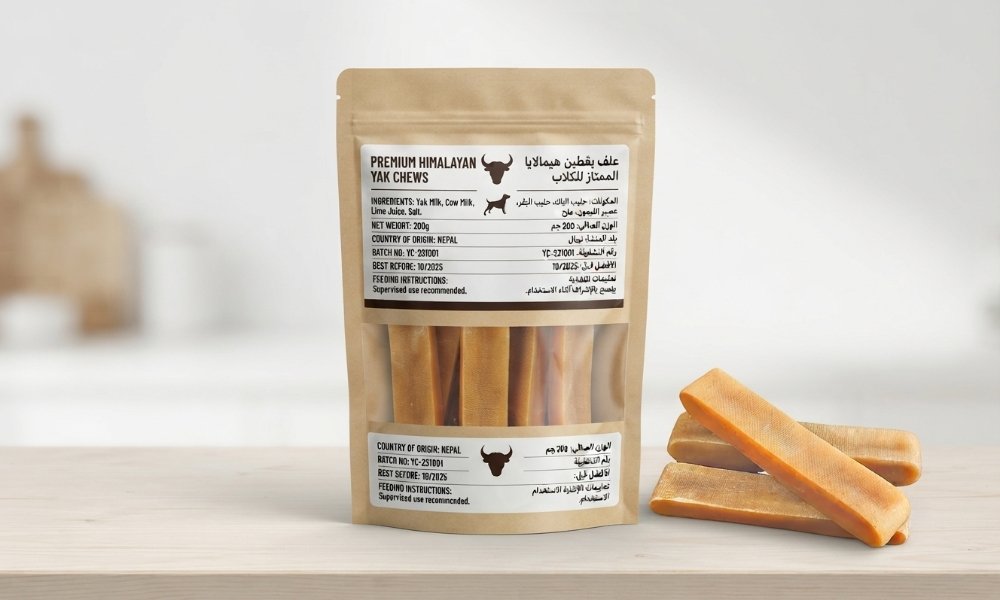
UAE pet food labeling requirements include Arabic-language labeling and the mandatory product information specified under UAE Standard 5031:2018. Arabic may be provided through compliant labeling or an approved sticker where permitted by the applicable registration requirements. The USDA Foreign Agricultural Service notes that Arabic labeling requirements apply to pet food and that the required Arabic sticker must be approved and applied before export where sticker labeling is used. Importers should obtain confirmation of the accepted label format during product registration rather than assuming that English-only packaging can be corrected after arrival.
What Information Should the Yak Chew Label Include?
A UAE-compliant yak chew label displays 7 mandatory data fields:
- Product name: descriptive name such as “Himalayan Yak Chew” or “Natural Yak Milk Dog Chew”
- Ingredients list: declared in descending order by weight; standard yak chew ingredients list: yak milk, salt, lime juice
- Net weight: displayed in metric units (grams or kilograms), positioned prominently on the principal display panel
- Country of origin: “Product of Nepal” or “Made in Nepal”
- Manufacturer name and full address: complete address of the production facility in Nepal
- Best before date: minimum month and year format; day-month-year is accepted and preferred
- Feeding instructions: guidance segmented by dog body weight category with a supervision advisory
Batch number and lot code are strictly mandatory on the consumer label under current UAE requirements to ensure MOCCAE product recall traceability and compliance.
Do Yak Chew Labels Need Arabic and English?
Yes. UAE regulations require product labels to carry all mandatory information in Arabic. English text is permitted alongside Arabic but does not substitute for Arabic. Labels arriving with English-only text are flagged during MOCCAE registration review and at customs inspection.
Arabic translation accuracy is verified by MOCCAE inspectors. Machine-translated labels with incorrect terminology, grammatical errors, or non-standard transliterations are returned for correction. A certified Arabic translation specialist with pet food or consumer goods experience produces compliant label text that clears MOCCAE review on first submission.
How Should Ingredients, Weight, Dates, and Feeding Instructions Be Displayed?
The following table defines the 4 critical display requirements for UAE-compliant yak chew labels, with the most common mistakes identified for each:
| Label Element | UAE Requirement | Common Non-Compliance |
| Ingredients | Descending order by weight | Ingredients listed alphabetically or randomly |
| Net Weight | Metric units, grams or kilograms | Weight displayed in ounces only |
| Best Before Date | Month + Year minimum | Date omitted, abbreviated incorrectly, or in non-standard format |
| Feeding Instructions | Segmented by dog weight category with supervision note | Generic statement only; no weight-based guidance |
Labels failing any 1 of these 4 requirements return to the importer for correction before UAE customs grants clearance.
How Much Does It Cost to Import Yak Chew Into the UAE?
The total landed cost to import yak chew from Nepal into the UAE consists of 6 components: product cost (FOB), international freight, marine insurance, UAE customs duty at 5% of CIF value, UAE VAT at 5% of CIF plus duty, and UAE customs clearance and port handling fees.
Per-kg landed cost for air-freighted yak chew ranges from AED 55 to AED 95, depending on the FOB product price, freight mode, and clearance fee structure.
What Costs Should You Include in the Import Budget?
The 6 cost components in a complete yak chew import budget are:
- Product cost (FOB Nepal or FOB Indian port): Nepal wholesale FOB pricing for yak chew ranges from USD 8 to USD 18 per kg, depending on size grade and certification level
- International freight: USD 3.50 to USD 5.50 per kg by air; proportional LCL sea rate ranging from USD 0.90 to USD 1.80 per kg for standard sea consignments
- Marine insurance: 0.5% to 1.0% of the CIF value per shipment
- UAE customs duty: 5% of CIF value, applied under the GCC common external tariff for HS Code 2309.10 (Dog or cat food, put up for retail sale).
- UAE VAT is charged at the standard 5 percent rate. For imports, the UAE Federal Tax Authority states that import VAT is calculated on the value of the goods, inclusive of applicable customs duty and excise tax. See the UAE Federal Tax Authority’s VAT Import Declaration Guide.
- UAE customs clearance and port handling: AED 800 to AED 2,500 per shipment, depending on shipment value, port, and broker rate
How Do Freight, Customs Duty, VAT, and Clearance Affect Landed Cost?
The following table shows a complete landed cost calculation for a 100 kg sample air freight shipment at an FOB unit price of USD 12 per kg:
| Cost Component | Calculation Basis | Amount (AED) |
| Product cost (FOB Nepal) | 100 kg × USD 12 = USD 1,200 | AED 4,404 |
| Air freight | 100 kg × USD 4.50 = USD 450 | AED 1,652 |
| Marine insurance | 1% of CIF (USD 1,650) | AED 61 |
| CIF value | FOB + freight + insurance | AED 6,117 |
| Customs duty (5%) | 5% × AED 6,117 | AED 306 |
| UAE VAT (5%) | 5% × (AED 6,117 + AED 306) | AED 321 |
| Clearance and handling | Fixed per shipment | AED 1,200 |
| Total landed cost | AED 7,944 | |
| Per-kg landed cost | AED 79.44 |
Exchange rate basis: 1 USD = 3.67 AED (2026 AED peg rate). Actual freight, product, and handling costs vary by supplier, season, and port.
How Can You Calculate the Total Landed Cost?
Total landed cost equals CIF value plus customs duty (5% of CIF) plus UAE VAT (5% of CIF plus duty) plus customs clearance and port handling fees.
CIF value equals FOB product cost plus freight charges plus insurance premium.
Applying this formula before confirming retail pricing with UAE distributors ensures the margin calculation is accurate. A product priced at AED 120 retail per unit must absorb a landed cost that leaves sufficient margin for the distributor, the importer, and VAT on the final sale. Importers who calculate landed cost after agreeing on distributor pricing frequently discover the product is not commercially viable at the agreed retail price point.
How Can You Clear Yak Chew Through UAE Customs?
Yak chew clears UAE customs through Dubai Customs (Jebel Ali Port and Dubai International Airport) or Abu Dhabi Customs (Khalifa Port and Abu Dhabi International Airport) via electronic declaration filing. The licensed UAE customs broker submits the complete 8-document package through the relevant customs portal, assigns the HS code, and receives a channel assignment within 4 to 8 working hours of submission.
What Happens When the Shipment Arrives in the UAE?
On physical arrival at the UAE port or airport, the freight forwarder or shipping agent notifies the UAE importer and the customs broker with arrival confirmation and cargo tracking details. The broker submits the formal customs declaration electronically within 24 hours of cargo arrival notification. The customs system reviews the declared HS code, declared customs value, and document completeness. While standard commercial goods may receive rapid green-channel release, animal-derived pet food requires mandatory MOCCAE veterinary clearance; compliant shipments with approved documentation are typically released within 1 to 2 working days after quarantine verification. Red-channel assignments proceed to physical inspection within 1 to 3 working days.
How Are Inspections and Customs Holds Handled?
Red-channel and quarantine inspections are conducted by UAE customs officers alongside MOCCAE veterinary quarantine officers, who hold primary border jurisdiction, with secondary coordination from Dubai Municipality or ADAFSA for retail compliance. Inspectors open 3 to 5 randomly selected cartons from the consignment to verify label compliance, physical product condition, and match between the declared HS code and the actual product. The Veterinary Health Certificate is cross-checked against the declared batch number and production details.
Compliant shipments receive a formal release order within 2 to 4 working days of the inspection date. Shipments held for documentation errors, such as a discrepancy between the declared weight on the invoice and the packing list, are released after the broker provides a corrected supplementary document. Shipments with label non-compliance require physical relabeling under customs supervision or return to the manufacturer.
What Can Cause a Yak Chew Shipment to Be Delayed or Rejected?
7 documented causes account for the majority of UAE customs delays and rejections for yak chew shipments:
- Missing or expired Veterinary Health Certificate, the most frequent detention trigger; the VHC must be original, current, and issued per consignment
- Label non-compliance, absent Arabic text, incorrect ingredient order, or missing mandatory fields
- HS code misdeclaration, classifying under Chapter 04 (dairy) or 2309.90 instead of the correct 2309.10 for retail-packaged dog treats.
- Invoice value inconsistency: declared CIF value differs materially from the purchase contract or wire transfer records.
- Expired MOCCAE product registration; registration lapsed before the shipment arrived; UAE customs checks registration status at declaration review.
- Incomplete Certificate of Origin, missing FNCCI or NCC stamp, or the country of origin statement is absent.
- Product composition mismatch: ingredients on the label differ from the Certificate of Analysis submitted during MOCCAE registration.
Addressing all 7 points during pre-shipment documentation review reduces the commercial risk of a UAE customs hold to near zero for compliant manufacturer-importer partnerships.
How to Choose a Yak Chew Supplier in Nepal for UAE Imports?

Choosing a reliable yak chew manufacturer in Nepal determines UAE import compliance as directly as the import process itself. A UAE-ready supplier provides 5 documented capabilities: HACCP or ISO 22000-certified production, verified export documentation experience, ISO-accredited lab testing on every batch, capability to produce UAE bilingual label artwork, and consistent product quality across repeat commercial orders.
Manufacturers with existing export history to the USA, UK, or EU markets are typically the fastest to produce UAE-compliant documentation, because FDA and UK/EU food safety verification frameworks share core documentation structures with MOCCAE requirements.
What Should You Check Before Choosing a Yak Chew Manufacturer?
Check 6 criteria before selecting a Nepal-based yak chew manufacturer for UAE export:
- Production certification: HACCP, ISO 22000, or GMP certification from a recognized body confirms food-safe manufacturing conditions; uncertified facilities produce documentation that MOCCAE registration reviewers consistently flag for additional verification
- Verified export history: shipping records to regulated markets confirm the manufacturer understands export documentation requirements and timelines — manufacturers already approved for yak chew imports into the US operate under FDA-aligned documentation frameworks that transfer directly to UAE compliance requirements
- ISO-accredited laboratory access: batch-specific Certificates of Analysis from an accredited lab are required for MOCCAE registration; manufacturers without lab partnerships delay this document by 4 to 6 weeks
- Raw material traceability: documented sourcing records for yak milk from identified highland herding communities, preferably above 3,000 metres elevation; origin traceability is a growing UAE retail buyer requirement in 2026
- Bilingual packaging capability: ability to produce Arabic-English label artwork and print compliant packaging; manufacturers who rely on the importer to create packaging from scratch add 3 to 4 weeks to the pre-launch timeline
- Trial order flexibility: willingness to fulfill 100 to 300 kg trial shipments before committing to full commercial production runs; this flexibility allows the UAE importer to complete customs clearance on a small test batch before scaling volume
How Can You Verify Product Quality and Export Documentation?
Product quality verification for UAE import involves 3 parallel checks conducted before the first commercial order is placed:
- Lab analysis: Request the current Certificate of Analysis from an ISO-accredited laboratory for the specific product SKU. Yak chew protein content ranges from 55% to 65% on a dry matter basis. Moisture content below 10% confirms the product meets the drying standard that supports the 18 to 24-month shelf life. Fat content typically falls between 2% and 8%, depending on the milk source and pressing method.
- Third-party factory audit: Commission an on-site factory audit by SGS, Bureau Veritas, Intertek, or an equivalent inspection body for suppliers receiving orders above 500 kg per month. The audit report covers production hygiene, storage conditions, raw material sourcing, and documentation systems. A clean audit report submitted alongside the MOCCAE registration dossier significantly reduces processing time.
- Document package review: Have a UAE customs broker review the manufacturer’s export documentation package before the first commercial shipment is booked. This review identifies gaps in the Veterinary Health Certificate language, Free Sale Certificate validity, Certificate of Origin issuing authority, or COA scope, all gaps that would otherwise cause a MOCCAE registration rejection or UAE customs hold.
Can Native Nepal Dog Chew Supply Yak Chew to UAE Importers?
Native Nepal Dog Chew supplies export-ready Himalayan yak chews to UAE importers with a complete UAE-aligned documentation package. Products are manufactured in HACCP-certified production facilities in Nepal’s Himalayan region, using yak milk sourced from high-altitude herders operating above 3,500 metres. The production process follows traditional Nepalese methods: boiling yak milk, pressing, smoking, and air-drying to achieve the hardness and shelf stability required for international retail distribution.
Native Nepal Dog Chew provides UAE importers with 5 export-ready deliverables per order:
- Veterinary Health Certificate from Nepal’s Department of Livestock Services, issued per consignment and bearing the signature and stamp of an authorized Official Veterinarian, or a verified electronic equivalent via approved digital trade channels.
- Free Sale Certificate from Nepal’s Trade and Export Promotion Centre (TEPC), confirming the product is legally manufactured and sold in Nepal
- ISO-accredited Certificate of Analysis with full batch composition data including protein, moisture, fat, ash, and microbial safety results
- Certificate of Origin from the Federation of Nepalese Chambers of Commerce and Industry (FNCCI)
- Arabic-English bilingual label artwork prepared to UAE federal labeling standards, covering all 7 mandatory data fields
UAE distributors, pet specialty retailers, and licensed importers evaluating a Nepal yak chew supply chain should review the wholesale yak chew supply guide to benchmark order volumes and pricing structures, then contact Native Nepal Dog Chew directly to request product samples, a current Certificate of Analysis, minimum order details, and a full export documentation package for review.
What Are the Key Steps to Import Yak Chew Into the UAE?
Importing yak chew from Nepal into the UAE follows 9 steps: find a licensed UAE importer, confirm MOCCAE and emirate-level requirements, select products and agree commercial terms with the manufacturer, prepare UAE-compliant bilingual labels, assemble the 8-document package, arrange Nepal-to-UAE freight via air or sea, submit the customs declaration electronically, complete UAE customs inspection, and receive and store the shipment under required dry storage conditions.
The 3 pre-shipment actions that determine import success are: confirming MOCCAE product registration eligibility and timeline, verifying the Nepalese manufacturer’s documentation capability across all 4 required export certificates, and securing approved bilingual label artwork before any packaging is printed. Importers who complete these 3 actions before freight is booked reduce average UAE customs clearance time from 10 to 14 days to 3 to 5 days.
A well-structured Nepal-to-UAE yak chew import operation covers landed cost accurately, maintains compliant product registration, and prepares the importer for the UAE pet specialty market. The UAE pet food retail market reached $219 million in 2024, a 254 percent increase over 10 years, with growing demand for premium, natural, and high-protein pet products, according to the USDA Foreign Agricultural Service’s 2025 UAE pet food market report.
Ready to source Himalayan yak chews for the UAE market? Native Nepal Dog Chew provides export-verified product, complete MOCCAE-aligned documentation, and bilingual label artwork for UAE importers. Contact the team to request a product sample pack and export documentation review.