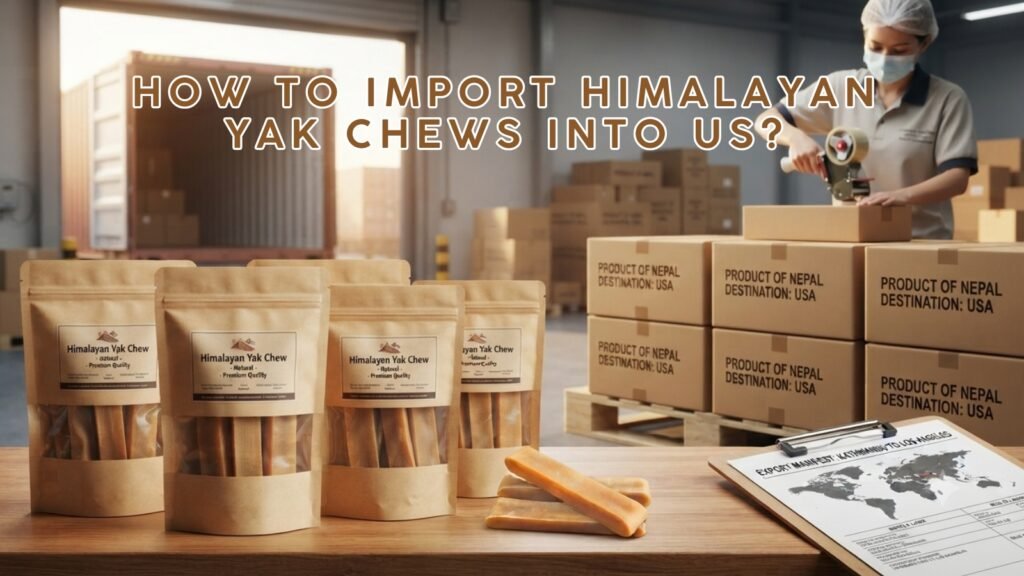
Himalayan yak chews are hard, long-lasting natural dog treats made primarily from yak and cow milk and traditionally known as chhurpi, a dense Himalayan cheese produced in Nepal. Importing Himalayan yak chews into the USA in 2026 requires coordinated compliance with the U.S. Food and Drug Administration (FDA), USDA Animal and Plant Health Inspection Service (APHIS), and U.S. Customs and Border Protection (CBP) because the product is an animal-derived pet food entering the U.S. commercial market. Pet food brands, private-label companies, distributors, and wholesale importers sourcing from Nepal must verify supplier eligibility, FDA facility registration, USDA APHIS requirements, HTS classification, product labeling, and export documentation before shipment.
A compliant Himalayan yak chew import requires navigating a multi-stage compliance process covering supplier qualification, U.S. import eligibility, FDA Prior Notice, FSVP documentation, veterinary health certification, customs entry, international freight, inspection, and final warehouse delivery. The core import file typically includes a commercial invoice, packing list, bill of lading or air waybill, lot-specific Certificate of Analysis (COA), a USDA VS 16-6A Import Permit, a veterinary health certificate, and FDA facility registration confirmation. Understanding these requirements before the first shipment helps importers prevent customs holds, documentation discrepancies, regulatory refusals, and avoidable storage or demurrage costs while establishing a repeatable sourcing process for Himalayan yak chews from Nepal to the U.S. market.
What Should You Know Before Importing Himalayan Yak Chews?
Before importing Himalayan yak chews, understand that the product is classified as animal food under FDA jurisdiction and also falls under USDA APHIS oversight because it derives from animal-sourced dairy, specifically yak and cow milk processed in Nepal. This dual-agency requirement adds a documentation layer that plant-based pet treats do not carry, and skipping either agency’s requirements results in port holds.
What Are Himalayan Yak Chews Made From?
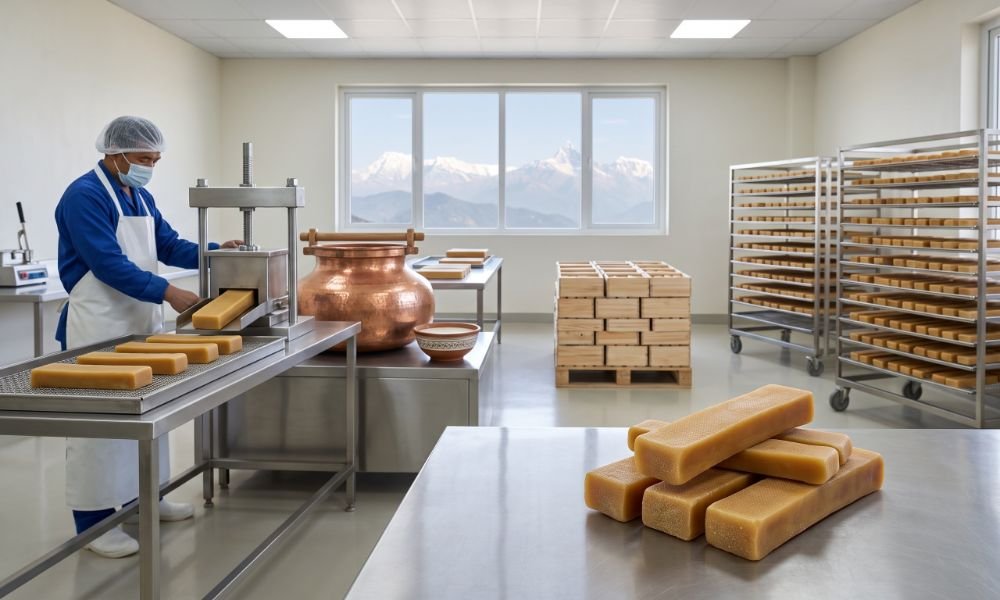
Himalayan yak chews are made from 4 ingredients: yak milk, cow milk, lime juice, and salt. These raw materials are sourced from high-altitude farms across Nepal, Bhutan, and the Tibetan plateau. The product category is also known as chhurpi, a traditional Nepali hard cheese produced by curdling yak and cow milk with lime juice, pressing the curd into dense blocks, and air-drying at altitude for weeks.
Chhurpi in its original form is a human food consumed in Nepal and other Himalayan communities. Pet-grade chhurpi undergoes additional manufacturing controls: controlled heat treatment at a minimum of 70°C for 30 minutes to satisfy USDA APHIS disease mitigation requirements, moisture reduction to under 15% (water activity ≤0.85) for FDA shelf-stability, and lot-level microbiological testing to meet animal food safety standards. The finished chew is a hard, dense, lactose-reduced product with high protein content and low moisture.
This dairy origin is the precise reason yak chews are subject to both FDA animal food authority and USDA APHIS dairy import controls. Both agencies are engaged at customs entry, regardless of how the product is labeled.
Which U.S. Agencies Regulate Yak Chew Imports?
3 U.S. federal agencies regulate the import of Himalayan yak chews: the Food and Drug Administration (FDA), the USDA Animal and Plant Health Inspection Service (APHIS), and U.S. Customs and Border Protection (CBP). Each agency performs distinct regulatory functions.
- FDA regulates Himalayan yak chews as animal food under the Federal Food, Drug, and Cosmetic Act (FD&C Act) and the Food Safety Modernization Act (FSMA). FDA requires facility registration, Prior Notice submission, and Foreign Supplier Verification Program (FSVP) documentation.
- USDA APHIS regulates animal-derived ingredients, including dairy products from Nepal, under the Animal Health Protection Act. APHIS Veterinary Services issues import eligibility determinations based on Nepal’s current livestock disease status.
- CBP processes the formal customs entry, collects applicable duties and fees, and coordinates inspection decisions with FDA and USDA. CBP assigns each shipment an Entry Number and issues the final release or hold instruction.
All 3 agencies are engaged in every commercial shipment of Himalayan yak chews entering a U.S. port of entry.
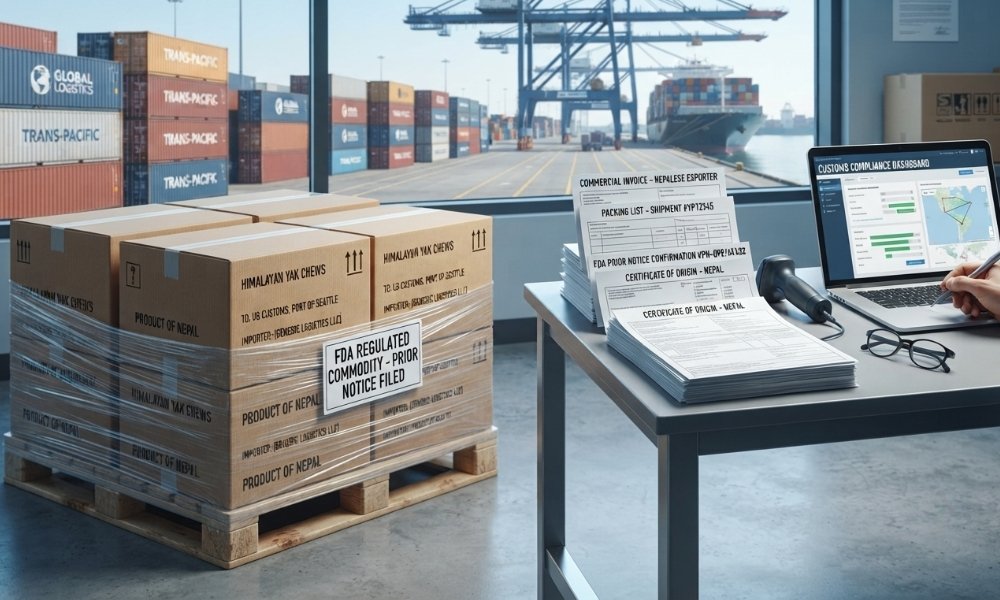
Step-by-Step Guide: How to Import Himalayan Yak Chews into the USA
Importing Himalayan yak chews into the USA requires multi-stage compliance steps, from supplier qualification through final warehouse delivery. Skipping or mishandling any single step, particularly FDA Prior Notice, USDA APHIS documentation, or HTS classification, results in customs holds, shipment rejection, or mandatory product destruction at the importer’s cost.
Step 1: Choose a Reliable Yak Chew Supplier
Select a reliable dog chew manufacturer that holds an active FDA facility registration number, HACCP certification, and a documented history of U.S. export shipments. Nepal’s pet food sector is a significant and growing U.S. trade corridor. According to the U.S. Trade Representative’s 2024 Annual Report on the Nepal Trade Preference Program, Nepal’s pet food exports to the United States reached $23 million in 2023, ranking as the country’s second-largest U.S. export category. Working with a DFTQC-registered manufacturer experienced in U.S. compliance requirements is therefore critical to accessing this established trade pathway.
Verify that the supplier’s Certificate of Analysis (COA) format confirms microbiological testing. Confirm the manufacturer has shipped both FCL (Full Container Load) and LCL (Less-than-Container Load) shipments to U.S. buyers previously, demonstrating familiarity with CBP and FDA entry protocols.
Step 2: Verify U.S. Import Eligibility
Himalayan yak chews manufactured in Nepal may be subject to USDA APHIS import requirements because they are animal-derived products. Their admissibility depends on factors such as the product’s ingredients, processing method, country of origin, intended use, and current U.S. animal-health requirements. APHIS regulates animal products and uses country- and commodity-specific requirements to determine whether an import permit, health documentation, processing certification, or other conditions apply. Importers should verify the current requirements for Nepal-origin yak chews through the USDA APHIS Veterinary Services Permitting Assistant and applicable country-specific and commodity-specific guidance before each shipment.
Step 3: Check FDA Requirements
The FDA Center for Veterinary Medicine (CVM) governs the import of all animal food, including dog treats. Three FDA requirements apply to every Himalayan yak chew import:
- Facility registration: Confirm the Himalayan yak chew manufacturer holds an active FDA Food Facility Registration under Section 415 of the Federal Food, Drug, and Cosmetic Act (21 U.S.C. 350d). Verify the registration status through FDA’s online portal; expired registrations block Prior Notice submission.
- Prior Notice filing: Prior Notice must be filed through FDA’s PNSI portal or via ABI. According to the FDA’s Guidance for Industry: Prior Notice of Imported Food, the filing window is 2 hours before arrival by road (truck), 4 hours before arrival by rail or air, and 8 hours before arrival for ocean vessel shipments. Upon successful submission, the FDA generates a Prior Notice Confirmation Number that your broker includes in the ACE entry.
- FSVP compliance: Maintain a Foreign Supplier Verification Program file documenting the supplier’s hazard analysis, HACCP controls, and corrective action records as required under 21 CFR Part 1, Subpart L.
FSVP compliance applies to U.S. food importers under 21 CFR Part 1, Subpart L. According to the FDA’s FSVP Small Entity Compliance Guide, “very small importers” with less than $1 million in average annual total food sales may qualify for modified FSVP requirements, but no importer is completely exempt. FSVP records must generally be retained for at least 2 years after the records are created or obtained. Importers above $2.5 million must maintain full FSVP documentation.
Step 4: Check USDA APHIS Requirements
USDA APHIS Veterinary Services regulates certain animal-origin products entering the United States, and animal-derived pet treats may be subject to APHIS requirements depending on their ingredients, processing, country of origin, and disease-risk classification. Himalayan yak chews made from yak and cow milk therefore require an assessment of the applicable APHIS import requirements before shipment.
Nepal is not listed among the countries and regions that APHIS currently recognizes as free from foot-and-mouth disease (FMD). APHIS maintains country- and disease-specific animal-health classifications and may impose or modify import restrictions when disease conditions change. However, Nepal’s FMD status alone does not establish whether a particular finished yak-chew product requires an APHIS import permit, health certificate, or specific processing documentation.
Before shipping Nepal-origin Himalayan yak chews, the U.S. importer should confirm the current commodity-specific requirements directly with USDA APHIS Veterinary Services. The applicable requirements may depend on the product’s ingredients, manufacturing process, intended use as animal food, and country of origin. APHIS requirements can change, so the importer should verify the requirements applicable to each shipment before export.
Step 5: Determine the Correct HTS Code
The Harmonized Tariff Schedule (HTS) code is the 10-digit numeric classifier that determines the duty rate, regulatory pathway, and agency review for your shipment. Himalayan yak chews classify under 2 possible HTS headings depending on packaging format:
- HTS 2309.10.0010: Dog or cat food put up for retail sale. Applies to individually packaged consumer units with a Guaranteed Analysis panel and AAFCO-compliant labeling.
- HTS 2309.90.1000: Other preparations used in animal feeding. Applies to bulk bags, wholesale units, or shipments without retail-ready consumer packaging.
Classifying retail-packaged chews under 2309.90 is the most common HTS error for first-time yak chew importers. Your licensed customs broker validates the final classification based on the actual packaging and labeling submitted.
Step 6: Calculate Duties and Landed Costs
The U.S. MFN (Most Favored Nation) duty rate on HTS 2309.10 and 2309.90 for Nepal-origin products is Free, $0.00 ad valorem, under standard MFN trade terms. Verify the current applicable duty rate with your customs broker at the time of import; tariff schedules and trade program status change, and additional section tariffs can apply based on current U.S. trade policy.
Landed cost components include: FOB product price, ocean or air freight, marine cargo insurance (0.3–0.5% of CIF value), CBP Merchandise Processing Fee (MPF), Harbor Maintenance Fee (HMF), broker fees, port handling, and drayage. CBP collects two standard fees on formal entries. The Merchandise Processing Fee (MPF) is 0.3464% of entered value, subject to minimum and maximum amounts that are adjusted periodically — verify current figures directly with your customs broker using the CBP MPF guidance. The Harbor Maintenance Fee (HMF) is 0.125% of commercial cargo value for all ocean port entries, as established under 19 CFR 24.24. A representative landed cost for a 500 kg LCL shipment from Kathmandu to Los Angeles runs $1,800–$3,500 in freight and logistics costs, depending on route and carrier rates.
Step 7: Prepare Import Documents
Assemble the complete import document set before the shipment departs Nepal. The 7 required documents are:
- Commercial Invoice (supplier-issued, denominated in USD)
- Packing List (carton count, dimensions, net and gross weights, lot numbers)
- Bill of Lading or Air Waybill (carrier-issued)
- Certificate of Analysis (per production lot, with pathogen testing)
- Veterinary Health Certificate (Nepal Department of Livestock Services-issued)
- FDA Facility Registration Confirmation
- USDA VS Form 16-6A Import Permit
Missing even 1 of these 7 documents is the leading cause of yak chew shipment holds at U.S. ports of entry. Document gaps discovered after the vessel departs Kolkata add 14–21 business days to the clearance timeline. FDA’s animal food safety framework, established under 21 CFR Part 507 and detailed in FDA GFI #245 (Hazard Analysis and Risk-Based Preventive Controls for Food for Animals — FDA GFI #245), requires facilities manufacturing pet treats to conduct a hazard analysis and implement preventive controls for pathogens including Salmonella and E. coli. A valid COA for each production lot should confirm pathogen absence per these requirements.
Step 8: Set Up the Importer of Record
The Importer of Record (IOR) is the legal entity that accepts responsibility for the shipment at U.S. Customs. The IOR holds a CBP Importer ID, an Employer Identification Number (EIN) for U.S.-based entities, and signs CBP Form 7501 (Entry Summary). The IOR is financially liable for all duties, penalties, and compliance failures associated with the entry.
Foreign entities that do not have a U.S. legal presence cannot act as IOR without designating a U.S.-based agent. Foreign buyers importing yak chews for U.S. resale must designate a U.S. entity or use a bonded customs broker acting as IOR.
Step 9: Choose a Customs Broker
A CBP-licensed customs broker (licensed under 19 CFR Part 111) manages entry filing, HTS classification review, duty calculation, Prior Notice cross-reference, and all agency communications. Select a broker with verifiable experience in FDA-regulated animal food imports and prior experience with Nepal or South Asia origin shipments. Standard broker fees for a formal entry range from $150 to $500 per entry depending on shipment complexity.
Step 10: Prepare Packaging and Labels
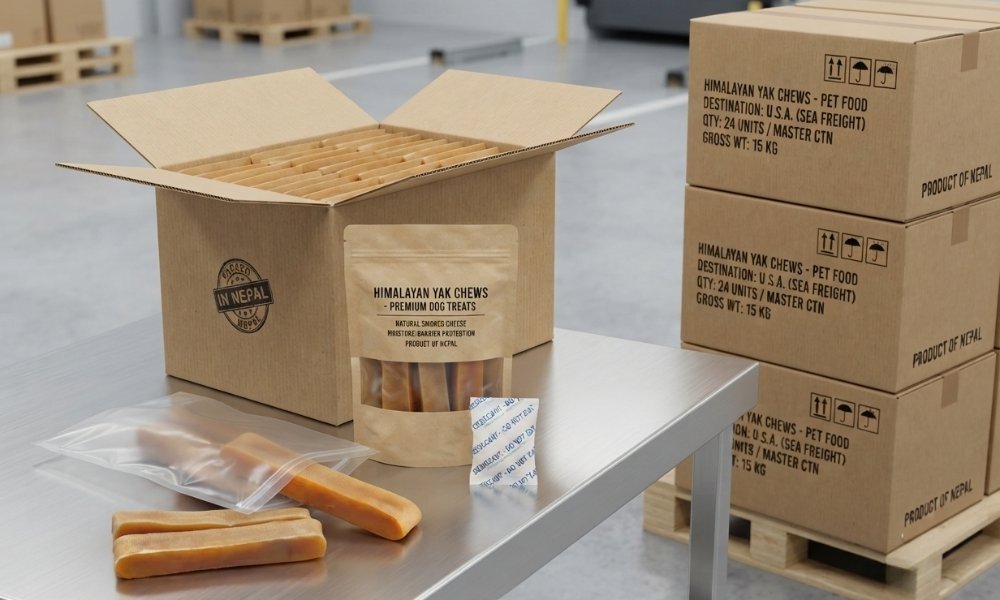
Retail-ready Himalayan yak chews sold in U.S. channels require label compliance with 2 regulatory frameworks; importers sourcing through private label yak chew packaging services must confirm that all packaging templates satisfy both 21 CFR Part 501 and AAFCO requirements before production begins:
- 21 CFR Part 501 (FDA animal food labeling regulations): product name, net weight, manufacturer or distributor name and address, country of origin, and ingredient list.
- AAFCO Model Bill of Feed Regulations: Guaranteed Analysis listing minimum crude protein, minimum crude fat, maximum crude fiber, and maximum moisture; feeding directions; and a species designator (“For Dogs Only”).
Labels must not include unsubstantiated health claims such as “prevents disease” or “heals joints,” nor regulatory terms such as “USDA Approved” or “AAFCO Certified”; these are not certifications that exist for pet treats. Pre-import label review by a U.S. pet food regulatory consultant eliminates the most common labeling compliance errors before production begins.
Step 11: File FDA Prior Notice
FDA Prior Notice is a mandatory pre-arrival notification filed through the FDA PNSI portal or via ABI. The filing window by transport mode is:
- 2 hours before arrival by road (truck)
- 4 hours before arrival by rail or air
- 8 hours before arrival for ocean vessel shipments.
Prior Notice must identify: the manufacturer, shipper, country of origin, anticipated U.S. port of entry, and product description. Upon successful submission, FDA generates a Prior Notice Confirmation Number. Your customs broker includes this number in the ACE entry. Failure to file Prior Notice results in refusal of admission; the shipment returns to Nepal at the importer’s expense.
Step 12: Arrange International Shipping
Nepal is landlocked. All export shipments transit overland to 1 of 3 primary departure points: Kolkata port, Nhava Sheva (Mumbai) port, or Tribhuvan International Airport (Kathmandu) for air cargo. Ocean freight transit time from Kolkata to Los Angeles runs 28–35 days. Air freight from Kathmandu reaches U.S. East or West Coast airports in 5–8 business days.
Ocean freight via LCL is cost-effective for shipments above 200 kg. Air freight is economical only for trial orders below 100 kg or time-sensitive replenishment orders. Nepal-based yak chew export services with established relationships at Kolkata ICD (Inland Container Depot) manage the Kathmandu-to-Kolkata leg, which adds 3–5 transit days to the ocean leg.
Step 13: Complete U.S. Customs Entry
Your customs broker files the customs entry through CBP’s Automated Commercial Environment (ACE) system. Shipments valued above $2,500 require a formal entry (CBP Form 7501). Shipments valued below $2,500 qualify for informal entry treatment with reduced documentation requirements.
FDA reviews the entry electronically and issues either a “May Proceed” authorization or a “Hold” notice for further review. USDA APHIS simultaneously reviews animal product entries through the ACE integration. Both agency responses arrive within 1–3 business days for shipments with complete documentation.
Step 14: Clear Inspections and Receive the Shipment
An FDA Hold produces 1 of 3 clearance outcomes:
- Documentary review: FDA examines the Prior Notice filing and product label. Release follows within 2–5 business days for compliant documentation.
- Physical examination: FDA port inspectors physically examine the product and collect samples for laboratory analysis. This process takes 7–14 business days.
- Automatic detention: Manufacturers on the FDA’s active import alert red lists face mandatory examination before any shipment is released. The most relevant import alerts for animal food importers are Import Alert 99-32 (foreign establishments refusing FDA inspection — Import Alert 99-32) and Import Alert 99-29 (melamine contamination in animal food products — FDA Import Alerts)
Once the FDA and USDA APHIS issue clearance, CBP releases the shipment. The importer or freight forwarder arranges port drayage to the final warehouse.
What Documents Do You Need to Import Himalayan Yak Chews?
Importing Himalayan yak chews into the USA requires 6 core documents: a commercial invoice, packing list, bill of lading or air waybill, certificate of analysis, veterinary health certificate, and FDA facility registration confirmation for the manufacturer. All 6 must be accurate, current, and available before the shipment departs Nepal.
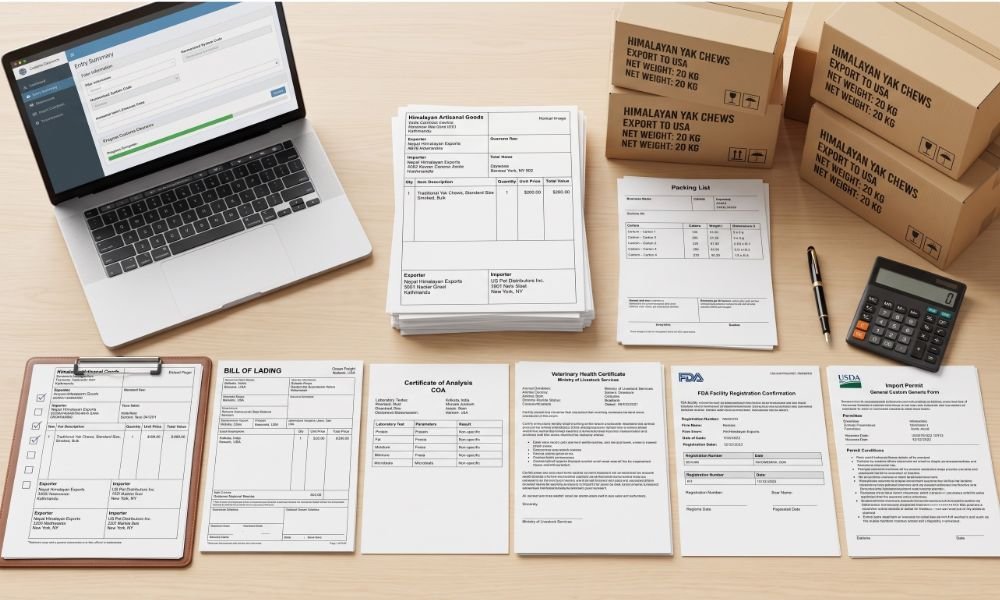
1. Commercial Invoice
The commercial invoice is the primary valuation document for CBP customs entry. It must include 8 fields:
- Buyer and seller names and full addresses
- Invoice date and unique invoice number
- Product description (product name, product form, grade)
- Country of origin (Nepal)
- Quantity in units and total weight in kilograms
- Unit price and total invoice value in USD
- Incoterms (FOB Kathmandu, CIF Los Angeles, or EXW)
- Payment terms
CBP uses the commercial invoice to determine dutiable value under the Transaction Value method (19 USC 1401a). Undervalued invoices trigger CBP penalties and formal audit procedures. The invoice value must match the actual price paid or payable.
2. Packing List
The packing list documents the physical contents of each carton in the shipment. It records: number of cartons, individual carton dimensions (L × W × H in cm), gross weight per carton, net weight per carton, product description and SKU per carton, and production lot numbers per carton.
CBP and USDA APHIS cross-reference the packing list against the physical examination findings during port inspection. Discrepancies between the packing list and the physical shipment trigger a CBP seizure notice for misrepresentation.
3. Bill of Lading or Air Waybill
The Ocean Bill of Lading (B/L) for sea freight or Air Waybill (AWB) for air cargo is the carrier-issued title document and contract of carriage. It identifies: the shipper, consignee, notify party, port of loading, port of discharge, vessel or flight number, container number or MAWB number, and freight terms.
Your customs broker cannot file the CBP entry without the B/L or AWB telex release or original surrender. Request the telex release from the carrier as soon as the vessel departs to avoid delays at the destination port.
4. Product and Health Documentation
This category covers 3 distinct documents:
- Certificate of Analysis (COA): A laboratory-issued document confirming the product’s specifications per production lot. For Himalayan yak chews destined for the U.S. market, the COA addresses moisture content (%), water activity (aw ≤0.60), crude protein (%), crude fat (%), crude fiber (%), ash (%), and pathogen absence for Salmonella spp. and E. coli O157:H7. COAs issued by ISO 17025-accredited laboratories carry greater weight during FDA documentary review.
- Veterinary Health Certificate: Issued by Nepal’s Department of Livestock Services, this certificate confirms the dairy source animals are from disease-monitored herds and the processing facility meets export hygiene standards recognized by the importing country. The certificate must be issued within 30 days of the shipment date.
- FDA Facility Registration Confirmation: Confirms the manufacturer’s active Food Facility Registration number in FDA’s database. Verify this registration through FDA’s online portal at the time of each shipment; registrations renew biennially during October–December of even-numbered years and can lapse without notice to the importer.
What FDA and USDA Requirements Should You Check?
FDA and USDA APHIS requirements for importing Himalayan yak chews cover 3 compliance areas: FDA facility registration and Prior Notice filing, USDA APHIS animal product import documentation, and U.S. label compliance under 21 CFR Part 501 and AAFCO model regulations. All 3 areas apply to every commercial import shipment.
1. FDA Registration and Prior Notice
Every facility that manufactures, processes, packs, or holds animal food for U.S. consumption must hold an active FDA Food Facility Registration number under 21 U.S.C. 415. Registrations expire during even-numbered year renewal windows (October 1–December 31). An expired or cancelled registration blocks the Prior Notice submission and prevents customs release.
Prior Notice is filed through FDA’s PNSI portal or through the broker’s ABI system. The filing generates a Confirmation Number within minutes. Your broker includes this number in the ACE entry package. A shipment that arrives without a valid Prior Notice Confirmation Number receives automatic refusal of admission at the first U.S. port.
FSVP compliance applies to all U.S. food importers. Importers averaging less than $2.5 million in annual animal food sales qualify as ‘very small importers’ and are subject to modified, reduced FSVP requirements. Importers exceeding the $2.5 million threshold must maintain full FSVP documentation. FSVP requires: a documented hazard analysis of each imported product, on-site audit or alternative supplier verification activities, and corrective action procedures. Maintain FSVP records for a minimum of 2 years after each import transaction.
2. USDA APHIS Permits and Certifications
USDA APHIS Veterinary Services administers import controls for ruminant-origin animal products under 9 CFR Part 94. Himalayan yak chews contain yak and cow milk, classifying them as ruminant-derived products subject to APHIS review.
Nepal participates in WOAH surveillance programs and reports annually on livestock disease status. The current dairy product export pathway from Nepal to the U.S. requires a full USDA VS Form 16-6A Import Permit because 9 CFR Part 94 requires restrictions on ruminant-derived products from countries not recognized as free of Foot-and-Mouth Disease (FMD). A Veterinary Health Certificate alone is insufficient to clear customs for ruminant-derived products from this region.
Contact USDA APHIS VS Import Staff at 1-844-820-2234 or submit an inquiry through the APHIS e-permit system before the first shipment to obtain a written determination of documentation requirements for Nepal-origin dairy pet treats. Print and retain this determination letter with your import files.
3. Product Labeling and Compliance
Pet treat labels for U.S. retail distribution require compliance with 21 CFR Part 501 (FDA animal food labeling regulations) and alignment with AAFCO’s Model Bill of Feed labeling guidance, which most U.S. state feed regulators adopt as law.
The label must display:
- Product name with species designator (“Dog Chew” or “For Dogs Only”)
- Net weight in U.S. units (oz/lb) and metric units (g/kg) on the principal display panel
- Name and address of the manufacturer, packer, or U.S. distributor
- Ingredient list in descending order of predominance by weight
- Guaranteed Analysis: minimum crude protein %, minimum crude fat %, maximum crude fiber %, maximum moisture %
Himalayan yak chews are classified as treats, not complete-diet products. The label must not contain an AAFCO nutritional adequacy statement, and must not imply nutritional completeness. Claims such as “balanced nutrition” or “complete meal” violate FDA animal food labeling rules for treat products and trigger Import Alert inclusion.
What Does It Cost to Import Himalayan Yak Chews?
The total landed cost to import Himalayan yak chews into the USA spans 3 cost categories: product price and international freight, customs duties and regulatory fees, and broker and port handling charges. First-time importers pay a total landed cost of $5.50–$10.00 per kg for ocean shipments and $9.00–$16.00 per kg for air shipments, depending on shipment volume, origin point, and destination port.
1. Product and Shipping Costs
Nepal-based manufacturer FOB pricing for wholesale Himalayan yak chews ranges from $4.00 to $8.00 per kg depending on chew size grade (XS through XL), formulation (standard or puffed), and packaging type (bulk bags, private label retail packaging, or OEM custom packs). Volume orders above 500 kg qualify for tiered pricing.
Ocean freight for an LCL shipment from Kolkata to Los Angeles ranges from $800 to $2,400 per CBM depending on lane rates, surcharges, and booking lead time. FCL shipments (20-foot or 40-foot containers) reduce per-kg freight cost significantly for volumes above 5,000 kg. Air freight from Kathmandu to JFK or LAX runs $3.50–$6.50 per kg in 2026 market rates, economical only for trial orders below 100 kg or urgent replenishment. Marine cargo insurance adds 0.3–0.5% of the declared CIF shipment value.
2. Duties, Tariffs, and Customs Fees
The U.S. MFN duty rate on HTS 2309.10 (dog food, retail) and HTS 2309.90 (other animal preparations) for Nepal-origin products is Free ($0.00) under current MFN tariff schedules. Verify this rate directly with your customs broker at the time of import using the CBP ACE Harmonized Tariff Schedule viewer, as applicable duty rates change with U.S. trade policy actions.
CBP collects 2 standard fees on formal entries:
- Merchandise Processing Fee (MPF): 0.3464% of entered value, minimum $33.58, maximum $651.50 (FY2026 fee schedule effective October 1, 2025, per CBP General Notice 90 FR 34665).
- Harbor Maintenance Fee (HMF): 0.125% of commercial cargo value for all ocean port entries
FDA examination fees apply when a physical exam is triggered: $90 for a document review, $300–$1,200 for a facility-conducted exam depending on exam type.
3. Broker and Port Charges
Licensed customs broker fees for a standard formal entry range from $150 to $500. Complex entries with FDA and USDA holds generate additional broker time charges at $75–$150 per hour.
Additional port-side charges include:
- Drayage (container pickup from port to warehouse): $200–$600 depending on port and delivery distance
- Examination site fees (when FDA or CBP exam is triggered): $350–$1,500 per examination event
- Demurrage and detention (storage and container fees when release is delayed beyond carrier-granted free days): $150–$450 per day per container
Importers who store shipments in a CBP-bonded warehouse defer duty payment until goods are released for consumption, improving cash flow management on large FCL orders.
What Common Problems Can Delay Your Import?
3 common problems delay Himalayan yak chew imports at U.S. ports: missing or incomplete documentation, incorrect HTS code classification, and holds issued by FDA, USDA APHIS, or CBP. Each of these problems adds 5–21 business days to the clearance timeline and increases the total landed cost by $500–$3,000 per shipment.
1. Missing Documentation
The 3 documents most frequently absent from yak chew import shipments are:
- Veterinary Health Certificate with correct issuing authority: Suppliers unfamiliar with U.S. APHIS requirements issue general DFTQC export certificates rather than livestock-service-issued veterinary documents. APHIS rejects export certificates that are not issued by a recognized government veterinary authority, the Nepal Department of Livestock Services, not the Department of Food Technology and Quality Control.
- COA with full pathogen testing: A COA that covers moisture, protein, and fat but omits Salmonella and E. coli O157:H7 results is insufficient for FDA documentary review. FDA places shipments on hold when the COA does not address the specific pathogens required under FSMA Preventive Controls for Animal Food (21 CFR Part 507).
- Current FDA Facility Registration: Importers assume the supplier’s registration is active without verifying it against FDA’s online database. Expired registrations, particularly from manufacturers who did not renew during the most recent biennial window, block Prior Notice submission and prevent entry filing.
Address all 3 documentation gaps before the shipment departs Nepal. Discovering missing documents after the vessel boards in Kolkata adds 14–21 business days to the clearance timeline and risks exceeding carrier free-time at the U.S. port.
2. Incorrect Classification
Classifying retail-packaged Himalayan yak chews under HTS 2309.90 instead of 2309.10 is the most frequent tariff classification error. Both codes carry a Free duty rate for Nepal-origin products; the financial impact is minimal, but the classification error triggers a CBP entry query that holds the release pending correction. Repeated misclassification on multiple entries generates a CBP formal classification review and potential penalties under 19 U.S.C. 1592.
A secondary classification error occurs when importers assign yak chews under Chapter 04 (Dairy Products, HTS 0406) rather than Chapter 23 (Preparations for Animal Feeding). Chapter 04 carries different duty rates and a distinct regulatory review pathway that does not align with the FDA animal food review process. A licensed broker with verifiable animal food import experience prevents this error at the entry filing stage.
3. FDA, USDA, or CBP Holds
An FDA Hold is issued when 1 of 4 conditions exists:
- The Prior Notice is filed late, filed with errors, or not filed at all
- The manufacturer appears on FDA Import Alert 99-33 (Adulterated Animal Food) or Import Alert 99-35 (Misbranded Animal Food)
- The product description in the entry does not match the HTS classification filed
- The entry is selected for routine exam as part of FDA’s annual field examination assignment
A USDA APHIS Hold is issued when the veterinary health certificate references a facility not recognized by APHIS, or when Nepal’s animal disease status changes between the time of documentation issuance and the shipment’s U.S. arrival.
A CBP Hold is issued when the declared commercial invoice value appears below market for the product category, when the shipment is selected for random intensive examination (X-ray or physical inspection), or when the importer’s ACE profile triggers a risk-based targeting flag.
A hold does not automatically mean rejection. Importers with complete and accurate documentation respond to FDA or USDA hold queries within 3 business days and resolve most documentary holds without physical examination.
How Can a Yak Chew Manufacturer and Wholesaler Help With Importing?
A compliant Himalayan yak chew manufacturer reduces your U.S. import risk by delivering 6 categories of pre-validated export documentation, coordinating with Nepal’s regulatory agencies on your behalf, and ensuring every shipment is built to pass FDA and USDA APHIS review before it leaves Kathmandu. This manufacturer-side compliance infrastructure compresses first-shipment timelines from 12 weeks to 6 weeks for buyers who work directly with an export-experienced supplier.
Can a Manufacturer Help With Product and Export Documentation?
Yes. A manufacturer with documented U.S. export experience provides the complete 6-document set required for FDA clearance and CBP formal entry, including lot-level COAs with pathogen testing, veterinary health certificates coordinated through Nepal’s Department of Livestock Services, and FDA-compliant label files. Export-experienced manufacturers also hold active FDA facility registration numbers and maintain HACCP documentation formatted for U.S. FSVP audits.
Native Nepal Dog Chew, a DFTQC-registered, FDA-registered, and ISO-certified Himalayan yak chew manufacturer based in Kathmandu, Nepal, provides B2B buyers importing to the U.S. with:
- Active FDA Facility Registration Number
- HACCP Plan and GMP documentation formatted for FSVP compliance files
- COA per production lot covering Salmonella, E. coli, moisture, water activity, crude protein, crude fat, crude fiber, and ash
- Veterinary Health Certificate coordinated through Nepal’s Department of Livestock Services
- USDA APHIS-compatible export documentation package
- OEM and private label packaging with U.S.-compliant 21 CFR Part 501 label files
- FCL and LCL export coordination through established Kathmandu-to-Kolkata freight partners
These 7 export deliverables collectively address the documentation requirements of all 3 U.S. regulatory agencies, FDA, USDA APHIS, and CBP, for a compliant formal entry. Buyers ready to place orders can review wholesale yak chew supply tiers, FCL pricing, and minimum order requirements directly.
What Are the Key Steps for Importing Yak Chews Into the USA?
The 5 most critical steps in a successful U.S. import of Himalayan yak chews are:
(1) verify the manufacturer’s active FDA facility registration,
(2) confirm USDA APHIS documentation requirements for the current Nepal animal health status,
(3) assign the correct HTS code with a licensed broker,
(4) file FDA Prior Notice before the shipment departs Kolkata, and
(5) resolve all documentation gaps before the vessel boards, not after.
Importing Himalayan yak chews into the USA follows a defined regulatory pathway. The process is sequential: each of the 14 steps depends on the previous step being complete. First-time importers who work with a compliant Nepal-based manufacturer and a licensed U.S. customs broker complete the full cycle, from initial inquiry to warehouse receipt, in 6–10 weeks.
The U.S. market for natural long-lasting dog chews is backed by significant market data: the global pet chews and treats market was valued at $11.2 billion in 2024 and is projected to reach $21.2 billion by 2034 at a 6.7% CAGR (Global Market Insights, 2025 — Global Market Insights Pet Chews and Treats Market). Himalayan cheese chew brands have attracted institutional investment, reflecting this growth trajectory, with chhurpi-based yak chews holding a recognized position within the natural treat segment. For pet brands, distributors, and importers entering this category, a clear understanding of the import regulatory process is the operational foundation for a compliant, scalable, and profitable sourcing program. Pet store buyers new to this category will also find the yak chew wholesale guide a useful companion resource covering supplier benchmarks, MOQ structures, and retail margin frameworks.