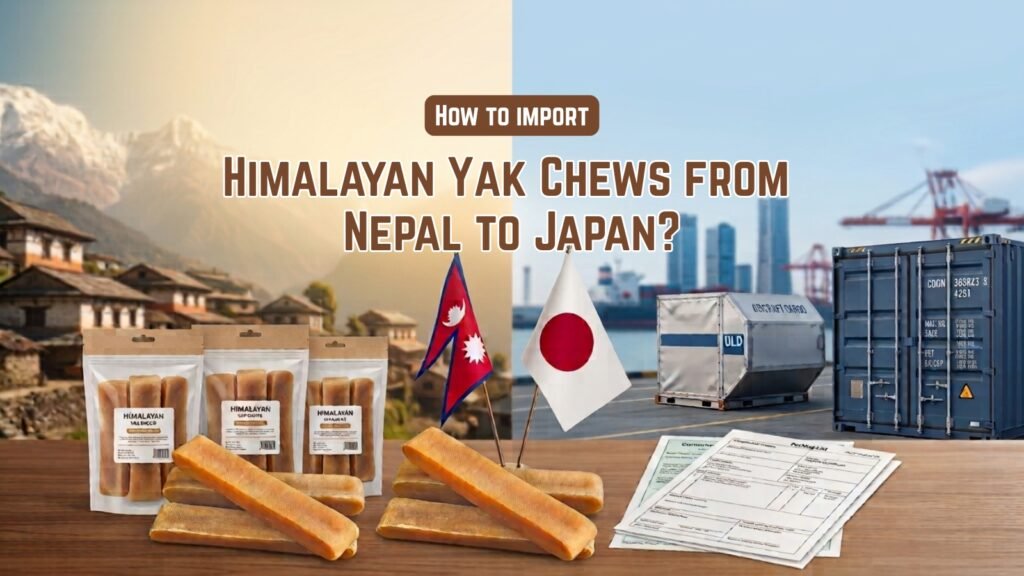
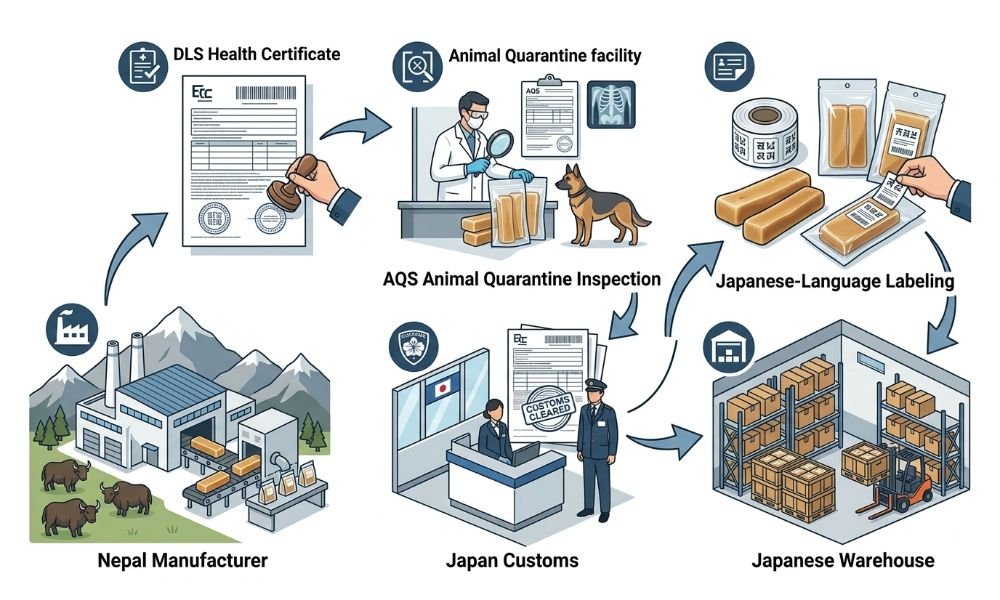
Himalayan yak chews are traditional, long-lasting dog treats made from yak and cow milk, valued for their simple ingredients, high protein content, durable texture, and origin in the Himalayas of Nepal. Importing Himalayan yak chews from Nepal to Japan requires more than sourcing a suitable product: Japanese importers must coordinate Japan’s Pet Food Safety Act requirements, Animal Quarantine Service (AQS) procedures, Japanese-language pet food labeling, health certification from Nepal’s Department of Livestock Services (DLS), laboratory testing, customs documentation, and compliant packaging. The supply chain typically runs from a Nepalese manufacturer through Kathmandu and either air freight or a Kolkata-linked sea route to a Japanese port, where AQS inspection and Japan Customs clearance determine whether the shipment can enter the market.
This guide explains the complete Nepal-to-Japan import process, from evaluating a DFTQC-licensed yak chew manufacturer and verifying moisture, protein, microbiological, mycotoxin, and heavy-metal specifications to preparing the commercial invoice, packing list, Certificate of Origin, health certificate, AQS advance notification, Japanese retail label, and customs declaration. It also covers typical MOQs, FOB pricing, air and sea freight costs, Japan’s consumption tax, landed cost per kilogram, HS classification, warehouse requirements, and the documentation errors that commonly cause clearance delays. For Japanese pet retailers, distributors, e-commerce sellers, and private-label brands, the objective is a compliant and commercially viable import process that moves Himalayan yak chews from Nepalese production facilities to the Japanese market with fewer avoidable customs, quarantine, labeling, and quality-control problems.
Himalayan Yak Chew Import Process: Nepal to Japan
Importing Himalayan yak chews from Nepal to Japan requires completing 11 steps, from sourcing a DFTQC-registered manufacturer to clearing AQS quarantine and Japan Customs. The process covers supplier evaluation, compliance verification, export documentation, shipping, and warehouse inspection.
1. Find and Evaluate a Nepalese Yak Chew Manufacturer
Start with manufacturers registered with the DFTQC and listed with the Nepal Chamber of Commerce and Industry. Trade platforms like Alibaba, GlobalSources, and Made-in-China.com list Nepalese yak chew exporters, though direct verification of credentials through the DFTQC database is faster and more reliable.
Request factory profiles from at least 3 suppliers before shortlisting. Key evaluation criteria: existing export destinations (a manufacturer already clearing EU or US customs understands regulated market documentation), production volume, and average response time to inquiries (slow communication at the sales stage predicts slow document turnaround at the export stage).
2. Request Samples and Confirm Product Specifications
Before placing a commercial order, request 2–5 kg sample kits across all size grades. Evaluate:
- Hardness consistency across the sample batch (soft spots indicate incomplete drying)
- Odor profile: minimal smell is the standard for Japanese indoor households
- Color uniformity: yak chews should be consistent amber to dark brown; white patches indicate incomplete curing
- Palatability: if field-testing is possible with Japanese dogs before ordering, this eliminates the single biggest unknown
Confirm that sample specifications, protein percentage, moisture content, and physical dimensions match what the manufacturer commits to delivering in commercial quantities. Reputable suppliers sign a product specification agreement before production begins.
3. Agree on MOQ, Pricing, Packaging, and Private Label Terms
For Japan-bound orders, typical wholesale MOQs from Nepalese manufacturers range from 100–500 kg per order. FOB price ranges (Kathmandu or Tribhuvan Airport) in 2025–2026:
| Size Grade | Weight Range | FOB Price per kg (USD) |
| Small | Under 50g | $9–$14 |
| Medium | 50–100g | $8–$12 |
| Large | 100–200g | $7–$11 |
| XL | 200g+ | $6–$10 |
Prices shift based on yak milk raw material costs (seasonal; milk is more expensive in winter months, November through February) and cargo booking availability at Kathmandu Airport.
Private labeling, Japanese-language printed packaging, custom branding, and custom size assortments are available from most mid-scale and larger Nepalese manufacturers at an additional setup fee of $0.50–$1.50 per kg on the initial order.
4. Confirm Japanese Import Compliance Before Production
Before the manufacturer starts a production run, complete a compliance confirmation checklist:
- Verify that all raw materials are on Japan’s permitted ingredient list under the Pet Food Safety Act
- Confirm target moisture content at dispatch (≤15%)
- Verify packaging material food-safety certification (particularly for primary packaging films)
- Agree on lab testing timeline; results must be available before the shipment departs; not after
This step prevents the most expensive mistake in yak chew importing: taking delivery of a full pallet that fails AQS inspection or customs review because of a compliance gap that could have been identified 6 weeks earlier.
5. Prepare Product Labels and Packaging
Design Japanese-language labels meeting all 9 mandatory elements. Have the finished label design reviewed by a Japanese regulatory consultant or your Japanese customs broker’s compliance desk before sending to print. Errors discovered after label printing are expensive, either reprinting labels at your cost or relabeling at the warehouse.
For private label orders, send print-ready artwork to the manufacturer at least 3 weeks before the production start date. Packaging printing capacity in Nepal is limited for rush orders, and errors in Japanese text require a complete reprint.
6. Prepare Commercial and Export Documents
The manufacturer prepares the commercial invoice and packing list, then initiates the health certificate request through Nepal’s DLS. DLS health certificate issuance takes 7–14 working days from the date of application.
Review the health certificate draft carefully before DLS issues the final stamped version. Check every field: product description, net weight, HS code reference, exporter and consignee names, country of destination, and the issuing veterinarian’s stamp. Errors in AQS-reviewed documents after departure require replacement certificates and customs re-submission, adding 10+ days to clearance.
Your Certificate of Origin is issued by the relevant Nepal Chamber of Commerce upon application with the final commercial invoice and packing list. Processing takes 2–3 working days.
7. Complete Japan’s Required Import Procedures
Submit the AQS advance import notification through the official MAFF Animal Quarantine Service portal — see the MAFF AQS import guidance page and the separate dairy product inspection requirements page — before the cargo departs Nepal or, at minimum, before it arrives at the Japanese port. Required attachments with the notification:
- Health certificate (scan of the stamped original)
- Commercial invoice
- Manufacturing specification sheet
AQS responds to most notifications within 3–5 working days. For regular shipments with consistent documentation, the AQS review process becomes a predictable step rather than an unpredictable variable.
8. Arrange Shipping From Nepal to Japan
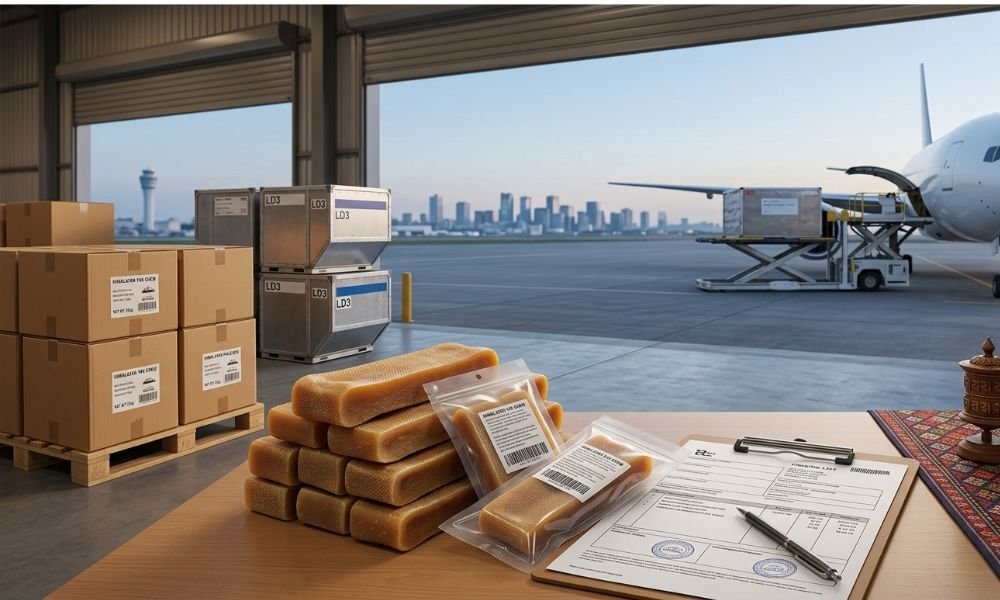
Nepal is landlocked, which adds one transport leg compared to coastal exporting countries. Two primary shipping routes serve the Japan market:
Air freight via Tribhuvan International Airport (KTM), Kathmandu:
- Transit time to Tokyo Narita (NRT) or Osaka Kansai (KIX): 3–7 days
- Cost: $4–$8 per kg depending on cargo weight and airline availability
- Best for first shipments, sample confirmations, and time-sensitive restocks
Sea freight via Kolkata Port, India (or Nhava Sheva):
- Transit time: 22–35 days total (Nepal to Indian port: 4–6 days by road; sea transit to Japan: 18–25 days)
- Cost: $1.50–$3 per kg for LCL (consolidated) loads; $1,800–$2,800 per 20-foot container for FCL
- Best for volume shipments above 500 kg where delivery timing is flexible
For most Japanese importers at the startup stage, air freight on the first 2–3 shipments is the right choice; it allows you to validate AQS clearance procedures and product reception at your warehouse before committing to sea freight volumes.
9. Prepare the Commercial Invoice and Packing List
The commercial invoice for Japan Customs must include:
- Importer and exporter legal names and full addresses
- HS code, typically 2309.10 (Dog or cat food, put up for retail sale) for packaged yak dog chews; if shipped in bulk for domestic repackaging, they fall under 2309.90. Proper classification is crucial, though both generally carry favorable duty rates under GSP.
- Unit price in USD or JPY and total shipment value
- Incoterms: CIF (Cost, Insurance, Freight). Japan is the most common arrangement
- Payment terms
- Country of origin: Nepal
The HS code classification is a decision with financial consequences. Some customs brokers have attempted to classify yak chews under HS 0406 (cheese and curd), which is the food-for-human-consumption dairy chapter and attracts significantly higher duty rates in Japan. Proper classification under Chapter 2309 (either 2309.10 or 2309.90, depending on packaging) is the correct classification for products sold as animal feed or pet treats. Confirm with your Japanese customs broker before your first import declaration; reclassification post-entry is possible but requires a formal correction procedure with Japan Customs.
10. Complete Customs Clearance in Japan
Japan Customs (日本関税) requires all commercial imports to be declared through a licensed customs broker (通関業者). Self-clearance is not an option unless your company holds a Japanese customs broker license, which takes years to obtain.
Documents submitted to Japan Customs include:
- Import declaration form (輸入申告書)
- Commercial invoice and packing list
- Bill of lading or air waybill
- AQS quarantine clearance certificate (issued after AQS inspection at port of entry)
- Certificate of Origin
- Laboratory test report (may be requested by customs officer; always have it available)
Japan’s consumption tax (消費税) of 10% applies to all imported goods, including pet food, calculated on the CIF value. This is collected at the point of customs entry and is non-negotiable.
11. Receive and Inspect the Shipment at Your Japanese Warehouse
Upon delivery:
- Count carton quantities against the packing list before signing the delivery receipt
- Inspect a random 10% of units per carton for visible damage, incorrect labeling, size inconsistencies, or signs of moisture damage.
- Check best-before dates on each production batch for label accuracy
- Document any discrepancies with timestamped photographs within 48 hours of receipt
Store yak chews at ambient temperature below 25°C in a dry environment away from direct sunlight. During Japan’s humid summer months (June–September), relative humidity in storage areas above 65% can accelerate moisture absorption in yak chews not sealed in airtight packaging.
File official claims with the manufacturer or freight forwarder within 7 days for any quantity shortfall or quality dispute. Most Nepalese exporters working with Japanese buyers maintain cargo insurance coverage that addresses transit damage claims for documented shortfalls.
Why Himalayan Yak Chews Are Entering the Japanese Pet Market
Himalayan yak chews are entering Japan’s 4.1 billion pet market because they deliver 3 attributes that Japanese premium dog owners actively pay more for: single-ingredient formulas, long-lasting chew duration, and verified Himalayan origin—a combination no competing dog chew category provides.
Demand for Natural Dog Chews in Japan
Japan’s pet food and treat market reached USD 4.1 billion in 2023, making it the largest in the Asia-Pacific region, according to the NZTE Pet Food in Japan Report (April 2024, PDF), drawing on Japan Pet Food Association and Euromonitor data. Within that total, dog and cat treats are the fastest-growing subcategory, confirming that natural, single-ingredient treat formats like Himalayan yak chews are entering the market at an opportune time. Within Japan’s total pet food market, dog treat spending grew by 35.3% between 2019 and 2023 — from ¥1,292 to ¥1,748 per dog per month — according to Japan Pet Food Association data compiled in the NZTE Pet Food in Japan Report (April 2024, PDF). Cat treats posted the highest single-year growth at 15.2% in 2023. This treat-led growth pattern favors single-ingredient formats like Himalayan yak chews, which compete on quality and duration rather than price.
Japanese dog owners prioritize 3 qualities above all others when buying treats:
- Single-ingredient or minimal-ingredient formulas with no synthetic additives
- Long-lasting chews that support dental health and satisfy working-breed needs
- Traceable raw materials with documented origin
Himalayan yak chews address all 3. The ingredient list is short: yak milk, cow milk, salt, and lime juice, and the production region (the Nepal Himalayas) is geographically distinct and verifiable. That combination of simplicity and traceability aligns with what Japanese premium pet consumers are actively paying more to find.
What Makes Himalayan Yak Chews Different From Other Dog Chews?
Himalayan yak chews are called churpi in Nepali. They are a traditional hard cheese consumed for centuries by people living at high altitude in Nepal and Tibet. For export as dog chews, churpi is produced in block or stick form, then smoke-dried for 60–90 days until moisture falls below 15%.
This drying process creates 3 functional properties that no competing dog chew category replicates together:
- Exceptional chew duration: a single yak block keeps a medium-to-large dog occupied for 4–8 hours across multiple sessions, which is a key claim that converts well on Japanese e-commerce platforms.
- High protein density: typically 60–65% crude protein by dry weight, which positions the product within the functional treat category alongside dental chews and joint-support products.
- No odor, no staining: unlike rawhide or bully sticks, yak chews produce minimal smell and leave no grease on surfaces. In Japan, where indoor living standards are high and apartment dog ownership is common, this matters enormously to buyers.
Rawhide, nylon, and synthetic chews cannot combine these 3 properties. This is why yak chews hold a premium tier in the US, UK, Germany, and South Korea, and why Japan represents a significant untapped distribution opportunity for an experienced Himalayan yak chew manufacturer with established export operations.
Japanese Buyers and Distribution Channels for Yak Chews
Japanese buyers entering the yak chew market typically fit one of 4 profiles:
- Pet specialty retailers: stores seeking differentiated premium products to separate themselves from mass-market competition. The first yak chew SKU on a boutique shelf often outsells 3–4 comparable treats within 60 days.
- E-commerce sellers on Rakuten, Amazon Japan, and Yahoo! Shopping: Japan Pet Food Association 2023 survey data shows that internet channels are now used by 38.3% of dog owners — up from 34.8% in 2019 — making e-commerce the second-largest distribution channel, behind home centers and discounters. Rakuten, Amazon Japan, and Yahoo Shopping account for the bulk of this activity (see NZTE Pet Food in Japan PDF for full channel breakdown). Sellers targeting cat owner households should also note that drugstores showed the fastest growth of all channels — rising from 27.9% to 43.2% among cat owners between 2019 and 2023.
- Pet wholesalers and distributors: companies consolidating specialty treats for resale to retail networks, typically requiring 500 kg+ MOQs and strict compliance documentation.
- Direct-to-consumer subscription brands: monthly dog treat subscription boxes with recurring subscribers, where new SKU additions drive renewal rates.
Each channel has different MOQ expectations, compliance pressure, and price sensitivity. Identifying your distribution channel—and reviewing the wholesale yak chew sourcing guide for MOQ benchmarks and compliance documentation requirements—before ordering determines the correct order size, packaging format, and documentation path.
Japan’s Import Requirements for Himalayan Yak Chews
Japan’s import requirements for Himalayan yak chews span 3 regulatory frameworks: the Pet Food Safety Act, AQS quarantine control, and Japan Customs documentation. Compliance requires 9 mandatory Japanese-language label elements and 7 pre-shipment documents. Importers, not manufacturers, bear full legal responsibility.
Japan’s Pet Food Safety Act and Yak Chews
The Act on Safety Assurance of Pet Food (Act No. 83 of 2008, in force from June 2009) governs all pet food sold in Japan, including imports. Under this Act, MAFF and FAMIC may conduct on-site inspections of importers without advance notice — see the MAFF Pet Food Guidance PDF for the complete importer checklist and FAMIC inspection requirements. Importers, not manufacturers, are the legally responsible party in Japan. Under this Act, every pet food product sold in Japan must meet 3 categories of obligations:
- Safety standards: raw materials must be safe for the target animal species. Yak milk and cow milk are both permitted animal-derived ingredients under the Act’s raw material standards. No notification or pre-approval is required for these base ingredients.
- Labeling compliance: all 9 mandatory label elements (detailed below) must appear in Japanese on every retail unit.
- Hazardous substance limits: Products must not exceed Japan’s statutory limits for mycotoxins, heavy metals, and microbial contamination as set under the Pet Food Safety Act compositional specifications — see the MAFF Pet Food Safety brochure (PDF) for full limits. Japan’s thresholds are enforced using FAMIC’s Official Inspection Method; importers should confirm lab results using this official method rather than method-equivalent testing from the exporting country.
One critical detail most importers overlook: Japan does not require pre-market approval or product registration for imported pet food. The system is post-market enforcement. You can import and sell without pre-clearance, but customs authorities and prefectural market surveillance bodies conduct random inspections. A failed inspection triggers mandatory product recall, import suspension, and financial penalties. This makes proactive compliance far more important than navigating an approval process.
Importers, not manufacturers, bear legal responsibility for compliance in Japan. The label must show your Japanese entity as the responsible party.
Animal Quarantine and Veterinary Requirements
Himalayan yak chews are classified as processed animal products derived from dairy (yak milk and cow milk). Japan’s Animal Quarantine Service (AQS), operating under the Ministry of Agriculture, Forestry and Fisheries (MAFF), controls all imports of animal-derived products at Japan’s ports of entry.
For yak chews imported from Nepal, AQS requires these 3 elements:
- A health certificate issued by Nepal’s Department of Livestock Services (DLS): this document confirms the product is fit for its intended use, free from specified animal diseases (particularly foot-and-mouth disease and brucellosis), and produced in a licensed, inspected facility.
- AQS inspections at the ports of entry: Tokyo Narita, Yokohama, Osaka Kansai, and Nagoya are the 4 primary Japanese ports with active AQS inspection facilities. AQS officers may examine the health certificate, check packaging integrity, and take samples for laboratory testing.
- Expedite clearance: Importers should submit the import inspection application (輸入検査申請書) via the NACCS system or AQS portal before the cargo arrives. While AQS allows applications upon arrival for processed dairy pet treats, failing to file in advance will almost certainly result in physical inspections and practical clearance delays of several business days.
AQS detentions typically add 5–15 business days to clearance time. The majority of detentions are caused by documentation errors, not product contamination, making document accuracy the single most effective risk-reduction step. Manufacturers providing yak chew export services for Japan-bound shipments maintain standing procedures for health certificate applications and AQS declarations, which eliminate most first-time documentation errors before the cargo departs Nepal.
Nepal is not classified under Japan’s foot-and-mouth disease high-risk zone restrictions for processed dairy products as of early 2026, but MAFF reviews country risk classifications annually. Verify the current status at aqs.maff.go.jp before placing an order.
Japanese Pet Food Labeling Requirements
Every retail unit sold in Japan must carry a compliant label printed in Japanese. The 9 required elements are:
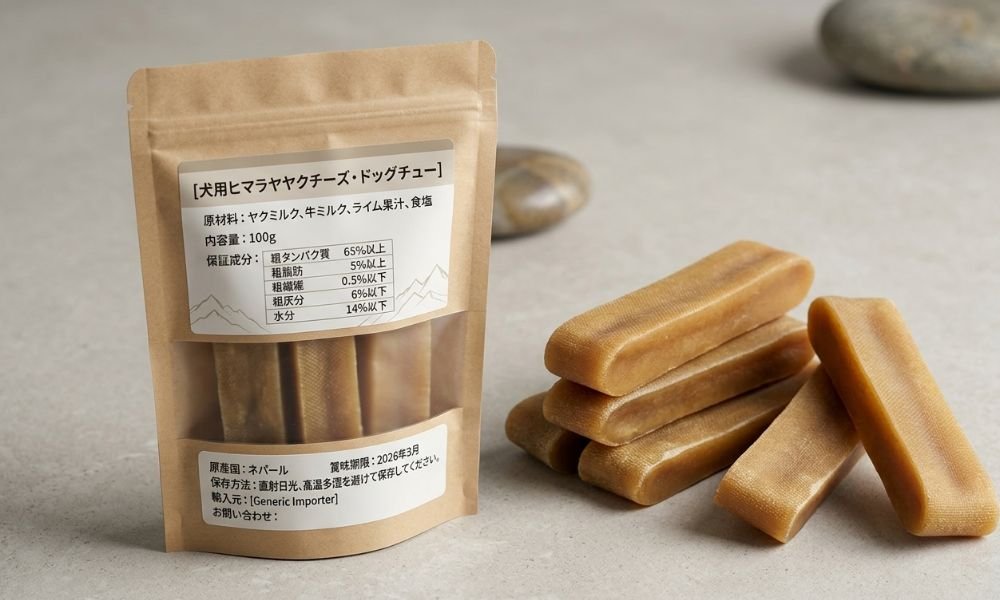
- Product name: must identify it as pet food or a dog treat (e.g., 犬用おやつ or 犬用ガムチュー)
- Target animal species: 犬用 (for dogs); mixing species on a single label is not permitted
- Net weight: in grams or kilograms using the Japanese metric system
- Ingredients list: in descending order of proportion by weight, with each ingredient named in Japanese
- Guaranteed analysis: minimum crude protein (%), minimum crude fat (%), maximum crude fiber (%), maximum crude ash (%), maximum moisture (%)
- Importer name and address: a Japanese entity address is mandatory; a foreign address does not satisfy this requirement
- Country of origin: must read ネパール産 (Made in Nepal) or ネパール原産
- Best-before date and storage instructions: using Japan’s 年月日 (year/month/day) date format
- Consumer inquiry contact point: a Japanese-language phone number or email address
Labels must be permanently affixed, legible, and printed at a minimum font size of 8 points for key information fields. Importers working with a private-label yak chew service can delegate Japanese-language label design and print coordination directly to the manufacturer, eliminating the need for an independent print production step. Japanese consumers report label completeness as a trust factor in purchasing decisions for imported products. Incomplete labels are among the 3 most common reasons for import clearance rejection at Japanese ports.
Required Import and Product Documents
Prepare these 7 documents before any shipment departs Nepal:
- Commercial invoice: itemized with HS code, unit price per kg, total shipment value, and Incoterms
- Packing list: gross and net weight per carton, unit count per carton, and batch number
- Health certificate: issued and stamped by Nepal’s Department of Livestock Services (DLS) veterinary officer
- Certificate of Origin: a standard CO issued by the Nepal Chamber of Commerce and Industry (FNCCI or regional Chamber). While Japan does not have a bilateral EPA with Nepal. Nepal’s LDC status qualifies shipments for Japan’s GSP special preferential treatment — in principle, all products from LDCs are duty-free under Japan’s scheme, which runs until March 31, 2031 (see Japan Customs GSP FAQ and MOFA’s GSP overview). To access this rate, importers must provide a valid GSP Certificate of Origin (Form A) issued by Nepal’s Chamber of Commerce with each shipment.
- Manufacturing specification sheet: full ingredient list, moisture content, protein content, shelf life, and production process summary
- Laboratory test report: issued by an accredited lab, covering microbiological, mycotoxin, heavy metal, moisture, and proximate analysis tests
- Bill of lading or air waybill: depending on shipping mode selected
What to Verify Before Ordering From a Nepalese Yak Chew Manufacturer
Ordering from a Nepalese yak chew manufacturer requires verifying 4 credential categories: DFTQC production license, export registration, HACCP certification, and verified production capacity. Request a 6-category technical data sheet, accredited lab reports, and batch traceability records before committing to a commercial order.
Manufacturer Credentials and Production Standards
Nepal has approximately 40–60 registered yak chew manufacturers at various production scales. Not all are export-ready for regulated markets like Japan. Before committing to a supplier, review the full criteria for choosing a reliable yak chew manufacturer—specifically the 4 credential categories that determine Japan export readiness:
- Government production license: The manufacturer must hold a valid food production license from Nepal’s Department of Food Technology and Quality Control (DFTQC), which is the national food safety regulatory authority.
- Export registration: Confirm the company is registered as a licensed exporter with Nepal’s Department of Commerce and Supplies Management. Without this registration, the manufacturer cannot legally export, and the health certificate process through DLS cannot be initiated.
- HACCP or GMP certification: Not a legal requirement in Nepal, but highly desirable for Japanese importers. Several Nepalese manufacturers producing for European and North American markets now carry third-party HACCP or GMP certifications that Japanese buyers can reference in their supplier audit records.
- Verified production capacity: Request monthly output data with documentary evidence (production logs, order records). Suppliers who inflate capacity estimates regularly fail to meet delivery timelines. A factory producing 2,000 kg per month cannot reliably deliver a 1,500 kg order in 3 weeks alongside existing client orders.
Ingredients, Manufacturing Process, and Product Specifications
Request a full technical data sheet covering these 6 specification categories:
- Raw material sourcing: Yak milk must originate from animals raised at altitude (typically 3,000–5,500 meters above sea level), which produces higher protein and fat concentrations than lowland cow milk; ask for documentation of source region
- Processing steps: Curdling temperature and duration, pressing method, shaping, and smoke-drying timeline
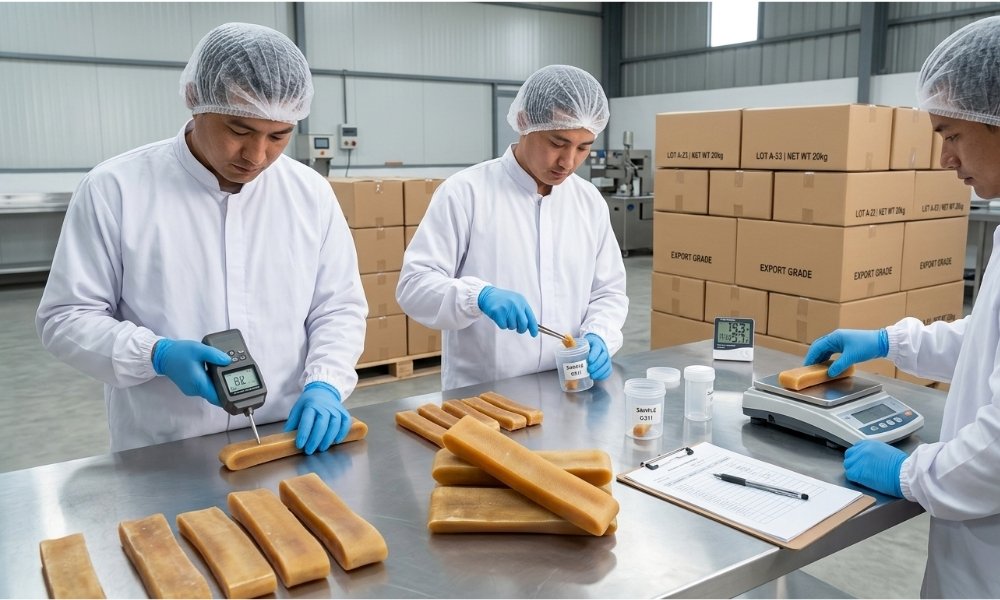
- Moisture content at dispatch: Must be ≤15% for safe international shipping and shelf stability; request batch-level moisture data, not just label averages
- Crude protein percentage: Reputable producers provide batch-level proximate analysis, not a single average figure
- Size and weight specifications: Japanese buyers and retailers expect well-graded sizes (small: under 50g, medium: 50–100g, large: 100–200g, XL: 200g+) with weight tolerances of ±10%
- Drying method: Traditional smoke-dried yak chews use juniper wood or other local Himalayan timber; industrial dryer methods reduce production time but affect the flavor profile, appearance, and long-term shelf behavior; Japanese premium buyers can detect the difference, and product photography also reveals it
Certificates, Laboratory Testing, and Health Documentation
Japanese importers require lab reports from an accredited laboratory. Both Nepal-based accredited labs and internationally recognized third-party labs (SGS, Bureau Veritas, Eurofins, Intertek) are accepted by Japanese AQS and customs authorities. The standard test panel for yak chews includes:
- Microbiological testing: Salmonella (absent in 25g), Listeria monocytogenes (absent in 25g), E. coli (presence/absence), total aerobic plate count (TPC)
- Mycotoxin panel: aflatoxin B1 (Japan limit: 20 µg/kg), total aflatoxins, fumonisin
- Heavy metals: lead, cadmium, mercury, arsenic (Japan’s limits align with Codex Alimentarius standards for animal feed)
- Moisture content: by oven-drying method (ISO 6496 or equivalent)
- Proximate analysis: crude protein, crude fat, crude fiber, crude ash, moisture (matches label guaranteed analysis)
Nepalese manufacturers with active export programs typically maintain standing relationships with accredited labs and can arrange per-batch testing for an additional fee of $80–200 USD per test panel, depending on the test scope and turnaround time required.
Packaging, Shelf Life, and Batch Traceability
Properly dried and sealed Himalayan yak chews carry a natural shelf life of 24–36 months. For Japanese import compliance and consumer expectations:
- Primary packaging must be airtight; nitrogen-flushed or vacuum-sealed laminated pouches are the industry standard; avoid stand-up pouches with simple zipper closures for single-unit retail items
- Secondary packaging must be food-safe corrugated cartons with moisture-resistant inner coating, suitable for international transit conditions, including high-humidity sea freight routes.
- Each carton must be labeled with: batch number, production date, best-before date, net weight, and product description in both English and Japanese.
- Batch records must be maintained by the manufacturer for at least 3 years; this is not a Japanese legal requirement but a standard condition in most Japanese importers’ supply agreements, and it is essential for any recall scenario.
How Much Does It Cost to Import Himalayan Yak Chews Into Japan?
Importing 200 kg of Himalayan yak chews from Kathmandu to Tokyo by air freight costs $3,780–$3,955 total, or $18.90–$19.75 per kg landed. Nepal’s LDC status qualifies shipments for Japan’s GSP duty-free rate. Japan’s consumption tax — officially 10% — applies to the combined total of the CIF value and any customs duty, not to the product price alone (see Japan Customs’ Tariff and Duty Rates overview). On a 200 kg air freight shipment, this adds approximately $320–340 USD to the total landed cost at current exchange rates.
Product, Freight, Insurance, and Customs Costs
A landed cost breakdown for a 200 kg air freight shipment from Kathmandu to Tokyo (2025–2026 price estimates):
| Cost Component | Estimated Amount (USD) |
| Product cost (FOB Kathmandu, $10/kg) | $2,000 |
| Air freight (200 kg at $6/kg) | $1,200 |
| Cargo insurance (0.5% of cargo value) | $10 |
| AQS inspection fee (¥3,000–¥8,000) | $20–55 |
| Japan customs broker fee | $150–250 |
| Japan consumption tax (10% of CIF value) | ~$321 |
| Port handling charges (Narita) | $80–120 |
| Total estimated landed cost | ~$3,780–3,955 |
| Per-kg landed cost | ~$18.90–19.75 |
Japanese Taxes, Brokerage, and Port Charges
While Japan’s MFN import duty rate for pet food preparations under Chapter 2309 can range from 3.6% to 6%, Nepal’s LDC status means shipments qualify for Japan’s Generalized System of Preferences (GSP). This allows importers to bypass standard MFN rates and access preferential duty-free treatment when the correct GSP Certificate of Origin is provided. Japan’s tariff schedule is revised annually; confirm the current rate with your customs broker before each import year.
Japan’s consumption tax at 10% is calculated on the CIF (Cost + Insurance + Freight) value of the shipment, not on the product price alone. This adds approximately 10% to the total freight-inclusive value at customs entry.
Customs broker fees in Japan vary by broker and shipment complexity. Standard fees for straightforward pet food shipments range from $150–$250 per customs entry. Brokers who specialize in food and agricultural imports are preferable for yak chew shipments because they have established working relationships with the relevant AQS inspection offices.
How to Calculate the Landed Cost Per Kilogram
Use this formula for any shipment size and mode:
Landed cost per kg = (FOB product cost + freight + insurance + AQS fee + customs duties + consumption tax + broker fee + port charges) ÷ total shipment weight in kg
For profitable retail pricing in Japan, most importers apply a 3–4× multiplier on landed cost. A ¥700–¥800/unit ($4.70–$5.35 USD) landed cost on a 100g yak chew enables retail pricing of ¥2,100–¥3,200 per unit, competitive positioning within Japan’s premium natural dog treat segment, where price points of ¥1,800–¥3,500 for single-ingredient chews are well-established.
Ways to Reduce the Cost Per Unit
4 cost-reduction strategies that produce measurable results on yak chew imports:
- Increase shipment volume: consolidating 3–4 SKUs into a single larger air shipment reduces the per-kg freight rate; most air freight carriers apply lower per-kg rates above 300 kg and again above 500 kg
- Transition to sea freight at scale: at 500 kg+, sea freight through Kolkata reduces per-kg freight cost from $6+ (air) to under $2.50, cutting total logistics cost by 40–50%
- Forward-price contracts with your Nepalese supplier: 6-month price commitments lock in FOB rates before yak milk costs rise in the November–February dry season when yak herd milk production falls
- Standardize packaging dimensions: custom-shaped pouches and unusual carton sizes increase packaging costs by 15–30% versus standard laminated pouches; standardizing packaging format across SKUs reduces both per-unit packaging cost and carton space waste in air freight.
What Common Problems Can Delay or Stop Yak Chew Imports?
Yak chew imports to Japan face 3 categories of problems: documentation errors, labeling violations, and product quality disputes. Incorrect HS codes, unauthorized DLS signatories, and late AQS filings cause the most clearance delays. Post-clearance labeling violations trigger mandatory product recall.
Documentation Errors and Customs Delays
The 3 most common documentation errors that delay Japan-bound yak chew shipments:
- An incorrect HS code on the commercial invoice: This leads to customs reclassification, additional inspection time, and potential back-duty assessment if a higher-duty code is applied retroactively.
- Health certificate issued by an unauthorized DLS signatory: Japan AQS only accepts health certificates stamped and signed by a DLS-registered and AQS-recognized veterinarian. Confirm the specific authorized signatory requirements with AQS before requesting the certificate.
- Import notification filed upon cargo arrival: While AQS’s online system technically permits applications upon arrival for processed dairy treats, doing so almost always triggers a physical inspection regardless of document quality. This adds unnecessary, avoidable delays of several business days to your clearance time compared to filing in advance.
Product Labeling and Compliance Problems
Post-clearance labeling violations, discovered during market surveillance inspections conducted by Japan’s Consumer Affairs Agency or prefectural authorities, result in product recall and potential listing removal from retail and e-commerce platforms. The 4 most frequent labeling violations for imported yak chews:
- Guaranteed analysis percentages missing or stated incorrectly (crude protein below the actual tested value, or moisture above the stated maximum)
- Country of origin not written in Japanese; “Nepal” in English alone does not satisfy the Japanese labeling requirement; the correct form is ネパール産
- Importer address is missing or showing a foreign address instead of a Japanese entity.
- Best-before date in a confusing format; Japan strictly requires the Year-Month-Day order (e.g., YYYY.MM.DD or YYYY年MM月DD日). Formats like MM/DD/YYYY or DD/MM/YYYY are regularly flagged by inspectors as they mislead Japanese consumers.
Quality, Quantity, and Shipment Disputes
Quality disputes most often arise from 3 specific sources:
- Moisture content above 15% at arrival: This causes mold development within 4–8 weeks, particularly during Japan’s humid summer season (June–September). Moisture issues trace to either incomplete drying during production or packaging seal failure during transit.
- Size grading inconsistencies: Receiving a “large” SKU that contains a significant proportion of medium-grade units creates problems at retail (customer complaints, return rates). Japanese consumers return products for grade inconsistency at higher rates than many other markets.
- Quantity shortfalls: Actual net weight 3–5% below invoiced weight is the most common quantity dispute. It typically results from production weigh-in variability or moisture loss during transit.
How to Prevent Import Problems Before Shipment
The 5-step pre-shipment checklist that addresses the vast majority of preventable problems:
- Confirm final product specs match the purchase order in writing before production begins
- Review the health certificate draft before DLS issues the final stamped version; check every field
- Verify moisture content of a random 10% sample of units from the production run using a calibrated moisture meter; reject any batch above 15%
- Submit the AQS advance import notification and confirm AQS receipt before the cargo departs Kathmandu; do not assume filing equals receipt.
- Have your Japanese customs broker review the full document set at least 5 business days before the cargo departs Nepal.
Pre-shipment independent inspection (PSI) by SGS, Bureau Veritas, or a comparable third-party body addresses items 3 and 5 in a single engagement. PSI fees run $150–300 per shipment. On any order valued above $3,000, PSI is a justified cost.
How Can Japanese Buyers Import Himalayan Yak Chews From Native Nepal Dog Chew?
Japanese buyers import Himalayan yak chews from Native Nepal Dog Chew by requesting a sample kit, reviewing the product specification package, and placing a commercial order with a 100 kg MOQ. Native Nepal Dog Chew provides DFTQC-licensed production, batch-level lab reports, and Japan AQS-formatted export documentation.
Can Native Nepal Dog Chew Supply Compliant Himalayan Yak Chews for Japanese Importers?
Native Nepal Dog Chew is a registered Nepalese producer and exporter of Himalayan yak chews, sourcing yak milk from high-altitude farming communities in Nepal’s Solukhumbu and Mustang districts at elevations between 3,500 and 5,200 meters above sea level, where traditional yak herding practices have remained consistent for generations.
For Japanese importers, Native Nepal Dog Chew provides:
- DFTQC-licensed production: The company operates under Nepal’s national food safety licensing framework, which is the foundational credential required for DLS health certificate issuance and AQS acceptance.
- Japan-market documentation support: Native Nepal Dog Chew assists importers in preparing health certificate applications, Certificates of Origin, and manufacturing specification sheets formatted to meet Japan AQS requirements. This support reduces the document preparation burden on the Japanese importer, particularly for first-time shipments.
- Private labeling with Japanese-language packaging: Japanese-language label design and packaging print production are available with MOQs starting from 100 kg, giving importers the ability to bring a branded product to market without managing international print production independently.
- Batch-level third-party laboratory reports: Microbiological, mycotoxin, heavy metal, and proximate analysis reports are available per production batch, ready for submission to Japan Customs and AQS.
- Flexible shipping options: Air freight via Tribhuvan International Airport (KTM) for urgent or first-shipment orders, and sea freight consolidation through Kolkata Port for larger volume orders where cost efficiency is the priority.
Japanese importers with established retail distribution or active e-commerce operations can request a sample kit and full product specification package to evaluate product quality before committing to a commercial order. Standard sample delivery time from inquiry to receipt in Japan is 10–15 days via air freight.
For importers wanting an end-to-end supply partner that understands Nepal-side export procedures and can coordinate documentation with Japanese customs requirements, Native Nepal Dog Chew is structured to support that process from the first inquiry through to repeat order management.
What Are the Key Takeaways for Importing Himalayan Yak Chews Into Japan?
Importing Himalayan yak chews from Nepal to Japan is a structured process with 4 critical compliance areas: Japan’s Pet Food Safety Act requirements, AQS animal quarantine procedures, mandatory Japanese-language labeling with all 9 required elements, and accurate customs documentation using the correct HS code (typically 2309.10 for retail-ready or 2309.90 for bulk).
The 7 key points every importer should carry forward:
- Japan’s Pet Food Safety Act does not require pre-market registration: compliance is enforced post-market, making proactive due diligence before import more important than navigating an approval queue
- A DLS-issued health certificate from Nepal is required for every shipment: this document must be prepared without errors before departure; corrections after cargo departs Nepal create delays that compound across every step of the clearance chain.
- Japanese-language labels with all 9 mandatory fields must be applied before products reach Japanese retail: relabeling after customs clearance is expensive and logistically disruptive.
- HS 2309.10 is the standard classification for retail-packaged yak dog chews in Japan (with 2309.90 used for bulk); confirm this with your customs broker before the first import declaration.
- Landed cost per kg for air freight shipments typically runs $18–$20; sea freight at volume reduces this to $12–$16, enabling competitive retail pricing in Japan’s premium natural treat segment
- Pre-shipment inspection by an accredited third party eliminates the most expensive problems: moisture content failures and quantity shortfalls that would otherwise be discovered only after arrival in Japan.
- A manufacturer with established export documentation experience — covering health certificates, Certificates of Origin, and third-party lab reports — cuts your first-shipment timeline and reduces compliance risk more than any other single sourcing decision.
The Japanese premium pet market rewards exactly the qualities Himalayan yak chews deliver: clean ingredients, verifiable origin, and lasting product performance. Importers who enter with correct documentation and compliant packaging build reorder relationships quickly. Those who don’t spend the first 3–6 months correcting fixable mistakes. Importers scaling to North American distribution after establishing Japan can compare the regulatory framework with importing yak chews into the US, where FDA documentation and FSMA compliance replace AQS quarantine clearance as the primary regulatory path.
For product samples, specifications, or export documentation support from Nepal, contact Native Nepal Dog Chew; the team can guide you through Nepal-side requirements and coordinate with your Japanese customs broker to align documents before your first shipment departs.