
Importing Himalayan yak chew from Nepal to Germany is an EU-regulated animal-by-product trade that depends first on third-country and establishment eligibility, followed by veterinary certification, Border Control Post (BCP) inspection, TRACES NT pre-notification, feed compliance, and German customs clearance. Himalayan yak chew, also known as chhurpi, is a dried dairy-based dog chew produced primarily from yak and other milk through acidification, pressing, heat treatment, and extended drying. For German importers, the critical starting point is confirming that Nepal and the specific Nepalese manufacturing establishment are authorized for the relevant Category 3 animal-by-product or pet-food export pathway under the EU Animal By-Products Regulation (EC) No 1069/2009 (EUR-Lex consolidated PDF), the foundational legal framework that classifies animal-derived material, establishes third-country eligibility lists, and defines Category 3 processing and traceability requirements — and its implementing regulation, Regulation (EU) No 142/2011. Both texts are publicly available on EUR-Lex. Product quality, HACCP certification, laboratory testing, or complete shipping documents cannot compensate for a missing EU country or establishment approval.
Once eligibility is confirmed, the Nepal-to-Germany supply chain requires an EORI-registered German importer, Futtermittelunternehmer registration, an EU-compliant official health certificate from Nepal’s competent authority, batch-level Certificate of Analysis (COA), consistent commercial and transport documents, TRACES NT Common Health Entry Document (CHED) notification, BCP veterinary inspection, and ATLAS customs clearance. Shipments typically enter through major German gateways such as Frankfurt for air freight or Hamburg for sea freight, where authorities perform documentary, identity, and physical checks before release into the EU market. This guide explains the complete regulatory and commercial pathway for importing yak chews from Nepal to Germany, including EU animal-by-product classification, Nepalese supplier eligibility, required documents, product testing, German labeling, TRACES NT and BCP procedures, customs duties and import VAT, freight and landed costs, rejection risks, and the compliance controls required before committing to a commercial shipment.
Are Yak Chews From Nepal Eligible for Import Into Germany?
Himalayan yak chews from Nepal are subject to EU third-country approval requirements before commercial import into Germany. Nepal must appear on the applicable EU-approved country list for the relevant product category, and the individual Nepalese manufacturing establishment must hold a specific EU export listing. Shipments that arrive without these approvals face detention and return at the Border Control Post.
How Are Yak Chews Classified Under EU Animal-By-Product Rules?
Himalayan yak chews, also known as chhurpi, are produced from yak milk and cow milk through controlled acidification, pressing, drying, and heat treatment. If the dairy material is an animal by-product or former foodstuff within the meaning of Regulation (EC) No 1069/2009, its category and the finished chew’s regulatory status must be determined from the material’s origin, reason for non-human use, composition, processing, intended use, and any applicable ABP end point under Regulation (EU) No 142/2011. When processed into dog chews or pet food ingredients, these products are governed by Commission Regulation (EU) No 142/2011 and, for feed use, by Regulation (EC) No 767/2009.
The product’s dairy origin is a distinct regulatory factor. Meat-based pet chews and dairy-based yak chews do not share identical EU approval pathways, even though both fall under the broader ABP framework. German customs and veterinary authorities classify the product’s HS code before determining which entry requirements apply. The tariff classification of a yak chew must be determined at the applicable EU CN/TARIC level from its objective characteristics, composition, processing, presentation, and intended use. HS 2309.90 should be treated only as a possible classification until confirmed by customs or, where appropriate, a Binding Tariff Information decision.
Does Nepal Meet the Applicable EU Country Requirements?
Nepal is classified as a third country under EU law. Nepal’s eligibility must be checked against the current EU country-list provisions for the precise product category and ingredients, and the Nepalese establishment must be listed in the relevant EU/TRACES-NT establishment category. The official result should be recorded by legal act, table row, product description, and establishment listing; do not describe Nepal as categorically barred from all Category 3 ABPs or all animal-origin pet food without that product-specific verification. This is the primary regulatory barrier facing German importers.
The relevant Nepalese competent authority must submit or support any EU country-listing application, and the European Commission evaluates the country’s guarantees through documentary assessment and, where necessary, an audit. The importer should obtain written confirmation from Nepal identifying the authority authorized to issue the applicable EU certificate; DFTQC should not be named as the veterinary certifying authority unless that mandate is confirmed. Importers who overlook this country-level approval issue encounter detention and rejection at German Border Control Posts regardless of product quality or documentation completeness.
What Does the Nepal-to-Germany Yak Chew Import Process Involve?
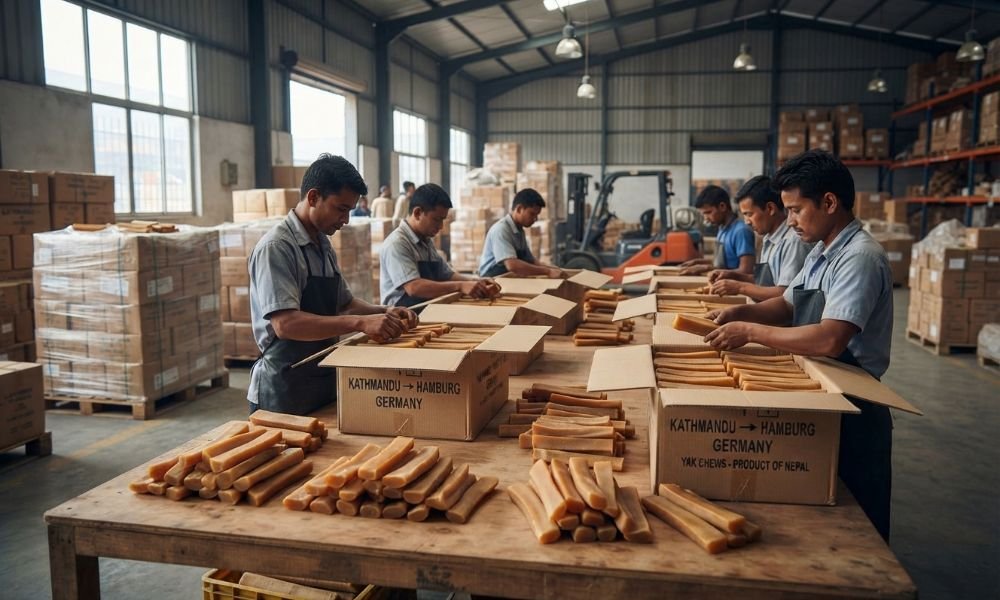
The Nepal-to-Germany yak chew import process involves 7 sequential stages, from supplier verification through final warehouse delivery. The total timeline from order confirmation to shipment release at a German BCP ranges from 45 to 90 days for first-time shipments, depending on documentation completeness, freight lead time, and BCP inspection scheduling.
1. Verify the Nepalese Supplier and Product Eligibility
Confirm the supplier’s EU establishment approval status through TRACES or European Commission databases before placing any order. Request the full documentation set, HACCP plan, processing records, COA template, and DFTQC veterinary certification capacity before committing to procurement terms. Suppliers who cannot provide these documents are not prepared for EU export, regardless of their volume or tenure in other markets.
2. Confirm EU and German Import Requirements
Engage a licensed German customs broker (Zollspediteur) with demonstrable ABP experience. Confirm the product’s HS code classification with the broker using a detailed product description and a physical sample where possible. Verify the applicable EU duty rate for the specific CN/TARIC subheading using the EU TARIC database (European Commission, DG TAXUD) — or the companion Access2Markets tariff finder, which presents the same TARIC data in a more accessible format for new importers. Both tools reflect real-time duty rates, anti-dumping measures, and any applicable GSP/EBA preferential rates for qualifying Nepalese shipments. Search by CN code 2309.90 and select Nepal as the country of origin to see the current applicable rate. Complete the Futtermittelunternehmer registration with the competent Bundesland feed authority before the shipment departs Nepal.
3. Prepare Product Compliance and Required Documentation
Coordinate with the Nepalese supplier and the DFTQC office to produce the official health certificate in the correct EU model format for the product category. Obtain the COA from an accredited laboratory for the specific production batch being shipped. Prepare the commercial invoice and packing list with batch-level weight details. Confirm that all product labels meet both German language requirements and EU feed labeling obligations under Regulation (EC) No 767/2009.
4. Arrange Freight and Complete Nepalese Export Procedures
Tribhuvan International Airport (TIA) in Kathmandu is the primary air export gateway for yak chew shipments from Nepal. Sea freight from Nepal transits via Kolkata or Mundra in India before ocean routing to Hamburg or Bremen, adding 25 to 40 transit days and 2 to 3 transshipment stops compared to air freight. The Nepalese supplier completes Nepal Customs export procedures and obtains the Certificate of Origin from the Nepal Chamber of Commerce in coordination with a Nepali freight forwarder.
5. Complete EU Border Control and German Customs Clearance
The importer or an authorized representative must submit the required CHED-P prior notification in TRACES-NT within the deadline prescribed by the applicable EU rules, taking account of the consignment type, transport mode, and designated German BCP. The BCP team conducts documentary, identity, and physical checks in sequence. A CHED with Part 2 completed and stamped by the BCP official veterinarian signals regulatory clearance. Without CHED Part 2 completion, the consignment cannot legally enter free circulation in Germany. BCP laboratory testing, when triggered, extends the inspection period by 3 to 7 working days.
6. Pay Applicable Duties, VAT, and Import-Related Charges
Three financial charges apply at German customs clearance:
- Import duty: The preferential duty rate for a product from Nepal must be verified in the current TARIC or Access2Markets result for the exact CN/TARIC subheading. A 0% or reduced rate should not be stated without confirming the classification, origin conditions, and applicable preference at the time of import. Confirm the exact applicable rate and any anti-dumping provisions through the TARIC database at the time of each shipment, as rates are subject to Commission amendments.
- Import VAT (Einfuhrumsatzsteuer): Germany applies the reduced VAT rate of 7% to animal feed and pet food products rather than the standard 19% rate. This applies to yak chews classified under HS 2309.90 as preparations used in animal feeding.
- Customs processing fees: German customs broker fees range from €200 to €600 per shipment, depending on declaration complexity. BCP inspection fees are set per Bundesland and typically range from €150 to €350 per physical inspection event.
7. Obtain Shipment Release and Arrange Final Delivery
For a consignment subject to veterinary border controls, the BCP must complete the applicable CHED before customs release can proceed. The customs authority then applies the relevant ATLAS customs procedure. The exact release package depends on the product, route, documents, and customs procedure. The customs broker delivers these release documents to the freight forwarder, who arranges inland transport to the importer’s warehouse. Dried yak chews do not require cold-chain storage, but the receiving warehouse must comply with Feed Hygiene Regulation (EC) No 183/2005 and maintain batch traceability records.

What EU Requirements Apply to Yak Chew Imports Into Germany?
EU import of yak chews triggers 3 overlapping regulatory frameworks: the Animal By-Products Regulation (EC) No 1069/2009, the Feed Regulation (EC) No 767/2009, and the Official Controls Regulation (EU) 2017/625. Each framework imposes distinct compliance obligations on the German importer, the Nepalese manufacturer, and the accompanying shipment documentation.
How Do EU Animal-By-Product Regulations Apply to Dog Chews?
Regulation (EC) No 1069/2009 establishes the legal framework for material derived from animals that is not intended for human consumption. Yak chews sold as dog treats fall within this regulation’s scope because they contain processed dairy material of animal origin. The regulation:
- Classifies yak chews as processed Category 3 ABPs (from healthy animals)
- Processing methods for animal-derived ingredients used in dog chews must comply with the specific pathogen-reduction and processing requirements applicable to the product category under the current consolidated version of Commission Regulation (EU) No 142/2011 (EUR-Lex, April 2022), which has been amended 26 times since its original publication. Importers should verify that the Nepalese supplier and DFTQC are working from the current model certificate formats contained in the relevant Annexes of this consolidated text, rather than relying on earlier versions that may predate amendments affecting dairy-origin dog chews.
- Mandates that manufacturing establishments appear on official EU-recognized third-country lists
- Where the applicable EU rules require an official certificate for the product and route, the consignment must be accompanied by the current model certificate issued by the designated competent authority. The importer should verify the exact model and documentary requirements before dispatch
What most importers overlook: Category 3 classification is not a lower compliance tier; it defines the full set of approved processing requirements, traceability obligations, and entry documentation that the product must satisfy before it legally enters German territory.
When Are Veterinary and Border Control Requirements Triggered?

Veterinary and Border Control Post requirements are triggered the moment a consignment of yak chews from Nepal enters a German port or airport. Under the Official Controls Regulation (EU) 2017/625 (EUR-Lex, consolidated January 2025), all animal product consignments from third countries receive mandatory checks at EU Border Control Posts (BCPs). Article 47(1) of this regulation requires each Member State to perform official controls at designated BCPs on every consignment of listed animal categories — there is no minimum weight or value threshold below which a yak chew shipment from Nepal is exempt from these controls. Germany has multiple designated Border Control Posts, but the appropriate entry point depends on the transport route and the BCP’s current authorization for the precise product category. The importer should verify the current EU BCP directory and obtain confirmation from the selected BCP before booking freight, rather than assuming that a major port or airport can accept the consignment.
At the BCP, customs and veterinary officials conduct 3 types of checks:
- Documentary checks: verification of all accompanying certificates and commercial documents
- Identity checks: confirmation that the consignment physically matches its accompanying documentation
- Physical checks: inspection and, where required, sampling and laboratory analysis of the product
The frequency of physical checks depends on the product category, origin country, and the shipment’s risk profile within the TRACES NT system. First-time shipments from new Nepalese establishments receive a higher rate of physical inspection.
What Must a German Importer Do Before Importing Yak Chews?
A German importer must complete 4 pre-import actions before the first shipment: obtain an EORI number, register with the relevant German state feed authority, set up TRACES NT access for pre-arrival notification, and confirm that the Nepalese supplier and manufacturing establishment meet EU export eligibility conditions. Sourcing from a certified Nepal yak chew manufacturer with a documented EU export track record substantially narrows the supplier-side burden before these 4 steps begin.
Does the Importer Need an EORI Number or Other Registration?
An EORI (Economic Operators Registration and Identification) number is mandatory for all importers conducting customs transactions in Germany. Registration is free and completed through the German Federal Central Tax Office (Bundeszentralamt für Steuern) portal or via the German Customs (Zoll) online system. The EORI number, prefixed “DE” for Germany, for example, DE1234567890, identifies the importer in all customs declarations and TRACES NT submissions.
German importers placing pet food or animal feed on the market must also register as a Futtermittelunternehmer (feed business operator) with the competent authority in their respective Bundesland (federal state). This registration is required under Feed Hygiene Regulation (EC) No 183/2005 and must be completed before the first commercial shipment, not after it arrives.
Which German Competent Authority Should the Importer Contact?
Responsibility for feed and animal-by-product controls in Germany is divided between federal institutions and the competent authorities of the Länder. The importer should contact the competent authority in the relevant Land, the designated BCP, and German Customs; BVL provides federal information, coordination, and certain registration-related functions but is not the operational authority for every individual import control. At the state level, each Bundesland operates its own Landesamt (state office) for veterinary and food safety matters.
The importer’s Bundesland state office is the first point of contact for Futtermittelunternehmer registration and compliance guidance. For pre-arrival TRACES NT notifications, coordination occurs directly within the TRACES NT system, which automatically connects the importer, the BCP veterinary team, and the BVL through a single digital workflow.
What Should You Verify Before Buying Yak Chews From Nepal?
Verify 2 eligibility factors at the supplier level before placing any order: the manufacturing establishment’s EU export approval status and the completeness of the product, processing, and traceability records. Skipping this verification step is the single most common cause of first-shipment rejection among German importers entering the Himalayan yak chew category. A structured framework for choosing a reliable yak chew manufacturer covers both eligibility factors before any procurement commitment is made.
Is the Nepalese Manufacturing Establishment Eligible for EU Export?
EU import law requires that the exporting establishment appear on the EU’s official list of approved third-country establishments. For Nepal, the DFTQC is the competent authority responsible for submitting establishment-level approval applications to the European Commission. An importer verifies establishment status by checking the European Commission’s TRACES portal and the relevant third-country establishment databases maintained at ec.europa.eu.
Suppliers who claim EU compliance without appearing on this list are not legally authorized to export ABP-containing pet products to Germany. A supplier’s HACCP certification, ISO registration, or FDA registration does not substitute for EU establishment approval. These certifications demonstrate internal quality management; they do not confer EU third-country export authorization.
What Product, Processing, Traceability, and Supplier Records Should You Request?
Request the following 8 categories of documentation from any Nepalese yak chew supplier before finalizing a procurement agreement:
- EU establishment approval status: listing reference or active application documentation submitted through DFTQC to the European Commission
- HACCP documentation: current HACCP plan covering all critical control points in the yak chew manufacturing process
- Processing records: heat treatment logs confirming validated pasteurization parameters (time and temperature combinations per EU ABP processing requirements)
- Water activity data: The supplier should establish and validate an appropriate water-activity specification for the finished chew-through product, supported by product-specific HACCP and shelf-life studies covering its formulation, processing method, packaging, and intended storage conditions. Aw ≤0.60 should not be presented as a universal EU legal threshold
- Batch traceability records: input material identification, processing dates, batch codes, and output quantities per production run
- Certificate of Analysis (COA): accredited laboratory results per production batch covering Salmonella, E. coli, total plate count, moisture, and heavy metals
- DFTQC veterinary certification capacity: confirmation that the DFTQC regional office serving the manufacturer can issue an official health certificate formatted for EU consignments
- Labeling samples: draft labels confirming species of origin, ingredient list, intended use as pet food, net weight in metric units, and EU importer identification field
German pet stores and distributors building a repeatable procurement cycle can pair this documentation checklist with the yak chew wholesale sourcing guide to align supplier selection criteria with commercial retail import standards.
What Product Compliance Requirements Apply to Yak Chews in Germany?
3 categories of product compliance apply to yak chews placed on the German market: processing and animal-health standards, packaging and labeling requirements, and microbiological safety verified through batch testing. Non-compliance in any category triggers detention, mandatory re-dispatch, or destruction of the consignment at the importer’s cost.
What Processing and Animal-Health Requirements Must the Product Meet?
The processing requirements for Category 3 material used in pet food are not set out universally in Annex X, Chapter II. The applicable requirements must be identified from the current pet-food and dog-chew provisions and relevant annexes of Regulation (EU) No 142/2011, including the specific rules for the chew’s ingredients, processing method, import conditions, and model certificate. Yak chews made from dairy-origin material must demonstrate:
- Pasteurization or equivalent heat treatment: achieving specified time-temperature combinations that eliminate target pathogens
- Pathogen reduction: The applicable Salmonella and Enterobacteriaceae criteria, including sampling plan and acceptance limits, must be identified from the current EU rules governing the chew’s specific product category and processing method; the raw-petfood criterion must not be applied automatically to processed dairy dog chews
- Animal health guarantee: production from milk sourced from healthy animals in areas free from notifiable animal diseases affecting bovine and yak populations, confirmed in the official health certificate
- Registered species compliance: Nepal’s yak (Bos grunniens) and yak-cow hybrids (dzo/chauri) qualify as accepted source species under EU ABP definitions when accompanied by veterinary certification confirming health status.
What Packaging, Labeling, and Batch Identification Requirements Apply?
Yak chews entering Germany must carry packaging and labeling that satisfy 5 mandatory requirements:
- Product name and intended use — formats such as Himalayan dog chew bars must state “dog chew” or “pet chew” explicitly on the label rather than informal or descriptive product names
- List of ingredients in descending order by weight, using EU-standard ingredient naming
- Net weight in grams or kilograms, not ounces or imperial units
- The label must identify the responsible feed business operator in accordance with the applicable EU feed-labeling rules; this may be the German importer or another legally responsible operator, depending on the supply-chain arrangement and the product’s legal category.
- Each retail unit should carry the batch or lot identification required for traceability. Linking the batch number to a production record or Certificate of Analysis may be a prudent quality-control practice, but it should not be presented as a universal EU labeling requirement unless specifically required for the product.
German-language labeling is required for products sold directly to German consumers or distributed within Germany. Importers who rebrand or relabel the product after customs clearance take on full responsibility as the EU feed business operator and must update all accompanying documentation to reflect that change. The USDA FAS GAIN Report on Exporting Feed and Pet Food to the EU (March 2026, PDF) provides a practical English-language compliance checklist for third-country exporters under Regulation (EC) No 767/2009, covering mandatory labeling fields, species identification, ingredient listing requirements, and the FEDIAF pet food labeling code that German distributors typically request from their suppliers.
What Testing or Certificate of Analysis May Be Needed?
The importer should determine, with the competent authority and supplier, whether a batch-specific Certificate of Analysis is required or commercially appropriate for the product and import pathway. Where testing is required, the laboratory, sampling plan, test parameters, reporting format, and accompanying document requirements must be confirmed in advance. The COA covers 4 primary test parameters:
- Salmonella: Salmonella testing and any applicable absence criterion must be determined from the specific EU animal-by-product and feed rules applicable to the finished chew; an absence-in-25-g requirement should not be presented as a universal rule for all animal-derived feed materials
- E. coli: Any E. coli specification must be based on the current legal or competent-authority requirements applicable to the product category. Regulation (EC) No 2073/2005 should not be described as a universal E. coli standard for animal feed or processed dairy dog chews
- Moisture and water activity: Moisture and water activity should be monitored against validated product specifications and supported by shelf-life evidence; an Aw result alone does not confirm microbiological stability during storage and transit
- Heavy metals: lead and cadmium within EU maximum levels set under applicable feed contaminant regulations
German BCP inspectors determine whether to request independent laboratory testing based on the shipment’s TRACES NT risk classification. First-time shipments from new Nepalese establishments face the highest rates of physical sampling and analytical testing.
What Documents Are Required to Import Yak Chews From Nepal?

The importer should prepare a product-specific document checklist with the designated BCP, German Customs, the broker, the carrier, and the competent authorities. Depending on the product and import pathway, this may include commercial and transport documents, any required official certificate, CHED-P prior-notification data, customs-declaration information, origin evidence where a preference is claimed, and product-specific permits or test records. Missing or internally inconsistent documentation across these 8 documents is the leading cause of BCP delays and shipment holds. Manufacturers that offer yak chew export documentation support as a standard commercial service close the most common gap between the supplier side and the importer side at this pre-shipment stage.
Commercial Invoice and Packing List
The commercial invoice should state the CN/TARIC code used for the customs declaration, but the code must be confirmed from the product’s specific characteristics and, where necessary, by German Customs or a Binding Tariff Information decision; a broker’s view alone may not provide binding legal certainty. The packing list must itemize each carton by gross weight, net weight, and batch number. Any discrepancy between the invoice, packing list, transport documents, and the goods should be investigated and explained before arrival. A material or unexplained difference may lead to further checks, but EU rules do not establish a universal 0.5 kg automatic-failure threshold.
Certificate of Origin and Transport Documents
A non-preferential Certificate of Origin may be obtained in Nepal from FNCCI (the primary government-authorized body), TEPC, NCC, or CNI; it confirms Nepalese origin for general customs classification purposes. However, to claim the EU GSP/EBA preferential duty rate, a non-preferential Chamber of Commerce CoO is not sufficient. The required proof of preferential origin is a statement on origin produced by a REX-registered exporter under the EU’s Registered Exporter system, or for consignments below €6,000, a statement on origin made by any exporter. Importers should ensure their Nepalese supplier is registered in the REX system before claiming any preferential duty rate. Nepal is currently listed as an EBA (Everything But Arms) beneficiary under the EU’s Generalised System of Preferences — verified on the European Commission DG TAXUD GSP page, which grants LDCs duty-free, quota-free access to EU markets. Importers should verify Nepal’s EBA status directly on this page before each shipment, since EBA eligibility is tied to Nepal’s LDC status, which is subject to change following the graduation scheduled for November 2026 and the Government of Nepal’s outstanding deferral request. However, according to the UN CDP Crisis Assessment for Nepal (July 2026, PDF), Nepal is scheduled for LDC graduation on 24 November 2026, after which EBA preferences continue for a minimum three-year transition period (at least until the end of 2029). The UN Committee for Development Policy confirmed that Nepal formally submitted a request in May 2026 to extend its preparatory period by three years — to 24 November 2029 — citing lingering impacts of global crises, erosion of trade preferences, and domestic political transition as grounds. The CDP’s response to this deferral request determines long-term EBA continuity for Nepalese exporters to the EU. Importers planning multi-year sourcing agreements must monitor the EU Access2Markets country page for Nepal and verify current EBA status at the time of each shipment, rather than treating EBA access as unconditional. Any preferential duty claim remains conditional on the exact CN/TARIC classification, the product meeting the applicable rules of origin, and the importer holding the required proof of origin. If the goods qualify for an EU GSP/EBA preference, the importer must use the proof of origin required by the applicable GSP rules—normally a statement on origin made by a registered exporter under the REX system, subject to the relevant value thresholds, exceptions, and documentary requirements. An Air Waybill (AWB) for air freight or a Bill of Lading (B/L) for sea freight serves as the primary transport document tying the shipment to its entry declaration.
Health Certificates and Official Veterinary Documentation
An official health certificate issued by the DFTQC of Nepal is the central veterinary document accompanying the shipment. The certificate must conform to the model format prescribed in Commission Regulation (EU) No 142/2011 for the relevant product category. A valid health certificate:
- Identifies the consignee (German importer) and consignor (Nepalese manufacturer) by full legal name and address
- Specifies the product category, species of origin, processing method applied, and batch identification
- Bears the official signature and stamp of a DFTQC-authorized official veterinarian
- Declares that the product meets EU health standards for Category 3 ABPs in the specific wording required by EU model certificate formats
The validity period of a health certificate depends on the specific current model certificate and the applicable EU rules for the product, route, and transport mode; a universal 10-day period should not be stated. Shipments delayed in transit beyond this window require re-certification before BCP clearance, a situation that adds cost, delays release, and requires active coordination between the importer and the DFTQC in Kathmandu.
TRACES NT and Customs Documentation
TRACES NT (Trade Control and Expert System, New Technology) is the EU’s mandatory digital platform for managing movements of animal products and ABPs across borders. Its legal basis was updated by Commission Delegated Regulation (EU) 2024/2104 (June 2024, PDF — EUR-Lex), which applies from 3 March 2025. Under this regulation, competent authorities at BCPs are now able to add written records of official controls — including any decision to reject a consignment — directly into the TRACES notification of arrival. This means a detention or rejection decision entered into TRACES NT immediately creates a record visible to the BVL and other Member State authorities, which affects the importer’s risk profile for subsequent shipments. The German importer or their licensed customs broker submits a Common Health Entry Document (CHED) in TRACES NT at least 1 working day before the shipment arrives at the designated German BCP. The CHED links the consignment to its documentary evidence and triggers the BCP’s inspection and scheduling workflow.
German customs clearance requires a Single Administrative Document (SAD), also called an import declaration, submitted through the German Customs’ ATLAS system (Automatisiertes Tarif- und Lokales Zollabwicklungssystem). The SAD incorporates the importer’s EORI number, confirmed HS code, CIF value, applicable duty rate, and import VAT calculation. Errors in the SAD, particularly HS code misclassification or incorrect CIF valuation, generate customs queries that delay release by 2 to 5 working days.
How Much Does It Cost to Import Yak Chews From Nepal to Germany?
Total landed cost for a yak chew shipment from Nepal to Germany includes 6 categories of charges extending well beyond the FOB product price. Importers who budget against FOB price alone consistently underestimate landed costs by 35 to 50%.
How Do Customs Duties and Import VAT Affect the Landed Cost?
Under Nepal’s EU GSP eligibility, HS 2309.90 preparations attract a 0% or reduced preferential duty rate when the importer provides a valid GSP Statement on Origin. Without a valid GSP declaration, the MFN (Most Favoured Nation) rate applies instead. Confirm the current MFN rate for the precise TARIC subheading with a customs broker before each shipment, as product-specific rates vary.
The German import VAT rate and taxable base must be calculated from the final customs classification and the applicable German VAT and customs rules. A reduced rate may apply to qualifying feed products, but the taxable base can include customs value, duty, and certain transport or incidental costs beyond the invoice’s CIF amount. For illustration only, if the legally determined import-VAT base were exactly €10,000 and the applicable rate were 7%, the VAT would be €700; the actual amount may differ because both the rate and taxable base depend on the final classification and import circumstances.
What Freight, Brokerage, Inspection, Storage, and Handling Costs Apply?
The following table summarizes typical charges for a 500 kg air freight consignment from Kathmandu (TIA) to Frankfurt (FRA):
| Cost Category | Typical Range (EUR) |
| Air freight (KTM → FRA, per kg) | €4.50 – €7.00 |
| Nepal export documentation and forwarding | €150 – €300 |
| German customs brokerage per shipment | €200 – €600 |
| BCP veterinary inspection fee | €150 – €350 |
| BCP laboratory testing (if triggered) | €250 – €500 per test |
| Airport handling and BCP storage (per day) | €100 – €300 |
| Inland delivery (FRA to importer warehouse) | €100 – €250 |
Sea freight from Kolkata or Mundra to Hamburg reduces per-kg freight costs to €1.20 – €2.50/kg for FCL (full container load) shipments but adds 25 to 40 transit days and increases the risk of health certificate expiry during transit.
What Can Delay or Cause Rejection of a Yak Chew Shipment?
4 categories of issues cause the majority of yak chew shipment delays and rejections at German BCPs: documentation errors, product compliance failures, labeling deficiencies, and country-level eligibility gaps. Each category triggers a distinct BCP response with different resolution timelines and cost implications.
Which Documentation Errors Commonly Cause Customs Problems?
The 5 most common documentation errors that cause BCP delays are:
- Health certificate format mismatch: the DFTQC certificate does not follow the EU model format for the specific product category, triggering documentary check failure on arrival
- CHED pre-notification timing failure: For sea freight, the standard minimum is one working day before BCP arrival; for air freight via Frankfurt Airport, the BCP may apply the EU Regulation 2019/1013 derogation permitting a minimum of four hours before landing. Confirm the exact pre-notification requirement with the designated Frankfurt BCP before booking air freight, as applying the sea-freight standard (one working day) to air shipments creates unnecessarily compressed timelines, and applying the air-freight window (four hours) to sea shipments causes a regulatory violation
- Invoice and packing list weight discrepancy: A discrepancy between declared and actual gross weight may lead the BCP or customs authority to request clarification or conduct additional checks, depending on its significance and the circumstances; no universal 0.3 kg threshold automatically requires re-inspection.
- Missing or inconsistent batch number: the COA batch number does not match the batch number on carton labels and the commercial invoice, preventing identity verification
- Expired health certificate: If a consignment may arrive after the validity period stated in its applicable certificate, the importer should obtain instructions from the designated BCP and the issuing competent authority before dispatch; any re-certification requirement depends on the certificate model and applicable rules.
Which Product, Labeling, Packaging, or Compliance Issues Can Trigger Delays?
A confirmed Salmonella non-compliance may lead to refusal of entry and a measure such as re-dispatch, destruction, special treatment, or another action required by the competent authority. Whether a consignment can be separated or otherwise treated depends on the product-specific law and the BCP’s written decision. English-only labeling without German-language mandatory fields triggers a labeling non-compliance hold. Packaging that lacks a legible batch number or EU importer address prevents BCP identity verification from being completed.
What Should You Do If German Authorities Hold or Reject a Shipment?
German BCP authorities issue 3 formal decisions under Official Controls Regulation (EU) 2017/625:
- Conditional release: minor documentary deficiencies corrected on-site, consignment proceeds into free circulation
- Re-dispatch: consignment returned to Nepal within 60 days at the importer’s cost; the importer bears storage, re-examination, and return freight charges
- Destruction: consignment destroyed when a confirmed public health risk is identified, such as a Salmonella-positive result; the importer bears destruction costs
Importers receive formal written notification (Entscheidung) from the BCP official veterinarian. Appeals are submitted to the responsible Bundesland veterinary authority within the deadline stated in the written notification. Engaging the customs broker and an EU food law advisor immediately upon receiving a hold notice maximizes the likelihood of resolution before the re-dispatch deadline expires.
How Can German Businesses Import Yak Chews From Nepal With Fewer Compliance Problems?
German importers minimize compliance failures through 4 consistent practices:
- Engage a customs broker with ABP-specific experience: General-purpose customs brokers are unfamiliar with CHED TRACES NT workflows, BCP veterinary requirements, and ABP documentation formats. An ABP-specialist broker reduces documentation errors by completing CHED submissions correctly on the first attempt, reducing BCP holds by an estimated 60 to 70% compared to first-time non-specialist submissions.
- Conduct pre-shipment documentation review: Review the DFTQC health certificate, COA, commercial invoice, and packing list against the EU format checklist before the supplier dispatches the consignment. Identifying format mismatches before the shipment departs Nepal costs zero; correcting them after arrival at Frankfurt adds days of BCP storage and potentially thousands of euros in re-inspection fees.
- Build a TRACES NT account before the first shipment: German importers who pre-register in TRACES NT and complete test CHED submissions avoid the 3- to 5-working-day delay that new users encounter during their first real pre-notification submission under time pressure.
- Engage EU regulatory specialists for country-level eligibility issues: Addressing Nepal’s third-country approval status under EU ABP regulations requires coordinated engagement between the importer, the Nepalese manufacturer, the DFTQC, and the European Commission Directorate-General for Health and Food Safety (DG SANTE). This process takes 12 to 24 months in most cases. Importers who source from Nepalese manufacturers already engaged in this approval process have a materially shorter timeline to compliant commercial shipments. Businesses operating across multiple markets can compare this EU framework against the distinct requirements for importing yak chews into the US, which operates under FDA and USDA jurisdiction with separate documentation and compliance pathways.
Can Native Nepal Dog Chew Support German Importers With Export-Ready Yak Chews?
Native Nepal Dog Chew is a Kathmandu-based Himalayan yak chew manufacturer with over 10 years of export history to B2B buyers across Europe, North America, and Australia. The company holds FDA registration, ISO certification, and DUNS verification, and provides full export documentation support, including DFTQC-coordinated health certificates, batch-level COAs from accredited laboratories, and HACCP-compliant production records for each consignment.
German importers sourcing from Native Nepal Dog Chew receive consistent product specifications, full traceability from raw yak milk to finished dog chew batch, and a manufacturing team experienced in preparing documentation aligned with EU BCP and customs requirements. For importers building an EU-compliant yak chew supply chain from Nepal, working with an established, documentation-ready manufacturer substantially reduces first-shipment risk and ongoing compliance burden.
What Are the Key Takeaways About Importing Yak Chews From Nepal to Germany?
Importing a dairy-origin yak chew from Nepal into Germany requires a product-specific assessment under the EU animal-by-products, pet-food/feed, official controls, customs, origin, and German market-labeling rules. Before placing an order, the importer should obtain the full composition and process description; confirm the applicable EU country and establishment listing for the exact product pathway; identify the Nepalese authority authorized to issue any required certificate; confirm the designated BCP; obtain the exact CN/TARIC classification and duty treatment; prepare the required TRACES-NT and customs data; and validate the German label and feed-business obligations. Nepal’s GSP/EBA beneficiary status is separate from sanitary eligibility, and no universal HS code, COA, AW limit, certificate-validity period, fee range, inspection frequency, or shipment timeline should be stated without product-specific legal and documentary support.