
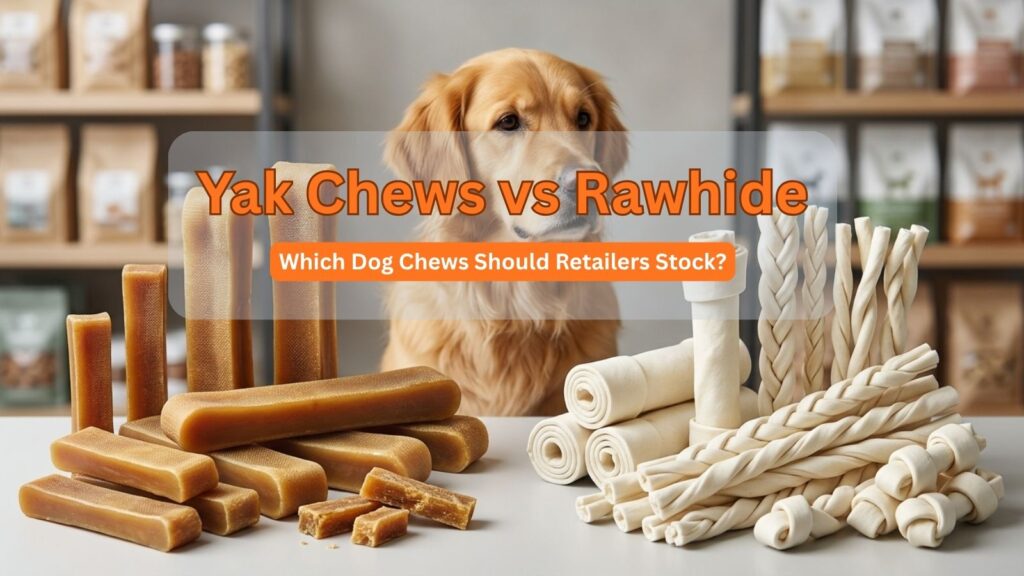
Yak chews and rawhide are two edible dog chews made from different materials and manufacturing processes, each serving a distinct role in a pet retail range. Yak chews are hard Himalayan cheese chews made from yak milk, cow milk, lime juice, and salt, while rawhide chews are manufactured from the inner split of cattle hides through soaking, liming, washing, drying, and shaping. Yak chews offer a four-ingredient, rawhide-free option for natural-focused shoppers, whereas verified rawhide provides a softer, lower-entry-price choice for value-conscious customers. Their differences extend beyond ingredients: yak chews carry tooth-fracture risks from extreme hardness, while rawhide raises choking, intestinal blockage, digestibility, and processing-contamination concerns. American Pet Products Association (APPA) data show that 65% of U.S. dog owners purchased chews in 2025, up 5% year over year, making product selection an important category decision for retailers.
This guide compares yak chews vs. rawhide across safety, digestibility, nutritional composition, chewing durability, consumer preferences, wholesale costs, retail margins, and repeat-purchase potential. It examines label data, including 52.6–74.5% crude protein in yak chews and 70–80% in rawhide, alongside ingredient counts, calorie density, processing methods, and documented product risks. Retailers will also learn how to verify FDA registration, certificates of analysis, supplier traceability, USDA APHIS import requirements, and country-of-origin labeling before placing orders. Practical range-planning advice explains how to position yak chews as a natural-category anchor, retain documented rawhide as a value tier, match chew sizes to dog size and chewing behavior, and compare landed cost, gross margin, and inventory performance before scaling purchases.
What Are Yak Chews and Rawhide Dog Chews?
Yak chews are hard, dried Himalayan cheese (chhurpi) made from yak and cow milk. Rawhide chews are dried inner hide layers from cattle, cut, rolled, or knotted into shape. Both are edible chews, but they differ in raw material, processing, texture, and import rules.
What Are Yak Chews Made Of?
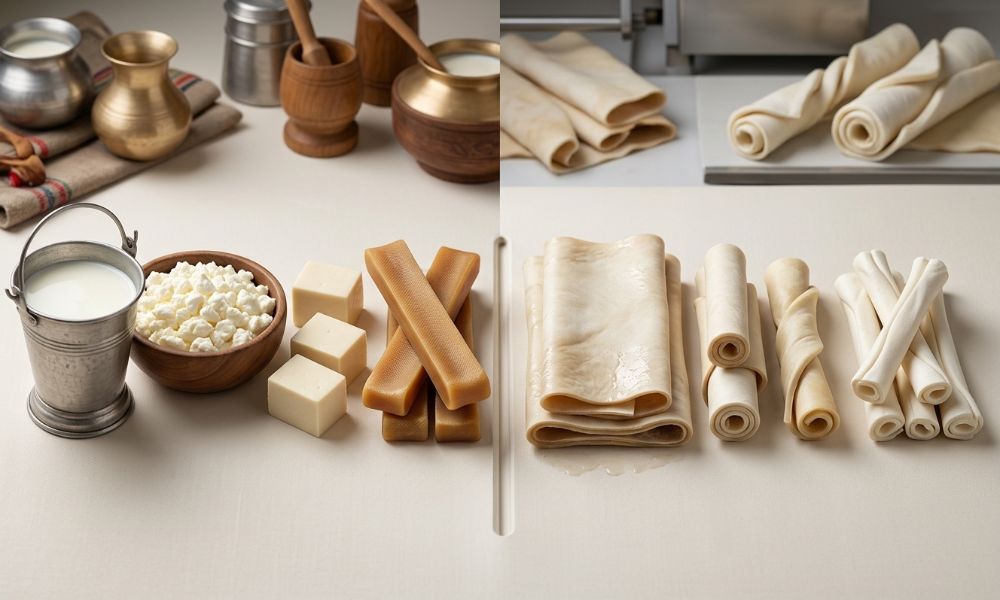
Yak chews are made of yak milk, cow milk, lime juice, and salt. Chhurpi (also spelled churpi) is the traditional hard cheese of the Himalayan highlands. Producers boil the milk, curdle it with lime juice, press the curd, cut it into pieces, and dry it for days. According to The Kathmandu Post, most Nepali chews come from the eastern hill districts of Ilam, Taplejung, and Panchthar. Retail labels cap moisture between 7% and 15%, which produces the rock-hard texture. Dogs soften the chew by gnawing. Supplier directions turn the final nub into a crunchy puff in the microwave.
How Is Traditional Rawhide Manufactured?
Traditional rawhide is manufactured from the inner split of cattle hides through soaking, liming, splitting, washing, bleaching, drying, and shaping. US Patent 9,016,241 describes soaking, depilation (hair removal, called liming when lime is used), deliming with acid, repeated washing, and swelling with acid or bleach. The outer layer becomes leather. The inner split, which holds little remaining value for leather, becomes chews. Manufacturers then dry, cut, roll, or knot the material. Flavored types add coatings, and ingredient panels list glycerine, starches, and the preservative potassium sorbate. Processing rules vary by country, so the supplier’s process file says more than the word “natural.”
What Are the Main Differences Between Yak Chews and Rawhide?
Yak chews are dairy-based, short-ingredient, and very hard. Rawhide is collagen-based, process-dependent, and softens as the dog chews. The table below compares 7 attributes that drive stocking decisions, using label data, published studies, and regulatory guidance.
| Attribute | Yak chew | Rawhide |
| Raw material | Yak and cow milk | Inner split of cattle hide |
| Ingredients | 4 (yak milk, cow milk, lime juice, salt) | 1 for plain; 8–10 for coated |
| Texture | Very hard; softens slowly | Leathery; softens with saliva |
| Digestibility evidence | Supplier labels; no feeding trial located | 50–85% digestible in vitro |
| Main hazard | Tooth fracture; large swallowed pieces | Choking, blockage, contamination |
| USDA APHIS permit | Written determination advised for dairy chews | None for plain; required for flavored or ground |
| Crude protein (label minimum) | 52.6–74.5% | 70–80% |
Yak chews carry a hardness risk. Rawhide carries an ingestion and processing risk. Every section below builds on that split.
How Do Yak Chews Compare to Rawhide in Safety and Digestibility?
Neither chew is risk-free. Rawhide carries choking, obstruction, and processing-contamination risks; yak chews carry a tooth-fracture risk from extreme hardness. Matching chew size and chewing style to the dog lowers the risk for both.
Are Yak Chews Easier for Dogs to Digest Than Rawhide?
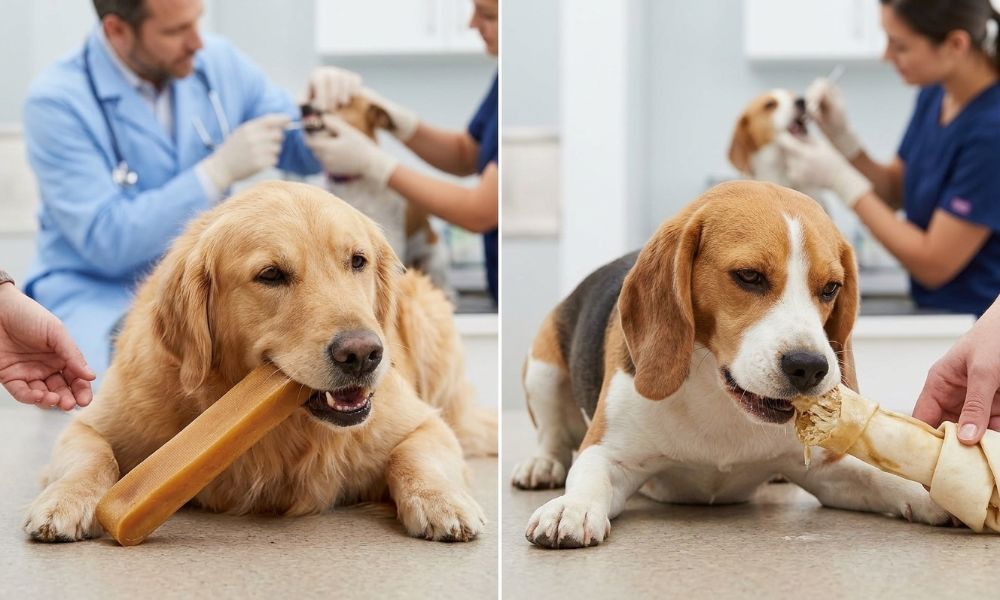
Rawhide measured only 50–85% digestible in vitro in a University of Illinois study, while yak chew digestibility rests on supplier labels and veterinary commentary, not published feeding trials. In that 2012 Journal of Animal Science study, rawhide gastric digestibility reached 7.6% at 6 hours and 41.6% at 18 hours. Yak chews contain casein, a milk protein dogs digest well, and a veterinarian cited by PetsRadar describes them as intended to be digestible. This review located no feeding trial on chhurpi chews. Ask suppliers for digestibility data.
What Are the Choking and Intestinal Blockage Risks?
Both chews carry choking and blockage risk when a dog swallows large pieces, and rawhide adds risk because it turns slippery and swells when wet. Trupanion veterinarian Dr. Sarah Nold names two main rawhide concerns: choking or intestinal blockage, and chemical or bacterial contamination. Blockage signs include vomiting, lethargy, appetite loss, and abdominal pain. Veterinarian Dr. MacMillan told PetsRadar that small swallowed yak pieces rarely cause problems, while large pieces still risk obstruction. Common mistake in chew buying: choosing a chew smaller than the dog’s mouth. Size every chew larger than the muzzle and discard small remnants.
How Do Hardness and Chewing Behavior Affect Dental Safety?
Hardness drives dental risk: chews that do not yield under a dog’s bite fracture teeth, and yak chews sit in the hard-chew group alongside antlers. A 2018 Frontiers in Veterinary Science study found maxillary fourth premolars fractured at a mean load of 1,281 newtons (±403). The authors flag higher fracture risk for dogs routinely given hard treats that do not yield at that point. A veterinary dentist writing in Veterinary Practice News lists yak cheese among hard items linked to fractures. Dr. MacMillan told PetsRadar that most dogs stay stoic after a fracture, so owners miss it. Rawhide softens with saliva, which lowers fracture risk, though VetHelpDirect notes very dry rawhide still damages teeth in small dogs.
The Veterinary Oral Health Council (VOHC) awards seals for plaque and tartar control. Its accepted list includes a rawhide category, with a soft rawhide product accepted in 2007. The list pages reviewed show no yak chew. Skip dental claims on yak chews.
Which Dogs Are Better Suited to Each Type of Chew?
Healthy adult dogs that gnaw steadily suit yak chews, steady rawhide chewers suit rawhide, and gulpers, puppies, and dogs with dental disease suit neither without supervision.
Yak chews fit these dogs:
- Adult dogs that gnaw rather than bite
- Dogs without dairy sensitivity
- Medium to giant breeds matched to a size tier
Rawhide fits these dogs:
- Dogs that chew slowly and drop pieces
- Dogs whose owners supervise and remove small remnants
- Dogs that need a softer surface than cheese
Dr. MacMillan places puppies at the highest fracture risk with yak chews. A Rover veterinary guide advises against rawhide for puppies with delicate baby teeth.
How Do Yak Chews and Rawhide Compare in Nutritional Value?
Yak chews list 52.6–74.5% crude protein and 90–105 kcal per ounce. Rawhide lists 70–80% crude protein and 79–94 kcal per ounce. Neither chew is a complete diet, and veterinary guidelines commonly cap treats at 10% of daily calories.
What Nutrients Do Yak Chews Provide?
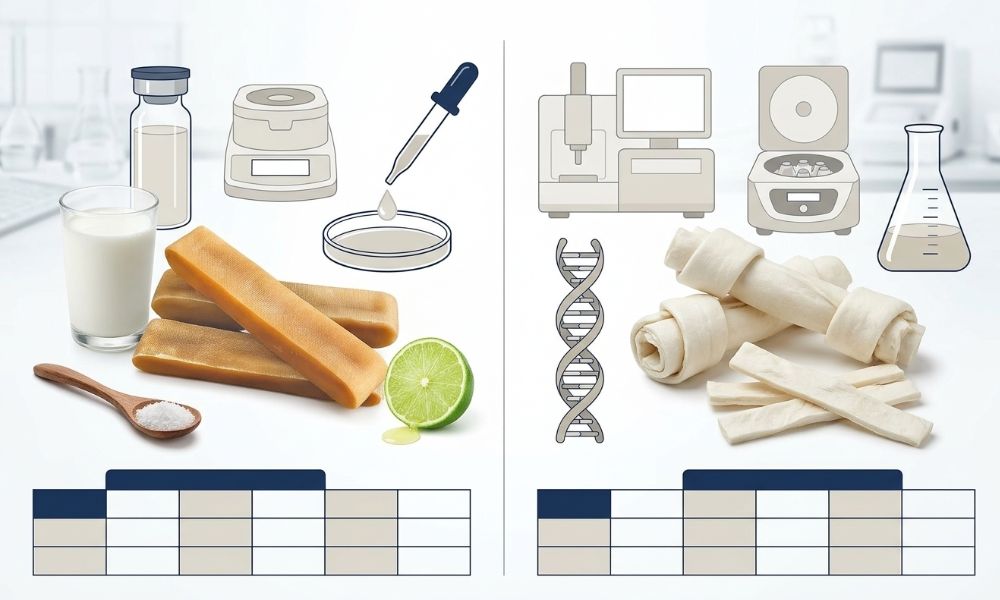
Yak chews provide casein (a complete milk protein), calcium, and minerals with very little fat. Market labels show crude protein of 52.6–74.5%, crude fat of 0.5–4.0%, and maximum moisture of 7.2–15% across 10 commercial brands. By comparison, Nepal’s January 2026 gazetted quality standard caps chhurpi moisture at 14%, requires at least 60% crude milk protein on a dry-weight basis, caps total ash at 7%, and mandates the total absence of E. coli and Salmonella. Analytical insight: a 52.6% as-fed protein level at 12% moisture equals ~59.8% dry basis, which falls slightly below Nepal’s 60% minimum standard, meaning the bottom of the label range is non-compliant. Buyers should require dry-basis protein on COAs alongside mandatory production dates and batch numbers. Ash runs 5–7% across tested lots. Compare certificate-of-analysis data against these legal thresholds rather than relying solely on retail label copy.
What Is the Nutritional Composition of Rawhide?
Rawhide is almost entirely collagen protein, with minimal fat and 14–20% moisture. Four rawhide labels list crude protein of 70–80%, crude fat of 0.5–1.5%, and maximum moisture of 14–20%. Collagen is an incomplete protein that lacks tryptophan, so high crude protein does not equal high nutritional value. Flavored rawhide adds ingredients. One label lists corn flour, dextrose, poultry digest, whey protein concentrate, and potassium sorbate. Screen coated rawhide for added starch and sugar when you serve allergic or overweight dogs.
How Do Protein, Fat, Calories, and Ingredients Compare?
Protein and fat overlap between the two chews; the real differences are protein type, ingredient count, and calorie density. The table below shows label values from 10 yak chew labels and 4 rawhide labels, as printed.
| Metric | Yak chews | Rawhide |
| Crude protein (min) | 52.6–74.5% | 70–80% |
| Crude fat (min) | 0.5–4.0% | 0.5–1.5% |
| Moisture (max) | 7.2–15% | 14–20% |
| Metabolizable energy | 3,168–3,700 kcal/kg | 2,780–3,333 kcal/kg |
| Energy per ounce | 90–105 kcal | 79–94 kcal |
| Ingredients | 4 | 1 (plain) to 10 (coated) |
Yak chews run slightly denser in calories per ounce. Rawhide runs higher in moisture and, when coated, in ingredient count.
Do Processing Methods Affect Nutritional Quality?
Yes. Heat, drying, and chemical treatment change digestibility, safety, and nutrient availability more than a crude protein figure shows. Yak chew processing relies on heating, pressing, and drying milk curd. Rawhide processing adds liming, acid swelling, and bleaching. The 2017 FDA recall shows how processing aids matter. United Pet Group recalled rawhide brands after facilities in Mexico and Colombia, plus a Brazilian supplier, used a quaternary ammonium compound. FDA states the compound is approved for cleaning food-processing equipment but not as a rawhide processing aid. Reported symptoms included reduced appetite, vomiting, and diarrhea. Request a process flow diagram and a processing-aid list from every supplier.
Which Dog Chew Offers Better Quality and Durability?
Quality follows documented process control, not product category. Yak chews deliver longer chew time per ounce when correctly sized, rawhide delivers a softer bite, and verified suppliers of either chew deliver consistent moisture, size, and lab results lot after lot.
How Long Do Yak Chews Last Compared to Rawhide?
Chew time scales with chew weight and the dog’s chewing style, and none of the sources reviewed hold an independent trial comparing yak and rawhide. Manufacturers describe yak chews as lasting hours. Customer reviews on retail pages report anything from one day to several days for the same size. Trade size sheets from leading manufacturers list 5 yak chew size tiers, ranging from 2–3 oz (small) up to 6–7 oz (king size). What most buyers overlook: duration claims are untested at shelf level. Run a 30-day in-store trial across 3 sizes, log chew times from 10 customers, and stock the tier that performs.
How Do Chew Texture and Hardness Affect Product Performance?
Hardness sets chew time, dental risk, and breakage; yak chews sit at the hard end, rawhide at the flexible end. Yak chews respond to humidity. One supplier notes that a chew softened by humid air returns to its hard texture after air drying. Hard chews also splinter at the edges. A retail yak chew label instructs owners to discard any chew that splinters, develops sharp edges, or breaks into pieces. Print that rule on shelf signage. A clear discard rule protects customers and cuts complaint volume.
What Quality Standards Should Retailers Evaluate?

Evaluate 6 standards: facility registration, certificates of analysis, moisture control, lot traceability, label accuracy, and breakage rate.
- Confirm the supplier’s FDA food facility registration and 2026 renewal
- Review lot-specific certificates of analysis for Salmonella and moisture
- Verify moisture against the label maximum
- Trace each lot code to a production date
- Compare label guaranteed analysis with independent lab results
- Track breakage at receiving
FDA’s 2026 renewal window runs October 1 through December 31. Registrations not renewed by December 31, 2026 expire, and FDA holds food from unregistered foreign facilities at the port.
How Do Natural Ingredients and Processing Methods Influence Quality?
Short ingredient lists reduce variables: yak chews list 4 ingredients, plain rawhide lists 1, and coated rawhide labels list 8–10. The coated labels reviewed include glycerine, corn starch, soy protein, sorbitol, caramel color, and potassium sorbate. Yak chews list milk, lime juice, and salt. One detail buyers skip: the name “yak chew” does not state the yak-to-cow milk ratio, and labels list both milks. Ask suppliers for the ratio. Native Nepal Dog Chew reports that ratios vary by SKU and discloses them to private label partners.
Which Dog Chews Do Pet Owners Prefer?
Pet owners are moving toward natural, short-ingredient chews while still buying rawhide for price and familiarity. APPA data shows chew purchases rising as overall treat spending falls, and 2026 market analysis attributes natural chew growth to rawhide-free demand.
Why Are Pet Owners Choosing Natural Yak Chews?
Owners choose yak chews for ingredient simplicity and a rawhide-free alternative. APPA reports 71 million U.S. dog households in 2025, a 4% increase. APPA also reports Gen Z chew purchases up 16%. According to a June 2026 Future Market Insights release, the global natural chew pet treat market grows from $0.8 billion in 2026 to $1.5 billion by 2036 at a 6.9% CAGR. The release lists rawhide-free products as a driver and long-lasting hard chews at 55.3% share. Supply confirms demand: Nepal exported 2,733 tonnes of chhurpi during the first 11 months of fiscal year 2025/26.
What Concerns Do Consumers Have About Rawhide?
Consumer concerns about rawhide center on choking, blockage, chemical processing, and unknown origin. Dr. Nold of Trupanion states that most veterinarians recommend avoiding rawhide or pressed chews. The 2017 recall tied rawhide to a processing chemical, which keeps the chemical question alive. A counterpoint exists. VOHC accepts specific rawhide chews for tartar control, and Rover’s veterinary reviewers note that some dogs gain an occupying, calming chew from rawhide. Present both views at the shelf.
How Do Ingredient Transparency and Product Origin Influence Buying Decisions?
Packs that show origin, ingredient count, and guaranteed analysis answer the questions shoppers ask first. Rawhide labels reviewed state “Product of Mexico” or “Product of South America.” Yak labels state “Made in Nepal.” U.S. Customs and Border Protection requires country-of-origin marking on imported retail packs. Nepal approved national chhurpi standards in January 2026, covering production, packaging, storage, and transport, according to The Kathmandu Post. Train staff to answer origin questions in one sentence. A documented answer builds more trust than a “natural” badge.
Which Customer Segments Prefer Yak Chews or Rawhide?
No public survey splits yak and rawhide buyers by segment, so the framework below is built from APPA trends and product attributes. APPA reports show spending down about 11% while chew purchases grew, which signals owners trading down in treats while keeping chews.
- Natural-first specialty shoppers fit yak chews
- Value-led shoppers fit entry-price rawhide from documented sources
- Gen Z owners, whose chew purchases rose 16%, fit rotating formats
- Owners of small or senior dogs fit softer chews over any hard chew
Are Yak Chews or Rawhide More Profitable for Pet Retailers?
Profit depends on landed cost, shelf price, turnover, and returns. No public wholesale price index covers either chew, so this section gives the formulas and the decision tests that apply to your own quotes.
How Do Wholesale Costs Compare?
Rawhide starts from a lower-cost raw material, while yak chews carry milk, hand processing, and freight costs. Rawhide uses the inner hide split, which holds little value for leather. The Kathmandu Post describes Nepali chews as widely popular but expensive. Freight moves the price. One Nepali exporter told the Post that a refrigerated sea container from Kolkata rose from about $5,000 to about $15,000, and air freight rose 30–40%. The Post also reports a 10% U.S. baseline tariff on Nepali goods in place since April 2025. Confirm the current rate with a customs broker. Retailers buying through a U.S. distributor avoid this variance. Direct buyers compare quotes in the Yak Chew Wholesale Guide for Pet Stores.
Which Product Offers Better Retail Margins?
Margin depends on the gap between landed cost and shelf price, not chew type; a 50% gross margin requires a landed cost equal to half the shelf price. Gross margin equals shelf price minus landed cost, divided by shelf price. Landed cost combines unit price, freight, duty, brokerage, and shrink. The table below illustrates the math at a hypothetical $12.00 shelf price. Substitute your own numbers.
| Target gross margin | Maximum landed cost | Gross profit per chew |
| 40% | $7.20 | $4.80 |
| 50% | $6.00 | $6.00 |
| 60% | $4.80 | $7.20 |
Common mistake: comparing price per piece. Piece weights range from 2 oz to 7 oz, so compare price per ounce. Pilot both chews on one bay for 90 days and compare gross margin return on inventory (GMROI), which equals gross margin dollars divided by average inventory cost.
How Do Shelf Life and Storage Requirements Affect Inventory Costs?
Shelf life sets how much inventory you hold; retail yak chew listings state anywhere from 1 to 4 years, so verify with the supplier’s stability data. Yak chews should be stored in cool, dry spaces away from sunlight, and humidity softens them. Coated rawhide labels list potassium sorbate, a preservative. Rawhide labels allow up to 20% moisture, against a 7–15% ceiling on yak labels. Rotate stock first in, first out, and keep backroom humidity controlled. Ask each supplier for a dated shelf-life claim backed by test data, not a generic number.
Which Product Has Greater Repeat-Purchase Potential?
Both chews are consumables, and repeat purchase follows chew time, dog satisfaction, and safety experience. APPA found 65% of dog owners bought chews in 2025. Pet Food Processing reports 17% of consumers buy treats by subscription. No public data compares repeat rates between yak and rawhide. Three levers lift repeat in either chew: a size ladder that lets owners move up a tier, 3-packs priced below single units, and a reorder prompt at the register.
How Do Packaging and Product Sizes Influence Average Order Value?
Size tiers and multipacks move shoppers from one chew to a bundle, which raises average order value. Trade sheets sell yak chews in 5 size tiers, packed 10 pieces per case. Retail listings sell 2-packs and 3-packs. Rawhide sells by bag count; one small flavored format packs about 30 chews in 8.6 oz. Print weight in ounces and grams, country of origin, and a resealable closure. The Yak Chew Packaging for USA Export guide covers labeling and shelf life for U.S. buyers.
What Should Retailers Consider When Sourcing Yak Chews and Rawhide?
Evaluate documentation first: facility registration, lab results, ingredient traceability, import compliance, and supply consistency decide whether a chew is safe to sell and reliable to restock.
What Quality Certifications and Safety Documents Should Suppliers Provide?
Suppliers provide 7 documents: FDA registration confirmation, a written food safety plan, certificates of analysis, a specification sheet, an ingredient statement, an audit certificate, and shipment compliance records. Certificates of analysis cover Salmonella, Enterobacteriaceae, and moisture, with lot codes that match the packing list. An audit certificate from a Global Food Safety Initiative (GFSI) benchmarked scheme supports supplier approval. It does not replace a written hazard analysis. Rawhide suppliers add 2 more documents: hide origin and a processing-aid list.
How Can Retailers Verify Ingredient Sourcing and Manufacturing Standards?
Verify through 4 checks: traceability records, independent testing, facility review, and sample-to-specification comparison. For yak chews, request the milk collection center and collection date for each lot. For rawhide, request the country of hide origin and every processing aid, because the 2017 recall traced to specific plants. Send the first lot to an independent laboratory for Salmonella and moisture. Search FDA warning letters and import alerts under the supplier’s name. FDA Import Alert 71-04 covers animal food with pathogenic Salmonella. Review the facility by live video or a third-party audit.
What Import and Labeling Requirements Apply to Dog Chews?
FDA classifies dog chews as animal food, so importers must meet facility registration, Prior Notice, the Foreign Supplier Verification Program (FSVP), and labeling rules, while USDA APHIS adds permit rules for animal-derived chews. The FSVP is the FDA rule requiring each U.S. importer to verify foreign suppliers in writing. Retailers buying from a U.S. distributor inherit that distributor’s compliance. Retailers importing directly carry the duties themselves.
FDA states a USDA APHIS Veterinary Services permit is required for dairy-derived chews from FMD-affected regions like Nepal. Guideline 1119 exempts only plain, unground, unflavored, unbasted, uncolored rawhide (and notes pork hides require a permit). Buyers should run every SKU through the APHIS VS Permitting Assistant. Exporters attribute the EU import restriction to FMD across all 77 districts and lumpy skin disease, contrasting it with authorized origins like India and noting estimated losses of up to Rs 10 billion in trade potential. However, U.S., Canadian, UK, and Japanese wholesale buyers can successfully import Nepali chews by meeting their respective customs and APHIS-equivalent veterinary requirements.
Labels require a statement of identity, net quantity, ingredient list, and manufacturer name and address under 21 CFR Part 501. Dental or health claims convert a chew into an unapproved drug. Read FDA Requirements for Importing Pet Treats before your first purchase order.
How Can Retailers Evaluate Supplier Reliability and Supply Consistency?
Evaluate reliability by lead-time history, lot-to-lot consistency, stated capacity, and speed of documentation replies. Test 3 consecutive lots for size, weight, and moisture. Hold safety stock that covers one full freight cycle, since freight costs moved sharply in 2026. Common mistake: judging a supplier on the sample alone. A sample shows the best piece, not the average one. Compare lot records instead. The How to Choose a Reliable Yak Chew Manufacturer guide lists further supplier checks.
How Should Retailers Build a Balanced Dog Chew Product Range?
A balanced range holds 3 chew tiers: a natural hard chew (yak), a softer or highly digestible chew, and a value tier, each sized for small, medium, and large dogs.
Should Specialty Pet Stores Prioritize Yak Chews?
Yes. Specialty stores prioritize yak chews as the anchor natural chew because the format matches natural-focused shoppers and supports clear safety guidance. The condition is staff training. Train staff on fracture risk, size selection, and the discard rule. Pair every yak display with a softer alternative for puppies and seniors. Dr. MacMillan advises limiting yak chews to once or twice a week for dogs that receive them. Put that frequency on the shelf card.
When Does Rawhide Still Make Sense as a Retail Product?
Rawhide makes sense for value-led shelves and steady chewers, when the supplier documents hide origin and processing aids. VOHC accepts specific rawhide products, so verified rawhide has a documented place. APPA data indicates treat spending dropped about 11% year over year while purchase frequency rose, signaling price-led traffic. Choose plain or lightly coated rawhide, size it to the dog, and keep supervision copy on the pack. Drop any rawhide supplier that cannot name its processing aids.
Which Dog Sizes and Chewing Preferences Should Retailers Target?
Target 3 dog-size bands and 3 chewing styles. One rawhide label sizes chews by dog weight: under 10 lb, 11–25 lb, and 26–50 lb. Yak chews run in 5 tiers, from small to extra-large and above. Match them by style:
- Gnawers take medium to extra-large yak chews
- Power chewers take supervised, larger-format chews, and some need a non-edible toy instead
- Gulpers need larger formats, close supervision, or training rewards in place of chews
How Can Retailers Merchandise Yak Chews Alongside Alternative Chews?
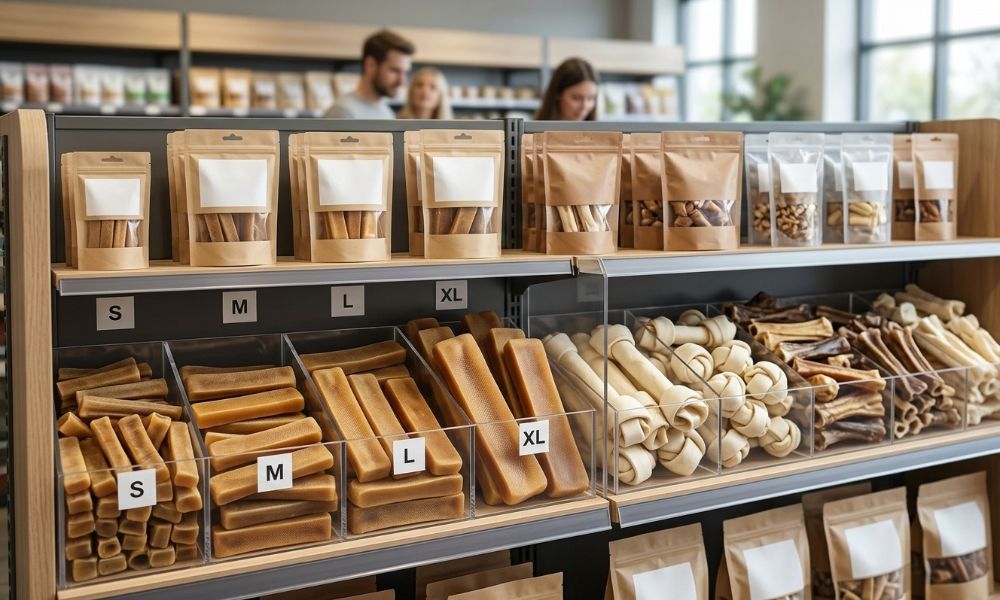
Merchandise by texture and dog size, not by brand: group hard chews, soft chews, and training treats in separate bays with size cues. Add a shelf talker with 3 rules: supervise, size up, and discard small pieces. Display price per ounce to make tiers comparable. Show the microwave puff for the final nub. Supplier directions range from 30 to 90 seconds, followed by cooling, so match the instruction on each pack. Stores planning an own-brand line compare sourcing models in Private Label vs White Label vs Wholesale Dog Chews.
How Can Native Nepal Dog Chew Help Retailers Source Yak Chews?
Native Nepal Dog Chew is a Nepal-based yak chew manufacturer and exporter that supplies wholesale and private label Himalayan yak cheese chews with export documentation support.
Why Should Retailers Consider Nepalese Himalayan Yak Chews?
Nepal is the established origin of hard yak cheese chews, with 2,733 tonnes exported during the first 11 months of fiscal year 2025/26 and roughly three-fourths shipped to the United States. The Kathmandu Post reports that Native Nepali Agro Suppliers exported about 100 tonnes in that fiscal year, up from about 80 the year before. According to company statements, Native Nepal Dog Chew chews contain 99% yak and cow milk plus lime juice and salt. The company states that it sources milk from 1,000+ farmers and 50+ micro dairies, maintains a monthly production capacity of 50,000 kg, and offers 5 size tiers from small to king. Product formats include Dog Chew Bars, nuggets, and puffed versions. Native Nepal Dog Chew also claims FDA registration, ISO 9001, HACCP, GMP certification, and a Nepal Department of Food Technology and Quality Control (DFTQC) license on its website. Verify each document before ordering, as this guide advises for every supplier.
What Should Buyers Look for When Choosing a Yak Chew Wholesale Supplier?
Look for key wholesale signals: verifiable FDA registration, lot-level certificates of analysis, a disclosed milk ratio, and transparent capacity. For example, Native Nepal Dog Chew supports wholesale buyers with an accessible 100 kg Minimum Order Quantity (MOQ) and reliable 3–6 week production lead times. Request all six in writing before the first purchase order. Ask for a size-graded sample set and compare 3 pieces per tier against the specification sheet. Suppliers that answer within days, not weeks, signal the same behavior during a shipment problem.
Next step for retailers
Request the Native Nepal Dog Chew documentation set (FDA registration confirmation, certificate of analysis, and specification sheet) with a size-graded sample. Learn more about Wholesale Yak Chew Supply or Contact Us.
Native Nepal Dog Chew, Chaya Center, Thamel, Kathmandu, Nepal.
What Are the Key Takeaways When Comparing Yak Chews and Rawhide?
In the yak chews vs rawhide comparison, yak chews win on ingredient clarity and natural positioning, rawhide wins on softness and entry price, and documentation decides quality for both.
- Anchor on yak chews. The 4-ingredient label and 65% chew-purchase rate (APPA, 2025) support a natural anchor range.
- Respect hardness. Yak chews carry tooth-fracture risk; sell with size, supervision, and discard guidance.
- Treat rawhide as a documented value tier. Rawhide is 50–85% digestible in vitro, and the 2017 recall shows why processing aids matter.
- Compare labels, not claims. Yak labels show 52.6–74.5% crude protein; rawhide labels show 70–80%, mostly collagen.
- Calculate landed cost. A 50% margin at a $12.00 shelf price needs a landed cost of $6.00 or less.
- Verify compliance. Require FDA registration, certificates of analysis, and APHIS clearance for dairy and flavored chews.
- Match sizes to dogs. Stock 3 dog-size bands and 5 yak tiers.
- Pilot before scaling. Test chew time, breakage, and repeat rate over 90 days.