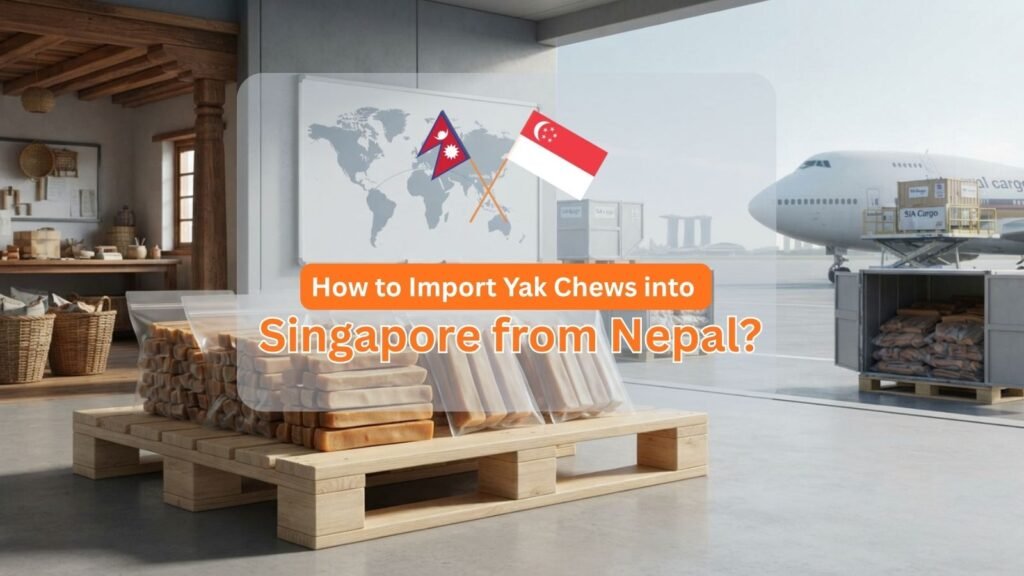
Himalayan yak chews are hardened dairy-based dog chews, commonly known as chhurpi, manufactured in Nepal from yak milk or yak-cow milk blends through cooking, pressing, and drying. Importing these animal-derived pet products into Singapore is a regulated commercial trade process involving Nepal’s Department of Livestock Services (DLS) for veterinary health certification, the Department of Food Technology and Quality Control (DFTQC) for facility registration and food safety, Singapore’s Animal & Veterinary Service (AVS), and Singapore Customs. Singapore importers must establish a valid UEN and TradeNet access, source from a DFTQC-registered manufacturer, obtain a DLS Veterinary Health Certificate (VHC) and a batch-level Certificate of Analysis (COA), and secure the required AVS import permit before shipment arrival.
The Nepal-to-Singapore yak chew import process covers product classification, AVS and TradeNet permit requirements, veterinary certification, HS code selection, English-language labelling, food-grade and moisture-resistant packaging, freight arrangements, customs clearance, GST, and shipment documentation. Retail-packed Himalayan yak chews are generally classified under HS 2309.10.00, with 0% MFN customs duty, while Singapore GST applies to the taxable import value under the applicable rules. Air freight from Kathmandu to Singapore can provide faster delivery, while sea freight supports larger wholesale consignments. Successful importation therefore depends on aligning the Nepal supplier’s DFTQC documentation, product specifications, packaging, and shipment records with Singapore’s AVS and Customs requirements before the cargo leaves Nepal.
Can You Import Yak Chews into Singapore?
Yes, Singapore permits the commercial import of Himalayan yak chews from Nepal, provided importers satisfy 3 regulatory conditions: obtaining an AVS import permit via TradeNet before shipment arrival, presenting a Veterinary Health Certificate (VHC) from Nepal’s Department of Livestock Services (DLS), which is the competent authority for issuing veterinary and quarantine export certificates for animal-derived products including chhurpi, and ensuring the product complies with Singapore’s pet food safety standards under the Animals and Birds Act 1965 and the Animals and Birds (Importation) Order.
Himalayan yak chews, commercially known as chhurpi dog chews, are a processed dairy-derived pet product made from hardened yak milk, lime juice, and salt. Singapore classifies them as animal-derived pet food, placing every commercial import under AVS control. Singapore-registered importers holding a valid Unique Entity Number (UEN) and an activated Singapore Customs account are eligible to import commercially.
Nepal exporters obtain DLS export clearance and a VHC for each shipment. AVS evaluates this certificate as the primary document in the TradeNet permit review.
What Is the Yak Chew Import Process into Singapore?
The import process runs through sequential stages: supplier selection and verification in Nepal, document preparation and pre-shipment compliance confirmation, freight booking and Singapore import declaration via TradeNet, and post-CCP customs clearance and cargo receipt. Each stage gates the next. Booking freight before verifying supplier credentials and documents is the single most consistent cause of first-shipment delays and clearance holds.
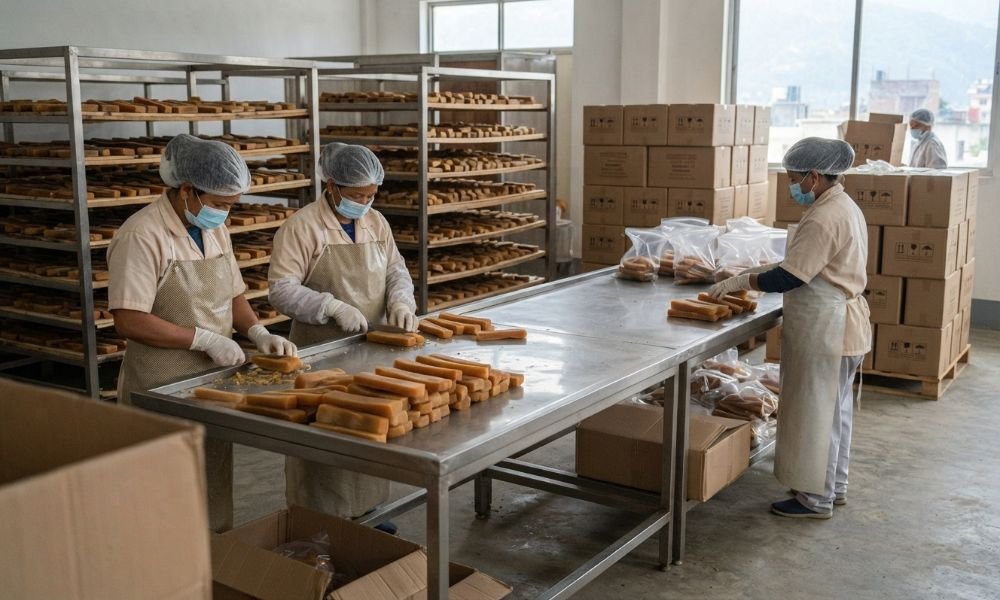
Select a Compliant Supplier in Nepal
Supplier compliance in Nepal directly determines whether your shipment clears Singapore’s border controls. A compliant Himalayan yak chew manufacturer holds and maintains 5 specific credentials:
- DFTQC registration: The Department of Food Technology and Quality Control registers food manufacturers under Nepal’s Food Act, 2023 BS (1966 AD) and the Food Hygiene and Quality Act 2024; only registered manufacturers receive official export health certificates
- HACCP certification: Hazard Analysis and Critical Control Points certification issued by a recognized third-party body confirms systematic food safety management
- GMP documentation: Good Manufacturing Practice records with facility inspection history demonstrate operational hygiene standards
- Food manufacturing licence: issued by the District Administration Office in the manufacturer’s province; in Kathmandu Valley, this is processed through the Kathmandu Metropolitan City Office
- Product batch testing records: microbiological and chemical test results covering moisture, Salmonella, E. coli, and heavy metals (lead, cadmium, mercury)
Request the supplier’s DFTQC registration number and verify it directly with DFTQC before placing any order. Unregistered manufacturers cannot issue DFTQC export health certificates, a document AVS requires for commercial clearance in Singapore.
Confirm Product Compliance and Prepare Documents
Before booking freight, verify that the specific product batch meets Singapore’s import standards. Prepare all 7 required documents before cargo departs Nepal:
- Commercial invoice (product description, HS code, quantity, unit price, total value in USD, Incoterms)
- Packing list (carton count, gross weight, net weight, dimensions)
- Certificate of Origin from the Federation of Nepalese Chambers of Commerce and Industry (FNCCI) or Nepal Chamber of Commerce
- DFTQC Export Health Certificate (issued per shipment, not reusable across consignments)
- Bill of lading (sea freight) or air waybill (air freight)
- ISO/IEC 17025-accredited laboratory test report covering moisture, microbiological counts, and heavy metals
- English-language retail label compliant with AVS pet food labelling requirements
Documents 1 through 5, alongside a Manufacturer’s Non-Meat Declaration, are mandatory for every commercial shipment. Documents 6 and 7 reduce the probability of AVS physical inspection and support a faster CCP approval cycle.
Arrange Shipping and Singapore Import Declaration
Freight options from Nepal to Singapore involve 2 routes: air freight via Tribhuvan International Airport (KTM) in Kathmandu, with direct or one-stop service to Singapore Changi Airport (SIN); and sea freight via Kolkata Port (INCCU), reached by road from Kathmandu across 1,100km, then onward by vessel to Singapore’s Tanjong Pagar or Pasir Panjang container terminals.
The Singapore importer, or their appointed freight forwarder, submits the import declaration through the TradeNet system before or upon cargo arrival. TradeNet is Singapore Customs’ mandatory electronic import platform. The declaration triggers automated risk assessment within Singapore Customs’ system. A complete submission with all 7 documents processes to CCP approval in 1 to 3 working days. An incomplete submission triggers a “Route for Query” status in TradeNet and requires additional supporting documentation before approval proceeds.
Complete Clearance and Receive the Shipment
After CCP approval, the freight forwarder presents the permit number to the cargo terminal operator for release. For air freight, cargo is collected from the Singapore Changi Airport Cargo terminal. For sea freight, cargo is released from the PSA terminal after port dues and the Delivery Order (DO) fee are settled.
On receipt, conduct a physical goods check: verify carton count against the packing list, inspect packaging integrity for damage or moisture exposure, and confirm lot numbers match declared documentation. Retain all customs documents, commercial invoice, packing list, CCP, bill of lading, and health certificate, for a minimum of 5 years. Singapore Customs requires importers to maintain complete import records available for audit.
How Are Yak Chews Classified for Singapore Import?
Himalayan yak chews are classified under HS code 2309.10.00, Dog or cat food, put up for retail sale, under Singapore’s ASEAN Harmonised Tariff Nomenclature (AHTN), carrying a Most Favoured Nation (MFN) import duty of 0% and full AVS control as an animal-derived pet product.
Product Classification and HS Code Considerations
The table below shows the 3 HS codes relevant to Himalayan yak chew imports into Singapore.
| HS Code | Description | MFN Duty | AVS Control |
| 2309.10.00 | Dog or cat food, put up for retail sale | 0% | Yes |
| 2309.90.90 | Other animal feeding preparations | 0% | Yes |
| 0406.90.90 | Other cheese and curd (bulk, unprocessed) | 0% | Yes |
Retail-packed yak chews in consumer-facing packaging are declared under 2309.10.00. Bulk yak chews not in retail presentation fall under 2309.90.90. HS code misclassification is 1 of the 3 most common import errors on the Nepal–Singapore trade lane and must be corrected at the TradeNet permit application stage, not at the port.
Animal-Derived Pet Product Requirements
Chhurpi-based yak chews are dairy-derived, which places them under AVS import control regardless of HS chapter. Every shipment requires 3 elements: an AVS import permit via TradeNet, a DLS-endorsed VHC certifying disease-free status and facility compliance, and a species-of-origin declaration specifying 100% yak milk or a bovine-yak blend. AVS assesses dairy-derived imports differently from meat-derived products, and importers state the dairy origin explicitly in both the permit application and the product label.
Which Singapore Authorities Regulate Yak Chew Imports?
2 Singapore government authorities regulate Himalayan yak chew imports: AVS under NParks controls animal-derived pet products and issues import permits, and Singapore Customs administers TradeNet declarations, collects GST, and manages customs clearance. Both agencies are involved in every commercial yak chew import transaction.
Animal and Veterinary Service Requirements
AVS, a cluster of Singapore’s National Parks Board (NParks), operates as the competent authority for animal products and animal-derived pet food under the Animals and Birds Act 1965 and the Animals and Birds (Importation) Order. AVS requirements for each yak chew import are: an approved TradeNet permit before shipment arrival, a DLS VHC certifying disease-free status and animal health compliance, and product conformance to AVS import conditions, including prohibited ingredient absence and label compliance. AVS conducts risk-based physical inspection of animal-derived pet products at Singapore’s ports.
Singapore Customs Requirements
Singapore Customs administers TradeNet, the national single-window trade portal for all import declarations. Customs collects GST at 9% on the total CIF value of all commercial consignments declared via TradeNet, issues customs permits for controlled and non-controlled goods, and enforces import regulations under the Customs Act. The TradeNet permit number is mandatory on all cargo documentation at the point of customs clearance.
What Importer Requirements Apply to Yak Chews?
Singapore importers of Himalayan yak chews must hold a valid UEN, maintain an activated Singapore Customs account with TradeNet access, and submit declarations either directly or through a licensed customs declaring agent. These 3 prerequisites are mandatory before any commercial import transaction.
UEN, Customs Account, and Import Permissions
A UEN is issued by Singapore’s Accounting and Corporate Regulatory Authority (ACRA) to all registered business entities. Importers then activate a Singapore Customs account and register as a TradeNet user, a process Singapore Customs completes within four working hours to three working days, after which importers must complete AVS pet food importer registration via GoBusiness prior to submitting TradeNet permit applications. AVS-controlled goods permit applications additionally require completion of AVS’s importer registration for pet food importation. The complete setup sequence is: ACRA registration for UEN → Singapore Customs account activation → AVS importer registration.
Declaring Agents and Commercial Importers
Importers without in-house TradeNet expertise appoint a licensed customs declaring agent, a registered freight forwarder, or a customs broker to file declarations on their behalf. Declaring agent fees range from SGD 50 to SGD 200 per declaration. Importers managing 3 or more shipments per month establish direct TradeNet access to eliminate recurring agent fees. Wholesale importers distributing to Singapore pet retailers register as commercial importers and maintain import records for a minimum of 3 years for AVS audit purposes.
What Documents Are Required to Import Yak Chews?
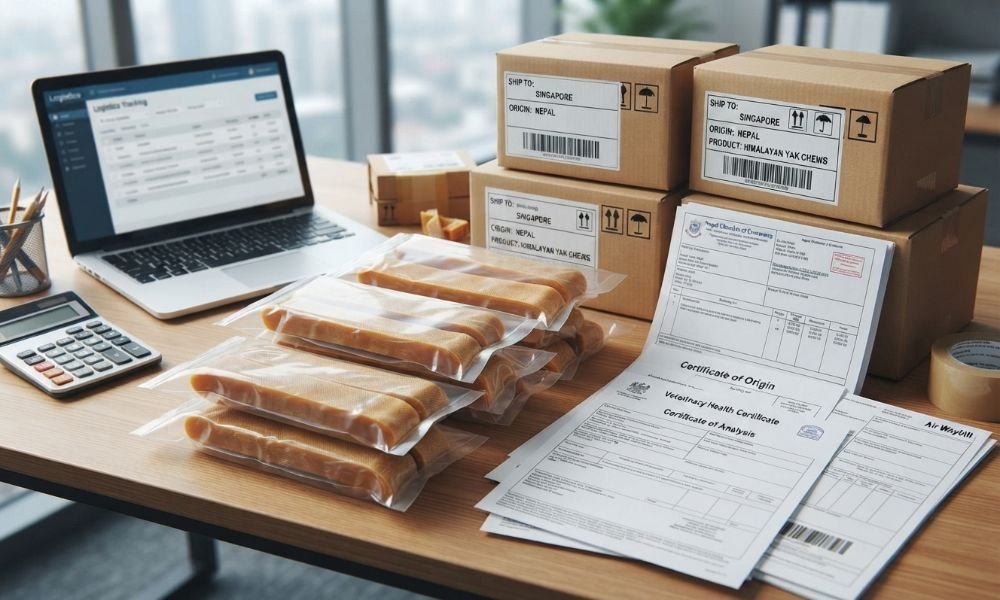
Importing Himalayan yak chews into Singapore requires 7 documents: commercial invoice, packing list, Bill of Lading or Airway Bill, Certificate of Origin, DLS Veterinary Health Certificate, batch-level Certificate of Analysis, and the TradeNet import permit approval. Missing or incorrect documentation is the primary cause of customs clearance delays on the Nepal–Singapore trade lane.
Commercial, Shipping, and Product Documents
The following table shows the 5 standard commercial and shipping documents for each yak chew import shipment.
| Document | Purpose | Issued By |
| Commercial Invoice | Declares product value, quantity, HS code, and Incoterms | Nepal exporter |
| Packing List | Itemises carton count, unit weight, and total volume | Nepal exporter |
| Bill of Lading / Airway Bill | Cargo transport contract and shipment receipt | Freight carrier |
| Certificate of Origin | Confirms Nepal as country of manufacture | Nepal Chamber of Commerce |
| Certificate of Analysis (COA) | Confirms composition, microbial results, and safety testing per lot | Manufacturer or accredited lab |
Singapore Customs uses the commercial invoice value as the basis for GST calculation. The Certificate of Origin is mandatory for Singapore Customs’ risk assessment.
Health Certificates and Other Regulatory Certificates
The DLS Veterinary Health Certificate is the primary document AVS evaluates for permit issuance. The VHC must state: product name, species of origin with percentage composition where applicable, manufacturing facility name and DFTQC registration number, a certification statement confirming safety and disease-free status, and the authorised DLS veterinary officer’s signature and official stamp. Supplementary HACCP, ISO 22000, or FSSC 22000 certificates from the Nepal manufacturer reduce AVS inspection probability; these are not mandatory but materially strengthen the import compliance profile.
What Product Safety Requirements Apply to Yak Chews?
Himalayan yak chews imported into Singapore must satisfy 4 product safety requirements: sourcing from disease-free livestock, hygiene compliance through manufacturing, absence of prohibited additives and contaminants, and full batch-level traceability from raw material to finished product. AVS enforces these through permit conditions and risk-based inspection.
Animal-Origin, Hygiene, and Safety Requirements
Yak chews are made from yak milk chhurpi through cooking, pressing, and smoke-drying, a process that reduces water activity to below 0.60, effectively halting all microbial proliferation; most pathogenic bacteria require water activity above 0.91 to grow, while halophilic yeasts and xerophilic molds are inhibited at or below 0.60. Singapore’s import safety standards address 3 categories: microbial limits (Salmonella absent per 25 g; E. coli and total viable count within accepted ranges), heavy metal limits for lead, cadmium, mercury, and arsenic, and prohibited substance compliance; ethoxyquin and unapproved colourants are prohibited. Yak chews using only lime juice and salt as processing agents are inherently compliant with the prohibited substance requirement.
Inspection, Testing, and Traceability
AVS applies elevated inspection probability to 3 categories: first-time importers, new product types not previously imported under the importer’s account, and shipments with incomplete compliance histories. When selected, the importer presents the full document set, VHC, COA, commercial invoice, and TradeNet permit, to AVS officers, who verify product identity, packaging integrity, and label compliance against the permit declaration. Importers maintain traceability records linking each import lot to its Nepal manufacturing batch, export date, and Singapore distribution records for 3 years.
What Packaging and Labelling Requirements Apply?
Himalayan yak chews imported into Singapore must use tamper-evident, food-grade packaging preventing moisture ingress, and must carry English-language labels disclosing product name, species of origin, ingredient list, net weight, manufacturer details, and country of origin. Non-compliant labels result in permit rejection or port-level holds.
Packaging and Contamination Prevention
Retail packaging for Singapore-bound yak chews meets 4 standards: food-grade primary material (heat-sealed polyethylene or multilayer laminate) complying with Singapore’s food contact material requirements; tamper-evident seals on each retail unit; moisture barrier maintaining product moisture below 14% under Singapore’s ambient humidity of 80 to 90%; and corrugated outer cartons labelled with lot number, production date, product description, and country of origin. Damaged or moisture-compromised packaging fails AVS visual inspection at Singapore ports.
Product Labelling and Information Requirements
Each retail unit of imported Himalayan yak chews carries 6 mandatory English-language label elements:
- Product name: “Himalayan Yak Chew,” “Chhurpi Dog Chew,” or equivalent descriptive name
- Ingredient list: in descending order by weight; typical declaration: “Yak milk, cow milk, lime juice, salt” or “100% yak milk chhurpi”
- Species of origin: identifying the animal source of the primary ingredient
- Net weight: in grams (g) or kilograms (kg) in metric units
- Manufacturer name and address: Nepal facility name, city, and country
- Country of origin: “Made in Nepal” or “Product of Nepal” on both retail unit and outer carton
Best-before date labelling is strongly recommended. Singapore retailers and e-commerce platforms increasingly require it as a product intake standard, regardless of the product’s low water activity.
How Do You Ship Yak Chews to Singapore?
Himalayan yak chews are shipped from Nepal to Singapore via 2 routes: air freight through Tribhuvan International Airport (Kathmandu) to Changi International Airport, or sea freight routed through Kolkata or Chennai to the Port of Singapore (PSA terminals). Air freight delivers in 4 to 7 transit days; sea freight takes 18 to 28 transit days.
Freight, Transport, and Shipment Preparation
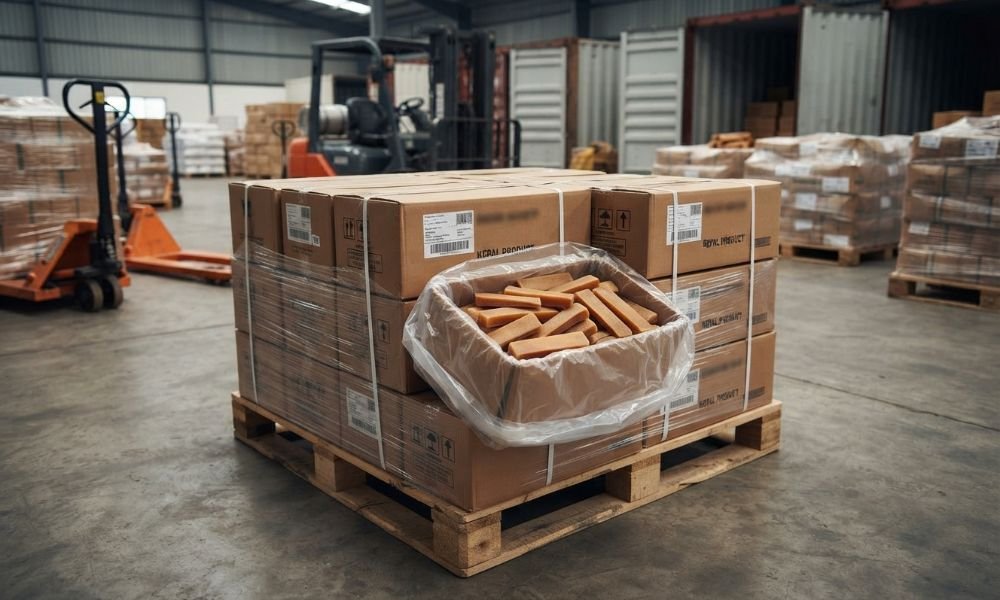
The Nepal exporter prepares the full document set and books freight through a licensed forwarder. The export process involves 3 steps: Nepal Customs export clearance (declaring under HS 2309.10, attaching VHC and commercial invoice), freight booking (LCL sea for shipments under 5,000 kg; FCL for larger wholesale volumes), and transmission of the Air Waybill or Bill of Lading to the Singapore importer. Air freight from Kathmandu costs approximately USD 3.50 to USD 6.50 per kilogram, including handling. Sea freight via LCL from Kolkata or Chennai costs approximately USD 80 to USD 180 per CBM, excluding origin terminal charges.
Import Clearance and Final Delivery
The Singapore importer submits the TradeNet import declaration before cargo arrival at Changi Airport or PSA terminals, referencing the AVS-approved permit number. Inspection-free air freight releases are completed within 1 to 4 hours of cargo arrival. Sea freight at PSA terminals clears within 1 to 2 business days after vessel arrival and documentation submission. AVS-selected shipments are held at the customs examination area until inspection clearance is confirmed. After release, the freight forwarder coordinates delivery to the importer’s Singapore warehouse.
What GST, Duties, and Other Import Costs Apply?
Himalayan yak chews carry 0% customs duty under Singapore’s MFN tariff schedule and attract 9% Goods and Services Tax (GST) on the CIF value of each shipment, as at 2026. Additional costs include freight charges, declaring agent fees, the TradeNet permit fee, port handling fees, and applicable AVS inspection charges.
GST and Customs Duty Considerations
The following table presents Singapore’s import cost structure for Himalayan yak chews.
| Cost Element | Rate / Amount |
| Customs duty (HS 2309.10.00) | 0% |
| GST on CIF value | 9% |
| GST on commercial imports | 9% on total CIF value (Cost + Insurance + Freight) for all TradeNet declarations |
GST is calculated on Cost + Insurance + Freight. A shipment with a product value of SGD 5,000 and freight cost of SGD 800 incurs GST of SGD 522 (9% × SGD 5,800). Importers using FOB Incoterms arrange their own freight and insurance, which gives them direct control over these cost components, but Singapore Customs still calculates GST on the full CIF value (cost + insurance + freight) regardless of Incoterms. FOB does not reduce the customs valuation base for GST purposes.
Freight, Clearance, Inspection, and Other Costs
5 cost categories apply beyond the product purchase price:
- Freight: USD 3.50 to USD 6.50 per kg (air) or USD 80 to USD 180 per CBM (sea LCL)
- Declaring agent fees: SGD 50 to SGD 200 per declaration
- TradeNet permit fee: approximately SGD 3.19 per permit application (comprising SGD 0.90 statutory fee and SGD 2.29 in processing and messaging fees, as at 2026)
- PSA terminal handling fees: SGD 80 to SGD 300 per Bill of Lading for sea freight
- AVS inspection fee: Variable per consignment; importers confirm current schedules on the AVS/NParks website
How Long Does Yak Chew Importation into Singapore Take?
The end-to-end timeline for importing Himalayan yak chews from Nepal into Singapore spans 10 to 47 days across 4 stages: pre-shipment document preparation (3 to 10 days), AVS TradeNet permit approval (2 to 5 business days), freight transit (4 to 28 days), and Singapore customs clearance (1 to 4 business days). Air freight with complete documentation consistently achieves the lower end of the range.
Typical Import Stages and Timing
| Stage | Air Freight | Sea Freight |
| Document preparation and permit application | 3 to 10 days | 3 to 10 days |
| AVS TradeNet permit approval | 2 to 5 business days | 2 to 5 business days |
| Freight transit | 4 to 7 days | 18 to 28 days |
| Singapore customs clearance | 1 to 2 business days | 2 to 4 business days |
| Total estimated timeline | 10 to 25 days | 25 to 47 days |
Repeat importers with established AVS compliance profiles and organised document workflows consistently achieve the lower end of each stage range.
Causes of Regulatory and Customs Delays
4 factors most commonly extend the import timeline:
- Incomplete or incorrect VHC: A missing DLS stamp, incorrect facility registration number, or species-of-origin discrepancy between the VHC and product label triggers permit rejection; DLS re-issuance from Nepal adds 5 to 15 days
- First-time importer inspection: AVS selects a higher percentage of first-shipment consignments for physical inspection, adding 2 to 5 business days at PSA
- Labelling non-compliance: Labels in Nepali only, or missing the “Made in Nepal” declaration, trigger port-level holds pending re-labelling approval
- TradeNet declaration errors: Incorrect product quantity, wrong unit of measure, or permit number transposition requires re-submission, adding 1 to 3 days
What Common Compliance Problems Can Delay Yak Chew Imports?
The 4 most common compliance problems delaying Himalayan yak chew imports into Singapore are HS code misclassification, Veterinary Health Certificate errors, English-language labelling failures, and COA-to-ingredient-list discrepancies. Each triggers either permit rejection at AVS review or a physical hold at the Singapore port of entry.
Classification, Documentation, and Declaration Errors
3 classification and documentation errors generate most import delays:
- HS code misclassification: Declaring retail yak chews under Chapter 4 (dairy, HS 0406) instead of Chapter 23 (pet food, HS 2309.10) mismatches the declared product type with the AVS permit category, requiring a full permit re-application
- Incomplete TradeNet permit application: Missing the DLS VHC reference number, incorrect product quantity, or wrong unit of measure extends AVS permit approval by 3 to 7 days
- Species mismatch: The VHC states “100% yak milk” while the product label reads “yak and cow milk blend”; AVS withholds the permit pending written clarification from the Nepal exporter, adding 5 to 10 days
Product, Packaging, and Shipment Compliance Issues
4 product and packaging failures arise regularly on the Nepal–Singapore trade lane:
- Nepali-only labelling: Singapore requires English as the primary label language; Nepali-only labels require in-country re-labelling or shipment rejection
- Missing country-of-origin declaration: “Made in Nepal” is mandatory; products manufactured for other markets without this statement require re-labelling before Customs clearance
- Non-batch-specific COA: A COA covering a different production lot than the shipped batch is invalid; AVS accepts only the COA corresponding to the specific production lot declared in the permit
- Packaging integrity failure: Outer cartons damaged in transit and inner packaging showing moisture ingress fail AVS visual inspection; the affected shipment portion is held pending re-inspection or destruction at the importer’s cost
What Should First-Time and Wholesale Yak Chew Importers Know?
First-time importers reduce compliance risk by importing a 50 to 100 kg trial shipment via air freight, ensuring all 7 required documents are ready before permit application, and selecting a Nepal supplier with active DFTQC registration and documented Singapore export experience. Wholesale importers build efficiency through direct TradeNet access, FOB Incoterms, and standardised product specifications across repeat purchase orders.
First-Shipment Considerations
First-time importers face 3 elevated compliance risks: higher AVS inspection probability for initial commercial consignments; a four-working-hour delay if no supporting documents are required, or up to three working days if complete supporting documents must be submitted for TradeNet account activation (initiated before, not after, placing the purchase order); and a 30-day document coordination window needed with the Nepal supplier for correct VHC, COA, and Certificate of Origin preparation. Selecting a Nepal exporter with prior DLS VHC issuances specifically for Singapore-bound shipments eliminates most first-shipment documentation errors.
Commercial and Repeat-Import Considerations
Wholesale importers establish 4 practices that reduce per-shipment cost and clearance time:
- Direct TradeNet access: Eliminates SGD 50 to SGD 200 in declaring agent fees per shipment; savings compound at monthly import volumes above 3 shipments
- FOB Incoterms: Gives importers direct control over freight and insurance selection, though Singapore Customs still adds actual freight and insurance costs to determine the taxable CIF base for GST.
- Standing AVS compliance profile: Consistent repeat importation of the same compliant product reduces AVS inspection frequency over time
- Standardised purchase order specifications: Fixed product parameters, chhurpi type, size range, packaging format, labelling template, eliminate product-level compliance variability between shipments and prevent VHC-to-label discrepancies
How Can Native Nepal Dog Chew Support Yak Chew Imports into Singapore?
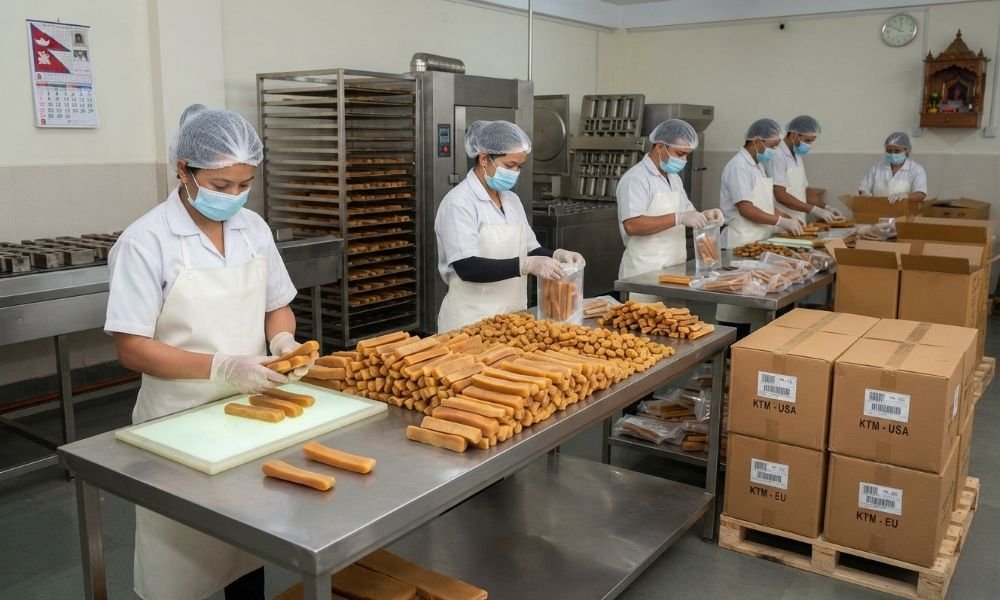
Native Nepal Dog Chew is a DFTQC-registered, HACCP-certified Himalayan yak chew manufacturer based in Kathmandu, Nepal, with 10+ years of verified export history and FDA and ISO registration. The company provides Singapore importers with pre-prepared regulatory documentation, Singapore-compliant English-language labels, and flexible FOB export terms at order volumes starting from 50 kg.
Can Native Nepal Dog Chew Supply Yak Chews for Singapore Importers?
Yes. Native Nepal Dog Chew (nativenepali.com) manufactures chhurpi-based Himalayan yak chews that meet Singapore’s AVS import conditions. The company’s documentation package—DLS VHC, batch-level COA, Certificate of Origin, and HACCP certificate—is prepared with each purchase order, directly supporting the Singapore TradeNet permit application process.
Singapore importers sourcing through Native Nepal Dog Chew receive pre-export regulatory documentation per production lot, English-language product labels meeting Singapore’s 6 mandatory label requirements, LCL-compatible order quantities from 50 kg for first-time trial shipments scaling to FCL for wholesale buyers, and FOB Kathmandu (air) and FOB Kolkata/Chennai (sea) export terms for direct Singapore importer control over freight and insurance costs.
Contact Native Nepal Dog Chew at nativenepali.com to request a product catalogue, sample shipment terms, and the full Singapore export documentation package.
What Are the Key Takeaways About Importing Yak Chews into Singapore?
Importing Himalayan yak chews into Singapore is a well-defined regulatory process governed by AVS and Singapore Customs, with a 0% MFN customs duty rate and a 9% GST obligation on CIF value. The 6 key takeaways are:
- AVS import permit is mandatory: Apply through TradeNet before the shipment departs Nepal; this is the regulatory gate for all animal-derived pet product imports
- DLS VHC is non-negotiable: Every shipment requires this health certificate from Nepal’s Department of Livestock Services; it is the primary document AVS evaluates for permit approval
- HS code 2309.10.00 is the correct classification: Retail-packed yak chews carry 0% MFN duty under Singapore’s AHTN tariff schedule and full AVS control
- GST applies to total CIF value: Calculated at 9% on Cost, Insurance, and Freight; selecting FOB Incoterms provides freight cost control but does not lower the customs valuation base.
- End-to-end timeline is 10 to 47 days: Air freight with complete documentation delivers clearance in 10 to 25 days; sea freight ranges from 25 to 47 days
- Supplier DFTQC registration determines document readiness: Nepal exporters with active DFTQC registration and Singapore export experience deliver the compliance documentation that drives permit approval speed and lowers inspection probability
Singapore importers who select a DFTQC-registered Nepal supplier and complete TradeNet registration, AVS importer setup, and full document preparation before placing their first purchase order complete the Himalayan yak chew import cycle without preventable regulatory delays.