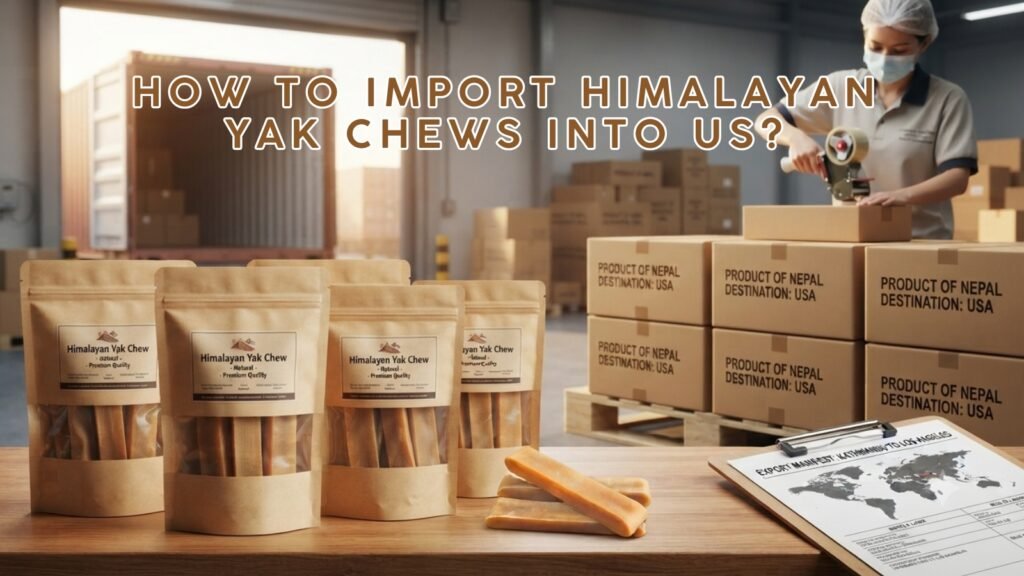
Himalayan yak chews are traditional, low-moisture dog treats manufactured from yak and cow milk, salt, and lime juice and exported from Nepal to international pet-food markets. For U.S. importers, the product may involve FDA pet-food oversight, CBP entry rules, and, depending on formulation and origin, USDA APHIS requirements. Importing Himalayan yak chews from Nepal requires reviewing FDA entry requirements and determining whether USDA APHIS review or permits apply based on the product’s ingredients and current country-specific rules.
A successful Nepal-to-USA yak chew supply chain begins before production and continues through customs clearance, quality verification, moisture-controlled packaging, and final delivery. This guide explains the 2026 import process, including FDA Prior Notice, tariff classification, labeling review, supplier verification, and customs documentation. It also shows how to evaluate Nepalese manufacturers, reduce compliance and quality risks, and build a repeatable import operation for standard yak chews, puffed yak chews, and yak chew powder.
What Are Himalayan Yak Chews?
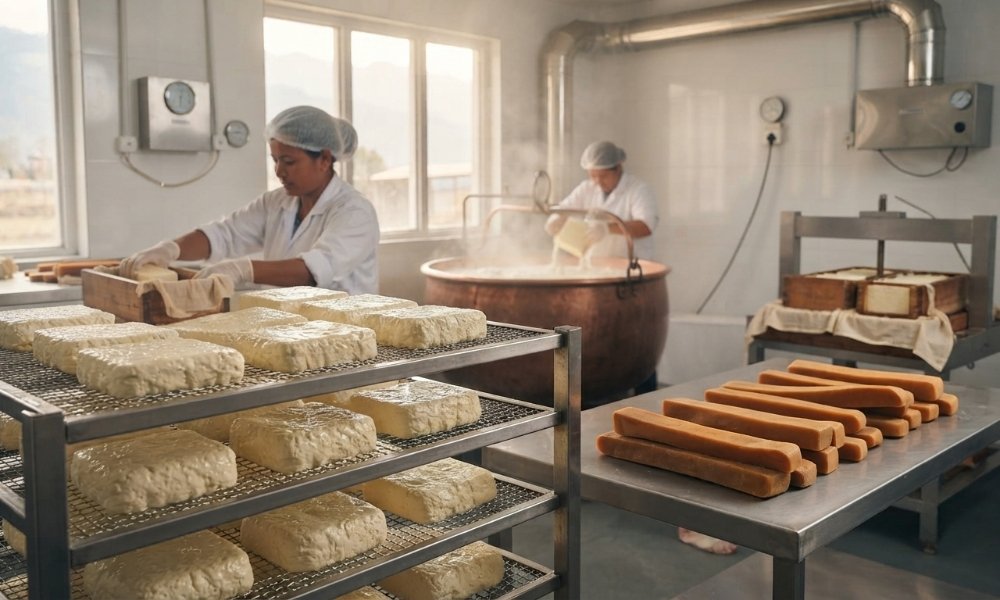
Himalayan yak chews are dense, hardened pet treats produced from a 4-ingredient recipe: yak milk, cow milk, lime juice, and salt, using a traditional preservation technique that originated in the high-altitude communities of Nepal, Tibet, and Bhutan centuries ago.
The manufacturing process removes moisture through prolonged pressing and drying, producing a hard, odor-free block that dogs chew for hours without breaking it apart quickly. Many yak chews are sold without artificial preservatives, synthetic binders, or added flavorings, but formulas vary by manufacturer. The final hardness depends on drying duration, which ranges from 4 to 8 weeks depending on the manufacturer.
For U.S. import purposes, yak chews are generally handled as pet treats or animal food products, not human food, and that classification determines which agencies review them at the border and what labeling they require.
What Makes Yak Chews Popular?
Yak chews rank among the top 5 fastest-growing pet treat categories in the US since 2021, driven by 4 measurable consumer demand signals:
- Clean-label ingredient transparency: The 4-ingredient formula satisfies the natural and clean-label positioning that US pet specialty retailers and DTC brands actively build around. Rawhide chews, synthetic bones, and artificial-flavoring products are losing shelf space to single-source, short-ingredient alternatives.
- Extended chew duration: A 3.5 oz standard yak chew delivers 2 to 5 hours of active chewing for medium-breed dogs. Most commercial treats last 15 to 30 minutes. That difference is a core selling point for pet owners dealing with destructive or anxious dogs.
- Verified geographic origin: “Himalayan” is not a marketing word here; it carries geographic credibility tied to actual high-altitude yak dairy farming in Nepal at elevations above 3,500 meters. US consumers pay a premium for that verifiable origin story.
- Grain-free and gluten-free compliance: Yak chews naturally satisfy two of the highest-traffic dietary filter searches in the $70+ billion US pet food and treat industry. No reformulation required.
Which Yak Chew Types Can You Import?
3 primary product formats are available for US import, each with distinct packaging requirements and retail positioning:
- Standard yak chews: Solid, block-shaped chews sold by weight, typically ranging from 1 oz for small breeds to 6 oz for large breeds. This is the dominant retail format and the most common import category.
- Puffed yak chews: Microwave-expanded versions of leftover chew stubs. Sold as a separate SKU or bundled with standard chews as a value-add. The puffing process requires no additional ingredients, which keeps the label clean.
- Yak chew powder: Finely ground chew material used as a meal topper or food supplement. This format triggers different FDA labeling requirements because its intended use shifts from treat to supplement.
All 3 formats fall under the same HS code family, but puffed chews and powders require supplementary label declarations that standard chews do not. Plan for this distinction before your first packaging run.
What US Import Rules Apply?
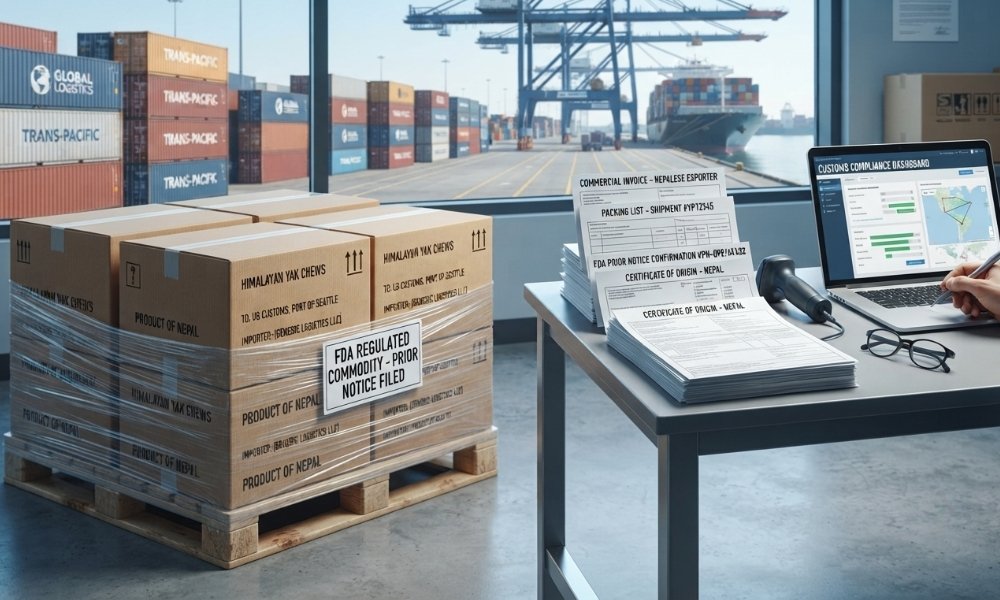
Importing yak chews into the US triggers compliance requirements from 3 federal agencies: FDA (including mandatory FSVP supplier verification and product labeling under 21 CFR Part 507), US Customs and Border Protection (documentation and duties), and USDA APHIS (animal-origin controls).
The regulatory path is manageable for processed, fully dried yak chews. The 2 most common mistakes importers make are treating this as a standard consumer goods import without FDA Prior Notice, and waiting until the shipment reaches a US port to address labeling issues. Both errors cost time and money that pre-shipment preparation eliminates entirely.
Do Yak Chews Need FDA Approval?
Yak chews do not require pre-market FDA approval. They do require FDA Prior Notice (PN) submission before every shipment enters the US, with no exceptions.
Prior Notice is a mandatory electronic notification filed through the FDA’s Prior Notice System Interface (PNSI) at prior-notice.fda.gov. The filing deadlines are:
- Ocean freight: Minimum 8 hours before anticipated arrival at a US port
- Air freight: Minimum 4 hours before arrival at the US port of entry (or before departure if flight duration is under 4 hours).
- Road/rail (if transiting through Canada or Mexico): Minimum 4 hours before border crossing
The Prior Notice submission must include 6 data fields: product identity and lot number, quantity and packaging description, manufacturer’s name and address in Nepal, country of origin, intended US port of entry, and importer of record information. Missing or inaccurate data in any of these fields triggers automatic FDA detention. The FDA reviews pet food imports under 21 CFR Part 1, Subpart I.
What Customs Documents Are Needed?
A standard yak chew import requires 7 core documents prepared and verified before the cargo departs Nepal:
- Commercial Invoice: Includes unit price, total declared value, HS code, country of origin, and both seller and buyer contact details
- Packing List: Lists each product SKU, unit count, gross weight, net weight, and carton dimensions for every pallet or package
- Bill of Lading (ocean) or Airway Bill (air): The primary contract between shipper and carrier; must match the commercial invoice exactly.
- Certificate of Origin: Issued by Nepal’s Department of Commerce or an authorized chamber of commerce, confirming Nepal as the country of production
- FDA Prior Notice Confirmation: The printable PN confirmation number from your PNSI submission
- Health Certificate: Issued by Nepal’s Department of Livestock Services; required by certain US destination states for animal-derived products
- Phytosanitary Certificate: Required if outer packaging materials include burlap, straw, or unprocessed natural fibers
One consistency rule applies across all 7 documents: every data field, product name, quantity, weight, declared value, must be identical across every document. A single-word discrepancy between the commercial invoice and the bill of lading is enough for CBP to flag the shipment for intensive examination.
Are USDA Rules Relevant?
USDA APHIS rules apply to yak chew imports in 2 specific situations: when the product contains unprocessed or raw animal tissue, and when the country of origin has an active disease outbreak affecting bovine or yak populations.
While fully processed, heat-dried yak chews undergo thermal treatment, USDA APHIS enforces strict controls on dairy imports from regions with animal disease risks (like Foot-and-Mouth Disease). Importers must verify if a USDA VS Form 16-6A Import Permit or an official Manufacturer Declaration detailing processing temperatures is required prior to shipping.
That said, USDA APHIS maintains the authority to inspect any animal-derived pet product, and their import guidelines for processed pet chews update based on disease risk profiles. Before each shipping cycle, verify current Nepal-specific status on the USDA APHIS Pet Chew Import Requirements page. This takes 5 minutes and eliminates the risk of importing under requirements that changed after your last shipment.
How Do You Prepare for Customs?
Customs preparation begins 30 days before the shipment departs Nepal, not after it arrives at a US port of entry.
Follow this 6-step pre-shipment customs preparation sequence:
- Assign a licensed US Customs Broker: A licensed broker files CBP Form 3461 (formal entry) on your behalf. This is not legally mandated for all importers, but it eliminates the filing errors that cause holds, particularly on first imports.
- Confirm importer of record (IOR) status: The IOR carries legal responsibility for the accuracy of all customs declarations. If you are a US entity importing directly from Nepal, you act as the IOR.
- File FDA Prior Notice: Submit through PNSI no later than 5 days before estimated ocean arrival.
- Verify declared value accuracy: CBP applies the transaction value method. The declared value on your commercial invoice must equal the actual purchase price, not a reduced estimate.
- Confirm HS code classification: Cross-reference your product against the US Harmonized Tariff Schedule before filing. A misclassified product triggers re-examination fees plus potential penalty notices.
- Submit ISF 10+2 (ocean shipments only): The Importer Security Filing must reach CBP and be accepted at least 24 hours before the container is loaded onto the vessel at Kolkata Port, India, to avoid an immediate $5,000 CBP penalty and hold upon arrival.
Which HS Code Should You Use?
Himalayan yak chews are classified under HTS code 2309.10.00.90, preparations of a kind used in animal feeding, not elsewhere specified.
The full tariff classification hierarchy:
- Chapter 23: Residues and waste from food industries; prepared animal fodder
- Heading 2309: Preparations of a kind used in animal feeding
- Subheading 2309.90: Other preparations
- Statistical suffix 9090: Other, other
Two common misclassification errors occur with yak chews. Some importers file under Chapter 04 (dairy and milk products) based on the milk origin of the chew. Others file under Chapter 41 (raw hides and skins), which is incorrect for any dried, processed food product. Both misclassifications trigger additional inspection, reclassification proceedings, and potential penalty notices.
Importers who prefer a legally binding classification before their first shipment can request an official CBP Binding Ruling electronically via the CBP eRulings portal. Submitting a binding ruling request to CBP is free of government application fees, though administrative processing typically takes 30 to 90 days and gives you a legally defensible classification that CBP officers cannot override at the port.
How Should You Label Yak Chews?
FDA-compliant yak chew labels for US retail display 8 mandatory elements that must appear on the primary (consumer-facing) packaging surface.
The 8 required label elements:
- Product name with species and intended use: Must specify “dog chew” or “dog treat” to identify the intended animal and product purpose
- Net quantity statement: Weight in both metric and US customary units (e.g., “3.5 oz / 99g”)
- Ingredient list: Listed in descending order by weight. Standard yak chew declaration: Yak Milk, Cow Milk, Salt, Lime Juice
- Guaranteed analysis panel: Minimum crude protein percentage, minimum crude fat percentage, maximum crude fiber percentage, maximum moisture percentage
- Manufacturer or distributor name and US address: A US address is required if you are the importer and distributor
- Country of origin: “Made in Nepal” or “Product of Nepal”
- Feeding directions: Size-appropriate guidance and supervision recommendation
- Statement of intended use: “For use as a treat for dogs” or equivalent wording
Federal labeling requirements are mandated by the FDA under the FD&C Act and 21 CFR Part 507, while AAFCO provides model regulations that individual state departments of agriculture adopt for state-level feed registration and labeling compliance. Most US states adopt AAFCO standards directly. California, New York, Florida, and Texas each run additional state-level pet food label review processes, so if you distribute in those 4 states, budget an extra 30 to 60 days for state registration before retail launch.
What Import Duties May Apply?
Himalayan yak chews imported from Nepal under HTS 2309.90.9090 carry a 0.0% MFN (Most Favored Nation) base duty rate as of 2026. Nepal qualifies under US trade preference programs, and most animal feeding preparations in Chapter 23 attract zero duty.
Confirm the current rate through the US International Trade Commission HTS database at usitc.gov before each shipment; duty rates change with trade policy and tariff schedule revisions.
3 additional fees apply at entry regardless of duty rate:
| Fee | Calculation Method | Typical Amount |
| Merchandise Processing Fee (MPF) | 0.3464% of declared customs value | $31.67 minimum per entry |
| Harbor Maintenance Fee (HMF) | 0.125% of cargo value | Ocean shipments only |
| FDA examination fee | Per physical exam if triggered | $175 to $375 per exam |
How Can You Source From Nepal?
Nepal yak chew manufacturers concentrate in 4 Himalayan districts, Solukhumbu, Dolpa, Mustang, and Humla, where yak dairy farming operates at elevations between 3,500 and 5,000 meters above sea level. The Trade and Export Promotion Centre (TEPC) of Nepal and the Department of Commerce maintain registered exporter directories that list licensed pet food manufacturers. These are the 2 verified starting points for supplier identification.
How Do You Verify Nepal Suppliers?
Supplier verification in Nepal requires 5 specific document checks before placing a purchase order:
- PAN and business registration certificate: Verified through Nepal’s Office of the Company Registrar (OCR). Confirms the company’s legal existence, incorporation date, and authorized business activities.
- Nepal Food Corporation or Department of Food Technology manufacturing license: Confirms authorization to manufacture and process food products within Nepal.
- Export license from Nepal’s Department of Commerce: Required for any commercial export. A supplier without this license cannot legally ship your order through customs.
- HACCP or ISO 22000 certification: Documents a hazard-controlled food safety management system. Not every Nepal manufacturer holds these certifications, but top-tier export-focused producers do. Uncertified suppliers carry higher contamination risk.
- Third-party product testing reports from an accredited laboratory: SGS Nepal, Bureau Veritas Nepal, or equivalent. Reports verify protein content (target: minimum 55% crude protein), moisture level (target: below 12%), absence of Salmonella and E. coli O157, and heavy metal concentrations within AAFCO-accepted limits.
Request physical copies of all 5 documents before issuing a purchase order. Legitimate Nepal yak chew exporters provide this documentation within 2 to 5 business days.
What Quality Checks Should You Use?
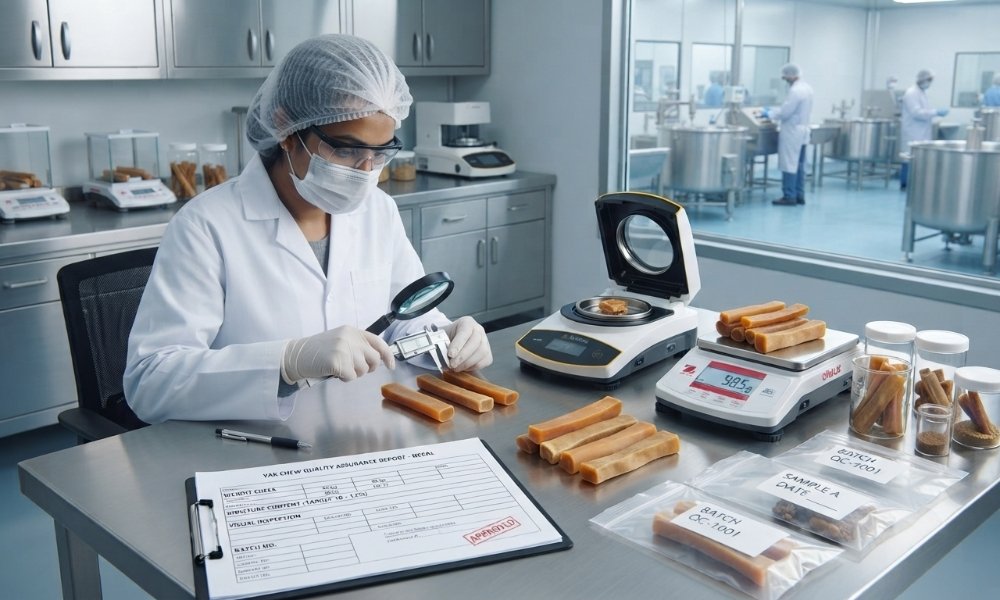
3 quality verification stages protect US importers from FDA-level product rejection and downstream customer complaints:
Stage 1, Pre-shipment factory inspection: Commission a third-party inspection agency (SGS Nepal, Bureau Veritas Nepal, or Intertek Nepal) to conduct a physical inspection at the Nepal production facility before the cargo loads. The inspector verifies quantity, dimensional conformity, packaging integrity, net weight accuracy, and label compliance. This inspection costs $200 to $450 and saves multiples of that amount in US-side re-packing or rejection handling.
Stage 2, Pre-shipment laboratory analysis: Send a minimum 500g representative sample from the production batch to an FDA-recognized laboratory before the ocean container closes. Standard test panel: Salmonella (absent/25g), E. coli O157 (absent/25g), lead (below 0.1 ppm), cadmium (below 0.05 ppm), arsenic (below 0.1 ppm), moisture content, crude protein, and crude fat.
Stage 3, Retained batch sample: Keep a minimum 500g sealed sample from each production batch in controlled storage at the Nepal facility for 60 days after export. If FDA requests additional testing after the shipment arrives, this retained sample enables same-day response without halting the shipment.
How Can You Avoid Import Risks?
The 4 highest-frequency import risks for yak chew shipments, and the specific action that eliminates each:
- Labeling violations at entry: Commission a US-based pet food regulatory consultant to review all label artwork before printing. Review cost: $200 to $800. Re-labeling 1,000 units at a US 3PL warehouse costs $1,500 to $3,000, 3 to 10x more expensive.
- Microbial contamination failures: Source exclusively from manufacturers who document internal production temperature and drying duration. Ask for production batch logs that confirm minimum internal temperature during processing. Manufacturers who refuse to share this data are the ones to avoid.
- Misdeclared HS code: Work with a licensed US customs broker who has prior pet food import experience. Self-filing on a first shipment under the wrong code triggers re-examination and penalty liability.
- Post-order product substitution: Write explicit product specifications into every purchase order: hardness rating, weight range by SKU, moisture percentage, color grade, and drying method. Lab-test every new production batch, not just the initial sample.
How Much Does Importing Cost?
A 100 kg LCL ocean shipment of Himalayan yak chews from Nepal to a US West Coast port carries an estimated total landed cost of $2,500 to $3,800-accounting for product FOB costs ($8–$18/kg), ocean LCL freight and destination CFS/terminal handling charges ($800–$1,200), customs broker fees, and statutory entry fees.
That figure breaks into 3 cost categories: product cost, shipping cost, and customs fees. Omitting any one of these from your financial model produces an inaccurate margin projection.
What Are Product Costs?
Nepal factory pricing for yak chews (typically FCA Kathmandu or CIF Kolkata) ranges from $8 to $18 per kg, determined by 3 variables:
- Chew size and milk concentration: Jumbo-grade chews (5 oz to 6 oz) cost more per kg than small-breed chews (1 oz to 2 oz) because they use more yak milk per unit.
- Certification premium: HACCP-certified manufacturers charge $2 to $4 per kg above uncertified producers. That premium pays for itself in reduced FDA exam risk and fewer quality-related customer returns.
- Volume discount structure: Orders above 500 kg per shipment access per-kg price reductions of $1 to $3 with most established Nepal exporters.
For US margin reference: standard yak chews retail at $4 to $8 per oz at pet specialty retail. A 3.5 oz chew retails at $14 to $28. At a $12 per kg import cost (roughly $0.38 per oz), the product economics justify consistent import volumes above 50 kg per month.
What Are Shipping Costs?
Ocean freight from Nepal via Kolkata, India to US West Coast ports (Los Angeles or Long Beach) runs $350 to $600 per CBM for LCL (Less than Container Load) shipments in 2026. Total transit time is 28 to 40 days, which includes 5 to 8 days of inland transit from Nepal to Kolkata.
Air freight from Kathmandu Tribhuvan International Airport to major US cargo hubs costs $4.50 to $8.50 per kg. Transit time is 4 to 7 days.
Use air freight for: test shipments below 150 kg, urgent restocks, and first-time imports where customs entry profile establishment matters. Use ocean freight for: recurring orders above 300 kg, LCL consolidation, and full container loads above 5,000 kg per cycle.
What Customs Fees Apply?
For a $1,500 declared customs value (100 kg at $15/kg) ocean shipment from Nepal:
| Fee Category | Calculation | Estimated Amount |
| Import duty (MFN rate) | 0.0% × $1,500 | $0.00 |
| Merchandise Processing Fee | 0.3464% × $1,500 | $31.67 (minimum applies) |
| Harbor Maintenance Fee | 0.125% × $1,500 | $1.88 |
| Customs broker filing fee | Flat rate | $125 to $350 |
| FDA examination fee (if triggered) | Per exam | $175 to $375 |
| Total estimated customs cost | $332 to $758 |
Customs costs on a $1,500 shipment represent 22% to 50% of product value. That percentage is the most commonly omitted figure in first-time importer cost models. Build it in before confirming your minimum viable order quantity.
How Do You Ship Yak Chews?
Yak chews ship from Nepal to the US via 2 primary routes: air freight direct from Kathmandu to US airports (5 to 7 days total transit), or ocean freight via land transit to Kolkata, India, then sea to a US West Coast or East Coast port (28 to 40 days total transit).
Air Freight or Sea Freight?
The right shipping method depends on 3 decision variables: shipment volume, urgency, and your current stage of the import process.
Air freight is the right choice when:
- The shipment is below 150 kg (ocean LCL fees make small shipments uneconomical by sea)
- You are completing your first customs entry and want faster clearance feedback
- A restock situation requires arrival within 10 days
Ocean freight is the right choice when:
- The shipment exceeds 300 kg per cycle
- You are consolidating multiple SKUs into a single LCL container from multiple Nepal suppliers.
- Order volume justifies a 20-foot FCL container (approximately 5,000 to 7,000 kg net cargo)
Nepal has no ocean port. All ocean shipments transit overland from Birgunj or Biratnagar customs points to Kolkata Port in India under a Nepal transit customs declaration. This inland leg adds 5 to 8 days and requires an inland transit document in addition to all standard export paperwork.
How Should Chews Be Packaged?
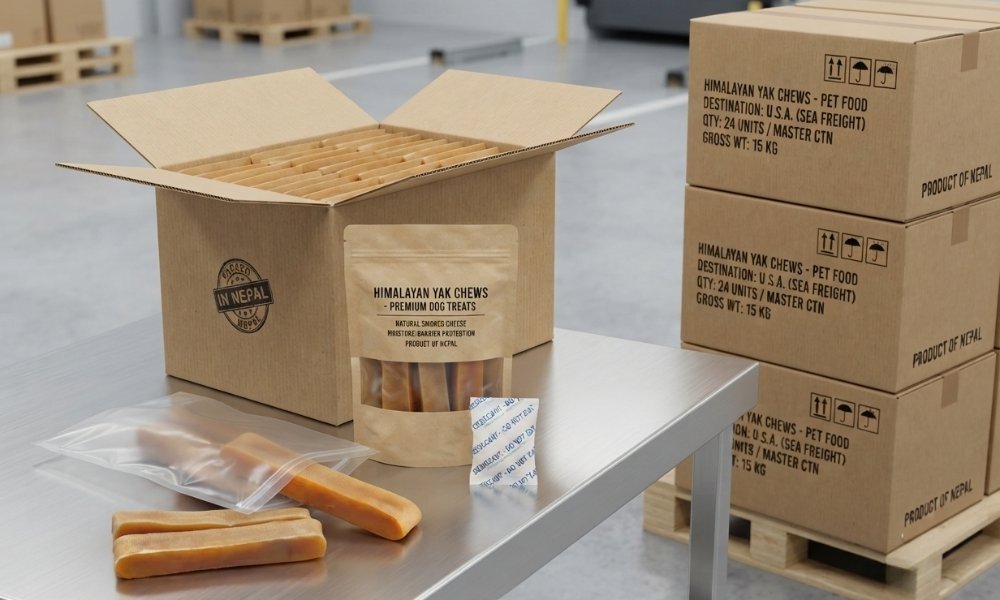
Export packaging for US import follows a 3-layer structure:
- Primary (retail) packaging: Each chew or multi-pack sealed in a retail pouch or bag. All 8 FDA-required label elements appear on this layer. The film material must be a moisture-barrier laminate, OPP/PE or foil construction, because yak chews are hygroscopic and absorb ambient humidity during long ocean transit.
- Inner (master carton): 10 to 24 retail units packed per master carton, with product name, lot number, net weight, production date, and best-before date printed or labeled on the exterior.
- Outer (shipping carton): Corrugated carton rated for a minimum 45 kg gross weight. Marked with shipper name, consignee name, country of origin (“Product of Nepal”), and HTS code on exterior panels.
Include a food-grade silica desiccant pack (minimum 5g per retail unit) inside each primary package. Shipments without adequate moisture protection arrive with softened chews that fail retailer quality standards and generate product return claims.
What Shipping Documents Are Needed?
Ocean freight shipments require 9 documents. Air freight shipments require 7.
Ocean freight document set:
- Commercial Invoice
- Packing List
- Original Bill of Lading (OBL) or Seaway Bill
- Certificate of Origin (Nepal Department of Commerce)
- FDA Prior Notice Confirmation (PNSI printout)
- ISF 10+2 Filing Confirmation (from your customs broker)
- Nepal Inland Transit Declaration (from Birgunj or Biratnagar customs)
- Phytosanitary Certificate (if outer packaging uses natural fiber materials)
- Shipper’s Letter of Instruction (SLI)
Air freight document set:
- Commercial Invoice
- Packing List
- Airway Bill (AWB)
- Certificate of Origin
- FDA Prior Notice Confirmation
- Health Certificate from Nepal Department of Livestock Services
- Shipper’s Declaration (if cargo requires special handling documentation)
What Problems Can Delay Imports?
5 specific issues cause over 90% of yak chew import delays at US ports: missing or incorrect FDA Prior Notice, labeling non-compliance, mismatched shipping document data, microbial contamination findings, and random FDA physical examination.
Each day a shipment sits on US customs hold costs $150 to $700 in 3PL warehouse holding fees, before any FDA exam fees are calculated.
What Causes Customs Holds?
The 4 most frequent reasons CBP and FDA hold yak chew shipments:
- FDA Prior Notice not filed, filed late, or filed with errors: A missing PN number triggers automatic hold. A PN submitted with an incorrect manufacturer address or mismatched lot number triggers a manual FDA review that takes 3 to 10 business days to clear.
- Label non-compliance detected during document review: Products missing a guaranteed analysis, an ingredient list, a country-of-origin statement, or a net weight in US customary units fail CBP’s documentary review at entry.
- Contradictory data across shipping documents: If the commercial invoice declares 100 kg net weight and the packing list shows 95 kg, CBP flags the discrepancy for intensive physical examination. The shipment does not move until the discrepancy is resolved.
- Random FDA physical examination selection: FDA selects a defined percentage of animal-derived product shipments for routine physical inspection, regardless of origin or importer track record. This is not a violation hold. It adds 2 to 5 business days to clearance and costs $175 to $375 per exam. Experienced importers budget for this annually.
How Can You Prevent Rejection?
Rejection prevention operates at 3 stages, each with specific actions:
Pre-production stage: Have all label artwork reviewed by a US pet food regulatory consultant before printing. Confirm your HS classification via a CBP binding ruling before the first shipment. Write product specifications into purchase orders before placing them with your Nepal supplier.
Pre-shipment stage: Commission a third-party factory inspection in Nepal at least 10 days before cargo loads. Cross-reference all document data, every quantity, weight, product name, and value, across the commercial invoice, packing list, and bill of lading. One-field mismatches cause holds.
Pre-arrival stage: Submit FDA Prior Notice 5 days before ocean arrival. Deliver ISF 10+2 to CBP at least 24 hours before vessel departure from Kolkata. Provide your customs broker with all 9 documents 10 days before estimated arrival so they can identify issues before the cargo reaches US waters.
What Happens If Rules Change?
US import regulations for animal-derived pet products change in response to 3 triggers: disease outbreaks in the origin country (particularly FMD or avian influenza affecting bovine herds), FDA guidance revisions to pet food safety standards, and USDA APHIS rulemaking on processed pet chew import requirements.
Monitor 3 official sources monthly:
- FDA Import Alert Database at accessdata.fda.gov: FDA publishes and updates Import Alerts by product category and country of origin. A new Import Alert for Nepal would affect all yak chew importers simultaneously.
- USDA APHIS Pet Chew Import Requirements page: APHIS updates this page when disease risk profiles change for specific exporting countries.
- CBP CSMS (Cargo Systems Messaging Service): Publishes real-time updates on documentation changes, port-specific guidance, and tariff schedule revisions.
Importers shipping yak chews 4 or more times per year receive monthly regulatory update summaries from their customs broker. A broker experienced in pet food imports flags product-specific changes before each shipping cycle, not after a hold is issued.
How Can Native Nepal Help?
Native Nepal Dog Chew is a Nepal-based manufacturer and exporter of Himalayan yak chews, operating from production facilities in Nepal with HACCP-compliant processes, verified export licenses, and full documentation support for US import compliance.
Native Nepal manufactures across the complete yak chew product range, standard chews, puffed chews, and yak chew powder, with export experience across the US, European, and Australian markets.
Can Native Nepal Supply US Importers?
Native Nepal supplies US importers with all 3 primary yak chew formats, with minimum order quantities starting at 50 kg per SKU and complete compliance documentation included with every commercial order.
What US importers receive from Native Nepal on every order:
- Third-party lab-tested batch reports: Salmonella-negative, E. coli O157-negative, heavy-metal screened, protein and moisture verified
- FDA-compliant label templates: Pre-reviewed for all 8 required label elements, ready for your brand customization
- Full shipping document set: Commercial invoice, packing list, and certificate of origin issued by Native Nepal’s export documentation team
- HACCP production documentation: Available for your customs broker and regulatory files
- Flexible export terms: FCA Kathmandu, CIF Kolkata, or DDP US port by arrangement
- Sample kit for first-time buyers: A 10 kg sample kit with complete compliance documentation ships before any commercial purchase order is required
US importers working with Native Nepal for the first time receive this sample kit to verify product quality, confirm label compliance, and test customs clearance before committing to full commercial volumes.
What Are the Key Takeaways?
Importing Himalayan yak chews into the USA in 2026 is a documented, repeatable process when compliance requirements are addressed before cargo loads in Nepal, not after it arrives at a US port.
The 8 actions that determine whether your import clears customs in 2 days or sits on hold for 2 weeks:
- File FDA Prior Notice through PNSI at minimum 5 days before ocean arrival: every shipment, no exceptions
- Classify your product under HTS 2309.90.9090 and confirm it via a CBP binding ruling before the first shipment
- Prepare 7 to 9 shipping documents with identical data across every field: commercial invoice, packing list, bill of lading/AWB, certificate of origin, FDA PN confirmation, and applicable Nepal government certificates.
- Verify your Nepal supplier through OCR business registration, an active export license, and third-party laboratory test reports on the production batch.
- Review label artwork for all 8 FDA-required elements before printing; the consulting fee is $200 to $800; US re-labeling costs $1,500 to $3,000
- Package with moisture-barrier film and food-grade desiccants in every retail unit to prevent chew softening during 28 to 40 days of ocean transit
- Budget $2,800 to $3,800 total landed cost per 100 kg, including product cost, ocean freight, MPF, broker fees, and FDA exam contingency in every financial model.
- Engage a licensed US customs broker for the first shipment to establish a clean import record and avoid self-filing errors on your debut entry.
The yak chew import process rewards preparation at the Nepal end. Importers who complete compliance work before a shipment loads typically clear US customs in 2 to 5 business days. Importers who address compliance after cargo arrives pay $500 to $3,000 in holding fees and lose 2 to 4 weeks of selling time.
Native Nepal Dog Chew provides lab-tested product, manufacturer-direct pricing, and full documentation support for US buyers who want a reliable Nepal supply chain without the sourcing guesswork. Request a sample kit and compliance documentation package from the Native Nepal team to start your first import with confidence.