
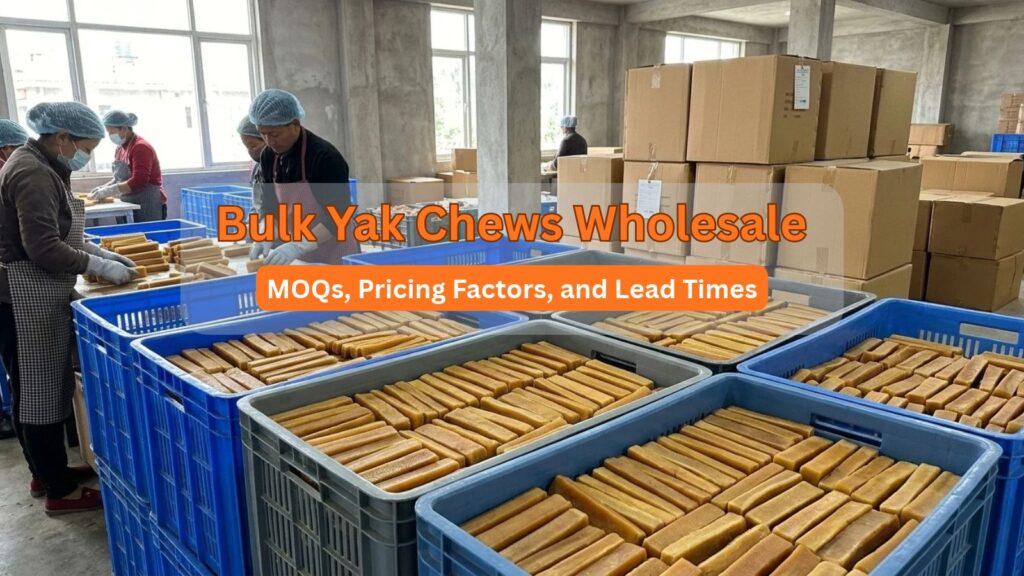
At Native Nepal Dog Chew, we help pet brands, importers, wholesalers, and distributors source Himalayan yak chews in commercial quantities. Bulk yak chews wholesale means buying our traditional chhurpi dog chews by the kilogram, carton, or pallet directly from our Nepal-based manufacturing and export operation. Wholesale buying lowers the cost per chew, supports batch consistency, and creates opportunities for private label packaging.
Our wholesale programs are built around production capacity, chew size, packaging format, food-safety requirements, and destination-market compliance. We do not publish one universal MOQ or one universal price because every order depends on the product format, size mix, packaging specification, and shipping terms. Instead, we provide a tailored quotation after we understand the buyer’s target market and product requirements.
This guide explains how bulk yak chew MOQs, pricing factors, and lead times work for importers, distributors, and private label pet brands. It also explains how we manage production, quality control, laboratory testing, export documentation, and shipping support from Nepal to international markets.
What Are Bulk Yak Chews and Why Buy Wholesale?
Bulk yak chews are hard, dried Himalayan cheese chews supplied in wholesale quantities rather than individual retail packs. Buying in bulk helps our partners reduce unit cost, maintain product consistency across a production run, and launch private label programs with their own branding.
Chhurpi is the traditional Himalayan cheese behind every yak chew. We make our chews from carefully sourced yak and cow milk using a traditional chhurpi process. The milk is coagulated, pressed, shaped, cut, and dried to create a hard, long-lasting dog chew.
Demand for natural, long-lasting dog treats continues to grow. According to MarketsandMarkets, the global pet treats market is projected to reach $58.71 billion by 2031, growing at an 8.9% compound annual growth rate. Long-lasting hard chews remain an important part of the natural chew category because pet owners value durability, simple ingredients, and a satisfying chewing experience.
Our Yak Chew Product Range
We manufacture and export several yak chew formats for wholesale, distribution, and private label programs:
- Dog chew bars: Long-lasting, hard chews made from 99% yak and cow milk with lime juice and salt.
- Dog chew nuggets: Smaller, nutrient-rich chews suitable for rewards and everyday treating.
- Puffed chew bars: Light, crunchy chews made by gently puffing Himalayan cheese into an airy texture.
- Puffed dog chew nuggets: Light, crunchy training treats made from yak and cow milk.
- Yak cheese protein powder: A high-protein cheese topper that supports meal appeal and everyday nutrition.
- Flavored and custom formats: Available through OEM and private label programs, subject to product development and minimum order requirements.
Our standard chew bars are available in five export sizes: small, medium, large, X-large, and king size. These sizes cover toy breeds through large and giant breeds. We can supply single-size orders or mixed-size assortments depending on the buyer’s market and customer base.
Benefits of Buying Yak Chews in Bulk
Bulk purchasing delivers five benefits: lower unit cost, batch consistency, private label eligibility, fewer shipments, and direct manufacturer traceability.
The unit-cost saving is real, but it should not be the only reason to buy in bulk. Larger production runs allow us to plan milk sourcing, processing, drying, cutting, packaging, and export documentation more efficiently. That planning supports more consistent color, hardness, moisture, and piece weight across the order.
Private label eligibility also begins at production scale. Printed pouches, custom labels, barcodes, and retail-ready cartons each require setup and minimum production quantities. Buyers who consolidate sizes and commit to a repeat order schedule often find it easier to reach an economical production quantity.
Direct sourcing also matters. Because we manage production from milk sourcing through packaging and export preparation, we can provide lot traceability and quality documentation. This matters for importers who need to respond quickly to customer questions, retailer audits, or regulatory checks.
What Are the MOQs for Wholesale Yak Chews?
Our MOQs vary by product format, size grade, packaging type, and order channel. Standard wholesale orders begin at quantities that support full production batches. Custom OEM programs with branded packaging, custom labeling, and recipe control carry volume thresholds confirmed at inquiry.
| Order channel | Typical MOQ | Packaging | Best for |
| Marketplace wholesale | Marketplace-specific minimum | Retail-ready packs | Boutiques testing the category |
| Unbranded bulk by piece | Supplier-specific piece minimum | Loose or bulk cartons | Repackers and small distributors |
| Export production run | Production-batch quantity | Bulk cartons | Importers and distributors |
| Private label run | Set by product format and packaging type | Branded pouches | Brands launching their own label |
We work with buyers across different volume levels. A boutique may begin with a smaller trial order, while an importer or distributor may need a production run large enough to support consistent supply and efficient shipping. Private label buyers should expect the packaging minimum to influence the final MOQ, because printed film, pouches, labels, and cartons each have production requirements.
Factors That Determine Wholesale MOQs
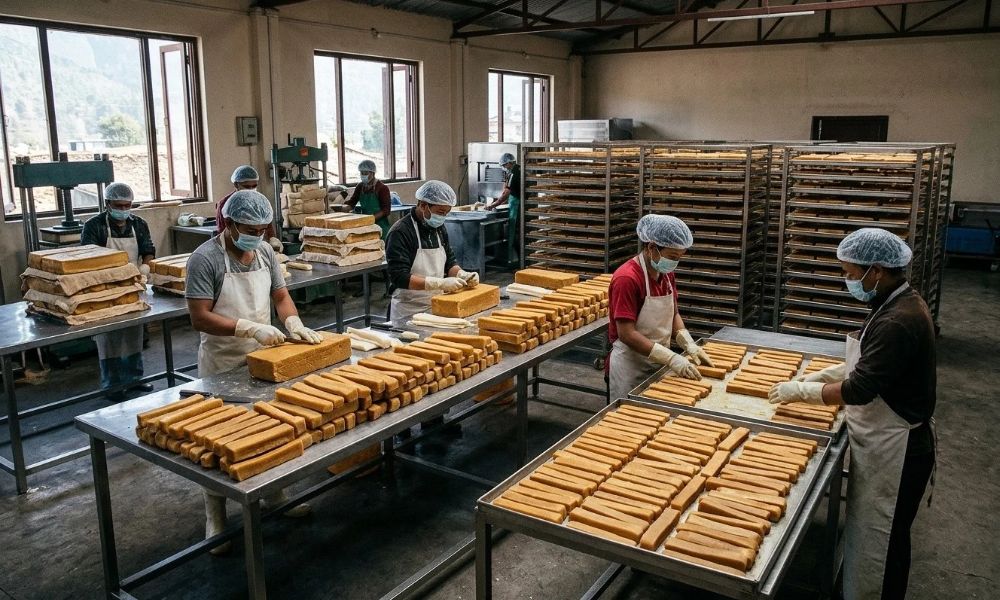
Five factors determine a yak chew MOQ: production batch size, drying capacity, size grade mix, packaging print minimums, and container economics.
A cheese-making batch produces a fixed quantity of chhurpi. Splitting that batch across too many small orders can reduce efficiency and create inconsistency. Our drying process also requires controlled time and capacity, so each order needs to fit realistically within the production schedule.
Each size grade requires its own cutting and drying plan. A buyer who orders one or two sizes can usually reach a production-friendly quantity more easily than a buyer who requests six sizes in small volumes. Packaging adds another layer: printed pouches require film, printing, filling, sealing, and carton labeling.
Container economics matter as well. A full container load spreads inland transport, port handling, and customs-related costs across more kilograms. A less-than-container-load shipment can be suitable for a first order, but it usually carries a higher freight cost per kilogram.
MOQ Differences for Custom and Standard Orders
Standard orders use our existing chew sizes and packaging options, so the MOQ remains closer to our base production batch. Custom orders add new cuts, flavors, packaging designs, or product specifications, and each addition can increase the MOQ.
Custom work includes OEM manufacturing, where we produce to a buyer’s specification, and private label manufacturing, where we pack products under the buyer’s brand. A new flavor may require a separate batch, ingredient sourcing, equipment cleaning, and quality testing. A new pouch design may require printing plates, artwork approval, and a minimum film run.
Buyers should always clarify whether an MOQ applies per order, per SKU, or per size. For example, a “100 kg minimum” may mean 100 kg per order, 100 kg per size, or 100 kg per SKU. Six SKUs at 100 kg per SKU would require 600 kg in total. We always clarify this basis in writing before confirming an order.
How Buyers Can Negotiate Flexible MOQs
We work with buyers to find a practical starting point, but we do not compromise the drying process or product quality to force an artificially low MOQ. Buyers can improve MOQ flexibility by:
- Consolidating sizes into one or two grades for the first order.
- Providing a written 6- to 12-month volume forecast.
- Starting with plain cartons and adding printed retail packaging on a later order.
- Splitting delivery into call-off shipments from one production run.
- Paying a deposit at order confirmation.
A realistic MOQ protects quality. A supplier that agrees to an MOQ below its practical cheese-making or drying capacity may need to blend leftover stock or shorten curing time. We prefer to agree on a workable first-order quantity and then scale production as the buyer’s sales data develops.
What Factors Affect Bulk Yak Chew Wholesale Pricing?
Bulk yak chew pricing depends on five cost layers: raw material, size and grade, manufacturing, packaging and branding, and shipping with duties. We quote pricing based on the buyer’s exact specification, destination, Incoterm, and packaging requirement.
| Cost layer | What it includes |
| Raw material | Yak and cow milk supply, seasonality, and milk composition |
| Size and grade | Chew dimensions, piece weight, hardness, and broken-piece allowance |
| Manufacturing | Milk processing, pressing, cutting, drying, labor, and quality control |
| Packaging and branding | Bulk cartons, retail pouches, printing, labeling, and private label setup |
| Shipping and duties | Inland transport, ocean or air freight, duties, brokerage, and clearance |
Published Nepal export listings sometimes show volume-based pricing examples around $13.25 to $14.00 per kilogram before freight and duty. Those figures can be useful market references, but they are not our published price schedule. Our actual quotation depends on the buyer’s specification, order quantity, packaging, destination, and agreed Incoterm.
Raw Material Quality and Sourcing Costs
Milk composition and supply directly affect raw material cost. Yak milk is nutritionally dense, but it is available in smaller volumes than cow milk because yak herds graze at high altitude and each animal produces limited milk. Many Himalayan chew producers use a yak-and-cow-milk blend to maintain supply and price stability.
Our bars and nuggets are made from 99% yak and cow milk combined, with lime juice and salt as the only additional ingredients. We do not use artificial preservatives, binders, or additives. The exact yak-to-cow milk ratio varies by product SKU and is disclosed to private label partners under a supplier agreement.
We source fresh milk from more than 1,000 farmers and more than 50 micro dairies in Himalayan communities across Nepal. Our sourcing model supports traceability, raw-material consistency, and fair economic participation for local dairy producers.
Yak Chew Size, Weight, and Grade
Larger chews cost more per piece because they require more material and longer drying time. Grade also affects the per-kilogram rate. A lower grade may include more broken ends, greater weight variation, or less uniform appearance.
There is no universal industry standard for grade A, grade B, or nugget grade. Each supplier defines these terms differently. We encourage buyers to request a written specification that states piece weight, length tolerance, moisture range, color range, and the permitted broken-piece allowance.
At Native Nepal Dog Chew, we supply five standard bar sizes: small, medium, large, X-large, and king size. We can also support custom size specifications for private label programs, subject to agreed minimum order quantities.
Manufacturing and Processing Costs
Manufacturing cost covers milk collection, pasteurization, coagulation, pressing, cutting, drying, packaging, labor, energy, and compliance. Drying is one of the most important stages because chhurpi must cure over time to reach the hardness and low moisture level expected in a long-lasting chew.
Nepal’s monsoon season, generally June through September, can raise humidity and extend drying cycles. Thick king-size bars take longer to dry than smaller bars or nuggets. Puffed chews require an additional heat-expansion step after drying.
Compliance also affects cost. HACCP, ISO certification, FDA facility registration, laboratory testing, and export documentation all require ongoing investment. A facility with audited systems may quote higher than an uncertified workshop, but that investment supports the documentation and quality controls that importers, retailers, and regulators expect.
Packaging, Branding, and Customization Costs
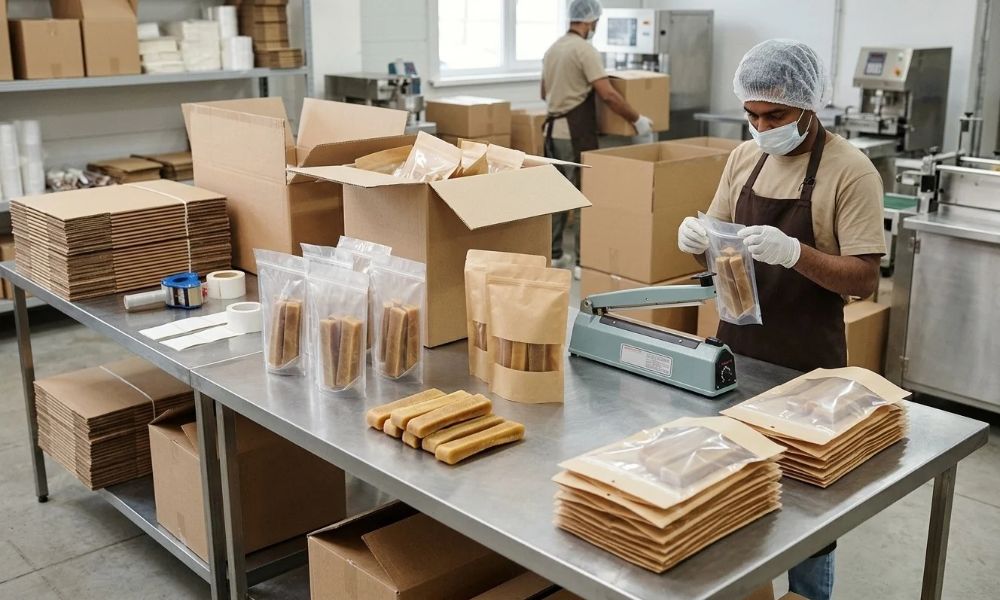
Packaging adds cost in four areas: pouches or film, printing plates, master cartons, and labeling. Bulk cartons are usually the most economical option. Retail-ready pouches add filling, sealing, and carton-labeling costs. Private label packaging adds one-time design and plate fees, which are amortized across the first production run.
US labeling requires careful planning. FDA reviews labeling at import, and AAFCO-based state labeling rules commonly require a product name, net quantity, manufacturer or distributor name and address, ingredient list, and guaranteed analysis. A labeling error discovered at the port can require relabeling in a US warehouse, which costs more than printing the label correctly before shipment.
We support custom packaging, compliance-ready labeling, and export documentation. Buyers should finalize net weight, barcode information, ingredient declarations, and artwork before printing plates are produced.
Shipping, Duties, and Import Expenses
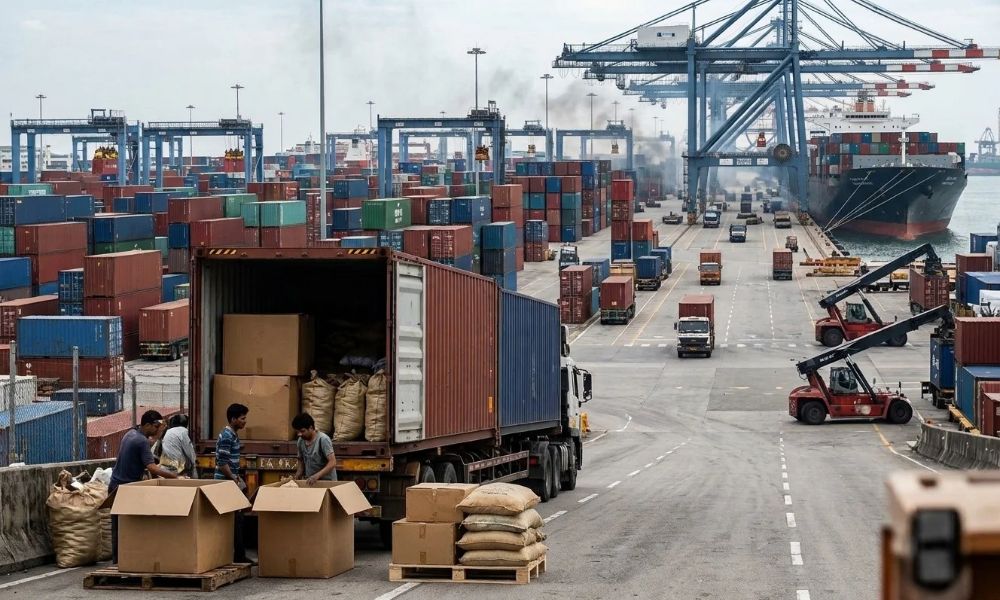
Landed cost includes the product price, inland freight, ocean or air freight, duties, broker and filing fees, and storage or inspection charges. Nepal is landlocked, so cargo normally travels by road to an Indian port such as Kolkata or Haldia before moving by sea through transshipment hubs such as Singapore or Colombo.
Duties can change, so buyers should not rely on a fixed duty estimate. Importers should verify the applicable MFN rate, HTS classification, and any additional tariff layers that apply to the product and origin country. For US imports, buyers should also confirm current FDA, CBP, and USDA APHIS requirements before placing an order.
The $800 de minimis exemption has been suspended, which means courier samples may now be subject to duty. Buyers should include sample duties, freight, brokerage, and clearance costs in their landed-cost model.
What Are the Typical Lead Times for Bulk Yak Chew Orders?
Lead time depends on production scheduling, drying time, packaging format, laboratory testing, inland transport, ocean transit, and destination-country clearance. A realistic first sea shipment from Nepal to a US warehouse can take approximately 9 to 16 weeks from purchase order to warehouse arrival. Air freight can reduce transit time, but it costs substantially more.
| Stage | Typical range | Main driver |
| Production and curing | 14–28 days | Drying capacity, chew size, humidity |
| Packaging | 5–10 days | Bulk cartons are faster; printed pouches take longer |
| Inspection and documents | 3–7 days | Laboratory testing and export certificates |
| Inland haulage to Kolkata or Haldia | 7–14 days | Road transport, border procedures, and port handling |
| Ocean transit | 30–45 days | Vessel schedule and transshipment |
| US arrival and clearance | 3–7 days | FDA prior notice, CBP entry, and inspections |
| Total | 62–111 days | About 9 to 16 weeks |
We provide dispatch schedules and cargo tracking for every export order. We do not promise a fixed delivery date because production, laboratory testing, port schedules, and customs processes can change. For a first order, we recommend planning with a buffer, especially during the monsoon season.
Production and Processing Timelines
Production can take 14 to 28 days, with drying accounting for much of that period. Milk collection and cheese-making generally take the first few days. Pressing, cutting, drying, and finishing follow.
Our chews are smoke-dried and air-dried through a controlled multi-day drying process. The exact drying duration and final moisture percentage vary by chew size and format. Bars, nuggets, and puffed formats each follow separate drying protocols. We include moisture data by SKU in the certificate of analysis provided with every export shipment.
Packaging and Quality Inspection Time
Packaging generally takes 5 to 10 days. Bulk cartons are the fastest option. Printed retail pouches require filling, sealing, carton labeling, and final inspection, so they take longer.
Quality inspection and laboratory testing add another 3 to 7 days. We test production batches for microbial safety, moisture content, and nutritional composition before export clearance. Buyers should hold vessel bookings until laboratory results and export documents are complete.
International Shipping and Customs Clearance
Sea freight from India to the United States generally takes 30 to 45 days port to port. Air freight takes 3 to 7 days, but it is significantly more expensive. Inland haulage from Nepal to Kolkata or Haldia can take 7 to 14 days depending on road conditions, border procedures, and port handling.
Before the shipment reaches the US, the importer files FDA prior notice. FDA reviews food facility registration, importer information, labeling, and entry documentation. Dairy-containing pet chews from countries with livestock diseases exotic to the United States may also require a USDA APHIS veterinary services permit.
Factors That Cause Wholesale Order Delays
Six factors cause most wholesale delays: monsoon humidity, milk shortages, failed laboratory tests, documentation errors, transshipment misses, and customs holds.
- Monsoon humidity: Higher humidity can extend drying time.
- Milk shortages: Seasonal supply gaps can delay production starts.
- Failed laboratory tests: A positive pathogen result can require reprocessing or rejection.
- Documentation errors: Mismatched invoice and packing-list weights can hold cargo at the port.
- Transshipment misses: A missed feeder connection can add a week or more.
- Customs holds: A registration mismatch, missing permit, or prior notice error can trigger inspection.
FDA Import Alert 71-04 covers detention without physical examination of animal food due to the presence of Salmonella. This is one reason we emphasize pre-shipment laboratory testing and lot-specific certificates of analysis.
How Buyers Can Evaluate Yak Chew Quality Before Ordering?
Buyers should evaluate yak chew quality through ingredient and process disclosure, specification consistency, and third-party test documents. A supplier that provides all three in writing before sampling is better positioned to support a reliable supply program.
Ingredients, Processing, and Food Safety Standards
Our hard yak chews are made from yak and cow milk, lime juice, and salt. We do not use artificial preservatives, binders, or additives.
Process disclosure matters as much as the ingredient list. Salmonella is a key hazard in dried animal-based chews. Drying alone does not automatically equal a validated pathogen-reduction step. Buyers should ask suppliers to explain their pathogen-control process and provide supporting validation records where applicable.
Size Consistency and Product Specifications
A written specification should set measurable limits for length, width, piece weight, moisture, color range, and broken-piece allowance. Buyers can use a scale accurate to 0.1 g and a caliper to check samples.
We recommend weighing 30 random pieces from each lot and recording both the average and the range. A practical starting threshold is to reject lots where more than 10% of pieces fall outside the agreed specification.
Hardness also matters. Yak chews are intentionally hard, but buyers should provide clear dog-weight guidance on retail packaging and direct small dogs, seniors, or dogs with dental concerns toward puffed chews or smaller formats.
Quality Certifications and Testing Documents
Buyers should request six documents: FDA food facility registration, ISO certification or an equivalent food-safety certificate, a lot-specific certificate of analysis, a DFTQC export certificate, a Salmonella test report, and a certificate of origin.
A COA is a laboratory report that lists moisture, nutritional, and microbiological results for one production lot. It should include a lot code that matches the carton label. A generic COA reused across shipments is a warning sign.
We hold FDA registration, DUNS registration, ISO certification, and HACCP certification. Every production batch undergoes third-party laboratory testing covering microbial safety, moisture content, and nutritional composition before export clearance. We share certification copies, COA reports, and compliance documents with verified wholesale buyers during onboarding.
How Buyers Can Choose a Reliable Bulk Yak Chew Supplier?
Reliable suppliers demonstrate verifiable capacity and export history, a clean sample process, and complete export documentation delivered on schedule.
Supplier Experience and Manufacturing Capacity
Export experience should be measured in completed shipments to the buyer’s region, not simply years in business. Buyers should ask about monthly capacity, drying capacity, export destinations, reference buyers, and completed shipments over the past 12 months.
We have more than 10 years of experience manufacturing and exporting Himalayan yak cheese dog chews. We export to more than 20 countries across North America, Europe, Asia-Pacific, and the Middle East. The United States is our largest single export destination. Our stated monthly capacity reaches 50,000 kg, and buyers should request current capacity confirmation when planning a specific production schedule.
Sample Orders and Product Evaluation
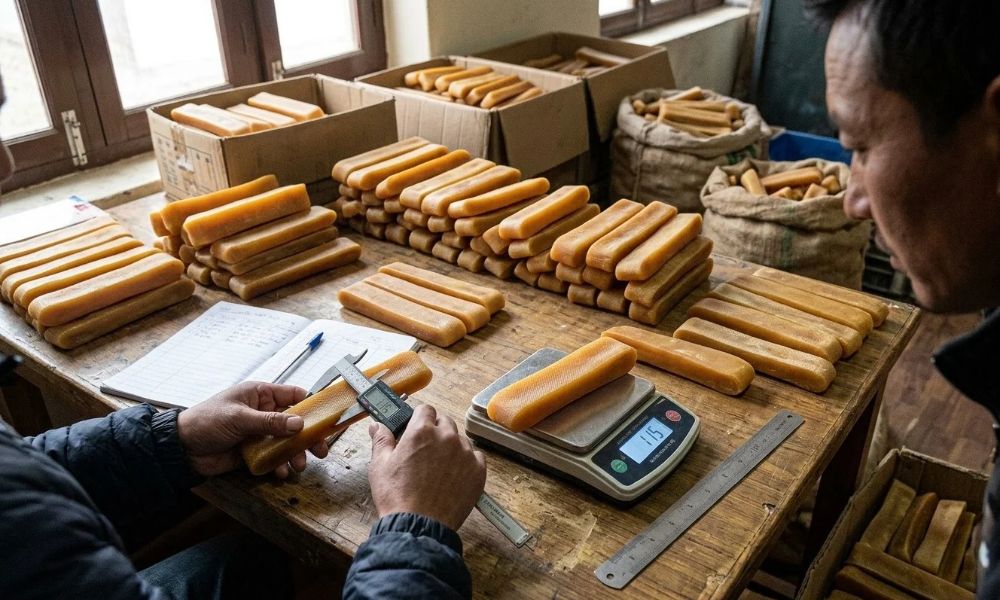
A sample order of 2 to 5 kg per size grade can test dimensions, hardness, odor, packaging, and laboratory results before a larger production commitment. We recommend the following process:
- Request a production sample from a current lot, including the lot code.
- Measure 30 pieces for weight and length.
- Send samples to an accredited laboratory for moisture and Salmonella testing.
- Run a retail trial with customers who own dogs of different sizes.
- Compare a second sample from a later lot against the first.
The final step reveals consistency, which is often the attribute buyers discover too late. Because courier samples may now be subject to duty, buyers should budget for sample shipping and import charges.
Export Documentation and Supply Chain Reliability
A complete yak chew export file should include a commercial invoice, packing list, certificate of origin, DFTQC export certificate, lot-specific COA, bill of lading or air waybill, FDA prior notice confirmation, and any required USDA APHIS permit.
We prepare export documentation, phytosanitary certificates, and product compliance records according to each destination market’s requirements. Buyers outside the US should confirm destination-specific biosecurity and import rules before ordering.
Reliable supply also depends on clear contract terms. Buyers should fix the Incoterm, payment structure, production schedule, quality specification, and remedy for late production before paying a deposit.
How Native Nepal Dog Chew Supports Bulk Yak Chew Wholesale Buyers?
Native Nepal Dog Chew is a Nepal-based Himalayan yak chew manufacturer and exporter. We supply wholesale, private label, and custom-packaged orders to buyers across North America, Europe, Asia-Pacific, and the Middle East.
We manage the full process from milk sourcing and production to shaping, packaging, labeling, laboratory testing, and export preparation. Our services include private label manufacturing, quality assurance, custom packaging, export documentation, and cargo support.
Wholesale Yak Chew Sourcing and Bulk Order Options
We produce chhurpi-based chews and ship worldwide. Order options include standard bulk cartons, private label production, and custom packaging. MOQs, per-kilogram pricing, and lead times are quoted per specification in a written quotation.
Request a wholesale quote by sharing your target sizes, quantity, destination country, and packaging requirements. We will also discuss sample availability, current production scheduling, and lead times for your route.
What Should Buyers Consider Before Placing a Wholesale Yak Chew Order?
Before paying a deposit, buyers should complete seven checks:
- Define the specification: size grades, flavors, piece weight band, and broken-piece allowance.
- Clarify the MOQ basis: per order, per SKU, or per size.
- Request pricing on one stated Incoterm and confirm what freight and duties include.
- Verify documents: FDA registration, ISO scope, and lot-specific COA.
- Test a production sample for weight, hardness, and laboratory results.
- Model landed cost using the applicable HTS classification and current tariff requirements.
- Plan a realistic sea-freight schedule and add a buffer during the monsoon.
Bulk yak chews wholesale pricing rewards buyers who define the specification first and negotiate volume second. Quality control, freight routing, packaging, and duty planning often affect total landed cost more than a small difference in the per-kilogram rate.