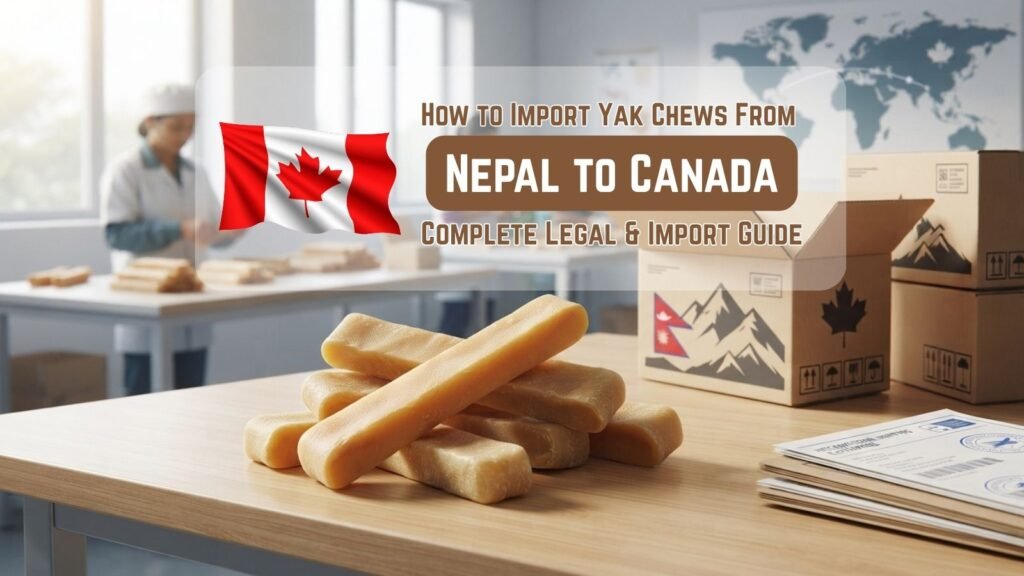
Importing yak chews from Nepal to Canada is a regulated animal-origin product trade that requires Canadian Food Inspection Agency (CFIA) eligibility verification, accurate HS tariff classification, Nepalese veterinary certification, batch-level microbiological testing, customs registration, and complete shipment documentation. Nepalese yak chews are traditionally dried dairy-based dog chews made primarily from yak milk, other milk, salt, and lime juice, with extended heat processing and drying that create a hard, shelf-stable product for dogs. Canadian importers must verify the product’s AIRS requirements, confirm Nepalese supplier and facility eligibility, obtain a DLS zoosanitary certificate and an accredited Certificate of Analysis (COA), align lot and product descriptions across every document, and complete Canada Border Services Agency (CBSA) clearance before distribution.
The Nepal-to-Canada yak chew trade combines growing demand for natural dog treats with a practical international supply chain through Kathmandu and Canadian gateways such as Toronto, Vancouver, and Montréal. Direct sourcing from Nepal can reduce procurement costs compared with Canadian distribution channels, while air freight supports smaller trial shipments and consolidated ocean freight reduces transportation costs at higher volumes. Compliance remains the central commercial requirement: importers need CARM and an active RM account, appropriate CFIA documentation, bilingual English-French retail labeling, moisture-protective packaging, microbiological controls, and a customs broker capable of handling animal-derived pet products. This guide explains the complete process for importing yak chews from Nepal to Canada, covering legal requirements, CFIA and CBSA procedures, supplier due diligence, required certificates, product testing, labeling, shipping, landed-cost calculation, common rejection risks, and the controls needed to build a compliant and scalable Canadian yak chew supply chain.
Are Yak Chews From Nepal Allowed Into Canada?
Yes, yak chews from Nepal are permitted to enter Canada, provided they meet the Canadian Food Inspection Agency’s animal health import conditions, carry accurate supporting documents, and pass applicable border inspection. No blanket prohibition exists on yak-milk-based chews from Nepal as of 2026.
Yak chews are classified as products of animal origin under Canada’s Health of Animals Regulations. That classification triggers import controls administered by the CFIA and enforced by the Canada Border Services Agency (CBSA). The product’s composition, processing method, and document accuracy determine whether a shipment clears on arrival or gets held.
Importers entering this category for the first time often assume that “natural” and “minimally processed” mean fewer regulatory requirements. That assumption is wrong. Any product derived from an animal, including dried yak milk, triggers animal health import requirements under Canadian law, regardless of how simple the ingredient list looks.
How Does CFIA Classify Simple Pet Chews?
The CFIA controls pet chews under the Health of Animals Regulations, defining them as products of animal origin (either single-ingredient or compound) intended for animal consumption but not for human food. Yak chews qualify as minimally processed non-bone chews when their composition contains only yak milk, cow or buffalo milk, along with minor processing agents like salt and lime juice, provided there are no synthetic flavours, chemical preservatives, or nutritional supplements.
This classification matters for 3 practical reasons:
- It determines which AIRS commodity code applies to the import declaration.
- It establishes what documentation the CFIA requires at the port of entry.
- It signals whether an import permit or facility questionnaire is triggered.
Misclassifying a yak chew as a pet food supplement or as a human food ingredient initiates a different and significantly more complex set of import conditions. The classification is not about what the chew looks like; it is about what the documentation says.
How Do Yak Chews Differ From Pet Treats and Compound Chews?
Yak chews contain no artificial additives, synthetic preservatives, or non-animal binding agents. Compound pet chews include added flavour enhancers, vegetable glycerin, grain fillers, or vitamin supplements introduced during manufacturing. Pet treats are flavoured, processed, and packaged for consumer appeal, often with shelf-stable coatings.
Yak chews are dried through natural boiling and kiln-drying or sun-drying without chemical preservatives. That processing difference creates 2 regulatory consequences in Canada:
- Simple yak chews follow a less complex CFIA documentation path compared to compound chews containing regulated additives.
- Compound chews with specific additives trigger additional scrutiny under the Canada Consumer Product Safety Act (CCPSA) when marketed as chew toys rather than consumables.
Importers confirm with their Nepalese supplier that the product composition matches the simple-chew classification claimed across all documents before placing an order.
Which Canadian Regulatory Authorities Oversee Yak Chew Imports?
3 federal agencies govern the import of yak chews into Canada: the CFIA, the CBSA, and Health Canada. Each agency plays a distinct role. A shipment does not receive final release until all 3 sets of requirements are satisfied.
- Health Canada becomes relevant when yak chews are marketed with health claims or positioned as human-grade food products. Importers structure product descriptions to remain within the pet-chew regulatory path and avoid the additional requirements that Health Canada oversight would introduce.
- The CFIA (Canadian Food Inspection Agency) is the primary regulator for animal-derived products. It verifies whether yak chews from Nepal meet animal health import conditions, reviews documentation, and conducts inspections at designated ports of entry.
- The CBSA (Canada Border Services Agency) manages customs clearance. It collects duties and taxes, enforces tariff classifications, and facilitates or holds shipments based on CFIA clearance status.
How Do You Import Yak Chews From Nepal to Canada?
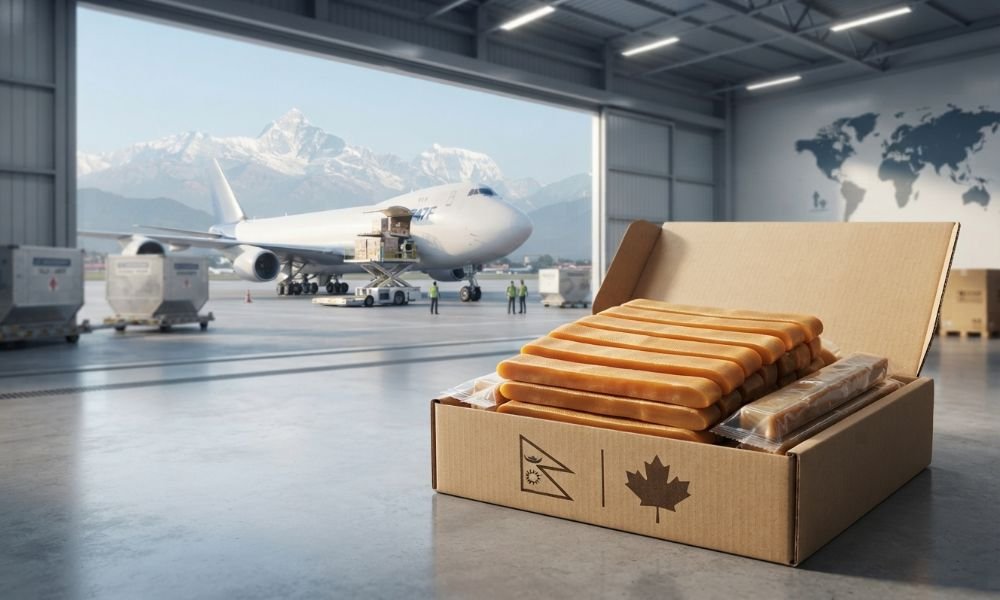
Importing yak chews from Nepal to Canada follows 11 sequential steps, from supplier verification to final delivery. Completing each step in order prevents the documentation gaps that cause CFIA holds after cargo has already departed.
1. Verify the Nepalese Yak Chew Supplier
Confirm 5 credentials before signing any purchase agreement: DFTQC registration, DLS veterinary export authority, full ingredient composition declaration, heat-treatment SOP, and batch traceability capability. Nepal’s Department of Food Technology and Quality Control (DFTQC) — designated by the Government of Nepal as the sole authority responsible for implementing and enforcing food and feed laws, quality control measures, and export certification throughout the country — must have the supplier’s manufacturing facility registered before any export can proceed. Separately, Nepal’s Department of Livestock Services (DLS) is the veterinary authority responsible for issuing zoosanitary certificates on animal-derived products, including yak chews. Both credentials are independently verifiable: Canadian importers can confirm DFTQC registration requirements on the official DFTQC government portal and request copies of both certificates from their supplier before placing a purchase order. A supplier without active authority from Nepal’s Department of Livestock Services (DLS) — the country’s veterinary regulatory authority since 1939 — cannot issue a valid zoosanitary certificate acceptable to CFIA border officers. Similarly, a supplier without current registration under Nepal’s Department of Food Technology and Quality Control (DFTQC) cannot obtain the export certification required before cargo departs. Canadian importers should request copies of both credentials directly from the supplier and cross-verify them against the official DLS and DFTQC government portals before issuing any purchase order, since CFIA document reviewers hold shipments pending verification of both. The heat-treatment SOP must document the exact temperature and duration of thermal processing because CFIA uses it to verify risk-mitigation compliance for animal-derived pet chews from countries with foot-and-mouth disease (FMD) presence. Batch traceability records must link each production batch to its raw material intake date, processing date, and finished product lot number, as these lot numbers must appear consistently across every export document.
2. Confirm Canadian Import Requirements
Run the commodity check using three inputs — product type (dried yak milk chew), country of origin (Nepal), and intended use (animal consumption/pet chew) — directly in the CFIA’s Automated Import Reference System (AIRS), then document the output and share it with your customs broker before issuing the purchase order. Since February 2024, AIRS has also performed automatic licence verification for manufactured foods, so any active licence number must appear correctly on the import declaration, or the shipment will be denied entry. The AIRS result defines the precise document set a CFIA border officer will look for when the shipment arrives. The Automated Import Reference System (AIRS) is CFIA’s online database that returns permit requirements, prohibited status, and conditions of entry for each commodity-country combination. Before importing, your company must create a business account on the CARM Client Portal (CCP) and digitally delegate authority to a licensed customs broker within the portal. To qualify for Release Prior to Payment (RPP), which allows shipment release before duties and taxes are paid, post a surety bond at a minimum of 50% of your highest monthly accounts payable to CBSA over the previous 12 months, or a cash deposit at 100% of the same figure, with a CAD $5,000 minimum floor per RM account for the surety bond option. Without RPP registration, CBSA holds the shipment at the border until full payment clears.
3. Verify Product Eligibility and Classification
Confirm Nepal’s country eligibility with CFIA for the dried animal-derived pet chew commodity category, then determine the correct 10-digit HS tariff classification and the applicable MFN duty rate. Two tariff classifications apply to yak chews: 2309.10 for dog or cat food put up for retail sale, and 2309.90.99 for bulk preparations used in animal feeding not elsewhere specified. The Most-Favoured-Nation duty rate on yak chews classified under HS 2309.90.99 (Preparations for animal feeding — other — other) is confirmed at 0% in the 2026 Canada Customs Tariff Schedule, Chapter 23. Nepal holds no preferential bilateral free trade agreement with Canada that would alter this MFN rate, though importers may also declare eligibility under the Least Developed Country Tariff (LDCT), which carries the same 0% rate for this subheading. Importers and customs brokers should verify classification directly against the current-year tariff PDF before filing the Commercial Accounting Declaration. Correct tariff classification determines 3 outcomes simultaneously: the customs duty rate at import, the CFIA regulatory program under which the shipment is reviewed, and the specific data fields required in the Commercial Accounting Declaration (CAD) submitted through CARM.
4. Prepare Required Certificates and Documents
Issue the purchase order to the supplier and specify 4 documentation requirements in writing: zoosanitary certificate format aligned with CFIA standards, COA from an ISO 17025-accredited laboratory, lot numbers on all documents, and commercial invoice product description alignment across all paperwork. Document preparation begins at purchase order issuance, not at shipment booking, because CFIA document review at the Canadian border matches lot numbers, product descriptions, and supplier details across all documents simultaneously. The zoosanitary certificate is issued by Nepal’s DLS and must identify the exporting facility, the product, covered lot numbers, and the veterinary health attestations CFIA requires for this commodity type. The Certificate of Analysis (COA) reports microbiological and compositional test results for the specific production lots, and the product description on the commercial invoice must use identical terminology to both the zoosanitary certificate and the COA. Any variation in terminology between documents, for example, “yak milk chew” on one document and “himalayan dog chew” on another, triggers a description mismatch that delays clearance.
5. Agree on Purchase Terms and Shipping Responsibilities
Agree on Incoterms in writing within the purchase order. Most Nepal-to-Canada yak chew shipments use FOB (Tribhuvan International Airport, Kathmandu) for air freight or FOB (Kolkata or Mumbai port) for sea freight, with the Canadian importer taking responsibility for freight, insurance, and customs from the FOB point forward. Incoterms 2020 defines 11 standard trade terms, and FOB is the most commonly applied in Nepal-origin exports because Nepalese suppliers manage export clearance through the FOB point independently. Nepal is landlocked, so sea freight routes overland to Kolkata (approximately 1,100 km from Kathmandu) or Mumbai (approximately 1,900 km) before loading onto an ocean vessel. Transit times are 5 to 9 days for air freight to major Canadian airports and 28 to 42 days for sea freight to major Canadian container ports.
6. Arrange International Freight and Cargo Insurance
Book freight with a freight forwarder experienced in Nepal-origin animal-derived products and obtain cargo insurance covering the declared commercial value plus a minimum of 10%. The freight forwarder manages 4 functions: carrier booking, air waybill or bill of lading issuance, ACI submission coordination, and document transmission to the Canadian customs broker before cargo departure. For air cargo arriving in Canada, the freight forwarder submits pre-arrival data to CBSA through the Advance Cargo Information (ACI) system at least 4 hours before the aircraft’s scheduled arrival. For ocean cargo, ACI submission is required at least 24 hours before loading at the foreign port.
7. Complete Export Customs Clearance in Nepal
The Nepalese supplier completes all 3 Nepal export clearance actions before cargo departure: DLS issues the zoosanitary certificate, DFTQC issues the export certification, and all documents are transmitted to the Canadian importer’s freight forwarder before cargo departs. Suppliers offering Nepal yak chew export services manage this three-step coordination on the importer’s behalf, reducing the risk of documentation discrepancies before departure. The zoosanitary certificate is issued by DLS after veterinary inspection of the production facility and a review of the specific production lots in the shipment. The DFTQC export certificate confirms that the product passed Nepal’s domestic export quality review, and the Nepalese customs export declaration confirms the goods, their declared FOB value, and their destination country. All 3 documents must carry the same lot numbers that appear on the commercial invoice and COA; any discrepancy triggers a CFIA documentation hold at the Canadian border.
8. Submit Canadian Customs and Import Documentation
Your delegated customs broker submits a Commercial Accounting Declaration (CAD) to the CBSA via the CARM system. For air cargo, ACI submission is required at least 4 hours before the aircraft’s scheduled arrival; CFIA-required documents are lodged with the applicable CFIA district office before or at the time of arrival. The CAD includes the tariff classification, the declared value for duty, the importer of record details, and all commodity-specific data fields required for animal-derived pet chews. CFIA district offices are located at all major Canadian international airports and seaports, and the CFIA document review process begins only after lodging is confirmed.
9. Complete Applicable CFIA and Border Inspection
CFIA border officers review documents on all yak chew shipments, with a percentage selected for physical inspection and laboratory sampling. Document release takes 1 to 3 business days; laboratory analysis on detained shipments adds 10 to 21 days to the clearance timeline. Physical inspection adds 1 to 2 business days and confirms that goods match documents in species composition, quantity, lot numbers, and labeling. Shipments held for laboratory analysis are stored in a bonded facility, incurring daily storage charges, and CBSA does not issue release until CFIA laboratory results confirm compliance. Shipments from new importers, suppliers with prior compliance violations, and consignments flagged by CBSA risk profiling face higher inspection selection rates.
10. Pay Duties, Taxes, Brokerage, and Clearance Charges
CBSA calculates and collects customs duty and federal GST at clearance. Yak chews classified under 2309.90.99 attract a 0% MFN customs duty rate as of 2026; GST at 5% applies to the Value for Duty (VFD), which is the FOB transaction price excluding international freight and insurance. With 0% customs duty, the GST base equals the FOB value directly; a shipment with a CAD $20,000 FOB value attracts CAD $0 in duty and CAD $1,000 in GST (5% × $20,000). Provincial Sales Tax (PST) is not collected by CBSA at the border on commercial goods imported for resale; the importer remits PST through provincial tax filings. Brokerage fees, bonded warehouse storage charges, and freight forwarder disbursements are invoiced separately and are not included in the CBSA duty and GST calculation.
11. Obtain Shipment Release and Arrange Final Delivery
Once CBSA issues the release, the customs broker transmits the release notification to the freight forwarder or carrier. The shipment moves from the port-of-entry facility, bonded warehouse, or airport cargo terminal to the importer’s warehouse or distribution address within 1 to 3 business days of release. For RPP-registered importers, release precedes duty and GST payment; CBSA collects both charges through the CARM account statement cycle, typically on a monthly basis. The importer inspects the delivery against the purchase order, commercial invoice, and COA lot numbers before accepting it into inventory.
What Canadian Import Requirements Apply to Yak Chews?
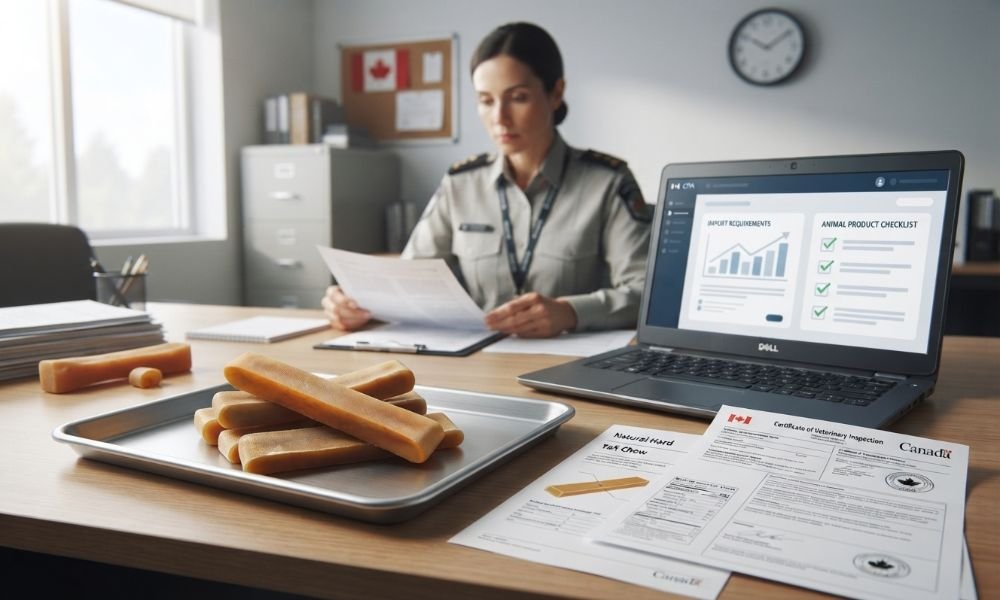
Canadian import requirements for yak chews include CFIA animal health documentation, accurate HS tariff classification, and microbiological testing completed before shipment departure. The specific set of requirements depends on composition, country of origin, and declared intended use.
CFIA Animal Health Requirements
The CFIA requires all products of animal origin to meet the import conditions specified in the Health of Animals Regulations. For pet chews specifically, the CFIA’s Import Policies for Animal Products and By-Products — which carry standing updates, with the most recent notices published in May 2025 — classify integumentary tissues imported as pet chews and treats as a distinct regulated commodity category under the Health of Animals Regulations. That policy page also specifies an Importer’s Statement of Compliance for pet chews containing animal products and by-products, a separate compliance document that importers should review before the first shipment departs Nepal. Importers should check the policy page directly before any shipment, since CFIA updates import conditions without prior notice. For yak chews from Nepal, this includes:
- Confirmation that the product originates from animals that were healthy at the time of milking
- Evidence of processing methods that reduce pathogen risk, specifically heat treatment or extended drying, is documented at specified temperatures.
- Country and establishment eligibility verification through the CFIA’s Import Control List and the AIRS system
Importers verify Nepal’s eligibility status for the specific commodity category before placing any purchase order. Discovering an eligibility gap after cargo has already departed Nepal is one of the most expensive mistakes on this trade route.
Health of Animals Act and Regulations
The Health of Animals Act (S.C. 1990, c. 21) — current to June 17, 2026 — and the Health of Animals Regulations (C.R.C., c. 296) are the primary legislative instruments governing animal product imports into Canada. Under Section 14 of the Act, the Minister holds authority to prohibit the importation of any animal or other thing into Canada, providing the statutory foundation for every CFIA import condition applied to yak chews. Importers can access the full text of both instruments on the Justice Canada laws portal to verify the exact documentation requirements before placing a purchase order. Under Section 16 of the Regulations, products of animal origin require documentation confirming:
- Animal species of origin (yak Bos grunniens)
- Country and region of animal origin
- Processing method applied to the product
- Certification by a competent veterinary authority in the exporting country
Every one of these 4 elements must appear across the supporting documents. Missing any one of them is grounds for a CFIA document hold.
AIRS Import Requirement Verification
AIRS (Automated Import Reference System) is the CFIA’s online tool that specifies the exact import requirements for any animal-derived commodity by product type, country of origin, and intended use. Importers enter those 3 variables into AIRS and receive the official list of required conditions and documents.
AIRS verification is the single most critical pre-import action in this process. It tells the importer exactly what a CFIA border officer looks for when the shipment arrives at the port of entry. Running AIRS before ordering from Nepal prevents requirement mismatches discovered after goods are already in transit over Nepal’s border.
Country and Establishment Approval Considerations
The CFIA maintains country-specific eligibility lists for animal-derived products. Nepal’s approval status for yak milk products differs from its approval status for fresh meat or poultry. Importers verify the specific commodity category, not just the country name.
For processed dairy-origin chews that have undergone documented heat treatment to pathogen-destruction standards, country approval requirements are typically less restrictive than for raw or minimally processed animal products. Importers document the heat-treatment process and temperatures in their supplier records to support the eligibility claim at the border. Suppliers already compliant with US yak chew import standards for heat-treatment documentation typically have these process records readily available.
What Must Canadian Importers Do Before Ordering Yak Chews?
Canadian importers complete 4 administrative registrations before placing the first purchase order: obtain a CRA Business Number with an RM import account, register with CARM, establish customs broker responsibilities, and confirm HS tariff classification.
Business Number and RM Import Account
The Canada Revenue Agency (CRA) issues a Business Number (BN) to all registered Canadian businesses. Importers who plan to clear goods through CBSA require an RM (import) sub-account linked to their BN. The RM account format is 15 digits: a 9-digit BN followed by “RM” and a 4-digit account reference.
A new importer without an active RM account cannot clear goods at any Canadian port of entry. Registration takes 5–10 business days through the CRA’s Business Registration Online (BRO) portal.
CARM Registration and Customs Account Setup
The CBSA Assessment and Revenue Management (CARM) system became the official system of record for all import duty and tax accounting on October 21, 2024, replacing over nine legacy CBSA systems in one release. All importers transacting with CBSA must register through the CARM Client Portal: over 93,000 importers had completed registration by September 2024, representing approximately 95% of Canada’s top importers by volume and value. CARM registration requires a valid CRA Business Number (BN9), a Government of Canada login credential, and business banking information for duty payment — all managed centrally through the portal.
CARM registration requires a valid CRA BN with an RM sub-account, a Government of Canada login (GCKey or Sign-In Partner), and business banking information for duty payment. Importers who delegate customs clearance to a licensed customs broker grant that broker delegated authority within the CARM portal.
Importer and Customs Broker Responsibilities
The importer of record bears full legal responsibility for the accuracy of every declaration made at the Canadian border. A licensed customs broker handles the technical submission of documentation but does not assume liability for incorrect product descriptions, false valuations, or missing CFIA documents.
Most first-time yak chew importers work with a licensed customs broker who handles CBSA filings, CFIA document coordination, and duty calculations. The broker’s value is not in taking responsibility; it is in knowing where the documentation gaps occur before the shipment arrives.
Product Classification and Intended Use
Yak chews fall under 2 possible HS (Harmonized System) chapters in Canada depending on composition and declared use:
- HS 23.09.90.99: Preparations for animal feeding (the applicable classification for dried yak chews marketed as pet chews)
- HS 04.06.90: Cheese and curd (applies when the product is presented as a dairy product rather than a pet chew)
The classification determines the applicable duty rate, CFIA documentation requirements, and whether the product falls under Canada’s supply management system for dairy, which carries substantially higher duty rates. Importers obtain a formal advance tariff classification ruling from CBSA when classification is ambiguous.
What Should Canadian Importers Verify About a Nepalese Supplier?
Canadian importers verify 4 critical aspects of a Nepalese yak chew supplier before committing to a purchase agreement: facility and export credentials, product composition, processing controls, and batch traceability records. For a structured due diligence framework, the guide on choosing a reliable yak chew manufacturer outlines the specific credentials and questions to assess before signing any purchase agreement.
Manufacturing Facility and Export Experience
Nepalese yak chew manufacturers exporting to regulated markets in the USA, EU, UK, and Canada operate under Nepal’s Department of Food Technology and Quality Control (DFTQC) and, for animal-derived products, under veterinary authority certification from the Department of Livestock Services (DLS).
Importers verify:
- DFTQC facility registration certificate for the manufacturing site
- Prior export records to Canada or equivalent regulated markets
- Nepal Veterinary Council or DLS authority recognition for health certificate issuance
Facilities with documented export history to the EU or USA demonstrate the operational capability to generate compliant documentation for Canadian entry. A supplier producing only for domestic Nepali markets has not generated zoosanitary certificates and almost certainly cannot produce one to CFIA standards on the first attempt.
Animal-Origin Materials and Product Composition
Traditional yak chews contain 4 ingredients: yak milk (Bos grunniens), cow or buffalo milk, lime juice (calcium hydroxide), and salt. Variation exists between manufacturers. Some add smokiness through kiln drying. Others use extended sun drying.
Importers obtain a full ingredient declaration with percentage composition from their supplier before placing the first order. This declaration forms the basis of the commercial invoice product description and must align with the zoosanitary certificate’s commodity description. Any undisclosed additive, even a common one such as carrageenan or glycerol, changes the regulatory classification and triggers a shipment hold.
Processing, Drying, and Heat-Treatment Controls
Pathogen reduction is the primary processing concern for animal-derived pet chews. Yak chews are heat-processed during boiling, typically at 80–95°C for 15–30 minutes, and then dried for 20–45 days, depending on the facility’s method.
Canadian import conditions for processed animal-origin products recognize extended drying at documented temperatures as a pathogen-mitigation step. Importers obtain 3 specific records from their supplier before shipment:
- Written SOPs (Standard Operating Procedures) for heat treatment and drying
- Temperature logs or process records demonstrating compliance with stated temperatures
- Third-party audit reports if the facility has undergone external food safety certification
Facilities that cannot provide documented temperature records create a gap that CFIA inspectors flag during document review.
Batch Traceability and Quality Records
Batch traceability connects each production lot to the raw materials used, the animals supplying milk, the processing dates, and the finished-product test results. This chain supports a rapid recall response if a microbiological issue is detected post-import.
Importers require lot-level records including: the unique lot number assigned at production, the raw milk sourcing record (region, herd, collection date), the processing and drying completion date, and the finished-product test result referenced by lot number.
What Documents Are Required to Import Yak Chews Into Canada?
Importing yak chews from Nepal to Canada requires 5 primary documents and, in some cases, 2 additional conditional documents based on AIRS output.
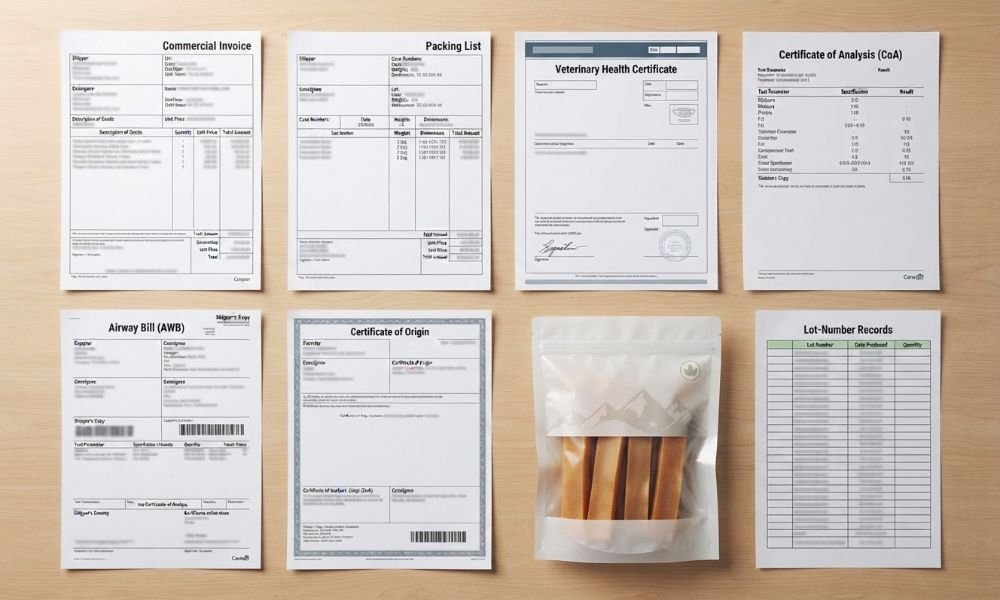
Commercial Invoice
The commercial invoice states the buyer, seller, product description, quantity, unit price in USD or CAD, total declared value, HS code, and Incoterms governing the shipment. CBSA uses this document to assess customs value and apply the applicable duty rate.
The product description on the commercial invoice must match the description on all other documents. A mismatch between “pet food” on one document and “pet chews” on another is enough to trigger a customs query that adds days to clearance.
Packing List
The packing list details each carton in the shipment: units per carton, net weight, gross weight, dimensions, and lot numbers. CFIA inspectors use the packing list to verify physical quantities against declared quantities and to match lot numbers to Certificate of Analysis results.
Certificate of Origin and Proof of Origin
The Certificate of Origin declares Nepal as the country of manufacture and production. It supports the applicable tariff treatment under Canada’s General Tariff. While Nepal lacks a direct FTA, it is a beneficiary of Canada’s Least Developed Country Tariff (LDCT). Importers should declare LDCT treatment, though the MFN rate for HS 2309.90.99 is also currently 0%.
Zoosanitary Certificate
The zoosanitary (animal health) certificate is issued by Nepal’s Department of Livestock Services (DLS) and certifies the animal health status of the product, species of origin, processing method applied, and the exporting facility’s registration status. Partnering with a dog chew manufacturer in Nepal that exports regularly to the USA, EU, or UK ensures this certificate is issued correctly across repeated shipments.
This is the document most frequently questioned by CFIA border officers. Common deficiencies include: missing official veterinary signature or stamp, vague commodity descriptions that do not match the commercial invoice, and no reference to heat treatment method or temperature. Each of these deficiencies, on its own, is grounds for a document hold.
Certificate of Analysis and Bacterial Testing Results
The Certificate of Analysis (COA) reports the microbiological test results for each production lot. Testing covers Salmonella spp., E. coli O157, Listeria monocytogenes, aerobic plate count (APC), and yeast/mould counts.
COAs issued by ISO 17025-accredited third-party laboratories carry more regulatory weight than in-house test results. Importers specify accredited laboratory testing in their supplier purchase agreements before the first order, not after the first hold.
Import Permit or Facility Questionnaire When Required
AIRS specifies whether the specific yak chew commodity from Nepal triggers an import permit requirement or a facility questionnaire. Not all yak chew shipments require these additional steps. Importers confirm through AIRS before shipment departure, not after the cargo has cleared Nepal customs.
What Product Safety and Testing Requirements Apply to Yak Chews?
Yak chews imported into Canada require microbiological testing at the batch level before shipment departure. Testing occurs at the Nepalese manufacturing facility using ISO 17025-accredited laboratories, and results accompany each shipment as mandatory supporting documentation.
Independent Laboratory Bacterial Testing
ISO 17025-accredited independent laboratories provide test results with internationally recognized validity. Testing commissioned by the manufacturer at an unaccredited in-house facility is not accepted as equivalent by CFIA inspectors. The accreditation status of the laboratory appears on the COA header; inspectors check it.
Salmonella and Other Applicable Microbiological Testing
Salmonella spp. Testing is mandatory for all animal-origin pet chews entering Canada. The acceptable standard is the absence of Salmonella in a 25-gram sample of the product. Additional parameters tested per lot include:
- E. coli O157:H7: Absence in 25g
- Listeria monocytogenes: Absence in 25g
- Aerobic Plate Count (APC): ≤ 100,000 CFU/g (typical standard for dried processed chews)
- Yeast and mould: ≤ 10,000 CFU/g
Lot Numbers and Document Matching
Every COA lot number must appear on the corresponding packing list carton markings and on the commercial invoice line items. A mismatch between the lot number on the COA and the lot number on carton labels is one of the 3 most common causes of CFIA document rejection. The fix is simple; the failure to check is not.
Preventing Cross-Contamination After Heat Treatment
Cross-contamination of heat-treated product with raw materials is the primary food safety failure mode in yak chew production. Importers verify through supplier audits or questionnaires that physical separation exists between raw and processed areas, with documented sanitation logs for shared equipment and surfaces.
What Labeling and Packaging Rules Should Yak Chews Meet?
Yak chew labeling for the Canadian market requires 4 mandatory elements: product identity with ingredient list, net quantity in metric units, country-of-origin declaration, and lot-level traceability information.
Product Identity and Ingredient Information
The package label identifies the product as “Yak Chew” or “Himalayan Dog Chew” and lists all ingredients in descending order of weight: yak milk, cow milk, lime juice, salt. No ingredient can be omitted or substituted without updating the label before retail distribution.
Net Quantity and Packaging Details
Net quantity appears in metric units, grams or kilograms, for the Canadian market. Bilingual labelling in English and French is mandatory for consumer retail packages sold in Canada. Under Section 4(1) of the Consumer Packaging and Labelling Act (R.S.C., 1985, c. C-38), no dealer may sell, import into Canada, or advertise any prepackaged product unless the label carries a declaration of net quantity in both official languages, displayed clearly on the principal display panel in a manner that is easily legible and in distinct contrast to surrounding information. Yak chew retail packages failing this bilingual requirement at the Canadian border face relabelling in a bonded warehouse before retail release — adding both cost and clearance delay. Importers who sell directly to Canadian retailers without bilingual labels face retail rejection.
Country-of-Origin and Traceability Information
“Product of Nepal” appears prominently on the retail package. The manufacturer’s name, address, and lot number appear on the package to support recall traceability. The Canadian importer’s business name and address can be added as the importer of record.
Packaging That Protects the Chews During Transit
Yak chews are hygroscopic – they absorb moisture readily. Retail packaging uses moisture-barrier materials such as metallized polyethylene with heat-sealed seams. Outer shipping cartons include desiccant packets to maintain product integrity through air transit (24–36 hours) or ocean transit (35–55 days via Kolkata or Mumbai). Moisture-compromised chews grow mould and fail APC testing.
How Much Does It Cost to Import Yak Chews From Nepal?
Total landed cost for a standard yak chew shipment from Nepal to Canada ranges from USD $10.00 to $19.00 per kilogram, depending on product grade, freight mode, order volume, and inspection outcomes.
Product and Supplier Costs
Ex-factory prices for yak chews from Nepalese manufacturers range from USD $4.00 to $9.00 per kilogram by size grade and quality tier. Minimum order quantities typically start at 100 kg. Importers building a consistent wholesale yak chew supply arrangement benefit from volume pricing at 500 kg and above with most established exporters.
Freight, Insurance, and Handling Costs
Air freight from Kathmandu (TIA) to Canadian gateway airports Toronto Pearson (YYZ), Vancouver International (YVR), or Montréal Trudeau (YUL) costs USD $3.50 to $7.00 per kilogram for general cargo. Sea freight via Kolkata or Mumbai adds 35–55 days of transit time but reduces per-kilogram freight cost to USD $0.80 to $1.80 in consolidated container shipments. Cargo insurance adds 0.5–1.2% to the declared commercial value.
Customs Duties, Taxes, and Brokerage Fees
Customs duty on yak chews under HS 23.09.90.99 at the MFN tariff rate: 0%. GST: 5% of the duty-paid value. Customs broker fees range from CAD $150 to $500 per shipment, depending on complexity and the broker’s fee schedule.
Inspection, Testing, Permit, and Documentation Costs
COA testing per production lot from an ISO 17025-accredited laboratory: USD $80 to $250, depending on parameter count. CFIA import permit fees, when applicable: CAD $30 to $100. Nepal export documentation through DFTQC and DLS: USD $50 to $150 per shipment.
How Can Importers Estimate Their Landed Cost?
The table below shows landed cost components for a sample 200 kg air freight shipment of yak chews from Nepal to Canada. All values are in USD.
| Cost Component | Estimated Amount (USD) |
| Product cost (200 kg × $6.50/kg) | $1,300.00 |
| Air freight (200 kg × $5.00/kg) | $1,000.00 |
| Cargo insurance (1% of $1,300) | $13.00 |
| Customs duty (0% MFN rate) | $0.00 |
| Canadian GST (5% of $1,300 Value for Duty) | $65.00 |
| Customs broker fee | $200.00 |
| COA laboratory testing (1 lot) | $150.00 |
| Nepal export documentation (DFTQC + DLS) | $100.00 |
| Total landed cost | $2,828.00 |
| Per kilogram landed | $14.14 USD |
Retail margins for yak chews sold through Canadian pet specialty retailers range from 40% to 60% of the retail selling price. A landed cost at or below CAD $20.00/kg supports competitive retail positioning at most price points in the Canadian pet chew category. Pet store buyers and distributors entering this category can consult the yak chew wholesale sourcing guide for minimum order benchmarks and pricing structures before approaching Nepalese suppliers.
What Can Delay or Cause a Yak Chew Shipment to Be Rejected?
6 categories of errors cause yak chew shipment delays or outright rejection at the Canadian border: documentation deficiencies, classification errors, failed microbiological testing, unapproved supplier records, labeling problems, and customs filing errors.
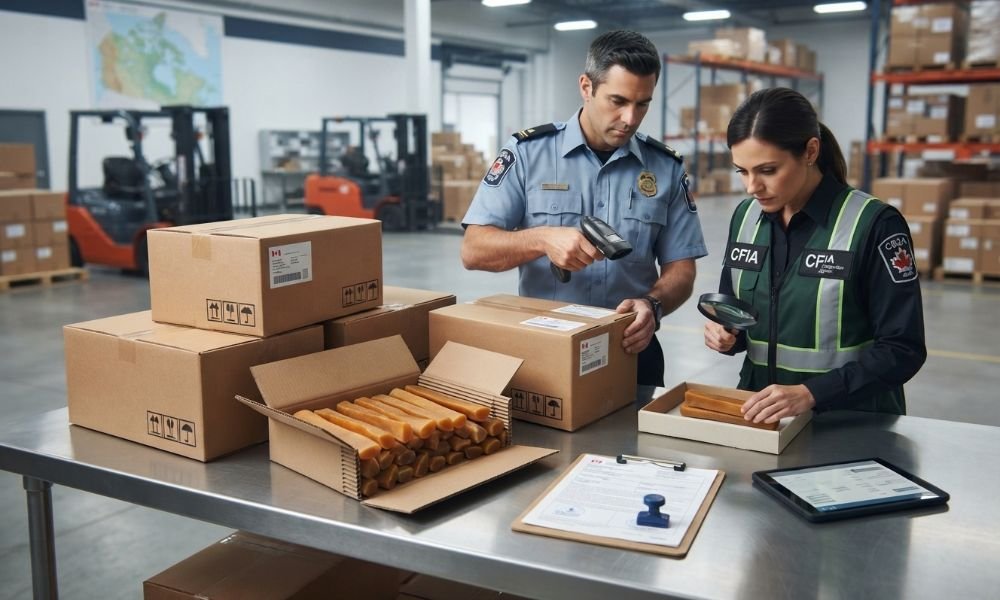
Missing or Incorrect CFIA Documentation
A zoosanitary certificate with a missing official stamp, an unsigned section, or a vague commodity description that does not match the commercial invoice triggers a formal CFIA query. Resolving a documentation hold adds 3–10 business days to clearance while cargo sits in bonded storage at the importer’s cost.
Incorrect Product Classification
Classifying a yak chew under Chapter 04 (dairy) rather than Chapter 23 (animal feeding preparations) can activate Canada’s tariff rate quota (TRQ) for dairy products, which carries substantially higher over-quota duty rates and supply management restrictions. An advance tariff classification ruling from CBSA before the first shipment costs almost nothing. Resolving a misclassification hold after cargo arrives costs significantly more.
Failed or Missing Laboratory Testing
A COA reporting a positive Salmonella result, or a shipment arriving without a COA, results in mandatory CFIA laboratory testing of the detained shipment. CFIA testing adds 10–21 days to clearance. Shipments with confirmed Salmonella contamination are refused entry and must be destroyed or re-exported at the importer’s expense.
Unapproved or Incomplete Supplier Documentation
A manufacturing facility that has not completed a CFIA facility questionnaire when the AIRS conditions require one cannot legally supply goods that enter Canada. Importers verify facility approval status before the first purchase order, not after the first shipment arrives.
Packaging, Labeling, or Traceability Problems
Retail packages without bilingual English and French labeling, missing “Product of Nepal” declarations, or absent lot numbers fail Canadian retail labeling requirements. Products failing labeling compliance at the border require relabeling in a bonded warehouse before retail release, adding both cost and delay to the importer’s timeline.
Customs and Border Clearance Errors
Incorrect declared commodity values on the B3 customs entry, quantity mismatches between the B3 and the packing list, or late ACI submission, required at least 4 hours before aircraft arrival for air cargo, all trigger customs queries, amendment processes, or physical examination orders that extend clearance timelines.
What Can Native Nepal Dog Chew Provide to Canadian Importers?
Native Nepal Dog Chew is a Nepal-based yak chew manufacturer with documented Canadian import documentation capabilities, including zoosanitary certificate issuance through DLS, ISO 17025-accredited COA testing, DFTQC-registered manufacturing, and export packaging configured for Canadian retail labeling compliance.
Canadian importers working with Native Nepal Dog Chew receive:
- Pre-verified export documentation packages aligned with CFIA import requirements, reviewed for document consistency before cargo departure
- Lot-traced production records with matching COA lot numbers for each shipment, with no mismatches
- Heat-treatment records documenting boiling temperatures and drying durations by lot
- Flexible order sizes starting at 100 kg, with consolidated shipping options for importers entering the category at smaller volumes
- Packaging with country-of-origin markings, lot number placement, and moisture-barrier materials that meet Canadian retail requirements
Canadian pet retailers, e-commerce businesses, and wholesale distributors entering the yak chew category benefit from working with a supplier whose export documentation history reflects experience with regulated markets. Contact Native Nepal Dog Chew to request a product sample kit, COA samples from recent production lots, and a documentation package formatted for CFIA pre-review.
What Are the Key Takeaways for Importing Yak Chews From Nepal?
Importing yak chews from Nepal to Canada is a legally viable, commercially attractive trade route in 2026. It rewards importers who complete pre-import compliance work and penalizes those who discover documentation gaps after cargo has cleared Nepal customs.
7 actions determine whether a yak chew import succeeds or faces a costly hold:
- Run AIRS for yak chews from Nepal before placing any purchase order; it defines the documentation set.
- Classify under HS 23.09.90.99 and obtain a CBSA advance ruling if any ambiguity exists to avoid dairy TRQ complications.
- Register with CARM and activate the RM import account before the first shipment departs Nepal.
- Select only DFTQC-registered suppliers with active DLS export authority; suppliers without these credentials cannot generate valid zoosanitary certificates.
- Require ISO 17025-accredited COA testing with lot numbers matching every document in the shipment package.
- Align all document descriptions across the commercial invoice, packing list, zoosanitary certificate, and COA before cargo departure.
- Work with a licensed customs broker experienced in animal-derived pet products, specifically someone familiar with CFIA document requirements for Nepal-origin animal chews.
The yak chew import process is a documentation-management discipline as much as it is a logistics exercise. Shipment holds at the Canadian border for document deficiencies cost more in daily bonded storage, CFIA testing fees, and broker amendment charges than the compliance work required to prevent them. Canadian importers who invest time in pre-import verification before their first Nepal shipment build supply chains that scale. Those who skip that work spend it resolving holds instead.