
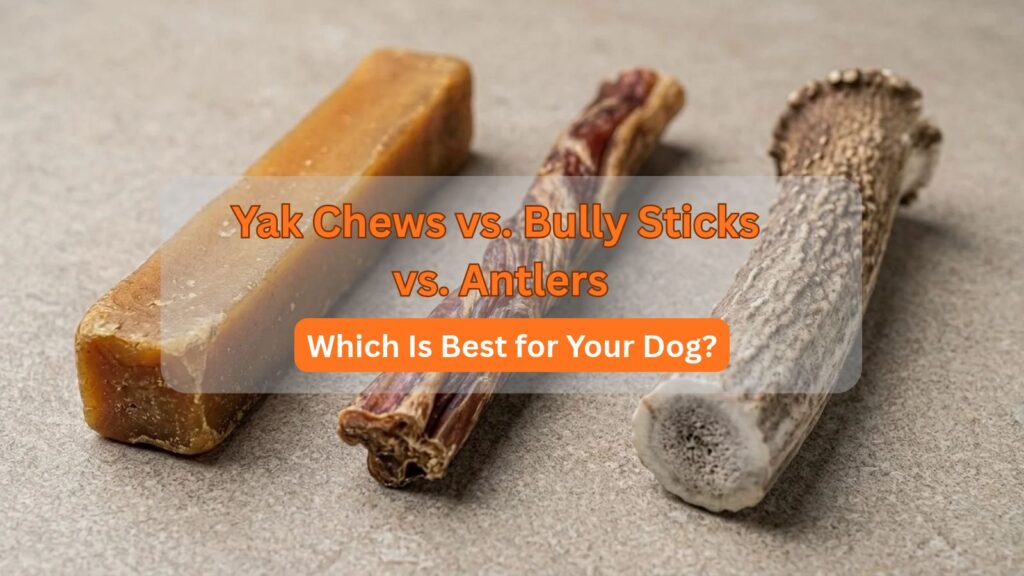
Yak chews, bully sticks, and antlers are three natural dog chews made from dairy, bovine tissue, and shed antler bone, respectively, with distinct differences in hardness, digestibility, chewing duration, and dental safety. Himalayan yak chews, traditionally known as chhurpi, are protein-dense, low-fat cheese chews made primarily from yak and cow milk; bully sticks are single-ingredient dried beef pizzle; and natural antler chews are mineral-dense elk, deer, or moose antlers that dogs barely digest. Bully sticks generally present a lower tooth-fracture risk; size-matched yak chews offer a balance of durability, high digestibility, and cost, while antlers last longest but carry a significant risk of dental fractures. Choosing the right dog chew depends on five practical considerations: chewing strength, age, dental health, digestive tolerance, and chew size. Veterinary dental guidance, including the fingernail test, helps owners assess hardness and reduce preventable injuries.
This comprehensive comparison of yak chews vs. bully sticks vs. antlers examines ingredients, nutritional value, protein and fat content, hardness, chewing time, retail prices, and cost per chewing hour. It explains the risks of fractured teeth, choking, intestinal blockage, and bacterial contamination, alongside chew suitability for puppies, senior dogs, aggressive chewers, and dogs with sensitive stomachs. The guide also covers plaque management, calorie intake, product quality checks, ingredient transparency, food-safety testing, and safe chewing practices. Native Nepal Dog Chew’s Himalayan chhurpi manufacturing process provides additional context on traditional milk-based chews, including hard and puffed formats, sourcing, production standards, USDA APHIS import clearance, and batch testing. Practical recommendations help dog owners match chew types and sizes to individual needs while comparing the advantages and limitations of all three options.
What Are Yak Chews, Bully Sticks, and Antlers?
Yak chews are hard cheese chews made primarily from yak and cow milk, bully sticks are dried beef pizzle, and antlers are naturally shed deer or elk bone. The 3 chews come from dairy, bovine tissue, and bone, and that source determines digestibility, hardness, and chew time.
Each chew has a distinct origin and production method. The 3 definitions below set the foundation for every comparison that follows.
What Are Himalayan Yak Chews (Chhurpi)?
Himalayan yak chews, called chhurpi in Nepal, are hard cheese bars made by curdling yak and cow milk with lime juice, pressing the curd, and drying it for several weeks.
Chhurpi is a traditional food of Himalayan herding communities in Nepal, Bhutan, Tibet, and Sikkim. Herders eat it as a protein-dense snack, and the same recipe was commercialized as a dog chew in 2007.
Production follows 5 steps: milk collection, pasteurization, coagulation, pressing, and slow drying. Native Nepal Dog Chew bars contain 99% yak and cow milk plus lime juice and salt, with no artificial preservatives, binders, or flavor enhancers. We cut each bar into 5 sizes, from small to king size, so the chew matches the dog’s weight band and mouth width.
Yak chews come in 2 forms. Hard bars and nuggets last hours. Puffed bars and nuggets are airy and crunchy, and dogs finish them in minutes.
What Are Bully Sticks Made From?
Bully sticks are single-ingredient chews made from the dried penis of a bull or steer, composed of smooth muscle and connective tissue, labeled “pizzle” on packaging.
Pizzle is bovine vascular tissue. A quality stick runs roughly 80–90% protein and 1–5% fat on a dry-matter basis. Beef processors supply the raw material as a byproduct of cattle processing, and producers dry, smoke, or bake it into lengths of 4, 6, or 12 inches. Thin, jumbo, braided, and ring shapes all exist.
Some producers wash and bake sticks to cut odor, and some irradiate them to kill bacteria. Researchers at Tufts University’s Cummings School of Veterinary Medicine and the University of Guelph noted in 2013 that many owners and veterinarians could not name the source of bully sticks. The label tells you what you are buying.
What Are Natural Antler Chews for Dogs?
Natural antler chews are shed elk, deer, or moose antlers cut into lengths and sold whole or split lengthwise.
Antler is bone, built from calcium and phosphorus minerals. Male deer and elk shed their antlers every year, so collectors gather them from the ground without harming the animal. A whole antler has a dense outer shell and a porous cancellous bone core. A split antler exposes the core, which gives the dog a softer surface to gnaw, but the shell stays rock hard. Density varies by species, animal age, and cut. A dog digests only the tiny shavings it swallows, and the bulk of the antler is largely indigestible.
How Do Yak Chews, Bully Sticks, and Antlers Compare?
Yak chews deliver low fat and a mid-range chew time, bully sticks deliver high protein density and shorter chew times, and antlers deliver the longest chew time with minimal digestibility.
The table below compares the 3 chews across 6 attributes, using manufacturer-guaranteed analyses, published research, and 2026 US retail listings.
| Attribute | Yak chew | Bully stick | Antler |
|---|---|---|---|
| Source | Yak and cow milk, lime juice, salt | Dried beef pizzle | Shed elk or deer antler |
| Typical analysis | 52–74% protein as-fed (≥60% dry-weight), 1–4% crude fat, 10–14% moisture, ~90–105 kcal/oz | 80–90% protein (dry-matter), 1–5% fat, 9–22 kcal per inch | Calcium and phosphorus minerals |
| Digestibility | Highly digestible | Highly digestible | Minimal |
| Hardness | Hard bars fail fingernail test when dry (soften with saliva); puffed chews pass | Firm and flexible, fingernail indents it | Rock hard, no indent |
| Typical chew time | Hard bars: 2–10+ hours; Puffed chews: 5–20 minutes | 15–45 minutes | 12 hours to several weeks |
| 2026 US retail price per chew | $6–$23 | $4–$12 | $13–$38 |
The table shows one pattern: durability rises as digestibility falls. Antlers sit at the end of both scales.
Differences in Ingredients and Nutritional Value
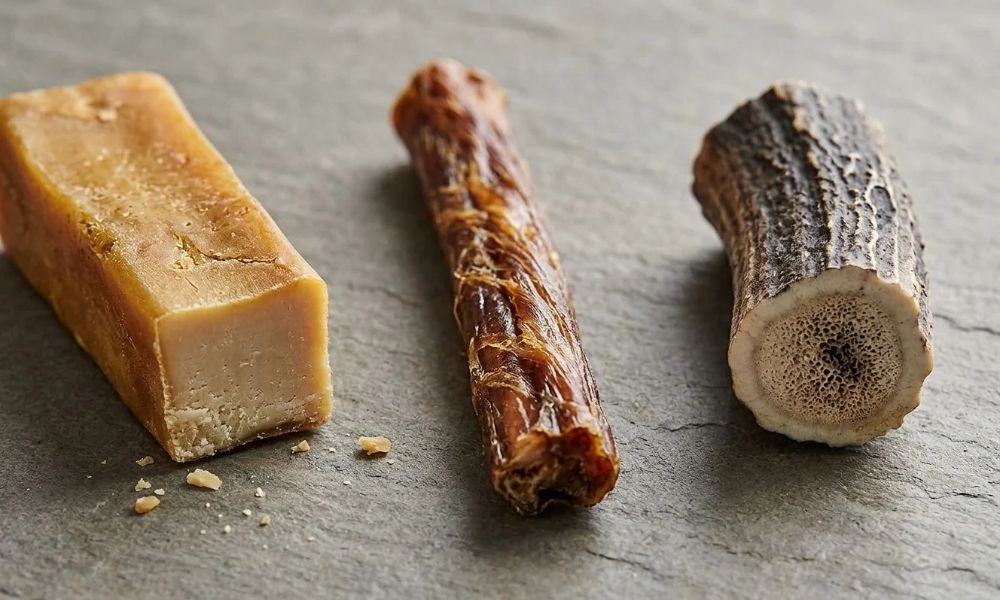
Yak chews supply milk protein and calcium, bully sticks supply beef protein and concentrated calories, and antlers supply minerals that dogs barely digest.
Yak chews start as milk, and pressing drains the whey, which carries most of the lactose. The result is a low-lactose, low-fat chew with 52–74% protein as-fed (and at least 60% dry-weight under Nepal’s January 2026 chhurpi quality standard), 1–4% crude fat, 10–14% moisture, and approximately 90–105 kcal per ounce.
Bully sticks pack more energy than most owners expect. According to Tufts University and University of Guelph research published in the Canadian Veterinary Journal in January 2013, 26 bully sticks from different manufacturers contained 9 to 22 calories per inch, an average of 88 calories per 6-inch stick. That stick equals 30% of the daily energy of a 10-pound dog and 9% of a 50-pound dog.
Veterinarians commonly cap treats at 10% of daily calories. One 6-inch bully stick consumes 9 of those 10 percentage points for a 50-pound dog. Antlers contribute almost no calories, which suits overweight dogs, but they also contribute almost no nutrition.
Differences in Texture, Hardness, and Chewing Duration
Antlers rank hardest, dry yak chews rank second, and bully sticks rank softest. Hardness and chew duration often rise together, and so does fracture risk.
Veterinary dentists at Cornell University’s College of Veterinary Medicine use the fingernail test: a safe chew should let you press a dent into it with your thumbnail. Bully sticks and puffed yak chews pass. Antlers fail. Dry hard yak chew bars fail the fingernail test initially, though they gradually soften as saliva hydrates the outer layer while the core remains dense.
Texture also shapes how the dog chews. Bully sticks bend, so dogs gnaw along the length. Antlers and yak chews resist, so dogs grind with the back teeth. Grinding with the carnassials, the large shearing premolars and molars, is the motion behind most chew-related fractures.
Which Chew Lasts the Longest?
Antlers last longest, yak chews rank second, and bully sticks rank third. Chew time depends on the dog’s weight, jaw strength, and the size of the chew.
Vetstreet reports that a jumbo bully stick occupies a moderate chewer for about 45 minutes, while a 6-inch stick vanishes in 15 minutes for a heavy chewer. Owners of 60-pound dogs report that a large yak chew lasts about 4 evenings, and a large elk antler shrinks below 4 inches after roughly 12 hours of intermittent chewing.
Common mistake: buying a bigger, harder chew to extend chew time. A longer chew adds minutes, but a harder chew adds fracture risk. Raise duration with size and rotation, not hardness.
Which Chew Offers the Best Value for Money?
Illustrative calculations show yak chews and antlers can average around $1.80–$1.90 per chewing hour, while bully sticks cost significantly more per hour due to shorter chew times. Antlers carry a hidden financial risk: tooth fracture treatment runs $1,000–$3,000, according to Vetstreet.
The table below illustrates sample estimates using the formula cost per chewing hour = price ÷ hours for 3 hypothetical chews given to a 60-pound moderate chewer, based on 2026 US retail pricing examples.
| Chew | Example price | Chew time | Illustrative cost / hour |
|---|---|---|---|
| Large yak chew | $9.00 | 5 hours | $1.80 |
| 12-inch bully stick | $6.39 | 0.5 hours | $12.78 |
| Large elk antler | $22.95 | 12 hours | $1.91 |
Actual times vary by dog, so substitute your own numbers. A $1,000–$3,000 fracture bill equals the price of 110 to 330 large yak chews. The cheapest chew per hour is not the cheapest chew per year.
What Are the Safety Profiles of Each Dog Chew?
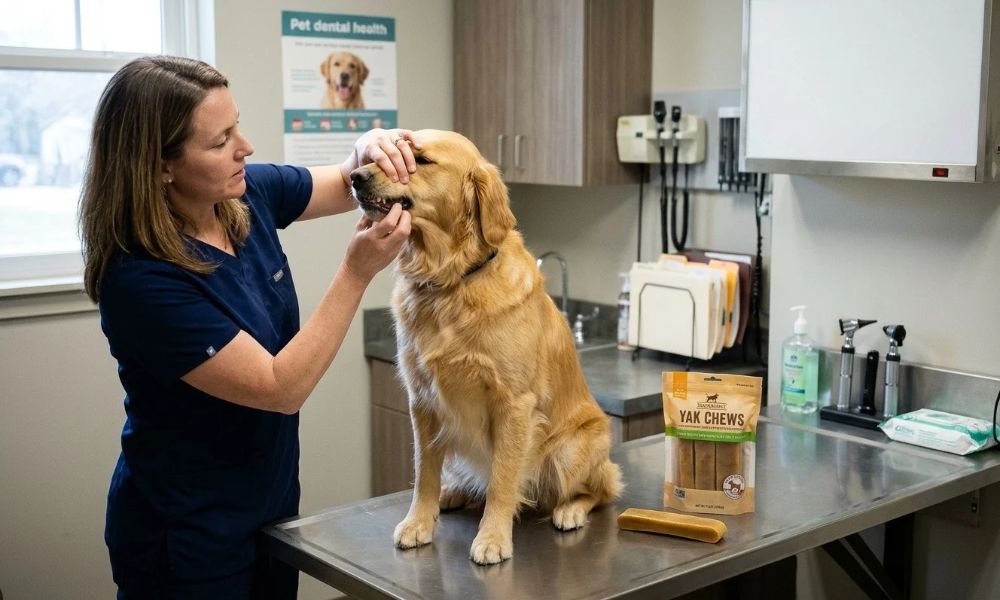
No natural chew is risk-free. Bully sticks present a lower dental fracture risk, yak chews offer high digestibility with variable hardness depending on format (hard bar vs. puffed), and antlers carry elevated risks on both counts. The fingernail test and supervision rules below help reduce risks across all 3 options.
The 3 chews fail in 3 different ways: broken teeth, blocked airways or intestines, and bacterial contamination. Each subsection below isolates one failure mode.
Are Yak Chews Safer Than Bully Sticks and Antlers?
Yak chews present less tooth-fracture risk than antlers, but hard bars pose a higher fracture risk than soft bully sticks. Yak chews are highly digestible, which eliminates the sharp splinter risk of antlers. However, because dry hard yak bars resist thumbnail indentation, veterinary dentists classify them alongside hard chews.
According to Dr. Bonnie Shope, VMD, past president of the American Veterinary Dental College, quoted in Tufts Your Dog, dental specialists see many fractured teeth from bones, antlers, cow hooves, Himalayan yak chews, hard nylon toys, and ice. She advises offering only chews that a fingernail can indent. According to veterinarian Dr. Rebecca MacMillan, quoted in PetsRadar, any dog that bites into a very hard chew risks a painful fracture. Those statements cover the whole yak chew category, including ours.
Yak chews offer key advantages: high digestibility, absence of sharp bone splinters, and production starting from pasteurized milk. Native Nepal batches are also subjected to third-party microbial testing prior to export. Five rules help mitigate dental and choking risks for yak chews:
- Choose a chew matched to your dog’s weight band and mouth width.
- Limit each session to 20–30 minutes, then remove the chew.
- Supervise every session.
- Soak the final 2-inch piece in warm water for 5 minutes, microwave in 15-second bursts for 30–60 seconds, and cool for 5–10 minutes before serving as a puff.
- Skip hard yak chews for puppies, seniors, and dogs with dental disease, and choose puffed formats instead.
The list covers the habits that matter most. Rule 4 removes the nub, the stage where choking risk peaks.
Which Chews Pose the Greatest Choking and Tooth Fracture Risks?
Antlers pose a high tooth-fracture risk. Bully sticks and hard yak chews pose a choking or obstruction risk at the nub stage, when the remaining 1–2 inch piece can be swallowed whole.
According to Dr. Lori Teller of the Texas A&M College of Veterinary Medicine, veterinarians noticed more fractured teeth as antlers grew popular as dog chews. The most common injury is the slab fracture of the upper fourth premolar, the carnassial tooth, which usually requires extraction or root canal therapy under anesthesia.
Bully sticks add a second hazard. According to the FDA, laboratory testing of bulk 5-inch bully sticks in 2018 recovered Salmonella, and a 2025 recall covered Nature’s Own Pet Chews Bully Bites for the same reason. The CDC advises washing hands with soap and water after handling any raw-animal-product treat.
Watch for 5 signs of a fractured tooth: dropping food, chewing on one side, pawing at the mouth, blood in the water bowl, and reluctance to chew. According to Dr. Rebecca MacMillan, many dogs show no signs at all because dogs hide pain well. Schedule a dental exam every 6–12 months for dogs that chew hard items.
Which Chews Are Suitable for Puppies and Senior Dogs?
Thin, supervised bully sticks and puffed yak chews suit puppies and senior dogs. Antlers and hard yak chews do not, because puppy teeth are thin-enameled and senior teeth are worn or diseased.
Puppies grow 28 baby teeth and replace them with 42 adult teeth between about 3 and 7 months of age. According to VCA Animal Hospitals, puppies avoid anything extremely hard, such as nylon, bones, or antlers, because developing teeth fracture easily.
Senior dogs face a different problem. According to the American Veterinary Dental College, periodontal disease affects roughly 80% of dogs by age 3, so many seniors chew with loose or inflamed teeth. Offer a 6-inch bully stick for 15 minutes or a puffed yak chew, and book a dental exam before introducing any hard chew.
What Are the Dental Health Benefits of Each Dog Chew?
Chewing removes plaque mechanically, but no chew replaces toothbrushing. The Veterinary Oral Health Council (VOHC) grants its seal to specific products proven in controlled trials, not to whole chew categories.
Plaque begins accumulating within hours of a meal and can harden into calculus over several days or weeks. A chew primarily scrapes the crown surfaces, leaving the gumline and interdental spaces requiring additional care. The 3 chews below clean differently, and each carries a different risk profile.
Do Yak Chews Help Reduce Plaque and Tartar?
Yak chews scrape plaque through prolonged abrasion, but no yak chew category-wide trial establishes a plaque or tartar reduction percentage. Verify any VOHC claim on vohc.org, because acceptance belongs to individual products.
The benefit comes from time. A 5-hour chew keeps the teeth working far longer than a 15-minute treat, and the ridged surface of a bar contacts the premolars directly. The limit comes from hardness: the same property that cleans also fractures. Pair a yak chew with brushing 3–4 times per week for a result a chew cannot deliver alone.
Can Bully Sticks Support Dental Hygiene?
Bully sticks support dental hygiene modestly. They flex, so they clean crown tips gently for 15–45 minutes per chew, but no bully stick category holds VOHC acceptance.
Flexibility is the advantage. A bully stick passes the fingernail test, which makes it the lowest-fracture option among the 3 chews. The disadvantage is calories: 88 per 6-inch stick adds weight to a dog that already carries excess plaque and weight. A DVM360 veterinary dentistry column also lists bully sticks among homecare items that lack proven efficacy, so treat them as entertainment with a small dental bonus.
Are Antlers Good or Bad for Dogs’ Teeth?
Antlers are bad for most dogs’ teeth. Their hardness scrapes plaque effectively and fractures teeth just as effectively.
A veterinary columnist in Veterinary Practice News states that bones, nylon, hooves, and antlers probably cut plaque and tartar well, yet he does not recommend them because they fracture teeth. The American Veterinary Dental College and the University of Illinois College of Veterinary Medicine both list antlers as too hard for routine chewing.
Some dogs chew antlers for years without a fracture. Fracture damage also accumulates: repeated chewing creates micro-damage in enamel, and the tooth can fail suddenly after years of apparent safety. Light chewers with healthy teeth carry the lowest risk, but the risk never reaches zero.
Which Dog Chew Is Best for Different Dogs?

Match the chew to the chewing style: thick bully sticks or puffed yak for heavy chewers, thin bully sticks for puppies, puffed or small yak chews for sensitive stomachs, and size-matched yak chews for long entertainment.
Four dog profiles cover most owners. Each profile below names a first choice, a backup, and a chew to skip.
Best Chews for Aggressive and Heavy Chewers
No natural chew is risk-free for heavy chewers. Thick braided bully sticks carry the least dental risk, and king-size yak chews offer the best durability-to-digestibility ratio when supervised.
Heavy chewers bite with more force, so fracture risk climbs with every chew in this category. Start with the fingernail test. Choose a thick, braided bully stick as the lowest-risk long chew, and keep sessions to 20–30 minutes. Choose a king-size yak chew when you want hours of work, and retire the piece when it drops below your dog’s mouth width. Skip antlers, and skip all hard chews for any dog with a prior fracture.
Best Chews for Puppies and Gentle Chewers
Thin 6-inch bully sticks and puffed yak chews suit puppies and gentle chewers. Both pass or nearly pass the fingernail test and give 10–20 minutes of safe chewing.
Teething puppies chew to relieve gum pressure, so offer a soft, flexible chew every day during the 3–7 month window. Gentle adult chewers enjoy puffed yak bars, which crunch apart without grinding. Supervise every session, and remove any piece small enough to swallow whole.
Best Chews for Dogs With Sensitive Stomachs
Yak chews suit sensitive stomachs well because they are low in fat, low in lactose, and highly digestible. Bully sticks may trigger digestive upset in some dogs due to high protein or fat content, while antlers offer minimal digestibility.
Acme Canine reported vomiting and diarrhea in 2 test dogs after bully sticks, and recommends starting with a 5–10 minute first session. Two ingredient rules apply. Skip yak chews for dogs with a confirmed milk-protein allergy, because the chew is dairy. Skip bully sticks for dogs with a beef allergy. Introduce any new chew in 10-minute sessions and watch stool quality for 48 hours.
Best Chews for Long-Lasting Entertainment
Antlers last the longest, but size-matched yak chews deliver the longest entertainment at acceptable risk. The microwave puff converts the leftover nub into a second treat.
A large yak chew spreads across 4–5 sessions. Rotating 2–3 chew types across the week keeps novelty high and caps the daily calorie load. Store the chew out of reach between sessions, because a dog guarding a chew chews it faster.
How Should You Choose Between Yak Chews, Bully Sticks, and Antlers?
Choose by 5 factors: chewing strength, age, dental history, digestive tolerance, and product quality. Apply the fingernail test first, then match chew size to weight band and mouth width.
The 2 subsections below turn that rule into a purchase checklist.
What Factors Do You Consider Before Buying?
Seven factors decide the right chew: chewing strength, age, dental history, allergies, size, daily calorie budget, and supervision availability.
- Chewing strength: heavy chewers need durable yet tooth-safe options; gentle chewers handle puffed formats.
- Age: puppies under 7 months and seniors over 8 years need chews that pass the fingernail test.
- Dental history: a prior fracture, extraction, or periodontal disease rules out hard chews.
- Allergies: a dairy allergy excludes yak chews, and a beef allergy excludes bully sticks.
- Size: the chew must match the dog’s weight band and exceed the mouth width so the dog cannot swallow it whole.
- Calorie budget: treats stay under 10% of daily calories, which leaves little room for a bully stick in a small dog.
- Supervision: every chew needs an adult watching, with no exceptions for “safe” categories.
How Can You Identify High-Quality, Natural Dog Chews?
High-quality chews list ingredients plainly, state their origin, and come from a food-safety-certified facility that shares lab results. Five checks separate good chews from risky ones.
- Read the ingredient list: authentic yak chews contain 3 simple ingredients (yak and cow milk, lime juice, salt), and bully sticks contain 1.
- Confirm the country of origin and the processing method, such as pasteurization, baking, or irradiation.
- Request a certificate of analysis showing microbial, moisture, and protein results.
- Check for administrative FDA facility registration (renewed biennially in 2026), USDA APHIS import clearance, and quality standards such as HACCP or ISO 9001.
- Inspect the chew for mold, an unusually sour smell, cracks, or sharp splinters.
Also search the FDA recall database for the brand before buying a bully stick, because Salmonella recalls have occurred in this category.
Why Are Himalayan Yak Chews a Worthwhile Choice?
Himalayan yak chews are a practical option because they are highly digestible, have a minimal ingredient deck, and remain low in fat. Size matching, format selection (hard vs. puffed), and supervision ensure safe use.
The case rests on 4 points. Digestibility removes the splinter and blockage risks of antlers. A 3–4 ingredient list removes the label guesswork. Low fat protects the waistline. The microwave puff turns waste into a safe second treat.
The honest limit: dry yak chews are hard. Dogs with dental disease, puppies, and seniors belong on puffed formats or flexible alternatives. Veterinary dentists are right about hardness, and the category earns its place only through good sizing and good habits.
Why Choose Native Nepal Dog Chew for Himalayan Yak Chews?
Native Nepal Dog Chew produces traditional chhurpi in Nepal with 10+ years of experience, FDA facility registration (with 2026 renewal), USDA APHIS import clearance, ISO 9001 and HACCP compliance, and third-party laboratory testing performed on production batches.
We source fresh yak and cow milk from 1,000+ farmers and 50+ micro dairies in Himalayan communities, which gives each batch a traceable origin. We control every stage in-house: pasteurization, pressing, drying, packing, and export documentation. Our chews reach buyers in 20+ countries, and the United States is our largest market.
Next step: Pet brands and retailers can review our Dog Chew Bars and Puffed Chew Bars, or ask our team for certificates of analysis.
What Makes Native Nepal Chhurpi Different From Other Natural Dog Chews?
Native Nepal chhurpi differs in 4 ways: a 99% milk base with only ~1% lime juice and salt, farm-to-export quality management, size-specific smoke- and air-drying, and puffed formats for softer chewing.
First, the recipe stays short: no artificial preservatives, binders, or flavor enhancers. Second, one manufacturer handles milk collection through shipping, which removes the quality gaps that appear when 3 or 4 vendors share a supply chain. Third, bars, nuggets, and puffed formats each follow their own drying protocol, so moisture and hardness stay consistent within a size. Fourth, puffed bars and nuggets give puppies, seniors, and gentle chewers a lower-hardness yak option.
Learn more: Read The Complete Guide to Himalayan Yak Chews (Chhurpi) for sizing charts and feeding rules, or compare yak chews with another popular chew in Yak Chews vs Rawhide: Which Dog Chews Should Retailers Stock?
Which Dog Chew Is the Best Overall Choice for Your Dog?
No single chew wins for every dog. Healthy adult dogs often do well on a rotation of size-matched yak chews and thick bully sticks; puppies and seniors do best on puffed yak or thin bully sticks, while antlers carry higher dental fracture risks.
The table below maps 5 dog profiles to a first choice and a chew to skip.
| Dog profile | Best first choice | Skip |
|---|---|---|
| Healthy adult, moderate chewer | Size-matched yak chew | Antlers |
| Heavy chewer without dental issues | Thick braided bully stick | Antlers, nylon bones |
| Puppy under 7 months | Thin bully stick, puffed yak | Antlers, hard yak |
| Senior or dental-disease dog | Puffed yak chew | All hard chews |
| Sensitive stomach | Puffed or small yak chew | Antlers, rich bully sticks |
Bully sticks offer flexibility and tooth safety, hard yak chews offer high digestibility and long durability (though dry bars fail the thumbnail test), and puffed yak chews provide a soft, highly digestible alternative. A balanced approach for healthy adult dogs involves a size-matched yak chew with supervision (puffing the end nub in the microwave) alongside bully sticks in rotation. Always consult your veterinarian for personalized dental guidance.
Yak chews, bully sticks, and antlers each satisfy the urge to chew. The best chew for your dog is the one that passes the fingernail test, fits the muzzle, and suits the stomach.