
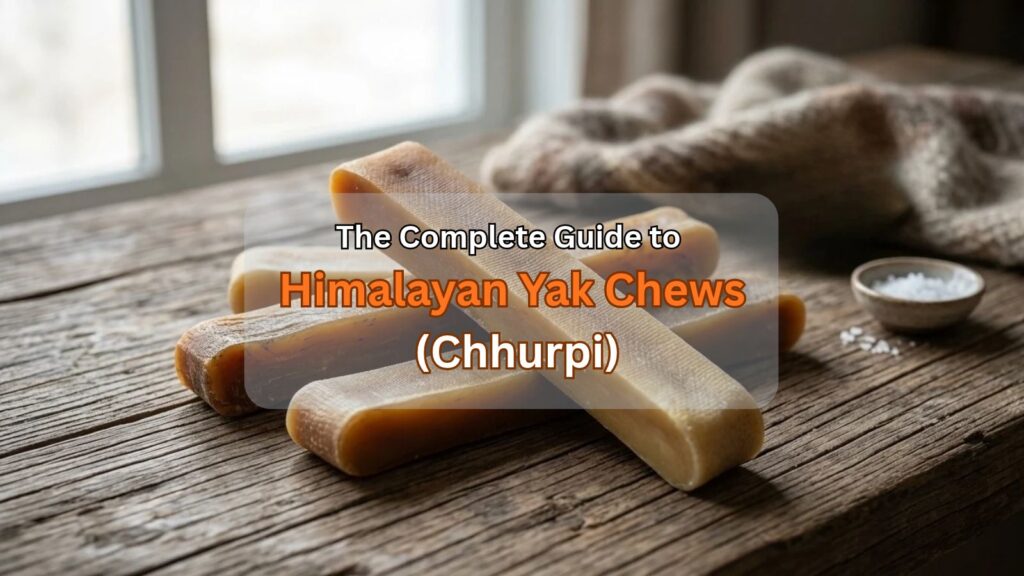
Himalayan yak chews, traditionally known as chhurpi, are hard, dried cheese chews made in Nepal and other Himalayan regions from yak milk, chauri milk, cow milk, salt, and lime juice. Himalayan herders have produced chhurpi for generations by curdling milk, separating whey, pressing the casein, and slowly drying the cheese until its moisture content stabilizes between 10% and 14%. Today, hard chhurpi is exported as a dairy-based chew with a short ingredient list for dogs in the United States, the United Kingdom, the European Union, and other markets. Its concentrated casein protein, low fat content, and minimal ingredient list make it a popular alternative to rawhide and other animal-based chews. However, its dense texture creates an important safety trade-off: hard yak chews can fracture teeth, particularly in dogs that bite down forcefully or have weakened teeth.
This complete guide explains the Himalayan origins of chhurpi, the traditional Nepali cheesemaking process, and the nutritional characteristics that make yak chews appealing to dog owners. Explore their potential benefits for sustained chewing, boredom relief, and mechanical plaque reduction, alongside risks such as tooth fractures, choking, intestinal blockage, dairy allergies, and excess calories. Learn how to choose the right chew size and firmness for your dog’s weight, age, and chewing style; check ingredients and verify authentic Himalayan origin; and follow safe feeding, supervision, and storage practices. The guide also compares yak chews with bully sticks, rawhide, dental chews, antlers, and bones, before explaining how to evaluate manufacturers such as Native Nepal Dog Chew for ingredient transparency, product quality, batch testing, and export credentials.
What Is Chhurpi and Where Does It Come From?
Chhurpi is a dried, hard casein cheese made from yak milk, or from the milk of chauri (a yak-cow hybrid), in Nepal, the Indian Himalayan region including Sikkim and Darjeeling, and Bhutan. The International Livestock Research Institute (ILRI) describes it as the dried hard casein product of Himalayan dairying. Hard chhurpi, the variety dogs chew, is pressed and dried until moisture drops between 10% and 14%.
The History and Cultural Origins of Himalayan Chhurpi
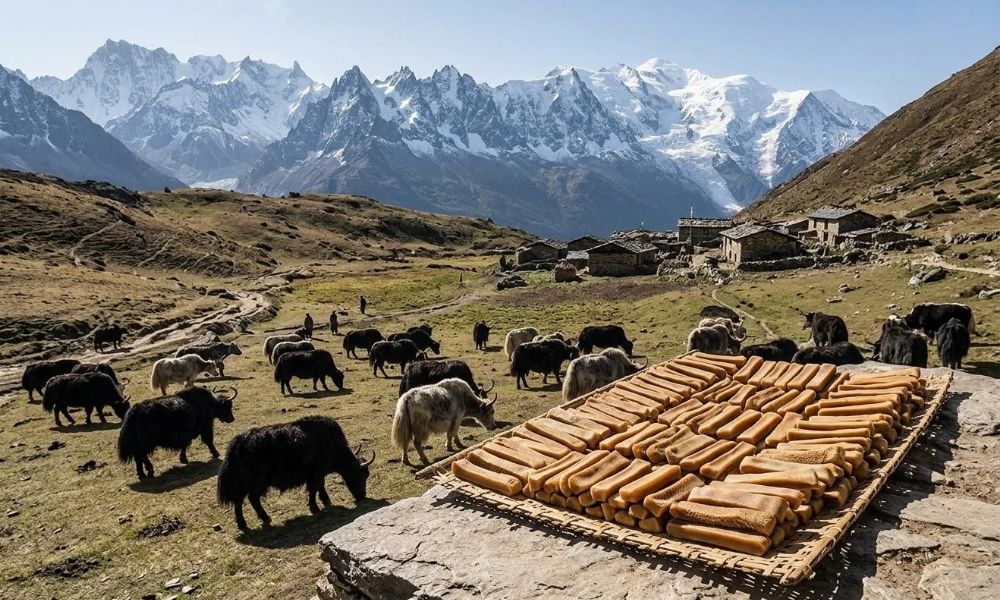
Chhurpi comes from yak-herding communities of the Himalayan highlands, who dried surplus buttermilk curd into a food that survived winter without refrigeration. According to Tribhuvan University anthropologist Mukta Singh Lama Tamang, dairy has anchored Himalayan culture and livelihood throughout history.
Commercial dairying came later. According to the Kathmandu Post (May 2026), Swiss specialist Werner Schulthess arrived in Nepal in 1952 with support from the Food and Agriculture Organization (FAO), leading to the establishment of Nepal’s first yak-cheese plant in Langtang at Kyangjin Gompa in 1955, using milk from the female yak, called a nak. That plant made Gruyère-style cheese, while chhurpi remained the herders’ own product primarily. Commercial Himalayan chhurpi dog-chew production began in Nepal in 2007.
The traditional herding supply base has shifted over time. The Post notes a historical recollection from a former manager that the Jiri plant produced about 18,000 kg of cheese a year around 2050 BS (1993/94), while two state-owned Dolakha factories now produce barely 400 kg in a season as younger generations leave yak and chauri herding. Meanwhile, commercial dog-chew production has grown significantly across Nepal’s eastern hill and mountain districts. According to the Nepal Churpi Business Association, total annual chhurpi production exceeds 2 million kg, with about 80% produced in Koshi Province. Official export data reflects this commercial growth: dog-chew exports reached about NPR 4.51 billion in FY 2024/25, and Mechi Customs recorded 275,246 kg exported in the first five months of FY 2025/26 alone.
Nepal’s 2026 Chhurpi Standard
Nepal’s first mandatory quality standard for chhurpi was published in 2026. The standard applies to hard chhurpi produced from single or mixed cow, yak, and buffalo milk. It specifies that moisture must not exceed 14% and crude milk protein must be at least 60% on a dry-weight basis. High-fat varieties are classified as containing 5% or more milk fat. The standard strictly prohibits chemical contamination, adulterants, and pests.
How Traditional Nepali Chhurpi Is Made
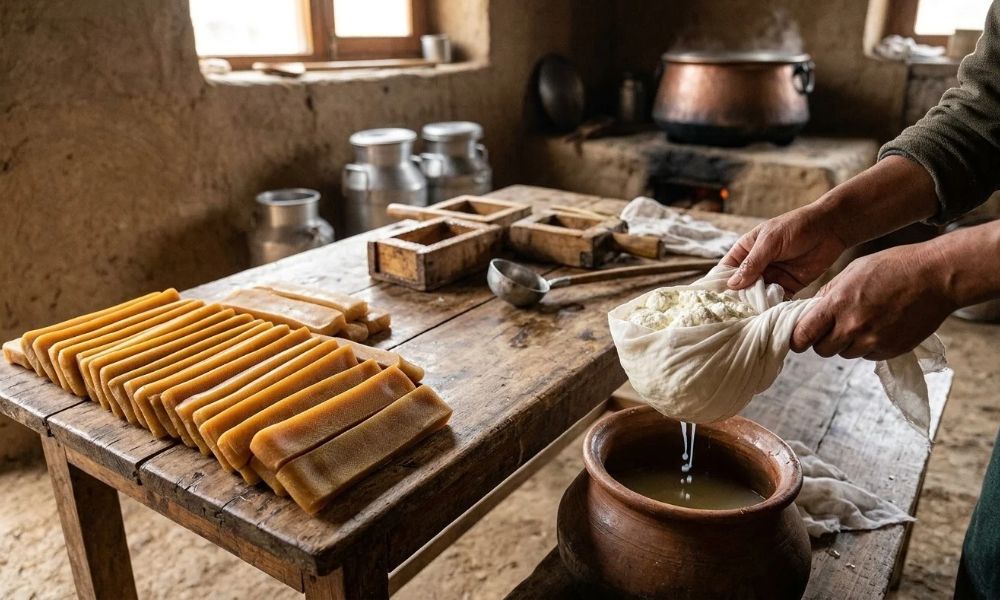
Traditional Nepali chhurpi is a by-product cheese: herders churn milk for butter, heat the leftover buttermilk until it curdles, then press and dry the curd. Butter and ghee carry the market value, and chhurpi preserves the remaining protein.
According to ILRI, buttermilk becomes sher (a cottage-cheese type), sewsew (when fermented), or chhurpi (when pressed and dried). A North Bengal University survey found that Bhutan and Sikkim cook the curd before pressing, while Darjeeling omits the cooking step.
The Role of Yak and Chauri Milk in Chhurpi Production
Yak and chauri milk produce a dense chhurpi because both carry more fat and protein than cow milk. According to the Food and Agriculture Organization (FAO), yak milk holds 15 to 18% solids, 5.5 to 9% fat, and 4 to 5.9% protein, against roughly 3 to 4% fat and 3.5% protein in cow milk.
The yak (Bos grunniens) is the high-altitude bovine of the Himalayas, the nak is the female yak, and the chauri is the yak-cow hybrid. Export chhurpi commonly blends cow, buffalo, yak, and chauri milk, and labels list dairy ingredients without specific percentage breakdowns. The name “yak chew” therefore functions as a commercial market category name rather than a guarantee of 100% yak milk.
How Are Himalayan Yak Chews Made?
Himalayan yak chews are made in 4 stages: skimming the milk, curdling it with lime juice, pressing out the whey, and smoke-drying the cut pieces for 30 to 50 days. Each stage removes fat, lactose, or water.
Traditional Milk Collection and Preparation
Milk preparation starts with fat removal: herders churn the milk for butter and keep the lean buttermilk or skim milk as the cheese base.
According to Shrestha, Pradhananga, and Das (a Nepal food technology study), buttermilk held 0.5% fat and skim milk 0.2%. Low starting fat explains why finished chews list only 0.9 to 3.8% crude fat and resist rancidity in storage.
Curdling, Pressing, and Separating the Whey
To curdle chhurpi, makers heat the milk and add lime juice until the casein coagulates and clear whey separates at a pH near 5.3. The curd is cooked briefly, drained through muslin, and pressed.
The Shrestha study pressed hot curd for 6 hours at 9 kg/cm². Pressing alone cannot lower moisture below roughly 55%, so drying finishes the job. Makers cut the pressed curd into pieces, commonly about 12 × 2 × 2 cm, to speed drying. Whey carries most of the milk’s lactose, so draining it makes chhurpi low in lactose.
Smoking, Drying, and Hardening the Cheese
Smoke-drying hardens chhurpi by hanging pressed pieces over a wood fire at 35 to 45°C for 30 to 50 days, until moisture consistently tests between 10% and 14%. One North Bengal University survey records 30 to 40 days, and another summary records about 50.
Smoke turns the surface amber-brown and adds a smoky scent, while air-drying on bamboo mats gives a paler, milder chew. Longer drying produces a harder chew.
What Makes Himalayan Yak Chews Naturally Long-Lasting?
Yak chews last because 4 properties work together: moisture between 10% and 14%, fat below 4%, a dense casein matrix, and an acidic, salted curd. Low moisture stops microbial growth, low fat stops rancidity, and dense casein yields only to saliva and sustained chewing.
The long shelf life is old knowledge. The Better India reports that hard chhurpi keeps for up to two decades in dry Himalayan storage. The same density creates the central trade-off: a chew built to last for hours is hard enough to damage a weak tooth.
Are Himalayan Yak Chews Safe and Healthy for Dogs?
Yak chews are digestible, minimally processed, milk-based chews that suit most healthy adult dogs, with one documented risk: a dry chew is hard enough to fracture teeth.
What Are the Nutritional Benefits of Yak Chews?
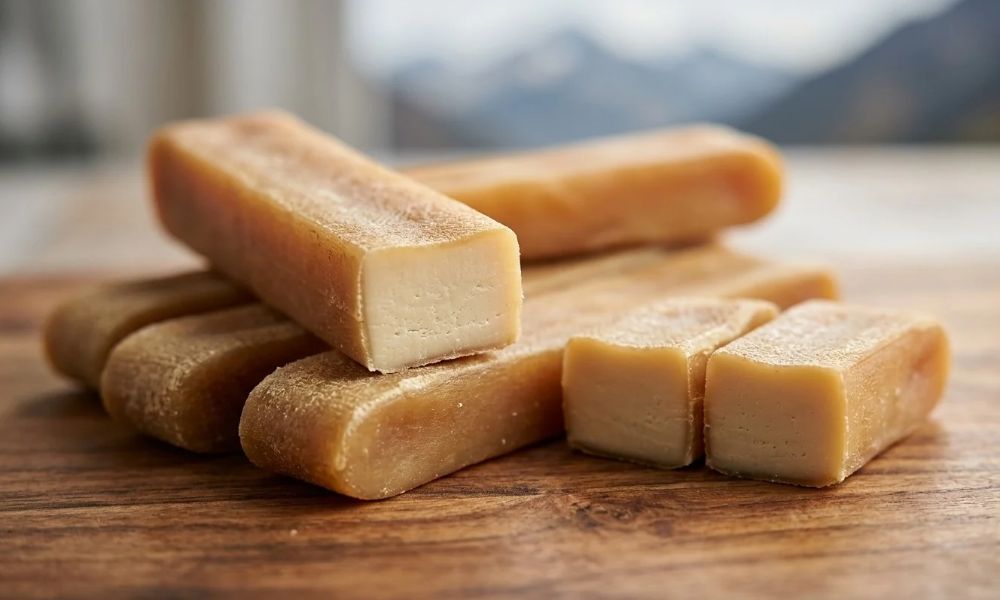
Hard yak chews supply concentrated protein with little fat: 52.6 to 74.6% crude protein, 0.9 to 3.8% crude fat, and 10 to 14% moisture across retail lines. Energy runs 3,188 to 3,700 kcal/kg, about 90 to 105 kcal per ounce.
Are Himalayan Yak Chews High in Protein?
Yes, hard yak chews are high in protein at 52.6 to 74.6% crude protein as fed, almost all of it casein. Crude protein measures nitrogen, not digestibility, and a dog eats grams of chew per day. A 15 g portion supplies roughly 8 to 11 g of protein.
Are Yak Chews Low in Lactose?
Yes, hard yak chews are low in lactose because whey, which carries most milk sugar, drains away during pressing, and drying removes more. Two retail labels call the chews virtually lactose-free.
Lactose intolerance and milk protein allergy are different conditions. Chhurpi still contains casein, the main milk protein, so dogs with a diagnosed dairy allergy skip yak chews.
Can Yak Chews Support Dental Health?
Yak chews support dental health through mechanical abrasion during long chewing, but they do not replace tooth brushing or professional cleaning. The benchmark for dental claims is the Veterinary Oral Health Council (VOHC) Seal of Acceptance, which requires at least a 20% reduction in plaque or tartar in controlled trials, according to PetMD. A chew without the seal has no independent efficacy verification.
Are There Any Risks or Side Effects of Yak Chews?
Yak chews carry primary safety risks such as tooth fracture, intestinal blockage from swallowed pieces, and digestive upset in dairy-sensitive dogs. In addition, caloric intake should be managed as a key nutritional consideration.
Tooth fracture is the most common. The Veterinary Ireland Journal reports a prevalence of 20 to 27% in dogs, and many owners never notice because dogs hide dental pain. According to veterinarian Julie Buzby, hard chews fracture the upper fourth premolar (the carnassial tooth) most often. A veterinarian quoted by PetsRadar says yak chews carry the same risk as antlers and bones, while Vetstreet lists them as generally well-tolerated, with hardness as the caveat.
Dog owners often use informal screening heuristics to check chew hardness. In the informal knee test, tap the chew against your own knee—a chew that causes discomfort is likely too hard. In the informal fingernail test, press a nail into the chew—a chew that leaves no dent indicates high density. While these are practical owner heuristics rather than validated clinical diagnostic standards, veterinary dentists emphasize that dense dry chews carry tooth fracture risks until saliva softens the surface.
The other 3 risks are smaller. According to PetsRadar, small swallowed pieces rarely cause problems, while large ones risk obstruction. A 94 g chew holds roughly 300 to 350 kcal.
Skip yak chews for 4 groups of dogs: puppies, seniors with worn or diseased teeth, dogs with a history of tooth fractures, and dogs with a dairy protein allergy.
What Are the Benefits of Himalayan Yak Chews for Dogs?
Himalayan yak chews give dogs main benefits such as sustained chewing, mechanical plaque reduction, an outlet for boredom and stress, and a digestible ingredient list.
How Do Yak Chews Help Reduce Plaque and Tartar?
Yak chews reduce plaque and tartar through friction: the teeth press into the slowly softening surface, and the grinding action scrapes soft plaque off the crown before it hardens. Plaque hardens into tartar, and only professional scaling removes tartar, according to Swedencare.
The effect has limits. Dogs chew with their back teeth, so premolars and molars get the contact while incisors and the gumline get little. A chew slows new buildup and does not remove existing tartar. Pair it with daily brushing and an annual professional dental exam.
Can Yak Chews Help Relieve Boredom and Anxiety?
Yak chews can help relieve boredom by providing focused, self-paced chewing time—often lasting roughly 20 to 30 minutes per session depending on the dog’s size and chewing intensity—which can lower restlessness in many dogs. A chew is an outlet, not a medical treatment, and it does not cure separation anxiety.
Offer the chew 10 minutes before a predictable trigger such as visitors or a grooming session. Never hand a chew to a dog in a crate before leaving the house, because nobody is present to respond to choking. Separation anxiety needs a behavior plan from a veterinarian or certified trainer.
Are Yak Chews Suitable for Aggressive Chewers?
Yak chews outlast most digestible chews for aggressive chewers, but the same hardness raises fracture risk, so suitability depends on bite style and tooth condition. Three chewing styles behave differently.
- Gnawers scrape with the front teeth. Yak chews suit them best.
- Crunchers bite down hard with the molars. They carry the highest fracture risk, and vets point them to chews that dent under a fingernail.
- Gulpers bite off and swallow pieces. They need the largest size and close supervision.
A common mistake is buying a thicker chew for a cruncher to make it last. Thickness raises hardness, and hardness raises fracture risk.
How Do Yak Chews Compare With Other Natural Dog Chews?
Among natural chews, yak chews rank high for longevity and digestibility and low for softness, so they trade tooth safety for chew time. Chew time and hardness rise together: antlers and bones sit at the hard end, bully sticks and dental chews at the soft end, and yak chews between them. Yak casein digests, while antler and bone do not.
How Should You Choose the Right Yak Chew for Your Dog?
Choose a yak chew by 4 criteria: a size matched to your dog’s weight, a firmness matched to age and chewing style, a short ingredient list, and verifiable Himalayan origin.
Which Yak Chew Size Is Best for Your Dog?
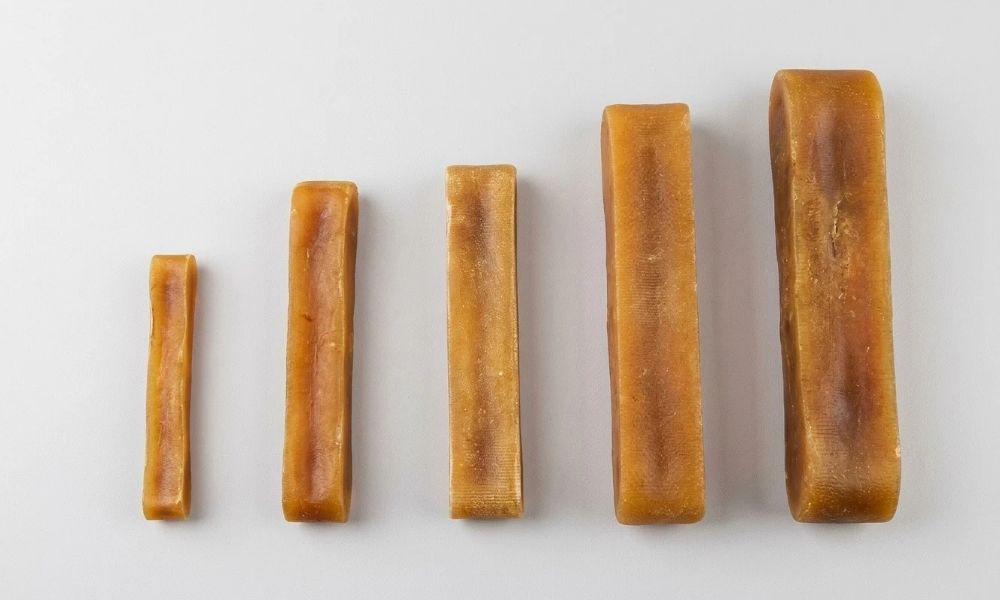
The best yak chew size is too large to fit entirely in the mouth and long enough for the dog to hold with both paws. The table below lists the weight bands most retail size charts follow. Two published listings anchor it: a small piece suits dogs under 15 lb with a muzzle up to 1.75 inches wide, and a 94 g (3.3 oz) large piece suits dogs up to 55 lb. Sizing varies by brand, so check each chart.
| Chew size | Dog weight (US) | Dog weight (metric) |
| Small | Under 15 lb | Under 7 kg |
| Medium | 15 to 30 lb | 7 to 14 kg |
| Large | 30 to 55 lb | 14 to 25 kg |
| Extra large | 55 to 90 lb | 25 to 41 kg |
| XX-Large / Jumbo | Over 90 lb | Over 41 kg |
Gulpers move up one size band, and gnawers stay in their weight band.
How Do You Choose Based on Your Dog’s Age and Chewing Style?
Match the chew to age first and chewing style second: dogs between 6 months and 7 years with healthy teeth take hard chews, and puppies and seniors take softer alternatives. Adult teeth finish erupting at about 6 to 7 months, and enamel wear and dental disease rise in later years.
Chewing style then sets the density: gnawers handle thick, fully dried pieces, and crunchers do better with thinner or partially puffed yak products. Hardness differs between brands and batches, so run the knee and fingernail tests on every new chew.
What Ingredients Should You Look for in Quality Yak Chews?
Quality hard yak chews are made with milk—which may be yak, cow, buffalo, chauri, or a blend—coagulated with an acid like lime juice, and a small amount of salt.
Read the rest of the label in 3 steps. First, check the guaranteed analysis: crude protein standards require at least 60% on a dry-weight basis under Nepal’s official standard (with retail packaging reporting on an as-fed basis) and moisture not exceeding 14%. Second, flag additives such as potato starch, vegetable glycerin, and potassium sorbate, which mark puffed and flavored products. Third, look for a stated country of origin.
How Can You Identify Authentic Himalayan Chhurpi?
Authentic Himalayan chhurpi passes 5 checks: a stated Nepal or Himalayan origin, a short milk-based ingredient list, an amber to ivory color, a dry, non-greasy surface, and a traceable lot code. Color varies between batches.
A greasy surface or chemical smell signals an additive-treated product. Importers verify compliance with key documentation: country of origin, a minimal milk-based ingredient label, guaranteed analysis, batch-level COA, FDA and HACCP facility registrations, and a veterinary health certificate meeting the destination market’s import requirements. A lot code on the pack shows the supplier tracks them.
How Do You Safely Give Himalayan Yak Chews to Your Dog?
Give yak chews safely with 4 rules: supervise every session, limit sessions to 20 to 30 minutes, retire the chew once it fits in the mouth, and count its calories within the 10% treat limit. The FDA advises supervising a dog with any chew, especially a new one.
How Long Should Dogs Chew on Yak Chews?
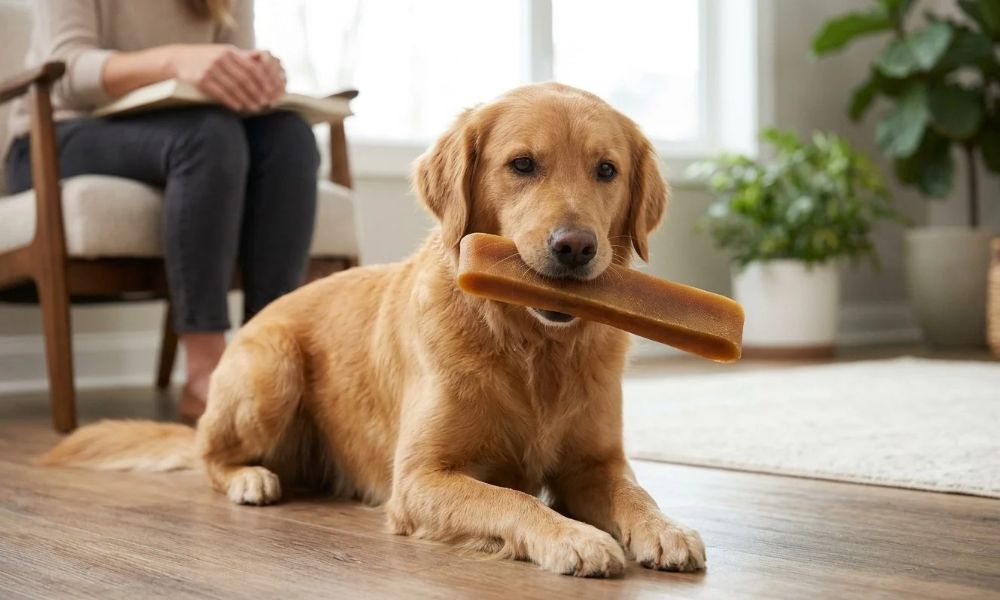
Dogs chew a yak chew for 20 to 30 minutes per session, then the owner removes it and stores it dry. A session limit protects teeth from repeated heavy loading and keeps calories predictable. One chew spans many sessions, because the hard core stays intact between them.
How Often Can Dogs Have Yak Chews?
Most adult dogs take a yak chew 2 to 3 times a week, because veterinary nutrition guidance caps all treats at 10% of daily calories.
A 20 lb (9 kg) adult dog eats roughly 550 to 600 kcal a day, so its treat budget is 55 to 60 kcal, about 15 to 19 g of chew. A 94 g chew at 300 to 350 kcal uses about 3 days of the treat budget of a 50 lb (23 kg) dog, which eats roughly 1,100 to 1,200 kcal a day.
Can Puppies and Senior Dogs Eat Yak Chews?
Puppies under 6 months and seniors with worn or diseased teeth should skip hard yak chews, and adult dogs with healthy teeth are the target group. A veterinarian quoted by PetsRadar names puppies, elderly dogs, and dogs with jaw problems as the highest-risk groups for hard chews.
Puppy baby teeth are thin and fracture easily. Seniors often carry hidden dental disease, so a veterinary dental exam comes before the first hard chew. Rubber toys and chews that dent under a fingernail replace yak chews for both groups.
What Should You Do With the Small Leftover Yak Chew Pieces?
Remove the leftover piece once it fits entirely inside your dog’s mouth, then discard it or puff it in the microwave. Small pieces are a swallowing and choking risk.
Mud Bay suggests microwaving the last bit into a crispy cheese puff. Heat a 1-inch piece in 15-second bursts for 30 to 60 seconds total, because power varies. Cool the puff for 5 minutes, then offer it as a supervised treat and count it in the daily calories.
How Do Himalayan Yak Chews Compare With Other Dog Chews?
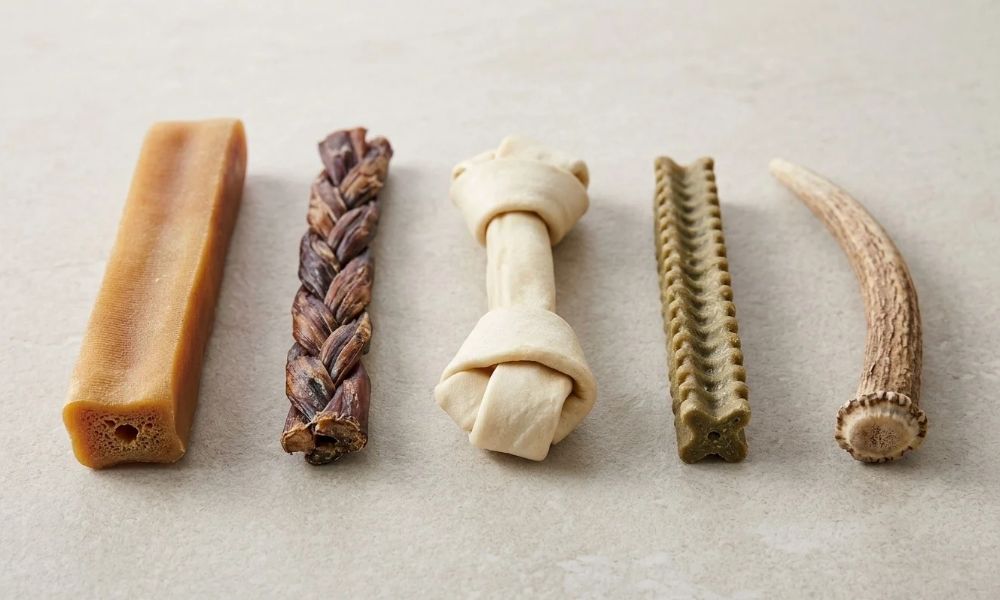
Yak chews last longer and digest better than rawhide, carry less fat than bully sticks, and are harder than dental chews, which puts them closest to antlers on the tooth risk. The table below compares 5 chews across chew time, digestibility, and main concern. It uses relative ratings because hardness and duration vary by brand and by dog.
| Chew | Chew time | Digestible | Main concern |
| Yak chew | Long | Yes | Tooth fracture |
| Bully stick | Medium | Yes | Bacteria, fat, calories |
| Rawhide | Medium to long | Poorly | Blockage, chemical residues |
| Dental chew | Short | Yes | Short-lived, calories |
| Antler or bone | Very long | No | Tooth fracture, splintering |
The sections below add the evidence behind each pairing.
Yak Chews vs. Bully Sticks
Bully sticks are softer and gentler on teeth, while yak chews last longer and carry less fat. A bully stick is dried beef pizzle. Yak chews list 0.9 to 3.8% crude fat, and vets note that dogs with pancreatitis struggle with high-fat chews such as bully sticks.
Bacteria separate the two more sharply. Tufts University and University of Guelph researchers found MRSA and Clostridium difficile in a subset of tested bully sticks, and Canadian Veterinary Journal research found E. coli and Salmonella. Dogs with a dairy allergy or fragile teeth choose bully sticks.
Yak Chews vs. Rawhide Chews
Yak chews digest, whereas rawhide is less digestible and can pose an obstruction risk when large pieces are swallowed. One study of chew types found rawhide more digestible than bones and less digestible than dental sticks and biscuits, according to Rover.
Rawhide adds 2 further problems. The hide is chemically processed, and a 2018 recall pulled rawhide chews for cleaning-chemical contamination, according to Vetstreet. Rawhide has also tested positive for Salmonella and E. coli. Yak chews skip the hide processing but share one trait: a large swallowed piece still risks obstruction.
Yak Chews vs. Dental Chews
Dental chews with the VOHC seal have trial evidence for plaque and tartar reduction, and yak chews do not, so dental chews win on oral-health claims. Dogs finish a dental chew in minutes.
Yak chews win on occupation time, since one chew fills many 20- to 30-minute sessions. The two chews do separate jobs: a VOHC-accepted chew for plaque control and a yak chew for supervised chewing time.
Yak Chews vs. Antlers and Bones
Yak chews sit close to antlers and bones on hardness but beat them on digestibility, because yak casein breaks down and bone and antler do not. Antlers are frequently associated with tooth fractures, including slab fractures, in veterinary dental case reports; individual studies and clinical populations vary.
Processed bone treats carry a documented injury record: the FDA received reports of about 90 illnesses and 15 deaths between November 2010 and September 2017, including choking, gastrointestinal obstruction, and mouth cuts. Yak chews share the tooth risk with antlers but not the bone-fragment injuries.
How Should You Store Himalayan Yak Chews?
Store yak chews in a cool, dry place inside an airtight container or resealable bag, away from humidity, heat, and direct sunlight.
What Is the Shelf Life of Yak Chews?
While traditional hard chhurpi historically was kept for extended periods in dry Himalayan storage conditions, packaged commercial dog chews rely on proper sealing and standard shelf-life guidance. Always follow the best-before date printed by the manufacturer.
Check the printed date at purchase, because retail packaging and household humidity differ from a mountain storeroom. Discard any chew with visible mold, an oily film, or a sour smell.
How Can You Keep Yak Chews Fresh and Hygienic?
Keep yak chews fresh and hygienic with 4 habits: seal the container after each use, dry the chew between sessions, wash your hands after handling, and clean the spots where the dog chews.
- Dry a saliva-softened chew on a rack for several hours before returning it to the container.
- Wipe floors and fabric where the dog chewed.
- Wash your hands after handling.
- Discard any chew that shows mold.
A common mistake is putting a damp, half-eaten chew back into a sealed bag, where trapped moisture grows mold within days.
Why Choose Native Nepal Dog Chew for Authentic Himalayan Yak Chews?
Native Nepal Dog Chew is a Kathmandu-based manufacturer of chhurpi dog chews with more than 10 years of export history, operating an FDA-registered and HACCP-certified production facility. Their complete product line includes traditional hard chew bars, puffed bars, nuggets, and specialized cheese protein powder. The company supplies wholesale, private label, and custom packaging programs to buyers in the US, UK, EU, and Australia.
Apply the checks from this guide to any supplier, including Native Nepal: country of origin, a short milk-based ingredient list, a guaranteed analysis, a batch-level COA, FDA and HACCP facility registrations, and a veterinary health certificate meeting destination market import requirements.
How Does Native Nepal Dog Chew Preserve Traditional Chhurpi Quality?
Traditional chhurpi quality rests on 3 controls: lean milk as the base, complete whey removal, and slow drying to between 10% and 14% moisture. Native Nepal builds its chews on that chhurpi foundation in Nepal, where modern commercial yak cheesemaking began with the 1955 Langtang plant.
The practical test is the label and the analysis: meeting Nepal’s official 60% crude protein dry-weight standard and moisture not exceeding 14% matches the traditional profile. Buyers can request the ingredient statement and guaranteed analysis for each product before ordering, choosing across traditional hard chew bars, puffed bars, crunchy nuggets, and specialized cheese protein powder.
What Makes Himalayan Yak Chews From Native Nepal a Natural Choice for Dogs?
Single-ingredient natural treat chews are evaluated based on authentic origin, ingredient transparency, guaranteed analysis, and food safety standards rather than complete-and-balanced AAFCO nutrient profiles meant for daily dog food. Quality chews contain four simple base ingredients—yak milk, cow milk, salt, and lime juice—without rawhide or artificial preservatives.
Natural does not mean risk-free. The same hardness guidance applies to every yak chew, Native Nepal’s: pick the right size, run the knee and fingernail tests, supervise each session, and skip hard chews for puppies and dogs with fragile teeth.
Learn more about Himalayan yak chews: Browse chew sizes, competitive export pricing, flexible Minimum Order Quantities (MOQs), and end-to-end private label manufacturing at Native Nepal Dog Chew.