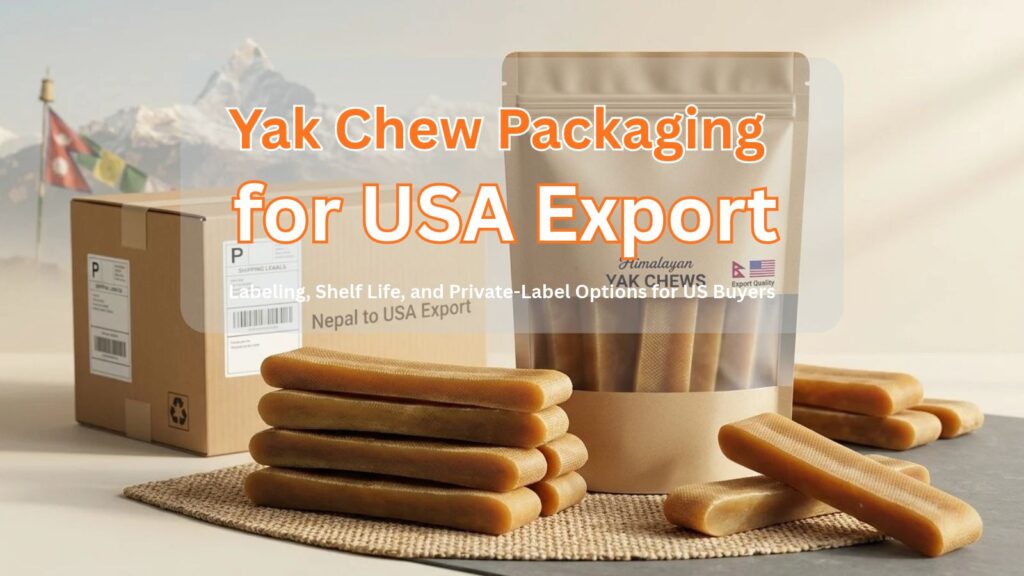
Yak chew packaging for USA export is the combination of compliant product labeling, moisture-resistant packaging materials, shelf-life protection, and export-ready cartons used to ship Himalayan yak cheese dog chews from Nepal to the United States. Also known as chhurpi, these hard cheese chews require packaging that preserves product quality during 30 to 50 days of ocean transit while meeting applicable US pet food labeling, country-of-origin marking, and import requirements. For US pet product importers, wholesalers, retailers, and brand owners, the right packaging protects chew quality, supports retail presentation, improves batch traceability, and reduces costly errors involving net weight, ingredient declarations, barcodes, and shipping documentation.
Choosing yak chew packaging for the US market involves more than selecting a pouch or printing a logo. Buyers must evaluate AAFCO model labeling requirements, FDA import compliance, moisture and oxygen barriers, water activity, shelf-life evidence, and packaging formats suited to retail, e-commerce, or bulk distribution. Private-label yak chews from Nepal also require accurate artwork, suitable minimum order quantities, verified product specifications, and coordinated export documentation. Native Nepal Dog Chew, an FDA-registered, DUNS-registered, ISO 9001, HACCP, and GMP-certified manufacturer, helps US buyers explore private-label branding, packaging specifications, product samples, batch-level Certificates of Analysis (COA), and export documentation to prepare yak cheese dog chews for the American pet market.
What Should US Buyers Know About Yak Chew Packaging for Export?
Export-ready yak chew packaging protects a low-moisture dairy chew, carries the label content US regulators check, and survives 30 to 50 days of ocean transit. Buyers judge it on three fronts: regulatory fit, moisture protection, and retail readiness.
A yak chew (chhurpi in Nepal) is a hard cheese made from yak milk, often blended with cow milk, plus lime juice and salt. Producers press, dry, and sometimes smoke the curd until it turns bone-hard. That hardness and low moisture shape every packaging decision below.
Why Does Packaging Matter for US Yak Chew Buyers and Importers?
Packaging decides whether a shipment clears US entry, whether chews arrive dry, and whether the product sells.
According to the FDA, field examiners sample imported pet food and check it against label requirements. A wrong net weight or a missing manufacturer address stops a pallet at the port, not at the shelf.
Freight raises the stakes. According to The Kathmandu Post, one Nepali exporter reports that a sea container routed through Kolkata rose from about $5,000 to about $15,000 after the 2026 West Asia conflict, while air freight rose 30% to 40%. At those rates, a bulky pouch that wastes 15% of carton volume costs real money.
In real-world use, the costliest mistake is an artwork error found after printing. A run of 5,000 pouches with the wrong net weight is scrap.
What Makes Export-Ready Yak Chew Packaging Different From Retail Packaging?
Export-ready packaging adds a master carton, origin and lot marking, ocean-transit moisture protection, and traceability. Retail packaging only sells the product. The table compares both across five features.
| Feature | Retail packaging | Export-ready packaging |
| Primary pack | Printed pouch, sleeve, or tag with ‘Made in Nepal’ marking, lot code, and best-by date | Same (retail packs remain identical); packed into master cartons |
| Secondary pack | Optional display box | Master carton with case count and weight |
| Marking | Brand, claims, barcode, and ‘Made in Nepal’ | Same, plus lot code and origin marking on the master carton |
| Moisture control | Pouch barrier | Pouch barrier plus carton liner |
| Pallet | Not addressed | Heat-treated ISPM 15 pallet, stretch-wrapped |
ISPM 15 is the international standard for treating wood packaging, and US agricultural inspectors reject untreated pallets. Master cartons also carry the lot of traceability that lets an importer recall one batch.
What Labeling Requirements Apply to Yak Chews Sold in the USA?
US yak chew labels carry nine required items under PFLM regulations: brand and product name, species, net quantity, guaranteed analysis, ingredient statement, calorie content statement, nutritional adequacy statement, intended use statement, and manufacturer name and address. Under older regulations, treats were exempt from the adequacy statement if the front panel named a treat, but new PFLM rules require an intended use statement on the front panel and a nutritional adequacy statement at the bottom of the Pet Nutrition Facts box. Feeding directions remain optional.
The Association of American Feed Control Officials (AAFCO) writes the model pet food regulations. The FDA enforces federal law, and states adopt the AAFCO model as state law. According to AAFCO, it does not review individual labels. State feed control officials hold that authority.
What Product Information Should Yak Chew Labels Include?
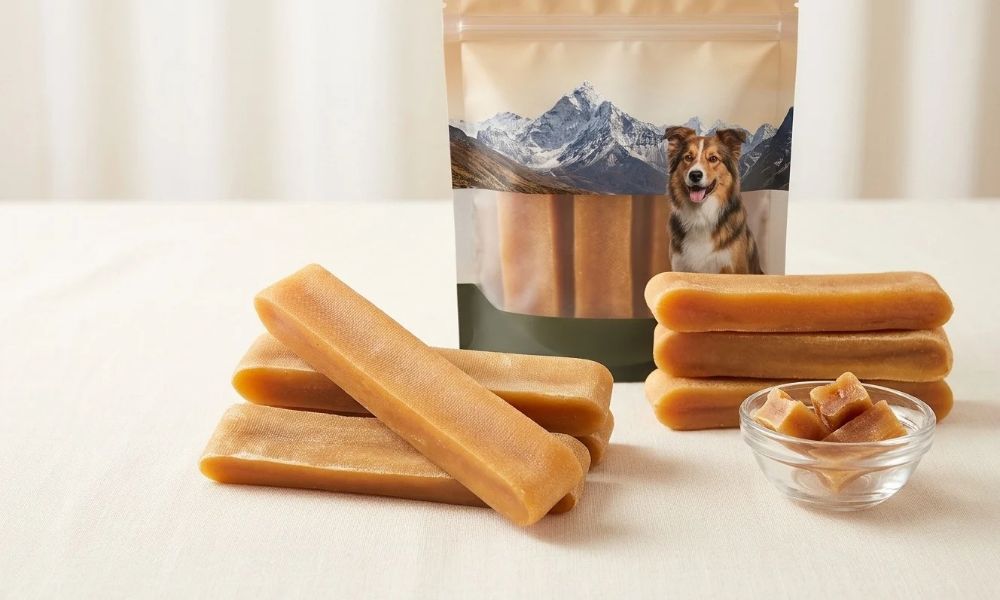
A yak chew treat label includes nine required items under PFLM: product name, species, net quantity, guaranteed analysis, ingredient statement, calorie content statement, nutritional adequacy statement, intended use statement, and manufacturer details. The table maps each AAFCO item to its placement.
| Item | Placement | Yak chew treatment |
| Brand and product name | Front panel | “[Brand] Yak Cheese Dog Chew” |
| Species | Front panel | “Dog Treat” or “for Dogs” |
| Net quantity | Bottom 30 percent of front panel | Ounces and grams |
| Guaranteed analysis | Information panel | Minimum crude protein and fat, maximum crude fiber and moisture |
| Ingredient statement | Information panel | Descending weight, as formulated |
| Calorie content statement | Information panel | “Calorie Content (calculated): [Value] kcal ME/kg; [Value] kcal ME/chew” (moves into Pet Nutrition Facts box under PFLM) |
| Nutritional adequacy statement | Front panel / Nutrition Facts box | Bottom of Pet Nutrition Facts box under PFLM (previously exempt if front panel named a treat) |
| Intended use statement | Front panel | Requires intended use statement on front panel under PFLM |
| Manufacturer or distributor | Information panel | “Manufactured for:” or “Distributed by:” |
Guaranteed analysis values come from laboratory testing of your own product. A published label for a comparable hard cheese chew lists crude protein at 62% minimum, crude fat at 1% minimum, crude fiber at 1% maximum, and moisture at 15% maximum. Copying those numbers onto a different recipe is misbranding.
Plan for the new label format now. According to AAFCO, the Pet Food Label Modernization (PFLM) model regulations were officially approved in July 2023, with a transition running through 2029. PFLM adds a Pet Nutrition Facts box and an Intended Use statement, and it covers treats and private-label products. Leave 25% to 30% of the information panel open, so a later redesign changes text, not pouch size.
How Should Net Weight, Country of Origin, and Manufacturer Details Be Displayed?
Display net weight in ounces and grams in the bottom 30 percent of the front panel, add “Made in Nepal” conspicuously, and name the brand owner with city, state, and ZIP code.
Net weight. AAFCO requires avoirdupois and metric units together. FDA type-size minimums scale with panel area: 1/16 inch for panels of 5 square inches or less, 1/8 inch for more than 5 but not more than 25 square inches, 3/16 inch for more than 25 but not more than 100 square inches, and 1/4 inch for panels of more than 100 but not more than 400 square inches. Conversions: 45 g is 1.6 oz, 100 g is 3.5 oz, 140 g is 4.9 oz.
Country of origin. According to 19 U.S.C. 1304, every imported article or its container carries the English name of the country of origin, marked legibly, indelibly, and permanently. “Made in Nepal” and “Product of Nepal” both qualify. CBP holds unmarked goods until they are marked, and goods released without proper marking face a 10% ad valorem marking duty. Brands that repack chews in the US cannot claim “Made in USA,” because the FTC standard requires all or virtually all content and processing to be domestic.
Manufacturer details. According to AAFCO, the street address may be omitted when the company appears in a local telephone directory, but city, state, and ZIP code stay mandatory. Private-label brands print “Manufactured for:” or “Distributed by:” before their address. The Nepali facility’s FDA registration number belongs on the prior notice, not the retail label.
What Claims About Natural Ingredients, Safety, and Quality Need Careful Review?
Five claim types draw the most regulatory attention on yak chew labels: natural, milk species, organic, human-grade, and health claims.
- Natural claims follow AAFCO’s definition, which excludes chemically synthetic additives. Watch the word “lime,” which suppliers use for both lime juice and calcium hydroxide. Name the exact ingredient.
- Milk species claims need batch records. According to The Kathmandu Post, Nepali chews are made primarily from yak milk along with cow milk. “Yak milk only” on a blended recipe is misbranding, and the ingredient statement lists every milk used.
- Organic and human-grade claims require USDA National Organic Program certification and AAFCO’s human-grade guidelines, respectively.
- Health claims become drug claims when they state an effect. AAFCO lists “reduces inflammation” and “improves joint function” as examples. Keep dental wording descriptive, such as “firm texture for long chewing sessions.”
AAFCO also rules out “veterinarian approved,” since only state agencies approve products. “Veterinarian recommended” requires a statistically sound survey. Add “Supervise your dog. Remove and discard when small enough to swallow. Provide fresh water.” Those lines cost nothing and protect the brand.
How Can US Buyers Verify Packaging Artwork Before Production?
Verify artwork in six steps: request the dieline, compare text, scan the barcode, confirm weights, approve one versioned file, and inspect a physical sample.
- Request the converter’s dieline so panels land clear of folds and seals.
- Compare every printed line, including numbers and the origin marking, against your approved text.
- Scan the barcode. According to GS1 US, a UPC-A prints at a nominal 1.469 by 1.020 inches and scales between 80% and 200%.
- Confirm the net weight conversion (ounces to grams) printed on the label is mathematically accurate.
- Approve one file with a version number and date, signed by both parties.
- Inspect a physical sample, because screens shift Pantone colors and kraft stock darkens them.
Have a state feed control official or a pet food compliance consultant review the artwork before printing. According to the National Animal Supplement Council, state registration does not mean a label passed PFLM review.
How Does Packaging Affect Yak Chew Shelf Life and Product Quality?
Yak chew shelf life depends on moisture, water activity, barrier strength, and storage temperature. Native Nepal Dog Chew’s hard cheese chews, maintained at a maximum moisture level below 12%, guarantee a 24-month shelf life. The right pouch holds that dryness through 30 to 50 days of ocean transit.
What Factors Influence Yak Chew Shelf Life?
Five factors set yak chew shelf life: moisture content, water activity, fat content, drying method, and temperature history.
- Moisture content. Native Nepal Dog Chew guarantees a maximum moisture content of 12% to prevent microbial growth during storage and transport. According to Hill’s Pet Nutrition, dry kibble sits at 5% to 12%.
- Water activity (aw). This measures free water available to microbes on a 0 to 1 scale. Bacteria, yeasts, and molds generally stop growing below 0.60.
- Fat content. A plain chew at 1% crude fat oxidizes slowly. A flavored variant at 14% turns rancid sooner and needs an oxygen barrier.
- Drying method. Traditional Himalayan yak chew manufacturers dry the pressed curd for 28 to 45 days in air or smoke, while mechanically assisted dehydration can reduce this timeline to 14 to 21 days.
- Temperature history. A container crossing the tropics swings 20 °C or more daily, and condensation wets cartons from outside.
How Do Moisture Barriers and Resealable Packaging Help Preserve Quality?
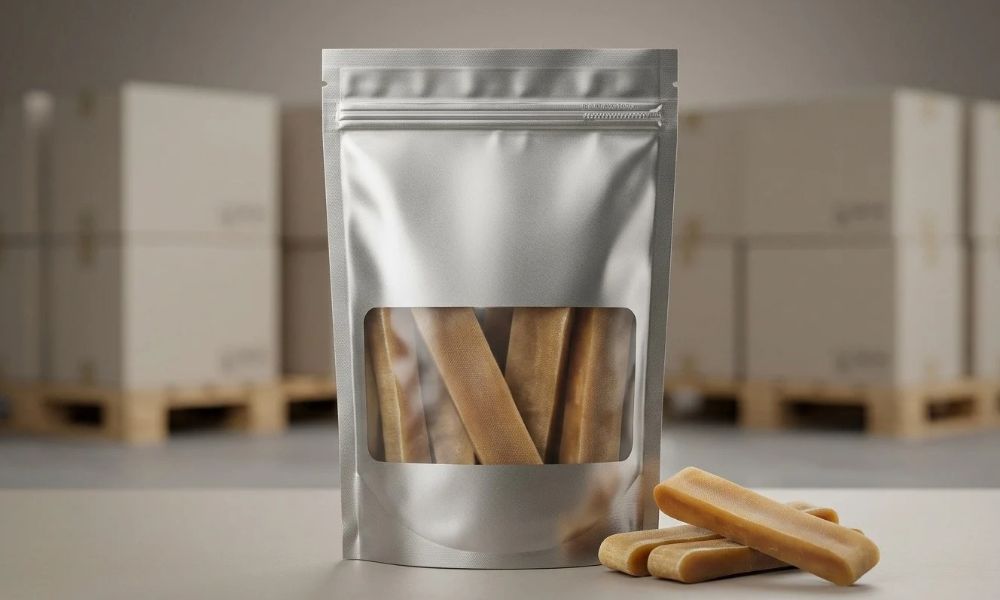
Moisture barriers slow water vapor transfer, and resealable zippers protect chews after first opening. Barrier strength is measured as water vapor transmission rate (WVTR), in grams per square meter per day. Metallized PET laminates run roughly 0.5 to 2, while clear polyethylene film runs roughly 5 to 20. Ask the converter for the datasheet at 38 °C and 90% relative humidity.
A high barrier cuts both ways. Chews sealed at 12% moisture while warm from drying trap that moisture and sweat inside the pouch. Confirm moisture at pack-out, cool the chews to room temperature, then seal.
Dogs eat what they find in a bag, so keep desiccant sachets out of retail pouches and use them in the master carton liner instead. A press-to-close zipper costs about $0.03 to $0.08 per pouch.
What Storage Conditions Should Yak Chew Packaging Communicate?
Yak chew packaging communicates five storage conditions: cool, dry, away from sunlight, resealed after opening, and not refrigerated. Storage guidance from hard cheese chew brands notes that refrigeration cracks the chew.
Print this set of statements:
- “Store in a cool, dry place below 77 °F (25 °C).”
- “Keep away from direct sunlight.”
- “Reseal after opening.”
- “Do not refrigerate.”
- “Best by: MM/YYYY. Lot: ______.”
A lot code and best-by date on every unit let retailers rotate stock and let importers trace a complaint to one batch.
How Can Buyers Evaluate Shelf-Life Claims and Product Consistency?
Evaluate shelf-life claims by requesting study data, per-lot certificates of analysis, and retained samples. A supplier claiming 24 months supplies a real-time study at 25 °C and 60% relative humidity, or an accelerated study at 40 °C and 75% relative humidity, with moisture, aw, and microbiology at each checkpoint.
The certificate of analysis lists moisture, water activity, protein, fat, and microbiology. The FDA treats Salmonella in finished pet food as adulteration, so the result reads negative. Insist on a retained sample from each lot, held for the full shelf life plus 6 months.
Run a spot check: measure moisture on 10 chews from one lot. A spread above 3 percentage points signals uneven drying, and the wettest chews mold first.
Which Yak Chew Packaging Options Suit US Retailers and Wholesalers?
Single-chew packs suit premium retail, multi-packs suit pet stores and subscription boxes, and bulk cartons suit wholesalers who repack. Printed pouches favor shelf display, crush-resistant multi-packs favor e-commerce, and 5, 25, and 50 lb bags favor wholesale.
How Do Single-Chew, Multi-Pack, and Bulk Packaging Options Compare?
Single-chew packs maximize shelf appeal, multi-packs maximize basket value, and bulk packs minimize packaging cost per kilogram. The table compares the three formats.
| Format | Typical unit | Best channel | Strength | Trade-off |
| Single chew | 1 chew, 45 g to 140 g | Boutique pet stores | Highest shelf appeal | Highest packaging cost per chew |
| Multi-pack | 3, 5, or 10 chews | Pet chains, online stores | Lower cost per chew | Bulkier shipping |
| Bulk | 5, 25, or 50 lb bags | Wholesalers, repackers | Lowest cost per kilogram | Needs repacking before retail |
A US wholesale marketplace listing for small chews of 1.6 to 2.1 oz shows about 40 to 45 chews per 5 lb bag, 210 to 215 per 25 lb bag, and 400 to 415 per 50 lb bag. Bulk buyers who repack in the US become the labeler, and every label rule above applies to them.
Which Packaging Formats Work Best for Pet Stores and E-Commerce?
Pet stores sell best with printed stand-up pouches or tagged chews on peg hooks. E-commerce sells best with puncture-resistant multi-packs that survive parcel handling.
For pet stores, add a hang hole, a front window showing the chew, and a counter display for impulse sales. For e-commerce, test the pack against the ISTA 3A parcel standard. Yak chews have sharp edges, so pick a laminate of 100 to 140 microns, since thin film punctures. Amazon requires a suffocation warning on poly bags with an opening of 5 inches or more.
Smoke odor is the sleeper issue, because customers smell the chew through thin film. A kraft pouch with a metallized liner contains it.
What Packaging Materials Balance Product Protection, Presentation, and Cost?
Metallized PET/PE laminate in a stand-up zipper pouch balances protection, presentation, and cost best for retail yak chews. The table lists five materials with approximate barriers and cost ranges at 5,000 units and above.
| Material | WVTR (g/m²/day) | Approx. cost per pouch | Best use |
| Clear PE or PP poly bag | 5 to 20 | $0.05 to $0.15 | Bulk, repacking |
| Cotton drawstring bag | No barrier | $0.40 to $1.00 | Short-turn gift packs |
| Kraft paper with PE liner | 3 to 10 | $0.20 to $0.50 | Retail, natural positioning |
| Metallized PET/PE laminate | 0.5 to 2 | $0.20 to $0.60 | Retail, e-commerce |
| Foil laminate | Under 0.1 | $0.30 to $0.80 | Long shelf life, flavored chews |
Treat these as planning ranges, since size, print method, and volume move the price. For a 5,000-pouch run at $0.35 each, packaging costs $1,750. On a pack retailing at $12.99, that is 2.7% of shelf price, so a better barrier is cheap insurance.
What Private-Label Yak Chew Packaging Options Are Available for US Brands?
Private-label programs let a US brand sell Nepali yak chews under its own name. The supplier makes and packs the chews, and the brand supplies artwork, barcodes, and label content.
Can US Buyers Sell Yak Chews Under Their Own Brand Name?
Yes. US buyers sell yak chews under their own brand through private-label supply, and the brand owner then carries the labeler’s compliance duties.
- The brand owner also handles regulatory tasks like registering products in each state that requires feed registration and acting as the FSVP importer when importing directly. (As a commercial best practice, brands should also clear their trademark with the USPTO before printing 5,000 pouches).
A USDA APHIS Veterinary Services permit is generally required for pet chews containing animal-origin material, including dairy, from countries with livestock diseases exotic to the US. Nepal reports foot-and-mouth disease, and The Kathmandu Post quotes an exporter who states that the US accepts veterinary certificates from Nepal’s Department of Livestock Services. Confirm your permit status with the APHIS VS Permitting Assistant before ordering.
What Customization Options Are Available for Logos, Labels, Colors, and Packaging Sizes?
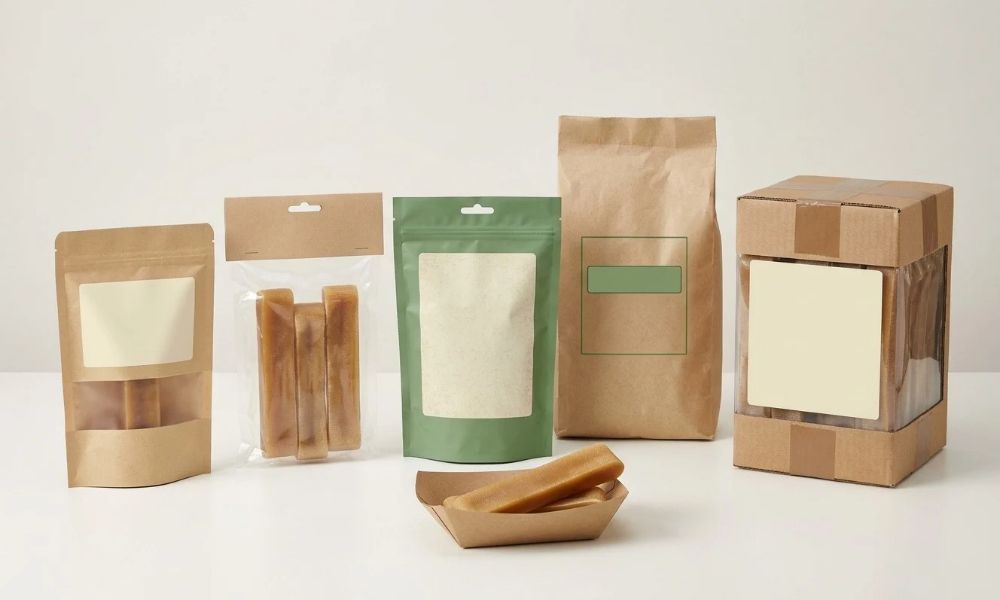
Private-label programs customize five elements: logos, labels, colors, pouch sizes, and chew sizes.
- Logos print from vector files in 1 to 4 spot colors, with foil or embossing on premium runs.
- Labels come as stickers on stock barrier pouches or full-surface printing on custom pouches.
- Colors match Pantone references, in matte or gloss finish.
- Pouch sizes run from 4 oz single-chew pouches to 5 lb bulk bags, with zipper, tear notch, hang hole, and window options.
- Chew sizes run across 5 standard categories (small, medium, large, X-large, and king size), graded by weight and length.
What Should Buyers Know About Minimum Order Quantities and Custom Packaging Costs?
Native Nepal Dog Chew structures product minimum order quantities (MOQs) by supply model: wholesale orders start at 50 kg, white label programs require 100 kg to 500 kg, and private label programs require 500 kg to 2,000 kg. Digital printing starts at 500 to 1,000 pouches, rotogravure near 5,000 to 10,000, and stickers on stock pouches near 500 to 2,000 labels. According to The Kathmandu Post, smaller importers typically buy one or two tonnes at a time.
Production lead times for manufacturing the chews run 3 to 6 weeks. Packaging lead times run 1 to 2 weeks for stickers on stock pouches, 2 to 4 weeks for digital print, and 6 to 10 weeks for rotogravure, which adds a one-time cylinder cost per color but delivers the lowest cost per pouch.
These are industry-typical ranges, and your converter sets the final figures. Budget four cost lines: chews, packaging, freight, and duty. Note that dog chews under HTS 2309.10 enter duty-free under Most Favored Nation (MFN) status, but confirm the HTS classification with a licensed customs broker at entry.
What Artwork, Branding Assets, and Specifications Should Buyers Provide?
Buyers provide eight assets: vector logos, Pantone colors, a dieline, barcode files, legal copy, storage statements, a spec sheet, and a lot code format.
- Vector logos in AI, EPS, or PDF format
- Pantone references for every brand color
- Dielines from the pouch converter
- Barcode files in UPC-A, issued through GS1 US
- Legal copy: ingredient statement, lab-based guaranteed analysis, manufacturer address
- Storage and safety statements in final wording
- Spec sheets listing chew weight, length, count per pack, pouch size, material, and finish
- Lot code formats such as YYMMDD plus a batch letter
How Can US Buyers Evaluate a Yak Chew Packaging Supplier?
Evaluate a yak chew packaging supplier at three checkpoints: pre-production samples, documented quality checks, and written approval of final artwork. A supplier holding FDA-registered, DUNS-registered, ISO 9001, HACCP, and GMP certifications that provides moisture data, seal-strength results, and a batch-level Certificate of Analysis (COA) per lot passes. One that sends photos alone does not.
What Packaging Samples and Quality Checks Should Buyers Request?
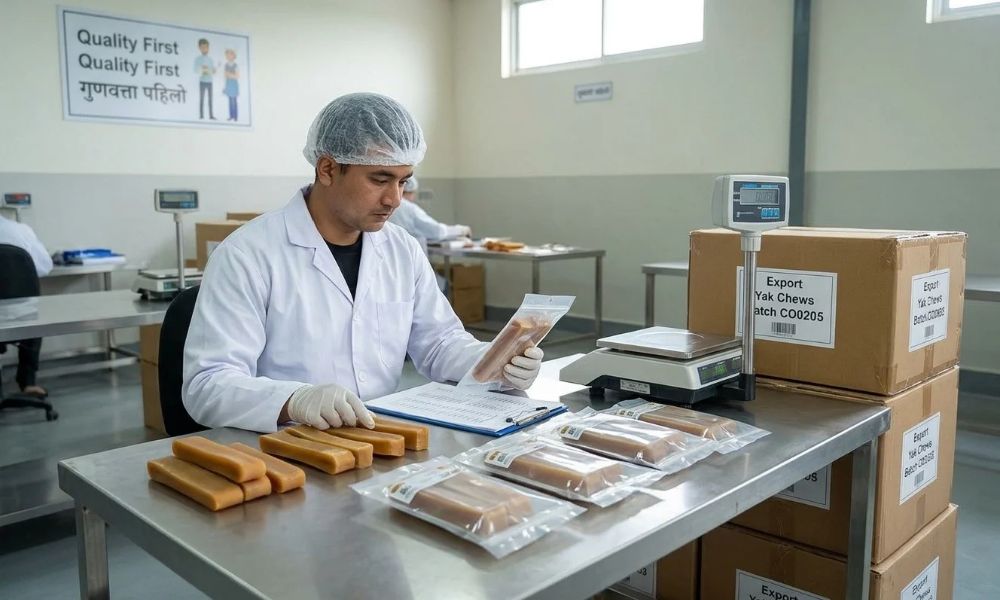
Buyers request three samples: empty printed packaging, a filled and sealed pack, and a signed pre-production sample.
Ask for six tests, in writing, with test date and laboratory name:
- Moisture and water activity per lot
- Microbiology, including Salmonella
- Seal strength, under ASTM F88
- Water vapor transmission, under ASTM F1249
- Oxygen transmission, under ASTM F1927, ASTM D3985, or equivalent standards
- Carton distribution testing, under ASTM D4169
How Can Buyers Assess Label Accuracy, Seal Integrity, and Batch Consistency?
Assess label accuracy by comparing printed packs to the approved proof, seal integrity by pull and leak tests, and batch consistency by lot-level sampling.
Label accuracy. Read every line of 5 printed packs against the signed proof, scan 10 barcodes, and weigh 20 filled packs on a calibrated scale. The average meets or exceeds the declared net weight. Chews lose water in transit, so suppliers add a 2% to 3% fill margin.
Seal integrity. Inspect seals for channel leaks, wrinkles, and trapped chew dust. Agree on a minimum seal strength with the converter in writing, in newtons per 15 mm.
Batch consistency. Inspect by lot using ISO 2859-1 at general inspection level II. A 5,000-unit lot draws a 200-unit sample, and an acceptable quality limit of 2.5 for major defects accepts up to 10. A unique lot code on every unit traces one defect to one batch.
What Should Buyers Confirm Before Approving a Private-Label Packaging Run?
Confirm ten items before approving the run.
- Approve one signed artwork file with a version number and date.
- Verify the ingredient statement, guaranteed analysis, and milk species against the formulation record.
- Confirm “Made in Nepal” on every unit and carton.
- Scan the barcode and match it to your product listing.
- Match net weight to a measured sample, in ounces and grams.
- Review the storage statement, best-by format, and lot code.
- Check the pouch material against the barrier datasheet.
- Align the invoice, packing list, and certificates with the label’s product description.
- Verify FDA facility registration, prior notice details, and your FSVP and APHIS status.
- Specify the pallet: ISPM 15 wood, carton count, and stretch wrap.
Common mistakes we see on first US orders include a net weight in grams only, a “yak milk only” claim on a blended recipe, and artwork approved from a screen proof. Each is cheap to fix before printing and expensive after.
How Can Native Nepal Dog Chew Support US Buyers With Export-Ready Packaging?
Native Nepal Dog Chew supports US buyers by discussing pack formats, private-label branding, artwork review, samples, and export documentation before a production run is committed. We treat packaging as part of the product spec, so label, barrier, and carton get decided together.
Next step for US buyers: Contact Native Nepal Dog Chew to request a packaging spec sheet and a sample set. Bring your target sales channel, chew size, and expected first-order volume.
What Yak Chew Packaging and Private-Label Options Can Native Nepal Dog Chew Discuss With US Buyers?
Native Nepal Dog Chew discusses six areas with US buyers: pack formats, private-label branding, chew sizes, artwork review, sample approval, and shipping documents.
- Pack formats across single chews, multi-packs, and bulk bags
- Private-label branding with your logo, colors, and label content
- Chew sizes matched to your dog-size positioning
- Artwork review against the AAFCO label items and the origin marking
- Sample approval before the full production run
- Shipping documents that match the label, invoice, and certificates
What Should US Buyers Consider When Choosing Yak Chew Packaging for Their Brand?
Choose yak chew packaging by matching five factors: sales channel, compliance readiness, shelf-life target, order volume, and budget. The table maps four common US buyer profiles to a starting packaging choice.
| Buyer profile | Starting packaging |
| New brand testing 500 to 1,000 units | Stickers on stock barrier pouches |
| E-commerce brand | Printed zipper pouch, 100 to 140 micron laminate |
| Wholesaler or repacker | 25 lb poly-lined bulk bags |
| Retail chain supplier | Rotogravure pouch with PFLM-ready panel space |
Yak chew packaging for USA export rewards early decisions. Lock the label content, barrier, and carton specification before the first print order, and the first shipment arrives dry, compliant, and ready to sell.
Ready to compare options? Ask Native Nepal Dog Chew for sample packs in two formats and test them against the supplier checklist above.