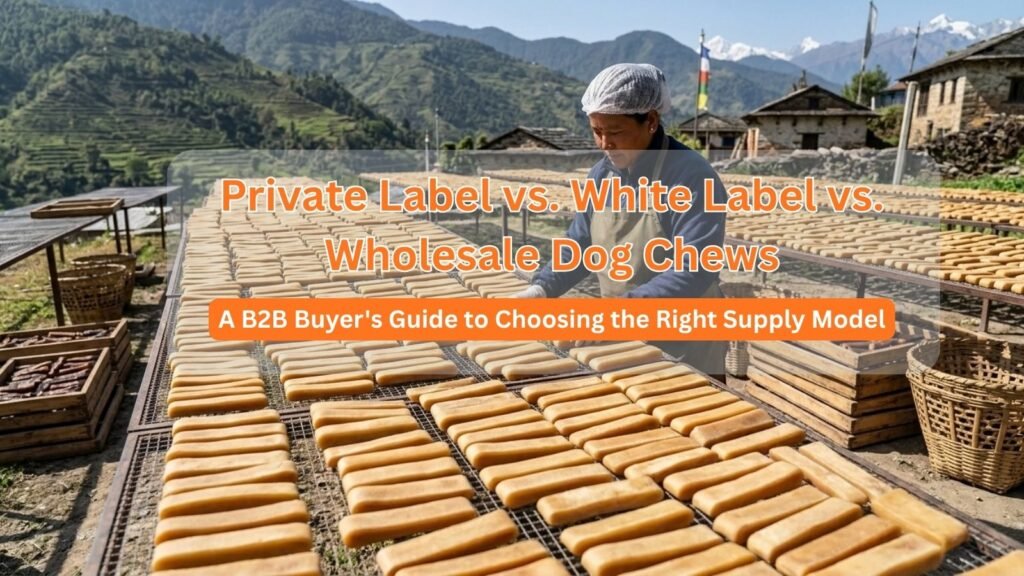
Private label, white label, and wholesale dog chews are three B2B supply models that determine how businesses control product formulation, branding, packaging, inventory, margins, and supplier relationships. Private label provides the highest product ownership and differentiation, white label offers a faster branded launch using an existing formulation, and wholesale provides the lowest-commitment route for reselling finished products. For Himalayan yak chews, the choice also affects ingredient traceability, manufacturing oversight, minimum order quantities, lead times, export documentation, and landed cost. Typical private label programs require 500–2,000 kg MOQs and 60–120-day lead times, while white label and wholesale programs can start around 100 kg and 50 kg, respectively, making each model suited to a different stage of business growth.
Choosing the right dog chew supply model requires more than comparing purchase prices. B2B buyers need to evaluate formulation ownership, gross margin potential, capital requirements, packaging control, production capacity, quality testing, food safety certifications, and international shipping requirements alongside their sales velocity and brand strategy. Himalayan yak chew sourcing adds further considerations, including milk origin, moisture and hardness specifications, batch consistency, HACCP certification, Certificates of Analysis, veterinary documentation, and export compliance for markets such as the United States, European Union, United Kingdom, Canada, and Australia. This guide compares private label, white label, and wholesale dog chews across these commercial and operational factors, explains the strengths and limitations of each model, and provides a practical framework for selecting a supply structure that supports both current market entry and long-term brand growth.
Private Label, White Label, and Wholesale Dog Chews Explained
The 3 supply models cover the full spectrum of B2B dog chew sourcing, from complete product ownership through private label to turnkey resale through wholesale. Each model assigns a different level of responsibility and control to the buyer.
Private Label Dog Chews
Private label dog chews are products manufactured exclusively for one buyer, using that buyer’s proprietary formulation, ingredient specifications, and brand identity. The manufacturer produces the chew to the buyer’s exact requirements, including raw material selection, yak-to-cow milk ratio, protein content, moisture level, product dimensions, hardness rating, and curing duration.
Private label yak chews use a buyer-defined recipe. No other brand on the market carries the same product under the same formulation. This exclusivity is the defining commercial advantage of the private label model.
White Label Dog Chews
White label dog chews are pre-formulated products manufactured at scale and made available to multiple buyers, each of whom applies their own brand name and packaging. The product itself, ingredient composition, size, shape, and texture, is identical across every buyer who sources from the same manufacturer.
White label differs from private label in 1 critical respect: the buyer does not own or control the product formulation. Multiple competing brands sell an identical product under different labels. Differentiation relies on branding and marketing execution, not on the product.
Wholesale Dog Chews
Wholesale dog chews are finished, fully packaged products purchased in bulk at wholesale prices for direct resale. The buyer purchases existing branded or generically labeled products from a manufacturer or distributor without applying their own label or modifying the product in any way.
Wholesale yak chews typically arrive with the manufacturer’s existing label or generic retail packaging. Buyers resale through pet retail channels, independent pet stores, Amazon, Chewy, and regional distributors, without rebranding or product modification.
Key Differences at a Glance
Private labels deliver the highest brand control and gross margins (40–65%) but demand the largest upfront investment ($5,000–$30,000+) and longest lead times (60–120 days). White label and wholesale reduce capital risk and accelerate market entry, but limit product differentiation and compress margins to 15–45%.
The following table compares private label, white label, and wholesale dog chews across 7 B2B dimensions most relevant to brand strategy, capital planning, and supply chain execution.
| Dimension | Private Label | White Label | Wholesale |
| Formulation Ownership | Buyer owns formula | Manufacturer owns formula | No formula access |
| Branding | Fully custom | Custom label, shared product | Resold as-is |
| Typical MOQ | 500–2,000 kg | 100–500 kg | 50 kg–pallet |
| Upfront Investment | $5,000–$30,000+ | $1,000–$10,000 | $500–$5,000 |
| Gross Margin Potential | 40–65% | 25–45% | 15–30% |
| Lead Time | 60–120 days | 30–60 days | 7–30 days |
| Market Differentiation | High | Medium | Low |
The table confirms a clear inverse relationship: higher brand control and margin potential require greater capital commitment and longer lead times. Buyers who understand this trade-off make supply model decisions that match their actual business position, not an aspirational one.
Private Label vs. White Label vs. Wholesale: Key B2B Differences
The 3 models differ across 7 B2B dimensions: customization depth, minimum order quantity, upfront investment, gross margin potential, product development control, packaging ownership, and lead time. Private label maximizes control and margin; wholesale minimizes capital barriers and commitment.
Customization and Branding
Private labels deliver complete product and brand customization across every variable a buyer can specify. Buyers control ingredient selection, formulation ratios, product dimensions, hardness levels, and all packaging elements, artwork, copy, barcodes, feeding guidelines, weight designations, and regulatory statements.
White label delivers brand-level customization only. Buyers apply their logo, name, and label design to a pre-existing product. The product inside the package is identical to competitors sourcing from the same manufacturer.
Wholesale provides no customization. Buyers purchase and resell the product as the manufacturer made it.
Minimum Order Quantities
Minimum order quantities (MOQs) reflect production economics and inventory commitment across the 3 models.
- Private label MOQs range from 500 kg to 2,000 kg per SKU. Manufacturers reconfigure production lines, source raw materials to specification, and run dedicated batches for custom formulations, a cost that justifies larger minimums.
- White label MOQs range from 100 kg to 500 kg. The product already exists in production, reducing the economic justification for high minimums.
- Wholesale MOQs start at 50 kg and scale to full pallet quantities. No production changes occur, so buyers commit only to what they intend to sell.
Upfront Investment
Capital requirements differ by a factor of 3 to 10 across the 3 models. Private labels require investment in formulation development, prototype production, packaging design, regulatory compliance review, and minimum production runs. For a new yak chew SKU, total upfront costs range from $5,000 to $30,000 depending on formulation complexity and packaging format.
White label reduces upfront investment to packaging artwork and minimum order cost, typically $1,000 to $10,000 total.
Wholesale requires only purchase capital, typically $500 to $5,000 for an initial inventory position, with no development costs.
Pricing and Profit Margins
Private label yak chew buyers achieve 40–65% gross margins because they manufacture at cost-plus structures and eliminate intermediary pricing layers. The buyer owns the product economics directly.
White label buyers typically realize 25–45% gross margins. The base product is already priced to include the manufacturer’s margin on the formulation and production process.
Wholesale buyers operate on 15–30% gross margins. Both the manufacturer’s margin and the distributor or trader’s markup are built into the wholesale price the buyer pays.
Product Development
Private label product development follows 4 sequential stages: formulation design, prototype production, buyer testing and approval, and final specification documentation. This process takes 45 to 90 days before full production begins. Buyers who skip sample approval and proceed directly to full production run the risk of receiving a product that does not match their quality expectations.
White label requires no product development. The buyer evaluates an existing product through a sample request and makes a binary decision.
Wholesale requires no development at all. Buyers order directly from existing product catalogs.
Packaging and Labeling
Private label packaging is designed to the buyer’s specifications from a clean slate. Format options include resealable zipper pouches, stand-up flat-bottom bags, retail boxes, bulk treat bags, or custom structural formats. All artwork, regulatory copy, and barcode placement follow the buyer’s brand standards and destination market requirements.
White label packaging uses the manufacturer’s existing structural format. Buyers apply a custom label within the available label space on the pre-existing packaging structure. This limits certain brand expression choices; label size, window placement, and structural format are fixed by the manufacturer’s tooling.
Wholesale products ship in the manufacturer’s original packaging. Some wholesalers offer generic, unbranded bulk packaging for buyers who intend to repackage locally or sell in bulk formats.
Lead Times and Scalability
Private label requires the longest commitment, 60 to 120 days from specification approval to delivered inventory. This timeline includes production scheduling, 28 to 45 days of natural sun-drying for Himalayan yak chews, quality inspection, export documentation, and international freight.
White label lead times run 30 to 60 days. Production begins immediately because the formulation and drying process are already in the manufacturer’s standard cycle.
Wholesale lead times range from 7 to 30 days for in-stock products. Custom wholesale orders tied to scheduled production runs take 30 to 45 days.
Private Label Dog Chews: Benefits and Considerations
Private label yak chews deliver formula exclusivity, full packaging control, and gross margins of 40–65%. The model requires $5,000–$30,000+ in upfront investment per SKU and a 60–120 day lead time. It suits established brands with verified sales velocity and available working capital.
Brand Ownership and Customization
Private label delivers 3 core brand ownership advantages: formula exclusivity, packaging differentiation, and competitive insulation. A buyer who owns their formulation prevents direct product price comparison. Competitors cannot list the identical product at a lower price because the product does not exist under any other label.
For yak chew brands, formula exclusivity translates into specific product attributes that become brand signatures: a higher yak-to-cow milk ratio for premium palatability, a defined hardness rating for aggressive chewers, or a proprietary slow-drying method that produces a denser, longer-lasting chew.
Product and Packaging Control
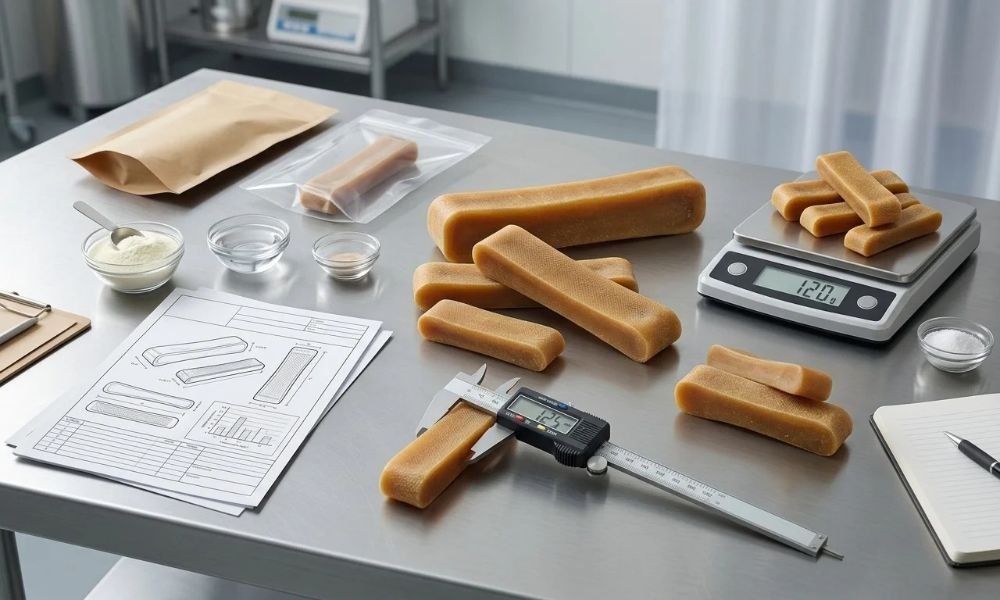
Buyers control 6 critical product variables in private label yak chew manufacturing:
- Yak milk percentage (premium formulations typically use a blend, with yak milk comprising 10–30% of the ratio due to high-altitude scarcity and premium cost)
- Cow milk percentage (typically 70–90%, providing the necessary volume for commercial-scale export production while maintaining traditional texture and hardness)
- Moisture content (below 12% for extended shelf stability and reduced mold risk)
- Product dimensions (XS through XXXL, or custom sizing mapped to specific dog weight ranges)
- Hardness rating (verified through penetrometer testing or Shore D durometer scale)
- Packaging format (retail single-pack, value multipacks, bulk treat bags, or subscription-box formats)
Higher Investment and Planning Requirements
Private labels require capital commitment 12 to 16 weeks before first product delivery. Buyers who underestimate lead time or overestimate demand face stockouts at launch or excess inventory that ties up working capital.
The 3 most common planning failures in private label yak chew sourcing are: ordering insufficient quantities to meet per-unit cost targets, failing to include freight and customs duties in landed cost projections, and skipping sample approval before committing to full production runs.
Best Fit for Established and Growing Pet Brands
Private label yak chews match businesses with 3 specific characteristics: an established or fast-growing customer base that justifies minimum order volumes, sufficient working capital to fund 90-day inventory cycles, and brand differentiation as a core competitive strategy.
Businesses entering the yak chew market without an existing distribution channel carry elevated risk with private labels. The model rewards businesses that already know their sales velocity per SKU.
White Label Dog Chews: Benefits and Considerations
White label yak chews deliver a branded, market-ready product in 30–60 days without any product development requirements. Gross margins range from 25–45%. The model suits brands prioritizing speed to market over product exclusivity, with MOQs starting at 100 kg.
Ready-Made Products Under Your Brand
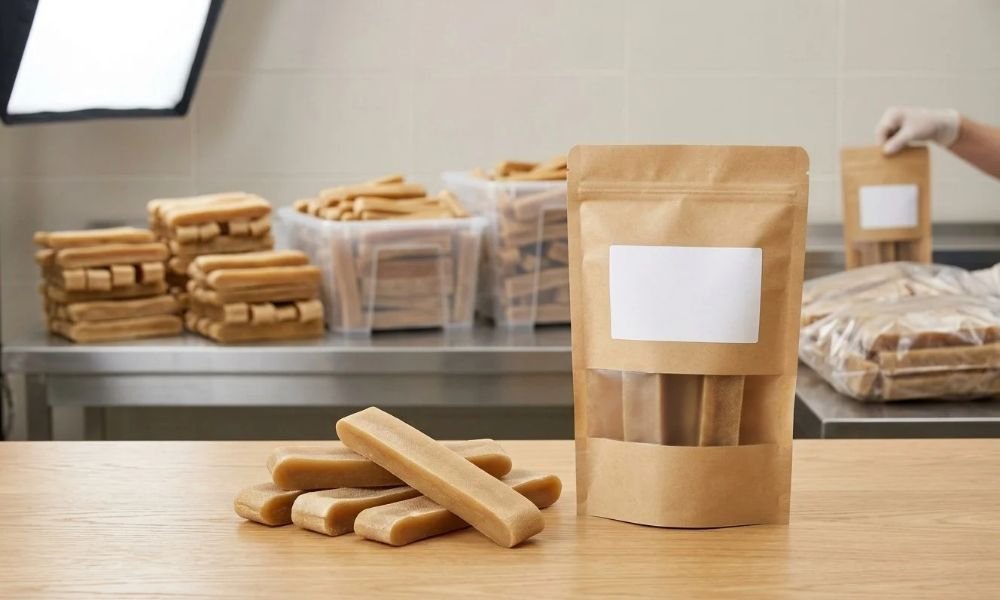
White label delivers a market-ready product in 30 to 60 days. The manufacturer handles formulation, production, quality testing, and base packaging structure. The buyer’s operational focus is label design, regulatory compliance review for the destination market, and distribution execution.
For yak chew buyers, white label means the manufacturer has already sourced Himalayan yak milk, produced and cured the chews, and verified basic quality parameters. Buyers enter the natural dog chew market without building direct supplier relationships with Himalayan producers.
Faster Market Entry
White label compresses time-to-market by eliminating the product development phase entirely. A buyer who sources a white label yak chew launches a branded product on Amazon, Shopify, or in retail stores within 60 days of placing an initial order, compared to 120-day minimums for private label.
This speed advantage matters during market timing windows: new regulatory openings in export markets, seasonal pet gift demand peaks, or retailer shelf resets where placement decisions happen on compressed timelines.
Lower Development Requirements
White label requires no food science expertise, no laboratory formulation work, and no prototype testing process. The buyer evaluates the manufacturer’s existing product through a sample request and makes a binary decision: accept the product as-is or source from a different supplier.
This lower technical barrier allows brands without dedicated product development teams to participate in the premium natural dog chew category.
Limitations on Product Differentiation
White label creates 1 structural differentiation limitation that buyers must account for in their commercial strategy: any other buyer sourcing from the same manufacturer’s white label line sells an identical product. Differentiation depends entirely on brand positioning, pricing strategy, marketing execution, and distribution channel exclusivity, not on the product itself.
In markets with multiple Amazon sellers sourcing the same white label yak chew, price competition compresses margins quickly. White label works best when distribution is regionally exclusive or when brand marketing creates a strong perception advantage the product itself does not.
Wholesale Dog Chews: Benefits and Considerations
Wholesale yak chews require the lowest entry investment (starting around $500 to $5,000), no product development, and deliver finished resale-ready inventory in 7–30 days. Gross margins range from 15–30%. The model suits retailers, distributors, and marketplace resellers building broad product assortments.
Ready-to-Sell Yak Chews
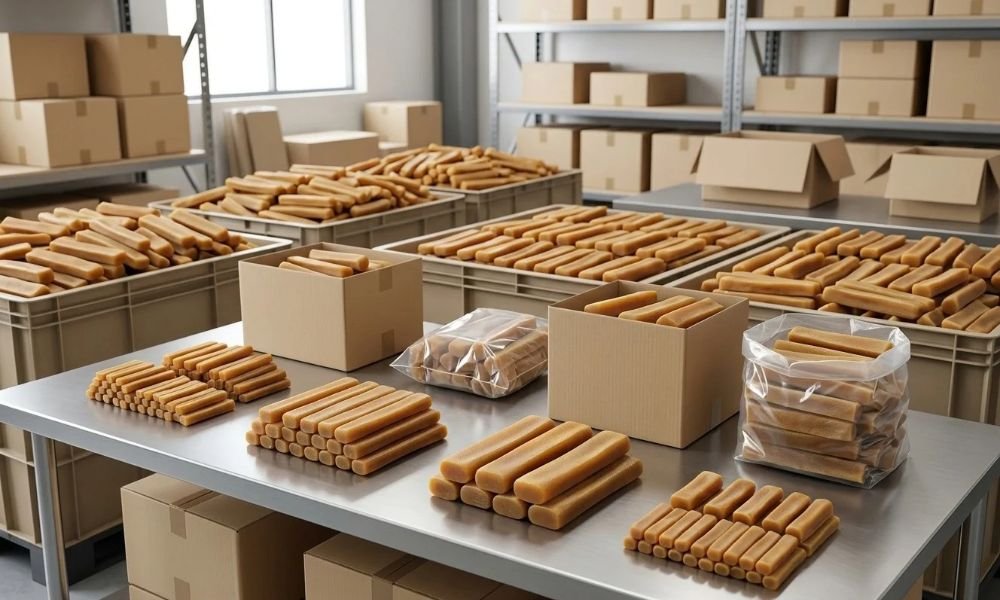
Wholesale yak chews arrive in finished, resale-ready condition. Buyers receive fully packaged products with existing barcodes, ingredient labels, feeding guidelines, and size designations. The buyer’s operational role is inventory management, storage, channel fulfilment, and sales execution.
This turnkey structure suits businesses that prioritize distribution efficiency and assortment breadth over proprietary brand development.
Lower Entry Barriers
Wholesale carries the lowest capital and operational barriers of the 3 models. Buyers enter the yak chew market with $500 to $5,000 in initial inventory investment, with no packaging design costs, no regulatory review obligations, and no supplier negotiation over formulation specifications.
For pet retailers adding natural chews to an existing product assortment, wholesale eliminates the operational complexity of direct sourcing from Nepal, Bhutan, or Tibet.
Flexible Product Selection
Wholesale buyers access a manufacturer’s or distributor’s full product catalog without locking into a single SKU. A buyer builds an assortment of 5 to 15 yak chew SKUs, covering multiple sizes, product formats (whole chews, sticks, bites, puffs), and flavor variations (natural, smoked, cheese-infused), from a single wholesale relationship.
This flexibility allows rapid demand testing across multiple product types before committing to higher-volume orders or a proprietary product investment.
Best Fit for Retailers, Distributors, and Resellers
Wholesale is the correct supply model for 4 business types: brick-and-mortar pet retailers managing diverse assortments, Amazon and Chewy resellers without brand registry, regional distributors building product selections for independent pet stores, and e-commerce businesses testing market fit before committing to private or white label investment.
These businesses generate profit through volume throughput and assortment width, not per-unit margin maximization on a single branded product.
What Should B2B Buyers Consider When Sourcing Yak Chews Worldwide?
B2B buyers sourcing yak chews internationally evaluate 6 core sourcing criteria: ingredient origin and purity verification, cross-batch product consistency, physical specification compliance, retail shelf presentation, food safety certification status, and export documentation completeness.
Yak Chew Ingredients and Sourcing
Authentic Himalayan commercial yak chews contain 4 ingredients: cow milk, yak milk, Himalayan rock salt, and food-grade lime juice. The lime juice triggers caseination, the protein coagulation and separation process that forms the chew’s dense, hard structure when pressed and dried.
Buyers verify ingredient sourcing through supplier disclosure documents and milk origin certificates. Nepal, Tibet, and Bhutan represent the 3 primary yak milk sourcing regions. Each region produces milk with distinct fat content and protein profiles that affect final product hardness and flavor characteristics.
Suppliers sourcing from high-altitude yak herds above 3,500 meters elevation produce milk with higher fat content, typically 7 to 8% fat versus 5 to 6% from lower-altitude herds. This higher fat content increases chew density and palatability scores in consumer preference testing.
Product Quality and Consistency
Batch-to-batch consistency is the most frequent supply chain failure point for yak chew importers. Artisan manufacturing, common among small Himalayan cooperatives and family producers, creates variation in moisture content, hardness, color, and odor across production runs.
Buyers specify 5 measurable consistency parameters in purchase contracts:
- Moisture content: maximum 12% (above this level, mold risk increases significantly during transit and storage)
- Protein content: minimum 60% on a dry matter basis
- Hardness rating: defined by penetrometer depth or Shore D durometer reading
- Color range: light golden to medium brown (dark brown or black discoloration indicates over-processing)
- Odor classification: mild, neutral dairy scent (ammonia or sour odors indicate microbial contamination)
Size, Shape, and Product Specifications
Yak chew sizing follows 5 standard weight categories recognized by US and EU pet retail buyers:
- XS: 15–25 grams (for dogs under 5 kg / 11 lbs)
- Small: 25–50 grams (for dogs 5–10 kg / 11–22 lbs)
- Medium: 50–80 grams (for dogs 10–20 kg / 22–44 lbs)
- Large: 80–120 grams (for dogs 20–35 kg / 44–77 lbs)
- XL/XXL: 120–200 grams (for dogs over 35 kg / 77 lbs)
Custom sizes outside this range create retail placement friction. Buyers who deviate from standard weight categories face compatibility issues with existing shelf packaging dimensions, and buyer expectation mismatches at point of sale.
Packaging and Shelf Presentation
Retail packaging for yak chews serves 3 commercial functions: product protection during transit and storage, regulatory compliance display for the destination market, and consumer communication at point of purchase.
Stand-up zipper pouches with clear product windows represent the current retail standard for premium yak chews in the US and EU markets. Flat-bottom pouches with hang holes suit both shelf placement and peg display. Buyers specify oxygen barrier properties, resealability requirements, and label surface area in packaging briefs to manufacturers.
Food Safety and Quality Standards
US buyers importing yak chews must ensure the manufacturer holds FDA food facility registration, and the US importer must legally comply with the Foreign Supplier Verification Program (FSVP) under the FDA Food Safety Modernization Act (FSMA) to verify food safety standards. EU buyers require TRACES NT documentation and veterinary health certificates from a competent authority in the country of origin. Australian buyers require Department of Agriculture, Fisheries and Forestry (DAFF) import permits via the BICON system and specific processing declaration documents.
The two most critical food safety certifications for Himalayan yak chew manufacturers exporting to regulated markets are HACCP (Hazard Analysis Critical Control Points) and ISO 22000, which must be accompanied by shipment-specific, government-issued veterinary inspection documentation equivalent to USDA standards.
Traceability and Export Documentation
Complete export documentation for yak chew shipments requires 5 core documents: Certificate of Origin (issued by Federation of Nepalese Chambers of Commerce and Industry (FNCCI) or equivalent authorized regional chamber), Veterinary Health Certificate, Commercial Invoice, Packing List, and Bill of Lading or Air Waybill.
Buyers who receive incomplete documentation face customs clearance delays, quarantine holds at destination ports, or mandatory return shipments at importer cost. Verifying documentation completeness before shipment departure eliminates 90% of customs-related delays.
How Should B2B Buyers Evaluate a Yak Chew Supplier?
B2B buyers evaluate yak chew suppliers across 6 operational dimensions: manufacturing and sourcing integration, quality control process maturity, MOQ and pricing structure, production capacity, sample approval protocols, and international shipping experience.
Manufacturing and Sourcing Capabilities
Vertically integrated manufacturers, those who source yak milk directly from registered herding cooperatives and process it in their own HACCP-certified facilities, deliver greater ingredient traceability than trading companies or export brokers.
Buyers distinguish manufacturers from traders by requesting 3 verification documents: facility photographs showing processing equipment and production environment, documented milk supplier agreements with identified farm or cooperative sources, and government-issued business registration certificates. A legitimate manufacturer provides all 3 within 5 business days of request.
Quality Control and Product Testing
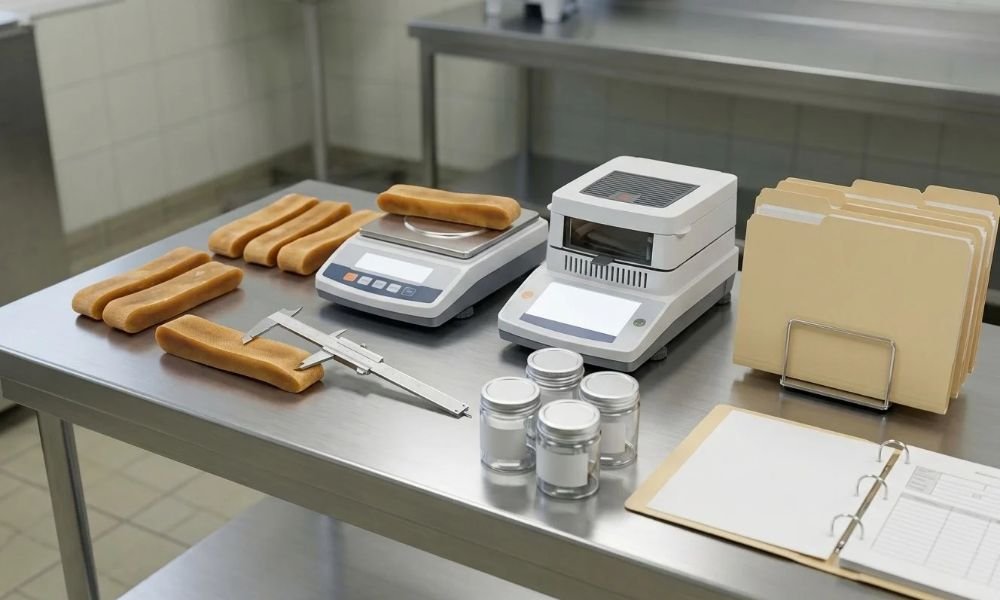
Verified yak chew manufacturers maintain internal quality control at 3 production stages:
- Raw material inspection: incoming milk testing for fat content, protein percentage, and microbial load before production begins
- In-process monitoring: moisture and temperature tracking during pressing and drying to ensure consistent product density
- Finished product verification: final weight check against specification, hardness testing, visual inspection for color and surface quality, and odor assessment
Buyers request Certificates of Analysis (CoA) for each production batch. CoA documents confirm that the delivered product meets every protein, moisture, fat, and microbial specification agreed in the purchase order.
Minimum Order Quantities and Pricing
MOQ and pricing structures vary across supplier types and supply models. The following table outlines typical FOB Nepal price ranges and MOQs for each model.
| Supply Model | Typical MOQ | FOB Nepal Price Range (per kg) |
| Private Label | 500–2,000 kg | $8–$14 per kg |
| White Label | 100–500 kg | $10–$16 per kg |
| Wholesale | 50 kg–pallet | $12–$18 per kg |
Price premiums in white label and wholesale reflect the manufacturer’s existing margin on developed and packaged products. Private label pricing reflects raw material cost plus manufacturing cost only, without a pre-built margin on formulation, which is why private label delivers higher buyer margins at scale.
Production Capacity and Lead Times
Yak chew production capacity is constrained by 2 interdependent factors: natural drying time and facility drying area. Traditional Himalayan yak chews require 28 to 45 days of sun-drying after pressing. Mechanically assisted dehydration reduces this to 14 to 21 days but affects product texture, density, and consumer palatability ratings.
Buyers sourcing more than 1,000 kg per month verify that the supplier maintains sufficient drying capacity before committing to annual purchase volumes. A supplier operating 200 square meters of drying area cannot reliably fulfil 2,000 kg monthly orders without stock shortfalls.
Samples and Product Approval
A structured sample evaluation covers 5 assessment criteria:
- Visual assessment: color consistency, surface texture uniformity, shape regularity within stated size tolerances
- Olfactory evaluation: dairy scent intensity, complete absence of ammonia, sour, or musty off-odors
- Hardness assessment: resistance to manual compression consistent with the stated size category
- Dog palatability observation: acceptance rate and consumption time in target dog weight categories
- Packaging review: structural integrity, label adhesion, regulatory statement completeness
Buyers who proceed to full production without completed sample approval risk receiving product that does not meet stated specifications. Sample approval documentation, signed by the buyer’s quality representative, establishes a contractual product standard the manufacturer must replicate on every subsequent delivery.
International Shipping and Distribution
Yak chews ship from Nepal through 3 primary routes:
- Air freight: Kathmandu Tribhuvan International Airport to major hub airports (Chicago O’Hare, Los Angeles, Frankfurt, Dubai). Delivers 100–500 kg shipments in 3 to 7 days at approximately $5 to $9 per kg.
- Sea freight via Visakhapatnam (Vizag) or Kolkata: consolidated LCL or FCL container shipping. Delivers pallet and container quantities in 25 to 45 days at approximately $0.80 to $1.50 per kg.
- Land freight to India + sea consolidation: road transit from Kathmandu to Visakhapatnam (Vizag) or Kolkata, followed by sea freight. Adds 3 to 7 days to sea freight lead time but reduces inland freight cost for heavy shipments.
Sea freight becomes the economically viable choice at shipment volumes above 300 kg. Air freight carries a freight cost premium of 4 to 6 times sea freight but delivers inventory 3 to 5 weeks faster, a trade-off that justifies air freight for initial product launches or urgent stock replenishment.
How Can Businesses Choose the Right Dog Chew Supply Model?
The correct supply model depends on 3 business-specific factors: available capital, brand strategy clarity, and speed-to-market priority. These 3 factors determine not just which model fits today, but which model supports growth 24 months from now.
Choosing Private Label for Brand Differentiation
Private label is the correct choice when a business meets 3 criteria: it operates in a competitive channel where product differentiation drives customer retention and pricing power; it has working capital available to fund 90-day inventory cycles without cash flow disruption; and it plans to build a durable pet brand as a long-term commercial asset rather than testing demand with minimal commitment.
The private label investment returns through higher per-unit margins, repeat customer loyalty built on product consistency, and brand equity that accumulates with every unit sold. The cost of private label’s upfront investment is recovered faster at scale than most buyers project when they first calculate it.
Choosing White Label for Faster Market Entry
White label is the correct choice in 2 scenarios: launching a branded yak chew product without an in-house product development team, or entering the market while a proprietary private label formulation is still in development.
White label functions effectively as a commercial bridge strategy, generating revenue, building retail relationships, and validating demand while the business develops the capability and capital to transition to private label.
Choosing Wholesale for Flexible Reselling
Wholesale is the correct choice for businesses that prioritize assortment breadth over brand exclusivity. Retailers, regional distributors, and marketplace resellers operate on wholesale economics because their commercial model profits from volume throughput across multiple SKUs, not from maximizing per-unit margin on a single branded product.
Wholesale yak chew buyers achieve higher revenue velocity by carrying 10 to 15 SKUs across multiple brands and size ranges than by concentrating inventory in a single private label product they have not yet validated.
Matching the Supply Model to Business Size and Growth
Business maturity maps to supply model selection in a predictable progression:
- Market entry phase (0–12 months): Wholesale or white label reduces capital exposure while demand data accumulates
- Growth phase (12–36 months): White label or private label builds brand equity alongside growing sales velocity
- Scale phase (36+ months): Private label maximizes margin, brand defensibility, and business value at volume
Some businesses operate all 3 models simultaneously, wholesaling complementary products to fill assortment gaps while selling their proprietary private label as the hero SKU driving brand identity and margin.
Comparing Total Cost and Long-Term Profitability
Total landed cost for yak chews comprises 8 cost components: FOB manufacturer price, ocean or air freight, customs duties (standard US imports for retail dog food under HTS Code 2309.10.00 are generally duty-free, though buyers must verify their destination market’s current tariff schedules), import bond fees, customs brokerage, destination warehouse inbound freight, third-party quality inspection (if used), and Amazon FBA or third-party logistics fees (if applicable).
Private label buyers who calculate total landed cost accurately realize a $4 to $8 per kilogram margin advantage over white label buyers and a $6 to $12 per kilogram margin advantage over wholesale buyers at equivalent retail price points. Whether calculated by the kilogram or the individual item, this advantage compounds significantly at retail volumes above 2,000 units per month.
How Can Native Nepal Dog Chew Support B2B Yak Chew Buyers Worldwide?
Native Nepal Dog Chew supports all 3 supply models: private label, white label, and wholesale, for international B2B buyers. The company holds HACCP certification and FDA food facility registration, and exports with full veterinary documentation directly from Nepal.
Native Nepal Dog Chew sources, manufactures, and exports Himalayan yak chews directly from Nepal. The company’s supply chain begins at high-altitude yak farms above 3,500 meters elevation in the Himalayan region and delivers to B2B buyers in the US, EU, UK, Canada, Australia, and across Asia-Pacific.
The company holds HACCP certification, maintains FDA food facility registration for US market exports, and ships with complete government-issued veterinary health certificates and Certificates of Origin. B2B buyers receive Certificates of Analysis for every production batch, confirming protein content, moisture level, and microbial compliance against purchase order specifications.
Can Native Nepal Dog Chew Provide Private Label, White Label, or Wholesale Yak Chews?
Native Nepal Dog Chew supports all 3 supply models for international B2B buyers. Private label buyers work directly with the company’s product development team to define formulation specifications, product dimensions across the XS to XXL size range, and custom packaging formats. White label programs require MOQs of 100 kg to 500 kg, while wholesale orders start at 50 kg.
Private label programs include formulation consultation, prototype production, sample shipment for buyer approval, and full production runs with batch CoA documentation. White label programs feature lead times of 30 to 60 days, whereas wholesale orders can ship in 7 to 30 days depending on order volume and shipping method.
Buyers building a long-term yak chew brand or expanding an existing pet product line can request product samples and a complete B2B pricing catalog through the Native Nepal Dog Chew contact page to begin the supplier evaluation process.
What Are the Key Takeaways for Choosing the Right Dog Chew Supply Model?
The right supply model depends on 3 variables: available capital, brand strategy, and speed-to-market priority. Private labels build the most defensible brand at the highest margin (40–65%). White label speeds market entry. Wholesale minimizes risk while validating demand. Each model suits a different growth stage.
Private label, white label, and wholesale dog chew supply models each deliver a distinct balance of brand control, capital efficiency, and time-to-market. The correct model is determined by where a business sits in its growth trajectory and where it intends to be 24 months from now.
The 5 decisions that determine supply model success for yak chew buyers are:
- Define brand strategy before selecting a model. Private labels build defensible brand assets. White label accelerates market entry. Wholesale maximizes assortment flexibility. Each serves a different strategic purpose, and mixing them without a clear strategy creates operational and margin inefficiency.
- Calculate total landed cost, not just FOB price. Freight, customs duties, brokerage fees, warehouse inbound charges, and fulfilment costs determine actual per-unit economics. FOB price is the starting point, not the decision point.
- Verify supplier credentials before committing to volume. HACCP certification, FDA food facility registration, and batch-level CoA documentation are non-negotiable requirements for US and EU market compliance. Suppliers who cannot provide these documents create import risk that exceeds any per-unit price advantage.
- Align MOQ commitments with verified sales velocity data. Overcommitting to private label volumes without established sell-through rates creates excess inventory and cash flow pressure. Start at the minimum viable order quantity and scale from verified demand.
- Match your supply model to your long-term business type. For brand-builders, treat white label as a transitional model toward private label to maximize margins and defensibility. For pet retailers and regional distributors, wholesale remains the permanent, most efficient model for managing a broad product assortment.
Private label, white label, and wholesale supply models each represent a viable entry point into the Himalayan yak chew market. The correct choice is the one that matches a business’s current capital, capability, and commercial strategy, with a clear migration path to the model that delivers the strongest long-term return.