
Importing Himalayan yak chews from Nepal to Taiwan is the process of sourcing a processed yak-milk dog chew from a Nepalese manufacturer and moving it through Taiwan’s animal-product import, customs, quarantine, labeling, and distribution requirements. The process connects Nepal’s yak-milk processing and export documentation system with Taiwan’s Bureau of Animal and Plant Health Inspection and Quarantine (BAPHIQ), Taiwan Customs Administration, and applicable pet-food regulatory requirements. A compliant shipment requires product and supplier verification, BAPHIQ eligibility confirmation, importer registration, Nepalese export documents, a shipment-specific Veterinary Health Certificate from Nepal’s Department of Livestock Services (DLS), appropriate freight arrangements, customs declaration, quarantine clearance, applicable duties and taxes, and Traditional Chinese labeling before retail distribution.
The Nepal-to-Taiwan yak chew import process also depends on practical decisions involving supplier certification, product specifications, packaging, HS classification, freight mode, landed cost, pre-shipment inspection, traceability, and post-clearance storage. Importers can structure trial orders and recurring commercial shipments around defined volume, documentation, and logistics requirements, including air freight from Kathmandu to Taiwan Taoyuan or sea freight through regional ports to Taiwan. Understanding these requirements before placing a purchase order helps importers coordinate BAPHIQ approval, DLS certification, customs clearance, product labeling, and Taiwan-side distribution while accurately estimating the total cost of bringing Himalayan yak chews from a Nepalese exporter to the Taiwanese pet market.
What Are Himalayan Yak Chews, and Why Are They Imported From Nepal to Taiwan?
Himalayan yak chew is a hard, processed dog chew made from 3 ingredients: yak milk or cow milk, lime juice, and salt. Nepal is the world’s primary producer of authentic Himalayan yak chews, supplying regulated markets across North America, the European Union, Japan, and increasingly, Asia-Pacific markets including Taiwan.
The product contains no artificial preservatives, no synthetic binders, and no chemical additives. Protein content ranges from 60% to 69% per 100 g depending on yak-to-cow milk ratio and milk density, per a 2023 Journal of Ethnic Foods analysis. Fat content stays below 5%, which sets it apart structurally and nutritionally from rawhide, synthetic rubber chews, and collagen-based alternatives.
What Makes Nepalese Himalayan Yak Chews Suitable for the Taiwan Market?
Nepalese Himalayan yak chews meet 4 quality attributes that directly match Taiwan’s growing premium pet product segment: single-ingredient composition, protein density above 65%, a shelf life of 24 months without refrigeration, and complete natural odor absence.
The chews are produced at altitudes above 3,000 meters across Nepal’s high-altitude districts, including Dolpa, Humla, Mustang, and Solukhumbu. Yak milk sourced at these elevations contains a higher protein-to-fat ratio than lowland dairy. This produces a denser curd structure during traditional hardening, resulting in a harder final chew with extended chew times of 30 to 90 minutes per piece, depending on dog size class.
Taiwan’s premium pet product channel, comprising specialty pet stores, licensed e-commerce platforms, and veterinary retail clinics, imports natural, single-ingredient dog chews in increasing volume. Himalayan yak chew occupies a market position that Taiwan domestic manufacturers cannot replicate, as no Taiwanese producer sources yak milk or replicates the altitude-dependent milk density required for the authentic product.
Why Are Taiwan Pet Owners Interested in Himalayan Yak Chews?
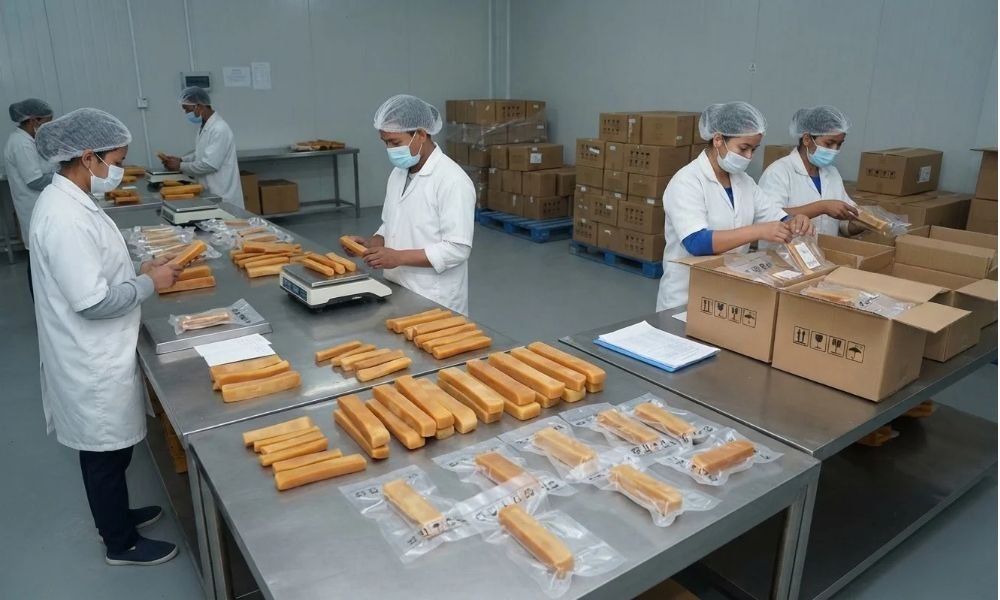
Taiwan’s pet owners choose Himalayan yak chews for 4 documented reasons: allergen-free composition for dogs with sensitivities, absence of rawhide and plastic-derived materials, odor control during indoor use, and alignment with the clean-label pet food preferences that dominate Taiwan’s urban pet market.
Taiwan’s estimated dog population reached approximately 1.48 million in 2023 (the most recent Ministry of Agriculture survey), with urban ownership concentrated in Taipei, New Taipei, Kaohsiung, and Taichung. Urban apartment owners specifically seek chews that produce no odor in enclosed spaces and contain no artificial ingredients that trigger food-sensitivity reactions. Himalayan yak chews fulfill both requirements with a product category that carries no domestic equivalent.
How Do You Import Himalayan Yak Chew From Nepal to Taiwan?
Importing Himalayan yak chew from Nepal to Taiwan follows 7 sequential process stages: eligibility confirmation with BAPHIQ, supplier verification in Nepal, commercial and veterinary document preparation, freight arrangement from Nepal, Taiwan customs declaration filing, quarantine inspection clearance, and post-release labeling before distribution.
Each stage carries specific documentation requirements that must be completed in order. Submitting customs declarations without an active BAPHIQ import permit results in an automatic shipment hold. Receiving shipments without a shipment-specific veterinary certificate results in product destruction at the importer’s expense.
How Can You Confirm Taiwan Import Eligibility Before Ordering?
Taiwan’s Animal and Plant Health Inspection Agency (APHIA), operating under the Ministry of Agriculture, classifies it as an animal-derived product subject to import permit requirements under the Statute for Prevention and Control of Infectious Animal Diseases and the Feed Control Act.
Before placing any order with a Nepal supplier, submit 3 documents to BAPHIQ: a product description specifying all ingredients and their origin, a manufacturing process overview from the Nepal exporter, and a proposed product label draft. BAPHIQ reviews these and issues a formal eligibility determination confirming whether the product requires an Animal Products Import Permit (APIP) or falls under an existing approved-product category.
As of early 2026, Nepal appears on BAPHIQ’s approved-country list for specific processed animal products intended for animal (non-human) consumption. Confirm the current status directly with BAPHIQ, as the approved-country list updates quarterly based on bilateral disease surveillance agreements.
How Should You Choose and Verify a Nepalese Himalayan Yak Chew Supplier?
A qualified Nepalese Himalayan yak chew supplier holds 4 active certifications that Taiwan import regulations require: an export license registration from Nepal’s Department of Commerce, Supplies and Consumer Protection (DoCSCP), plus an EXIM code issued by the Department of Customs, a food-processing facility registration from the Department of Food Technology and Quality Control (DFTQC), a veterinary health certificate issuance capability through the Department of Livestock Services (DLS), and a HACCP or GMP certification from an internationally recognized body.
Request certified copies of all 4 documents before signing any commercial agreement. Conduct a video-verified facility inspection if an in-person audit is not immediately feasible. Confirm that the supplier currently exports to other regulated markets, such as the United States (FDA-registered), the European Union, or Japan, as this demonstrates existing compliance infrastructure compatible with Taiwan’s BAPHIQ requirements.
Common mistakes at this stage include accepting incomplete documentation and relying on supplier self-declarations without certificate verification. Obtaining documents directly from the issuing Nepal government bodies eliminates fraudulent or outdated certificate risk.

How Can You Confirm Product Specifications and Packaging Requirements?
Product specification confirmation covers 5 areas before order placement: ingredient declaration (yak milk percentage, cow milk percentage, lime content by weight, salt percentage), moisture content (below 12% for 24-month shelf life), protein content by laboratory analysis, chew dimensions by size grade, and primary packaging material type and seal integrity.
Request a signed product specification sheet and a third-party laboratory test report from a laboratory accredited under ISO/IEC 17025. Taiwan’s FDA and BAPHIQ both accept test reports from labs accredited under this standard. SGS Nepal, Bureau Veritas Nepal, and Intertek Nepal operate ISO/IEC 17025-accredited laboratories in Kathmandu with experience issuing reports formatted for Taiwan regulatory submissions.
Packaging specifications for Taiwan require individually vacuum-sealed primary units within a moisture-resistant secondary carton. Packaging must withstand a 72-hour transit simulation without moisture ingress, as Nepal-to-Taiwan shipments, particularly sea freight routes, pass through humid port environments.
How Should You Prepare Commercial Invoices and Packing Lists?
Commercial invoices for Nepal-to-Taiwan Himalayan yak chew shipments require 9 mandatory data fields: seller name and Nepal address, buyer name and Taiwan address, invoice date, product description including HS code, unit quantity and size grade breakdown, unit price in USD, total invoice value, country of origin (Nepal), and payment terms (T/T 30 days or L/C are standard).
Packing lists add 4 additional fields: gross weight per carton in kilograms, net weight per carton in kilograms, carton dimensions in centimeters, and total carton count. Both documents carry the exporter’s authorized signature and company stamp. Taiwan customs cross-references the commercial invoice and packing list against the BAPHIQ import permit and the DLS veterinary certificate during the documentation review stage of customs clearance.
Discrepancies between the invoice product description and the veterinary certificate product description are the most common cause of documentation-related customs holds. Ensure the product name, ingredient list, and HS code are identical across all documents.
How Can You Arrange Veterinary, Health, or Sanitary Certificates When Required?
Nepal’s Department of Livestock Services (DLS) issues the Veterinary Health Certificate (VHC) for every Himalayan yak chew export shipment. Taiwan’s BAPHIQ requires a shipment-specific VHC for every consignment of animal-derived products, including processed yak chews.
The VHC confirms 3 declarations: that the product originated from animals free of notifiable diseases at the time of slaughter or milk collection, that the manufacturing facility passed a DLS inspection within 12 months of the shipment date, and that the product meets Nepal’s export standards for processed animal products. VHC processing time at DLS ranges from 3 to 7 working days after complete application submission.
Submit the VHC application simultaneously with commercial document preparation. The VHC must be dated within 30 days before the shipment date to satisfy BAPHIQ validity requirements.
How Should You Choose Air Freight or Sea Freight From Nepal to Taiwan?
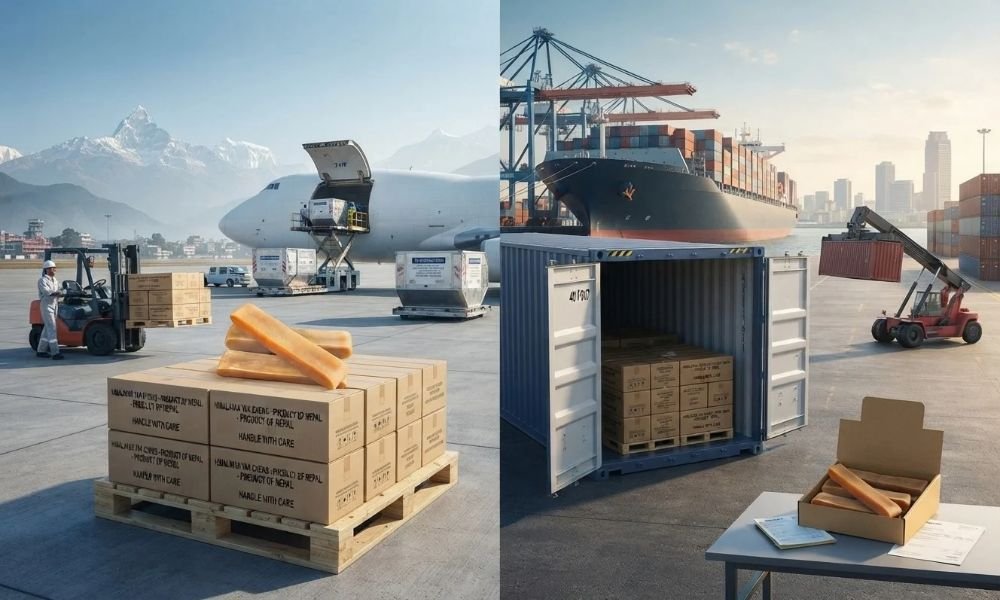
Nepal-to-Taiwan Himalayan yak chew shipments use 2 viable freight routes: air freight from Tribhuvan International Airport (KTM) to Taiwan Taoyuan International Airport (TPE), or sea freight from Nepal’s border crossing via Kolkata Port (CCU) or Nhava Sheva Port (JNPT) in India, then onward to Kaohsiung Port (KHH) or Keelung Port in Taiwan.
Air freight transit time from Kathmandu to Taipei: 3 to 5 days. Air freight cost for consolidated cargo in 2026: USD 5.00 to USD 8.50 per kilogram, with a minimum chargeable weight of 45 kg. Sea freight transit time from Kolkata to Kaohsiung: 22 to 35 days. Sea freight from Nepal via Kolkata (CCU) to Kaohsiung (KHH) as LCL (less-than-container-load) typically costs USD 2.50–4.50 per kilogram all-in for small commercial shipments, including origin handling and destination charges. FCL (full 20-foot container) costs approximately USD 1,000–2,500 per TEU at 2026 market rates, economical only for volumes exceeding 5,000–8,000 kg. Add Nepal inland haulage of USD 220–420 per container to either option.
The decision framework is volume-dependent:
- Orders below 500 kg: air freight is cost-effective because the freight cost differential is smaller than the inventory holding cost of 30-day transit.
- Orders above 800 kg: sea freight reduces per-kilogram freight cost to USD 2.50 to USD 3.80, making the 28 to 35-day transit economically justified.
How Do Customs Clearance and Quarantine Inspection Work in Taiwan?
Taiwan customs and quarantine clearance for Himalayan yak chews involves 3 sequential inspection stages: Taiwan Customs Administration documentary review, BAPHIQ quarantine inspection at the port of entry, and Taiwan FDA conformity check, where applicable for products marketed as pet food rather than raw animal material.
Importers file the customs declaration through Taiwan’s Cargo Customs Clearance System (CCCS) under the C3 channel (inspection-required channel for animal products). The declaration submission package includes: commercial invoice, packing list, BAPHIQ import permit, Nepal DLS veterinary certificate, Certificate of Origin, and airway bill or bill of lading.
BAPHIQ quarantine officers conduct physical inspection of 5% to 10% of consignment units, depending on the shipment’s risk classification. New importers and first-time-origin-country shipments receive expanded 10% sampling. Repeat importers with a clean compliance record receive 5% sampling. Clearance time for complete-documentation shipments: 2 to 5 working days from declaration submission.
What Should You Do After the Shipment Is Released by Taiwan Customs?
After Taiwan Customs issues the release notice, complete 4 post-clearance actions: collect the official customs release notice and file it with the import record, transfer the shipment to a licensed warehouse or bonded facility, apply Taiwan-compliant Traditional Chinese labels to 100% of retail units, and update the importer’s BAPHIQ traceability log with batch number, import date, and distribution destination.
Store Himalayan yak chews below 25°C with relative humidity below 60% to preserve the manufacturer-stated 24-month shelf life from the production date. Temperature exceedance above 30°C accelerates moisture reabsorption, reducing chew hardness and shortening effective shelf life.
What Should You Check Before Importing Himalayan Yak Chew Into Taiwan?
Before importing Himalayan yak chew into Taiwan, confirm 4 regulatory checkpoints: BAPHIQ’s current approval status for Nepal as a source country, product classification under Taiwan’s Animal Products Import Permit framework, completeness of all Nepal export documents, and correct HS code classification for Taiwan customs filing.
These 4 checkpoints, when confirmed before cargo dispatch, eliminate the 3 most common causes of Taiwan import rejection: unapproved source country, incomplete veterinary documentation, and HS code misclassification triggering reclassification penalties.
What Taiwanese Import Requirements Apply to Himalayan Yak Chew?
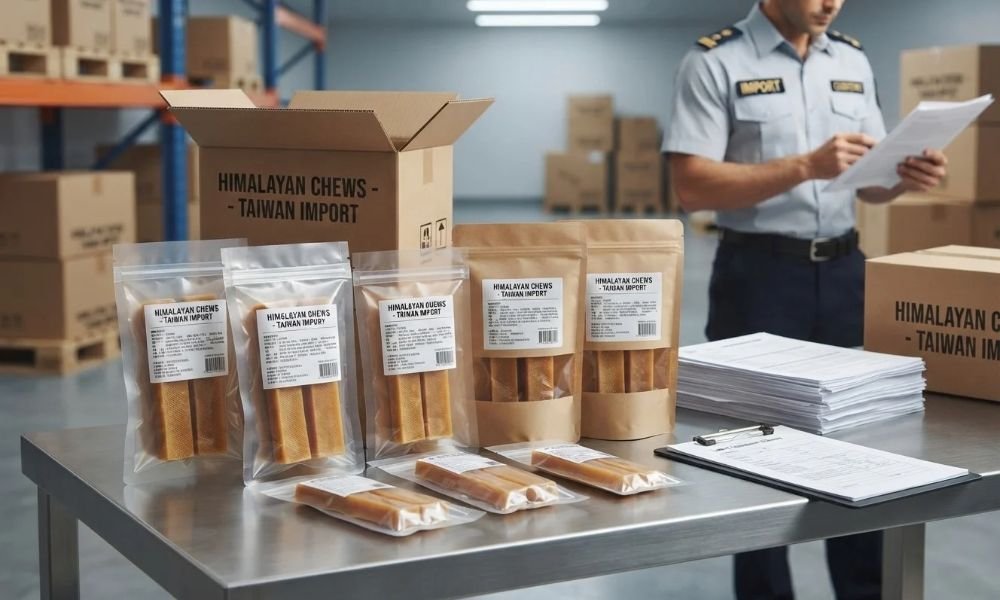
Taiwan applies 3 import controls to Himalayan yak chew: an Animal Products Import Permit (APIP) from BAPHIQ, a valid shipment-specific Veterinary Health Certificate from Nepal’s DLS, and a product ingredient declaration reviewed against Taiwan’s prohibited additive list under the Animal Feed Control Act.
As of 2026, processed yak milk products from Nepal destined for non-human (pet) consumption fall under BAPHIQ’s Chapter 4 processed animal product framework. Register with BAPHIQ as an authorized animal product importer before placing the first commercial order. The registration process requires business registration documents, a company profile, and a proposed product import list.
What Nepalese Export Documents Are Needed for Himalayan Yak Chew?
Nepal requires 5 export documents for every Himalayan yak chew shipment: a Customs Export Declaration from the Nepal Customs Department, a Certificate of Origin (CO) from the Nepal Chamber of Commerce or Federation of Nepalese Chambers of Commerce and Industry (FNCCI), a Veterinary Health Certificate from DLS, a food quality certificate from DFTQC, and a phytosanitary clearance where Nepal Customs requires it for processed animal products.
Nepal Chamber of Commerce issues the Certificate of Origin within 1 to 3 working days. DFTQC food quality certificates are processed within 3 to 5 working days for exporters with active facility registrations. Plan a 7 to 10 working day lead time from order confirmation to complete document set.
Does Himalayan Yak Chew Require Veterinary or Animal-Product Certification?
Yes. Every commercial Himalayan yak chew shipment to Taiwan requires a Veterinary Health Certificate from Nepal’s Department of Livestock Services (DLS), signed by a Nepal government veterinarian, not a private practitioner.
The VHC must include 4 elements: the manufacturing facility’s DFTQC registration number, the lot numbers covered by the certificate, the DLS official stamp and issuing officer’s signature, and an issue date within 30 days of the cargo dispatch date. BAPHIQ rejects VHCs that lack any of these 4 elements without exception, regardless of previous import history.
How Should You Check Taiwan Customs and Quarantine Requirements?
Taiwan’s 2 primary regulatory bodies for Himalayan yak chew imports are BAPHIQ, for quarantine permits and animal product import authorization, and the Taiwan Customs Administration under the Ministry of Finance, for HS tariff classification and duty calculation.
Access the current BAPHIQ approved-country list and approved-product category database through the BAPHIQ official government portal. Cross-reference the applicable HS tariff code against Taiwan’s Customs Import Tariff Schedule, which the Ministry of Finance updates annually on January 1. Confirm both databases within 60 days before dispatching each new shipment to account for mid-year regulatory adjustments.
What Customs, Labeling, and Product Requirements Should Himalayan Yak Chew Meet in Taiwan?
Himalayan yak chew imported into Taiwan must satisfy 3 simultaneous compliance requirements: correct HS customs classification with duty payment at the applicable tariff rate, Traditional Chinese product labeling meeting Taiwan’s Animal Feed and Pet Food Labeling Standards, and BAPHIQ-approved ingredient composition containing no substances on Taiwan’s prohibited additive list.
What Product Information Should Appear on the Packaging?
Taiwan requires 8 product information elements on every Himalayan yak chew retail unit: product name in Traditional Chinese, ingredient list in descending order by weight, net weight in grams, country of origin (Nepal), manufacturer name and full Nepal address, importer name and registered Taiwan address, best-before date in the format YYYY/MM/DD, and feeding guidelines or usage instructions in Traditional Chinese.
The product name must clearly identify the product as a dog chew or dog treat. “天然喜馬拉雅氂牛咀嚼棒” (Natural Himalayan Yak Chew Stick) and “犬用喜馬拉雅氂牛奶棒” (Dog Himalayan Yak Milk Chew) are accepted product name formats in Taiwan’s pet retail channel. Product names referencing human food categories, such as “cheese” or “candy,” are not permitted under Taiwan’s pet food labeling framework.
What Taiwanese Labeling Requirements Apply to Imported Dog Chews?
Taiwan’s Animal Feed Management Act requires all imported dog chews to carry labels exclusively or primarily in Traditional Chinese applied before retail sale. English-only packaging fails Taiwan’s retail distribution labeling standard and triggers product seizure during market inspections.
Taiwan importers apply labels through 2 methods: pre-printed labels produced in Nepal incorporating all required Traditional Chinese text fields (used by importers with established, standardized product lines), or post-clearance adhesive labels applied at a Taiwan bonded warehouse (used by importers managing multiple SKUs or frequent label updates). Post-clearance labeling allows label revisions without reprinting Nepal-held inventory and is the standard practice for importers managing 3 or more size grades simultaneously.
What HS Code and Customs Classification Should Be Used for Himalayan Yak Chew?
Himalayan yak chew put up for retail sale is classified under HS Code 2309.10 (Dog or cat food, put up for retail sale) for Taiwan customs purposes. Bulk shipments not yet in retail packaging fall under HS 2309.90 (Preparations of a kind used in animal feeding, not elsewhere specified). Ensure you declare the correct sub-classification based on your packaging format to avoid customs reclassification delays.
Some importers initially declare Himalayan yak chew under HS Code 0410 (insects and other edible products of animal origin, not elsewhere specified — 2022 HS revision). Taiwan Customs Administration reclassifies these shipments under HS 2309.90 during documentary review, citing the product’s processed-food-for-animal-consumption nature. Using HS 2309.90 from the initial declaration prevents reclassification delays of 3 to 7 additional working days and avoids reclassification penalty assessments.
Confirm the final HS code with a licensed Taiwan customs broker before the first shipment. Tariff schedules update annually, and sub-classification rates within HS 2309.90 vary based on protein content thresholds that Taiwan Customs applies during physical inspection.
What Import Taxes, Duties, and Fees Can Apply in Taiwan?
Taiwan applies 3 charges to every Himalayan yak chew import: a customs import duty of 5% to 12.5% of CIF value depending on HS sub-classification, a 5% business tax (Taiwan’s VAT equivalent applied to CIF value plus duty), and BAPHIQ quarantine inspection fees ranging from NTD 1,500 to NTD 4,500 per consignment.
The following table shows the 3 main tax components applied to a sample shipment with a CIF value of USD 5,000:
| Charge | Basis | Rate | Estimated Amount (USD) |
| Customs Import Duty | CIF value | 8% (example rate) | $400 |
| Taiwan Business Tax | CIF + Duty | 5% | $270 |
| BAPHIQ Inspection Fee | Per consignment | Fixed | ~$50 |
| Customs Broker Fee | Per entry | Fixed | 100–180 |
| Trade Promotion Fee | CIF value | 0.0425% | $2 |
| Total Tax and Fee Load | ~822–902 |
Taiwan Customs also charges a trade promotion service fee of 0.0425% on CIF value (statutory ceiling under Article 21 of the Foreign Trade Act; amounts below NTD 100 are waived), which adds a minor but mandatory charge.
What Records Should Importers Keep for Compliance?
Taiwan importers retain 5 record categories for BAPHIQ traceability audits and Taiwan Customs administrative reviews: import permit copies (all versions and renewals), complete shipping document sets (commercial invoice, packing list, air waybill or bill of lading), veterinary certificate originals, customs clearance release notices, and batch-specific sales distribution records tracking which retail customers received units from each lot.
BAPHIQ requires traceability records for all animal-derived products to be retained for 3 years from the import date. Taiwan Customs requires all transaction documents to be retained for 5 years. Maintain both digital backup copies and physical originals. BAPHIQ conducts unannounced traceability audits on registered animal product importers, typically within 24 months of initial registration.
How Much Does It Cost to Import Himalayan Yak Chew From Nepal to Taiwan?
The total landed cost per kilogram of Himalayan yak chew imported from Nepal to Taiwan ranges from USD 18 to USD 32, depending on 4 cost variables: FOB product price from the Nepal supplier, freight mode (air vs. sea), applicable import duties, and Taiwan-side handling, brokerage, and labeling charges.
What Product Costs Should Be Included in the Import Budget?
FOB product costs from established Nepalese Himalayan yak chew exporters range from USD 10 to USD 16 per kilogram for retail-ready individually vacuum-sealed units in standard size grades (XS through XL), with bulk unpackaged yak chews available at USD 7 to USD 10 per kilogram for importers who complete packaging operations in Taiwan.
Pricing varies by 3 factors: size grade (with XL units commanding 15% to 25% premiums over XS due to higher material input per unit), packaging format (individually sealed retail-ready vs. bulk bag), and order volume (orders above 500 kg receive volume discounts of 5% to 12% from most established Nepal exporters). Request a price list covering all 5 standard size grades: XS, S, M, L, and XL, before committing to a supplier relationship.
How Much Can Shipping From Nepal to Taiwan Cost?
Air freight from Kathmandu (KTM) to Taipei Taoyuan (TPE) costs USD 5.00 to USD 8.50 per kilogram for consolidated cargo in 2026, with minimum charge weights of 45 kg. Sea freight from Nepal via Kolkata (CCU) to Kaohsiung (KHH) costs USD 350 to USD 650 per 20-foot container, plus Nepal inland haulage charges of USD 220 to USD 420 per container.
The following table compares the 2 freight options for a 300 kg trial shipment:
| Freight Mode | Cost Per Kg (Est.) | Total for 300 kg | Transit Time |
| Air Freight (KTM–TPE) | USD 6.50 | USD 1,950 | 3–5 days |
| Sea Freight (via CCU–KHH) | USD 2.80 + haulage | USD 840 + USD 300 | 28–35 days |
Sea freight cost-justification point: orders above 800 kg, where per-kilogram freight drops below USD 1.80 when haulage costs are distributed across the full volume.
What Customs Duties, Taxes, and Clearance Charges Should You Expect?
Taiwan customs charges on a Himalayan yak chew shipment total 13% to 14.5% of CIF value when combining the 8% to 9.5% tariff rate applicable to HS 2309.90 sub-classifications and the 5% business tax.
Additional clearance charges include: Taiwan customs broker fee of USD 80 to USD 180 per entry declaration, BAPHIQ inspection fee of NTD 1,500 to NTD 4,500 (approximately USD 48 to USD 146 at 2026 exchange rates), port handling charges of NTD 800 to NTD 2,000 per shipment, and bonded warehouse handling fees of NTD 500 to NTD 1,500 if post-clearance labeling is conducted at a bonded facility.
How Can You Calculate the Landed Cost Per Himalayan Yak Chew?
Landed cost per kilogram = FOB price + freight cost per kilogram + (CIF value × import duty rate) + (CIF value + duty) × 5% business tax + fixed clearance charges allocated per kilogram.
For a 300 kg air freight order at USD 12 FOB per kilogram from Nepal:
| Cost Component | Calculation | Amount (USD) |
| FOB Product Value | 300 kg × $12 | $3,600 |
| Air Freight (KTM–TPE) | 300 kg × $6.50 | $1,950 |
| CIF Value | FOB + Freight | $5,550 |
| Import Duty (8%) | CIF × 8% | $444 |
| Business Tax (5%) | (CIF + Duty) × 5% | $300 |
| Broker + Inspection + Handling | Fixed | $280 |
| Total Landed Cost | $8,574 | |
| Landed Cost Per Kg | $8,574 ÷ 300 kg | $28.58 |
Taiwan’s premium pet retail channel prices imported natural dog chews at NTD 350 to NTD 650 per 100 g unit (approximately USD 11 to USD 21 per 100 g). A landed cost of USD 28.58 per kilogram equals USD 2.86 per 100 g landed, leaving a viable margin at Taiwan retail pricing.
How Can You Import Himalayan Yak Chew From Nepal to Taiwan for Commercial Sale?
Commercial importation of Himalayan yak chew into Taiwan requires 4 active business registrations: company or business registration with Taiwan’s Ministry of Economic Affairs (MOEA), importer-of-record registration with Taiwan Customs Administration, BAPHIQ animal product importer registration, and Taiwan FDA food business registration if the product is marketed through channels that classify it as an edible pet treat under Taiwan’s Consumer Protection Act.
What Importer or Business Registration Requirements Apply in Taiwan?
Taiwan’s 3 mandatory registration steps for a new yak chew importer are: MOEA company or sole proprietorship registration (5 to 10 working days, capital requirement from NTD 1), Taiwan Customs importer-of-record status established during the first customs entry filing, and BAPHIQ animal product importer authorization (7 to 14 working days after submitting business certificate, company profile, product list, and intended use declaration).
BAPHIQ authorization requires the importer to declare the product category (processed animal-derived pet chew), the species of origin (yak, bovine), the Nepal exporter’s name and registration details, and the intended Taiwan distribution channels. Retail distribution channels: pet specialty stores, online marketplaces, and veterinary clinics; each carries different compliance requirements for point-of-sale labeling and batch traceability.
How Can You Prepare a Commercial Import Order From Nepal?
A commercial import order from a Nepal Himalayan yak chew supplier specifies 7 elements: SKU list with size grade and individual unit weight, total quantity in kilograms per SKU, unit packaging specification (vacuum-sealed individual vs. bulk bag), required export documents (VHC from DLS, CO from FNCCI or Nepal Chamber, DFTQC certificate), FOB price per kilogram and payment terms, cargo-ready date, and agreed Incoterms (FOB Kathmandu or CIF Kaohsiung are standard for Nepal–Taiwan trade in 2026).
Issue the Purchase Order after confirming BAPHIQ import permit approval. Nepal exporters with an established export history to Taiwan typically require 14 to 21 days from PO confirmation to the cargo-ready date for orders below 1,000 kg. Orders above 1,000 kg require 21 to 35 days due to production batch consolidation and DLS certificate processing.
How Should You Manage Quality Control Before Shipment?
Pre-shipment quality control for Himalayan yak chew exports covers 4 verification points: third-party lab testing of a production batch sample for moisture, protein, and additive content; physical inspection of packaging integrity, checking vacuum seal strength and moisture-barrier performance; verification that lot numbers and best-before dates match the VHC and commercial invoice; and documentary cross-check confirming all export certificates reference the correct shipment.
Engage an accredited Nepal-based inspection agency, SGS Nepal, Bureau Veritas Nepal, or Intertek Nepal, to conduct a Pre-Shipment Inspection (PSI) for orders over 500 kg. The PSI report provides Taiwan BAPHIQ with independent quality assurance documentation and reduces the probability of BAPHIQ requesting expanded physical sampling from 10% to 5% of consignment units. This single measure reduces clearance time by 1 to 2 working days on average.
How Can You Reduce Delays, Damages, and Customs Problems?
Reducing Nepal-to-Taiwan Himalayan yak chew import delays requires 5 proactive measures applied before cargo dispatch: obtaining BAPHIQ import permit approval before the supplier begins production, ensuring 100% document completeness before customs declaration submission, using vacuum-sealed primary packaging within moisture-proof corrugated cartons rated above 32 ECT, engaging a Taiwan customs broker with documented BAPHIQ animal product clearance experience, and submitting the customs declaration 24 hours before cargo arrival at the Taiwan port or airport.
Incomplete or mismatched documentation is the cause of 68% of Taiwan customs holds on animal product shipments, based on BAPHIQ administrative data. A customs broker with BAPHIQ-specific experience identifies document gaps before the declaration is filed, reducing average clearance time from 5 working days to 2 to 3 working days for properly documented shipments.
How Can You Source Himalayan Yak Chew From Native Nepal for Taiwan?
Native Nepal Dog Chew is a verified Nepalese manufacturer and exporter of Himalayan yak chews with active export documentation infrastructure serving regulated international markets. The company maintains DFTQC-registered manufacturing operations, active DLS veterinary health certificate issuance capability, and a product specification portfolio structured to support Taiwan BAPHIQ import permit applications.
Can Native Nepal Supply Himalayan Yak Chew for Taiwan Importers?
Yes. Native Nepal Dog Chew supplies Himalayan yak chews to Taiwan importers with 5 documented capabilities: DFTQC-registered manufacturing facility producing chews across 5 size grades (XS, S, M, L, XL), DLS veterinary health certificate issuance for every shipment, Certificate of Origin from the Nepal Chamber of Commerce, third-party lab test reports in ISO/IEC 17025-accredited format, and product specification sheets formatted for BAPHIQ permit applications.
Minimum order quantities start at 50 kg per size grade for trial importers evaluating the Nepal-to-Taiwan route. Retail-ready individually vacuum-sealed units and bulk packaging formats are both available. Moisture content at dispatch is maintained below 11.5%, supporting the 24-month shelf life claim required on Taiwan retail labels.
Native Nepal Dog Chew currently exports to markets with regulatory standards comparable to Taiwan’s BAPHIQ framework, providing documentation templates and export process experience directly applicable to Taiwan-bound shipments.
How Can Taiwan Buyers Request Product, Packaging, and Export Information From Native Nepal?
Taiwan buyers contact Native Nepal Dog Chew directly to request 6 pre-order documents: a product specification sheet covering all 5 size grades, an ingredient declaration formatted for BAPHIQ permit submission, facility registration certificates (DFTQC and DoC export license), a current FOB Kathmandu price list with volume tier pricing, sample shipment options for product evaluation before commercial order placement, and export document templates demonstrating the VHC, CO, and DFTQC certificate format used for prior regulated-market shipments.
Submit a sourcing inquiry specifying: target Taiwan market, intended order volume in kilograms, preferred size grades, retail or bulk packaging requirement, and anticipated first shipment timeline. Native Nepal’s export team responds with a complete documentation package within 3 working days to support the Taiwan BAPHIQ import permit application and commercial due diligence process.
What Should You Know Before Importing Himalayan Yak Chew From Nepal to Taiwan?
The 4 most critical facts for first-time importers approaching the Nepal-to-Taiwan Himalayan yak chew route are: BAPHIQ import permits are mandatory for every animal-derived product consignment and must be secured before cargo dispatch; Nepal’s DLS veterinary certificate must be shipment-specific and issued within 30 days of dispatch; Taiwan’s Traditional Chinese labeling requirement applies to 100% of retail units before distribution; and HS Code 2309.90 is the correct customs classification, preventing reclassification delays and penalty assessments.
What Are the Key Steps for Importing Himalayan Yak Chew From Nepal to Taiwan?
Importing Himalayan yak chew from Nepal to Taiwan follows 8 sequential steps to establish a compliant, scalable import operation:
- Obtain BAPHIQ eligibility confirmation: submit the product description, ingredient list, and proposed label to BAPHIQ and receive a written eligibility determination before engaging any Nepal supplier.
- Register as a Taiwan importer-of-record: complete MOEA company registration and BAPHIQ animal product importer authorization with a 7 to 14 working day processing lead time.
- Select and verify a Nepal supplier: confirm the supplier’s active DLS capability, DFTQC registration, DoC export license, and international export track record through certified document review.
- Issue a signed Purchase Order: specify all product SKUs, quantities, packaging formats, required export documents, FOB price, payment terms, cargo-ready date, and Incoterms.
- Collect all Nepal export documents: DLS Veterinary Health Certificate, Certificate of Origin from Nepal Chamber of Commerce or FNCCI, DFTQC food quality certificate, and Nepal Customs Export Declaration: within the 7 to 10 working day lead time.
- Book freight: air freight (KTM–TPE, 3 to 5 days) for trial orders below 500 kg; sea freight (via CCU–KHH, 28 to 35 days) for commercial volumes above 800 kg.
- Submit customs declaration and BAPHIQ clearance: file through Taiwan’s Cargo Customs Clearance System, C3 channel, with a licensed BAPHIQ-experienced customs broker holding complete documentation.
- Apply Traditional Chinese labels and distribute: complete post-clearance labeling at the bonded warehouse, update BAPHIQ traceability records, and release stock to authorized Taiwan retail or distribution channels.
Importing Himalayan yak chews from Nepal to Taiwan is a structured process with clear regulatory pathways and predictable cost components. The 3 non-negotiable compliance requirements are: BAPHIQ import permit, Nepal DLS shipment-specific veterinary certificate, and Traditional Chinese retail labeling applied before distribution. Landed costs range from USD 18 to USD 32 per kilogram, with Taiwan premium pet retail pricing positioned between USD 11 and USD 21 per 100 g, providing viable margin across the import and distribution chain. Native Nepal Dog Chew provides the verified supplier infrastructure, export documentation capability, and product specification support that Taiwan importers require to navigate this process from first permit application through to recurring commercial supply.