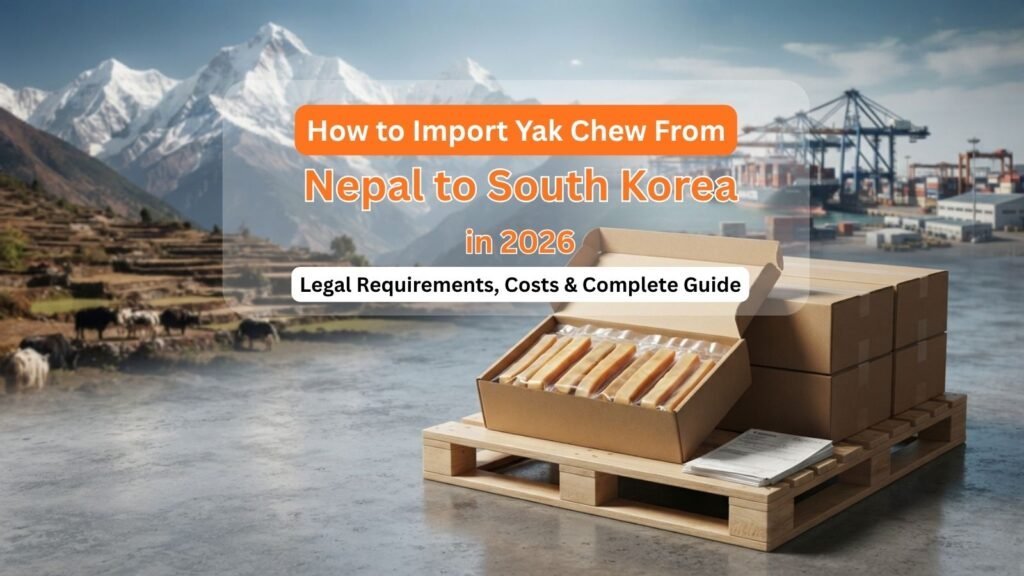
Importing yak chew from Nepal to South Korea is a regulated cross-border process involving Nepalese export documentation, South Korean animal-product quarantine, pet food compliance, customs clearance, Korean-language labeling, and controlled storage. Nepalese yak chew is a Himalayan dog treat made primarily from yak milk and traditionally processed through prolonged drying to produce a hard, long-lasting chew with low moisture and no synthetic binders. Successful imports require a DFTQC-registered manufacturer, DLS Veterinary Health Certificate, Certificate of Analysis (COA), appropriate product classification, MAFRA registration, APQA quarantine approval, and customs documentation before the shipment reaches Incheon. First-time importers should plan approximately 8–16 weeks for supplier verification, regulatory registration, testing, documentation, shipping, inspection, and final clearance.
South Korea offers a growing commercial market for Nepalese yak chew because pet owners increasingly seek natural, single-ingredient, and long-lasting dog treats with clear ingredient provenance. The import route typically connects Kathmandu with Incheon through Indian transit hubs such as Kolkata or Nhava Sheva, while air freight provides faster trial shipments and sea freight reduces unit logistics costs at commercial volumes. Importers must also manage HS classification, Korean labeling, moisture control below 10%, veterinary and food-safety certificates, import duties, VAT, bonded storage, and APQA inspection requirements. This guide explains the complete Nepal-to-Korea yak chew import process, including supplier verification, product compliance, required documents, shipping methods, landed-cost calculation, packaging, customs risks, and practical controls for building a legally compliant and profitable South Korean distribution operation.
What Makes Nepalese Yak Chew Attractive to South Korean Buyers?
Nepalese yak chew delivers 3 advantages Korean pet owners actively seek: a single-ingredient protein source, a traditional smoke-drying process with zero additives, and a hardness profile that supports dog dental health without synthetic binding agents.
According to the KB Financial Group Research Institute’s 2025 Korea Pet Report, South Korea’s pet-related industry was estimated at KRW 4.5 trillion as early as 2023 and reached approximately KRW 10.2 trillion by 2024 under a broader market definition, meaning the market surpassed the KRW 4 trillion threshold years before 2025. Consumers in Seoul, Busan, and Incheon research product ingredient labels before purchasing. Yak chew answers that demand cleanly: 4 ingredients only: yak milk, cow milk, salt, and lime juice.
The product carries authentic Himalayan provenance. According to a Government of Nepal livestock survey, yaks and chauri are raised across multiple Himalayan districts, including Solukhumbu, Dolpa, Humla, and Mustang, with yak farms historically established in Solukhumbu and Dolpa. This origin story translates directly into retail positioning for Korean buyers who connect Himalayan food traditions with natural purity and craft production methods.
Why Is Yak Chew Demand Growing in South Korea?
According to Korea Times, citing KB Financial Group’s 2025 Pet Report, the dog population in South Korea stood at approximately 5.46 million in 2024, a slight year-on-year decline of 100,000. The combined dog and cat population was approximately 7.63 million in 2024 (5.46M dogs + 2.17M cats), compared to 7.98 million combined in 2022. The 7.9 million figure misrepresents the source and year. The Korean natural pet treat category is growing, supported by rising premium pet food spending and consumer demand for clean-label products, though the precise growth rate for this specific segment could not be confirmed against primary sources as of 2025–2026. For verified market size data, refer to the KB Financial Group 2025 Korea Pet Report and MAFRA’s annual pet food import statistics. For general natural pet food trends, see IMARC Group’s South Korea Organic and Natural Pet Food Market report.
According to the Korea Times, citing KB Financial Group’s 2025 Korea Pet Report, average monthly spending on all pet care in South Korea reached KRW 194,000 (~USD 142) in 2024, a 6.8% increase from KRW 154,000 in 2022. This total covers food, veterinary care, grooming, and supplies; food and treats represent approximately 57.6% of monthly pet household spending. Yak chew competes directly against rawhide, bully sticks, and artificial dental chews and wins on clean-label positioning.
Korean veterinary influencers promoted yak chew across Naver Blog, YouTube, and Kakao throughout 2023 and 2024. Those campaigns accelerated consumer awareness significantly. By 2025, Coupang, Gmarket, and SSG listed over 140 yak chew product variations, with retail prices ranging from KRW 8,000 to KRW 45,000 per piece depending on size and brand. That retail spread creates a genuine margin opportunity for importers who source directly from Nepal rather than through Singapore or Hong Kong middlemen.
What Types of Yak Chew Products Can Be Imported?
4 yak chew product types qualify for import into South Korea, each with distinct sizing, HS code classification, and packaging requirements.
- Standard hardened yak chew blocks: the core SKU, available in XS to XXL sizes for dogs weighing 2 kg to 45 kg, accounting for over 80% of Nepal’s export volume by weight
- Yak chew puffs: microwavable expanded pieces made from leftover chew ends, marketed as a separate treat SKU in Korea
- Yak chew powder and crumble: finely ground chew used as a meal topper or high-value training reward.
- Yak milk soft chews: a lower-hardness alternative formulated for senior dogs and puppies
Each type carries its own packaging requirements under Korean pet food labeling rules. Standard hardened blocks represent the dominant import format and the most established category on Korean e-commerce platforms.
What Is the Process for Importing Yak Chew From Nepal to South Korea?
The import process from Nepal to South Korea runs 8–16 weeks for first-time importers and 4–8 weeks for importers with established supplier relationships and active Korean MAFRA registration.
Find and Verify a Qualified Nepalese Yak Chew Supplier
Source suppliers through TEPC Nepal, the FNCCI trade directory, or producer associations in Kathmandu’s Himalayan product export network. Request 3 documents at initial inquiry: DFTQC registration certificate, NBSM product certification, and a sample COA from a recent export batch. Any supplier unable to produce these 3 documents immediately is not export-ready.
Order a sample shipment of 2–5 kg via international courier before committing to a commercial order. Send the sample to a Korean-accredited testing laboratory for pre-import analysis against Korean pet food standards. Pre-import laboratory testing costs KRW 200,000–500,000 and prevents the far higher cost of rejecting a full commercial shipment.
Confirm South Korean Import Eligibility and Product Classification
Submit the sample test results and product specification sheet to a licensed Korean customs broker for pre-import classification confirmation. Confirm the HS code (2309.90.9090) and identify the applicable import duty rate and APQA quarantine requirements.
Check Nepal’s current FMD disease status on the APQA official portal (qia.go.kr) before any commercial commitment. Import eligibility for animal-origin products from Nepal depends on Nepal’s OIE disease-free status and bilateral veterinary protocols between Nepal and South Korea. Status can change seasonally.
Agree on Product Specifications, Pricing, and Incoterms
Negotiate the Purchase Order with specifications covering: product size categories, moisture content ceiling (maximum 10%), individual vacuum packaging with desiccant, Korean-language label application method, and minimum batch laboratory testing obligations per shipment.
Use CIF Incheon as the Incoterms basis for initial shipments: it fixes the shipping cost and simplifies landed cost calculation. Experienced importers with established freight relationships switch to FOB Kathmandu or FOB Kolkata once they control the freight procurement directly.
Prepare the Required Export and Import Documents
The Nepal export document set includes 6 items: DLS Veterinary Health Certificate, DFTQC Export Certificate, Certificate of Origin, Commercial Invoice, Packing List, and batch COA. Allow 10–15 business days to collect all 6 documents after production confirmation, coordinating the DLS and DFTQC issuance dates against the planned shipment departure.
The Korean import document set includes the APQA advance import declaration, Korean-language label proof (physical label or artwork file), and the Commercial Invoice with HS code declaration. Submit the APQA advance import declaration before the shipment departs Nepal, not after arrival in Korea. APQA requires a minimum of 3 business days’ advance notice.
Complete Customs and Animal-Product Import Procedures
APQA requires an advance import declaration (사전신고) at least 3 business days before the vessel or aircraft arrives at the Korean port. Submit the declaration through the Korea Customs UNI-PASS electronic clearance system, processed through your licensed customs broker. Include the full document set with the advance declaration.
APQA quarantine inspection occurs at the designated animal product inspection facility at Incheon Port or Incheon Airport. Inspection covers documentary review, physical examination, and potential laboratory sampling. Laboratory results take 3–7 business days when APQA collects samples.
Arrange International Shipping From Nepal to South Korea
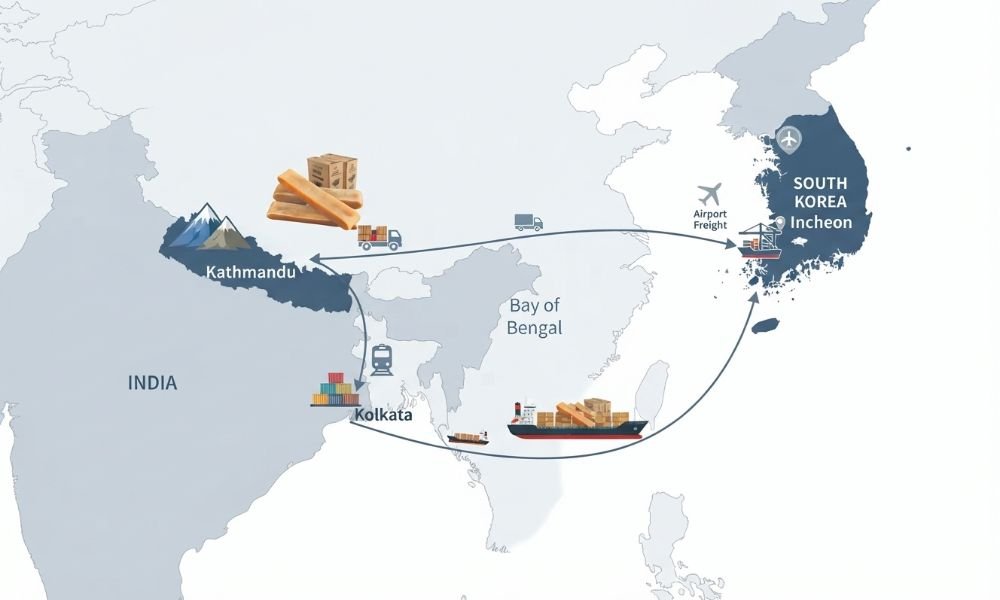
Nepal is landlocked. All cargo from Nepal transits India by road before reaching an international port. The standard sea freight route runs: Kathmandu → Kolkata or Nhava Sheva (India) → Busan or Incheon (South Korea). Total sea freight transit time: 18–28 days.
Air freight from Tribhuvan International Airport (KTM) to Incheon International Airport (ICN) takes 3–5 business days. Freight forwarders experienced in Nepal-Korea trade manage the Indian transit leg documentation, which requires a separate Indian customs transit permit. Verify your freight forwarder has active India transit experience before booking.
Complete Korean Customs Clearance and Required Inspections
After APQA issues the quarantine inspection clearance certificate (검역증명서), the shipment enters the Korea Customs Service (KCS) processing. Submit the customs declaration through UNI-PASS. The Korean import duty on HS 2309.90.9090 is 5% of the CIF customs value. Apply 10% VAT (부가가치세) to the customs value plus duty.
Shipments held for APQA laboratory sampling remain in the bonded warehouse at the importer’s storage cost until test results confirm compliance. Average APQA laboratory hold: 5 business days. Budget for bonded storage at approximately KRW 3,000–8,000 per metric ton per day.
Receive, Store, and Distribute the Yak Chew in South Korea
Store yak chew in a warehouse maintained below 25°C and below 60% relative humidity. Ambient temperature above 30°C accelerates moisture absorption and shortens effective shelf life. Confirm warehouse conditions before the first shipment arrives.
Korean distribution channels include Coupang, Naver Shopping, SSG, and Kakao Gifts for e-commerce; Pet Land, Pet’s Garden, and independent pet specialty stores for retail; and veterinary clinics for premium positioning. E-commerce direct-to-consumer distribution yields the highest per-unit margin by eliminating wholesale intermediary markups.
What Should You Check Before Importing Yak Chew From Nepal?
Before importing yak chew from Nepal, verify 4 areas: manufacturer export credentials, product compliance with Korean animal-origin import standards, completeness of the export document set, and packaging readiness for Korean retail.
Skipping any of the 4 verification areas costs more in rejected shipments than it saves in pre-shipment due diligence time.
How Do You Evaluate a Nepalese Yak Chew Manufacturer?
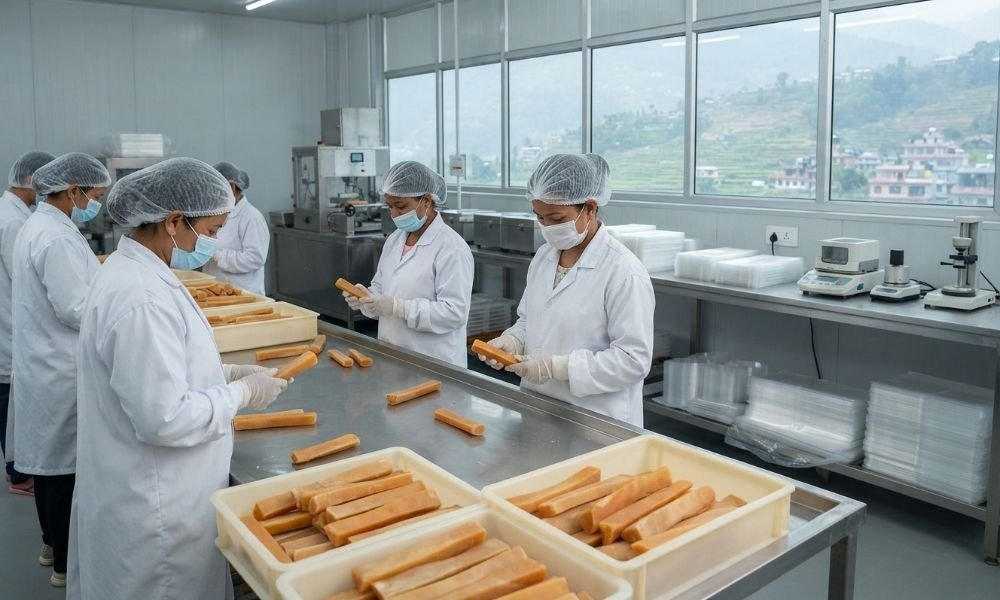
A qualified Nepalese yak chew manufacturer holds 4 active certifications: DFTQC registration, NBSM product certification, a municipal food hygiene license, and a TEPC export license.
- DFTQC (Department of Food Technology and Quality Control): the national food safety authority of Nepal. Verify the registration number directly on the DFTQC official portal. A manufacturer without active DFTQC registration cannot legally export food or animal-origin products.
- NBSM (Nepal Bureau of Standards and Metrology) issues product quality certification for Nepali-manufactured goods destined for export.
- Municipal food hygiene license: issued by the local ward office, confirming hygienic production facility conditions.
- TEPC export license (Trade and Export Promotion Centre of Nepal): authorizes the entity to conduct international trade.
Arrange a physical facility visit or third-party factory audit through Bureau Veritas Nepal or SGS Nepal before placing any commercial order. Red flags during audits include non-segregated production lines, absence of batch temperature records, and employees lacking personal hygiene controls during production.
Request the manufacturer’s 3 most recent export records and the countries they currently export to. Manufacturers with active export history to the EU, the United States, or Japan have already cleared stringent import requirements: a reliable indicator of export readiness for the South Korean market.
What Product Quality and Safety Standards Should Yak Chew Meet?
Yak chew exported to South Korea meets 5 mandatory quality parameters under the Korean Animal Feed Safety Management Act.
- Moisture content below 10%: prevents mold growth during 18–28 day sea freight transit
- Total plate count below 30,000 CFU/g: confirms hygienic production and drying
- No detectable Salmonella or E. coli: standard pathogen-free certification
- No artificial preservatives, synthetic colors, or binding agents: required for clean-label market positioning
- Commercially validated shelf life of 24 months at ambient temperature, calculated from the production date and supported by an Accelerated Shelf Life Testing (ASLT) report: Korean authorities may request scientific evidence to support shelf-life claims, even though no statutory minimum is mandated by the Korean Animal Feed Safety Management Act
The Korean Animal Feed Safety Management Act (사료안전관리법) additionally mandates residue testing for veterinary drugs and heavy metals, including lead below 5.0 ppm, cadmium below 1.0 ppm, and arsenic below 2.0 mg/kg, per the National Agricultural Products Quality Management Service (NAQS). Manufacturers in Nepal obtain a Certificate of Analysis (COA) from a lab accredited by the Nepal Accreditation Board (NAB) for each export batch. APQA inspectors in South Korea cross-reference these COA values against Korean permissible limits. Manufacturers in Nepal obtain a Certificate of Analysis (COA) from a lab accredited by the Nepal Accreditation Board (NAB) for each export batch. APQA inspectors in South Korea cross-reference these COA values against Korean permissible limits.
What Documents Should a Nepalese Supplier Provide?
A qualified Nepalese yak chew supplier provides 6 mandatory documents per export shipment.
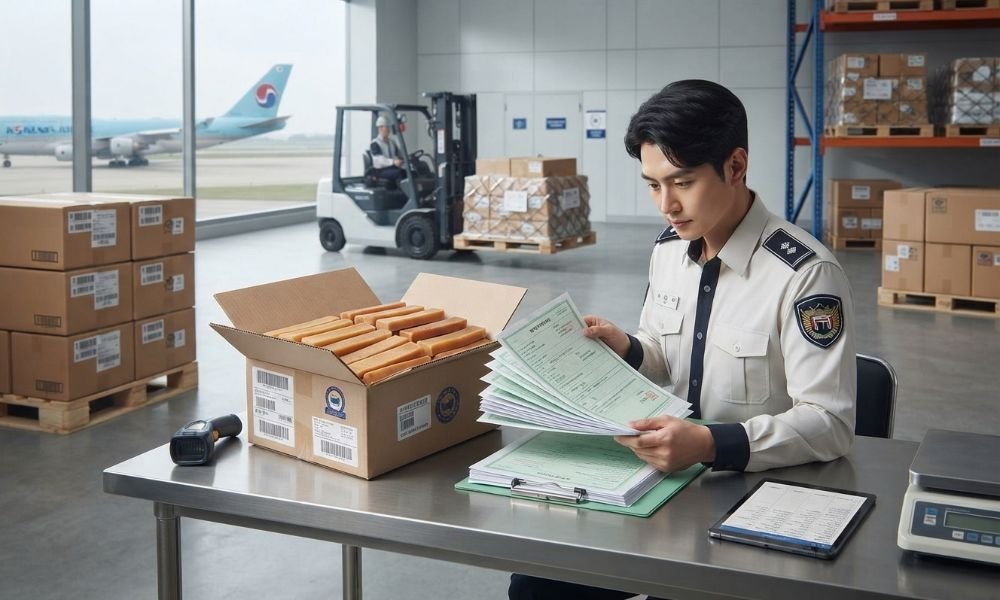
- DFTQC Export Permit: issued per shipment, confirming the product meets Nepal’s food safety export standards
- Veterinary Health Certificate: issued by the Department of Livestock Services (DLS) of Nepal, confirming derivation from disease-free animals processed under veterinary supervision
- Phytosanitary Certificate: issued by the Plant Quarantine and Pesticide Management Centre for lime juice components
- Certificate of Analysis (COA): from an NAB-accredited laboratory, covering microbiological, chemical, and nutritional analysis per batch
- Certificate of Origin: issued by FNCCI (Federation of Nepalese Chambers of Commerce and Industry) or TEPC
- Commercial Invoice and Packing List: detailing HS code, product description, net weight, gross weight, and declared value in USD
Missing any of these 6 documents triggers automatic detention at Korean customs. The Veterinary Health Certificate is the single most commonly absent document in first-time Nepal export shipments: primarily because importers mistake the DFTQC Export Permit for a sufficient substitute. It is not.
How Should You Verify Ingredients, Processing, Packaging, and Shelf Life?
Verify ingredients by requesting the manufacturer’s official recipe card and cross-referencing it with the COA ingredient panel. Authentic Himalayan yak chew contains exactly 4 ingredients: yak milk, cow milk, salt, and lime juice.
Any binder, preservative, or emulsifier in the recipe disqualifies the product from Korean “natural treat” retail positioning. Verify processing by confirming the smoke-drying temperature range at approximately 95°F (35°C) for 12 days to 3 months, followed by additional air-drying. Importers should verify production parameters directly with the manufacturer via COA and facility inspection.
Packaging verification confirms vacuum-sealed or nitrogen-flushed pouches maintain moisture below 10% during transit. Packaging materials must meet food-contact standards free from phthalate-based plasticizers. Shelf-life validation requires an Accelerated Shelf Life Testing (ASLT) report conducted at 40°C and 75% relative humidity for a minimum of 6 months, following international ASLT protocols.
What South Korean Import Requirements Apply to Yak Chew?
South Korean import requirements for yak chew cover 5 regulatory areas: product classification, authority registration, importer licensing, health certification, and Korean-language labeling. All 5 areas require compliance before the shipment arrives at Incheon Port or Airport.
Arriving first and clearing later is not an option for animal-origin products. APQA holds uncleared animal products in a bonded facility at the importer’s cost.
Is Yak Chew Classified as a Pet Food or Animal-Origin Product?
In South Korea, yak chew falls under 2 regulatory frameworks simultaneously: the Animal Feed Safety Management Act (사료안전관리법) as a pet treat (반려동물 사료), and the Livestock Products Sanitary Control Act (축산물 위생관리법) as a processed animal-origin product.
This dual classification requires clearance from 2 separate regulatory streams: pet food import registration under MAFRA and animal-product import approval under APQA. Importers who classify yak chew exclusively as pet food and bypass the animal-origin stream face automatic shipment rejection at the port of entry with no option for on-site reclassification.
The preliminary HS code for yak chew entering South Korea is 2309.10 for products put up for retail sale as dog treats, or 2309.90.9090 for bulk/non-retail preparations. The applicable subheading depends on packaging format and retail presentation; confirm the exact Korean HSK 10-digit classification with a licensed Korean customs broker before preparing any commercial documentation, as misclassification incurs reclassification fees and potential customs penalties.
Which South Korean Authorities Regulate Imported Yak Chew?
3 Korean government authorities regulate yak chew imports: MAFRA sets the policy framework, APQA conducts quarantine inspection, and the Korea Customs Service manages customs clearance.
- MAFRA (Ministry of Agriculture, Food and Rural Affairs / 농림축산식품부): sets compositional standards, labeling requirements, and pet food import policy
- APQA (Animal and Plant Quarantine Agency / 농림축산검역본부): the primary enforcement authority; conducts physical quarantine inspection and laboratory testing at designated inspection facilities at Incheon Port and Incheon International Airport
- Korea Customs Service (KCS): processes customs classification, assesses import duties, and authorizes final release
APQA is the authority importers engage with most directly. APQA inspectors examine every consignment of animal-origin products and retain the right to collect samples for laboratory analysis. The APQA inspection fee ranges from KRW 30,000 to KRW 100,000 per consignment depending on shipment weight, as of the 2025 fee schedule.
What Registration or Importer Requirements Must Be Completed?
Korean yak chew importers complete 3 registrations before the first shipment departs Nepal.
- Business registration as a food or animal product importer with the Korea Chamber of Commerce and Industry and the National Tax Service
- Animal product importer registration with MAFRA under Article 21 of the Livestock Products Sanitary Control Act: requires a Korean food hygiene education certificate, warehouse facility inspection, and business representative background check; processing time: 3–6 weeks
- Pet food importer notification with the relevant metropolitan or provincial government under the Animal Feed Safety Management Act
Importers who skip the animal product importer registration and proceed directly to shipment face permanent confiscation of the entire consignment and a KRW 3 million fine (approximately USD 2,200). The registration requirement is not waivable for any product category.
What Veterinary, Sanitary, or Health Certificates May Be Required?
APQA requires 2 certificates per import shipment: the Nepal DLS Veterinary Health Certificate and the DFTQC Export Certificate. Both must be issued within 30 days of the shipment’s Korean port arrival date.
- DLS Veterinary Health Certificate: Issued by Nepal’s Department of Livestock Services. Confirms the product derives from animals free from Foot and Mouth Disease (FMD), Brucellosis, and other OIE-listed notifiable diseases. Confirms processing occurred under veterinary supervision in a registered facility.
- DFTQC Export Certificate: Issued by Nepal’s Department of Food Technology and Quality Control. Confirms compliance with Nepalese food safety export standards.
The 30-day certificate validity window is the leading cause of first-shipment delays for Nepal-origin yak chew. A certificate issued 35 days before Korean port arrival triggers an automatic shipment hold and mandatory re-inspection at the importer’s expense.
What Labeling Requirements Apply to Yak Chew Sold in South Korea?
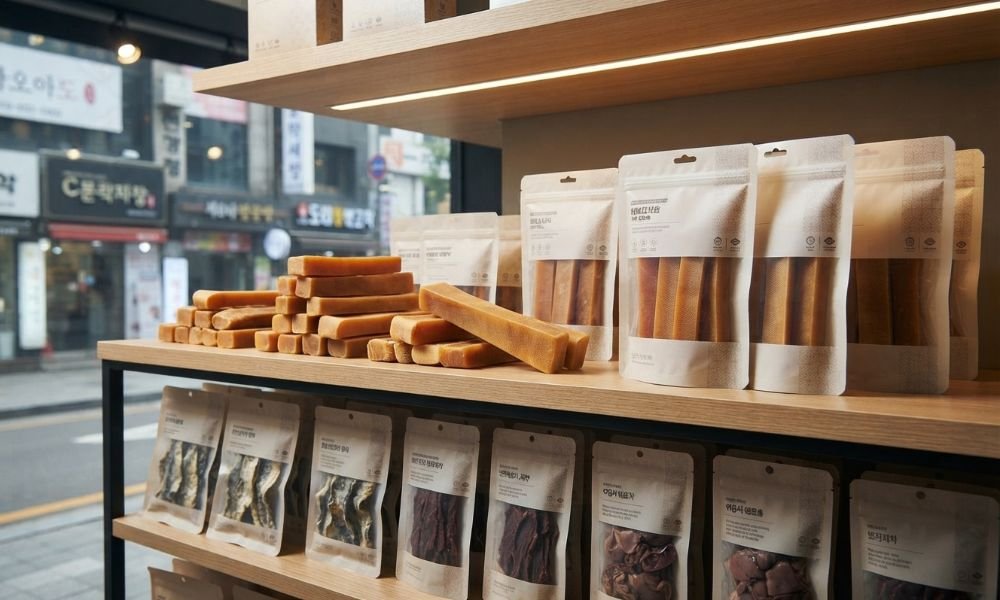
Korean labeling regulations require 8 mandatory elements on every yak chew package sold in South Korea, all printed or affixed in Korean.
- Product name in Korean (제품명)
- Ingredient list in Korean, in descending order by weight (원재료명)
- Guaranteed analysis (조성분): minimum crude protein %, minimum crude fat %, maximum crude fiber %, maximum moisture %
- Net weight in grams (내용량)
- Best-before date in YYYY/MM/DD format (유통기한)
- Storage instructions in Korean (보관 방법: 서늘하고 건조한 곳에 보관)
- Korean importer name and address (수입자)
- Country of origin: Nepal (원산지: 네팔)
Labels must use a minimum 10-point Korean font for standard label areas; where the main label area is too small to display all mandatory elements, all text must be rendered at 12 points or larger, in line with Korean MFDS Food Labeling Standards. English-only labels are not accepted at customs. Sticker labels applied over original foreign-language packaging are accepted, provided all original foreign text is covered. A label declaring 100g on a product physically weighing 93g triggers a labeling fraud investigation by KCS.
How Much Does It Cost to Import Yak Chew From Nepal to South Korea?
The total landed cost of Nepalese yak chew in Souis is divided into 3 categories: product and packaging costs, export and shipping costs, and Korean import costs. A 200 kg trial shipment via air freight lands at approximately USD 5,200–6,500 total, before Korean retail markup.
What Are the Product, Packaging, and Export Costs?
Nepalese yak chew wholesale prices in 2025 range from USD 8 to USD 22 per kg, driven by 3 factors: size category (XS commands the lowest price per kg; XL the highest due to longer drying time), certification level (NBSM-certified batches carry a 10–15% premium), and order volume (orders above 200 kg unlock tiered discounts from most manufacturers).
Individual vacuum-sealed Korean retail packaging adds USD 1.00–2.50 per unit depending on pouch size and print specification. Korean-language label setup costs KRW 300,000–600,000 for an initial print run of 500–2,000 label units. Nepal export documentation (DLS certificate, DFTQC certificate, Certificate of Origin, and laboratory analysis) totals NPR 25,000–45,000 (approximately USD 185–340) per shipment.
What Shipping, Customs, Duties, Taxes, and Clearance Costs Apply?
The table below presents 2025 cost benchmarks for a 200 kg shipment from Kathmandu to Incheon:
| Cost Item | Air Freight | Sea Freight |
| Freight (KTM → ICN) | USD 900–1,400 | USD 600–950 |
| APQA inspection fee | KRW 50,000–100,000 | KRW 50,000–100,000 |
| Import duty (5% of CIF) | On CIF value | On CIF value |
| VAT (10%) | On dutiable value | On dutiable value |
| Customs broker fee | KRW 150,000–250,000 | KRW 150,000–250,000 |
| Bonded warehouse (if held) | KRW 3,000/ton/day | KRW 3,000/ton/day |
| Port handling / D/O | Not applicable | USD 100–200 |
Sea freight becomes the cost-optimal choice at order volumes above 100 kg and where shelf-life runway exceeds 18 months. Air freight is justified for trial shipments below 100 kg and for urgent restocking during Korean peak retail periods: December holidays, Chuseok (추석), and Valentine’s/White Day season.
How Can Importers Calculate Their Landed Cost and Profit Margin?
Landed cost = Product cost + Packaging cost + Export documentation + Freight + Insurance + Korean customs duty + Korean VAT + Customs broker fee + APQA inspection fee + Bonded storage (if applicable) + Korean warehouse receiving cost.
For a 200 kg air-freight shipment priced at USD 15/kg (product cost: USD 3,000), combined with Korean import costs, a realistic landed cost reaches USD 5,500–6,500: approximately USD 27.50–32.50 per kg in Seoul.
Korean retail pricing for branded yak chew averages KRW 25,000–38,000 per 100g piece in 2025. At KRW 30,000 per 100g piece and a landed cost of KRW 38,000 per 100g, the gross margin on single-piece retail sales runs 15–30% depending on the channel. Bundled multi-pack e-commerce listings at KRW 85,000–120,000 per 3-piece set achieve higher basket value with lower per-unit fulfillment cost.
How Can You Choose the Right Shipping Method for Yak Chew?
Choose between air freight and sea freight using 3 criteria: shipment weight, remaining shelf life of the production batch, and the urgency of market delivery. Air freight suits orders below 150 kg and first-time trial shipments. Sea freight is cost-optimal for orders above 300 kg with 15+ months of shelf life remaining.
When Should You Use Air Freight Instead of Sea Freight?
Use air freight in 4 specific situations:
- First-time trial shipments below 100 kg: validate product quality and Korean customs clearance before scaling commercial volumes
- Restocking during Korean peak retail seasons: Chuseok (September–October), Christmas (December), and White Day (March) demand spikes require 2–3-week replenishment cycles that only air freight supports.
- Products with shelf-life runway below 18 months: sea freight’s 28-day transit plus Korean distribution time reduces effective shelf life significantly
- Express reorders after stockouts: a Korean e-commerce listing showing out-of-stock drops search ranking on Coupang and Naver Shopping within 48 hours.
Sea freight from Kolkata to Incheon adds 14–18 days of transit compared to air freight. For a product with a 24-month shelf life on a 500 kg order, that transit difference costs approximately USD 400 less in freight, making sea freight the rational choice at scale.
How Should You Package Yak Chew for Long-Distance Transportation?
Package yak chew in 3 layers for the Nepal-to-Korea transit distance.
- Primary packaging: individual nitrogen-flushed or vacuum-sealed food-grade pouches with Korean-language labels and transparent display windows for retail visibility
- Secondary packaging: moisture-barrier corrugated cartons (minimum B-flute, 200 ECT) with 4–8g silica gel desiccant per carton, depending on carton volume
- Tertiary packaging: heat-shrink wrapped pallets for sea freight containers; reinforced foam-cushioned master cartons for air freight pallets
Mark outer cartons with HS code, country of origin (Nepal / 네팔), net weight, gross weight, and storage temperature range (below 25°C). APQA inspectors verify outer carton markings during physical examination. Missing or incorrect carton marks add 1–3 days to the inspection process.
What Common Problems Can Delay or Prevent Yak Chew Imports Into South Korea?
5 problem categories account for over 90% of yak chew import delays and rejections in South Korea: documentation errors, expired certificates, product contamination failures, labeling non-compliance, and unregistered importer status.
Each category has a known prevention mechanism. Most delays are preventable with the correct process setup.
Which Documentation Errors Should Importers Avoid?
4 documentation errors cause the majority of yak chew customs delays.
- Health Certificate issued more than 30 days before Korean port arrival: the single most common rejection cause across all first-time Nepal-to-Korea animal product importers.
- HS code mismatch between the Commercial Invoice and the Customs Declaration: triggers reclassification review and penalty assessment
- Certificate of Origin signed by an unauthorized FNCCI or chamber official: invalidates the certificate and requires re-issuance from Nepal, adding 10–15 business days
- COA issued by a laboratory without Korean-recognized accreditation: APQA rejects COAs from non-accredited labs regardless of test result content
Resolve the 30-day certificate window by coordinating shipment departure dates with the DLS certificate issuance date. The DLS Veterinary Health Certificate must be issued within 2 days of the confirmed Nepal departure date when using sea freight to guarantee the 30-day validity window remains intact upon Korean port arrival. For the minimum transit scenario (18-day transit), issuance up to 12 days before departure is permissible. Always calculate backward from the estimated Korean port arrival date, not forward from the Nepal departure date.
What Product Quality or Labeling Issues Can Cause Problems?
3 product quality failures trigger APQA laboratory rejection after physical inspection.
- Moisture content above 10%: indicates improper smoke-drying, production batch contamination, or packaging seal failure during transit
- Total plate count above the Korean statutory limit indicates pathogenic contamination during production, cooling, or packaging
- Detection of undeclared animal species DNA occurs when production equipment shared with beef or pork products receives inadequate sanitation between yak chew production runs
Korean labeling failures cause KCS holds independent of APQA clearance. A label declaring 100g net weight on a product physically weighing 90g triggers a labeling fraud investigation with a potential import ban for the specific product line.
How Can Importers Reduce Customs, Inspection, and Supply Risks?
Reduce 4 main import risks through 4 documented operational controls.
- Document expiry risk: Build a shipment document tracking calendar with 7-day advance alerts for each certificate’s expiry date. Track every Nepal shipment in this calendar from production confirmation through Korean port arrival.
- Product contamination risk: Requires pre-shipment laboratory testing from the manufacturer on every batch. Receive the COA by email before authorizing shipment departure from Nepal.
- Supply disruption risk: Maintain 60 days of safety stock inventory in Korea to buffer against Nepal-side production delays during winter months (November–February), when mountain access and yak herd availability reduce production capacity.
- Regulatory change risk: Subscribe to MAFRA and APQA regulatory update notifications. Korean pet food regulations were updated 3 times between 2022 and 2025, each time introducing new labeling or testing provisions with 90–180-day compliance windows.
How Can You Successfully Import Nepalese Yak Chew With Native Nepal Dog Chew?
Native Nepal Dog Chew is a Nepal-based yak chew manufacturer and exporter producing Himalayan yak chew under active DFTQC registration, NBSM product certification, and DLS veterinary inspection protocols: the 3 certifications South Korean APQA importation requires.
For South Korean importers, Native Nepal Dog Chew provides 4 export-ready services:
- Complete export document preparation per shipment: DLS Veterinary Health Certificate, DFTQC Export Certificate, Certificate of Origin, and batch COA from an NAB-accredited laboratory
- Korean-label-ready individual vacuum packaging with Korean-language sticker label application before shipment
- Trial order volumes starting from 50 kg, with scaled pricing for orders above 200 kg
- Direct coordination with Korean customs broker partners for first-time importers navigating MAFRA registration and APQA advance declaration processes
Native Nepal Dog Chew currently exports yak chew to buyers across the United States, the European Union, and Asian markets. First-time South Korean importers receive a product sample kit with a complete export document set for pre-import compliance review before committing to a commercial order.
Contact Native Nepal Dog Chew to discuss South Korean import requirements, minimum order quantities, pricing schedules, and document readiness for your first shipment to Korea.
What Are the Key Takeaways for Importing Yak Chew From Nepal to South Korea?
Importing yak chew from Nepal to South Korea is legally achievable and commercially viable, provided 5 compliance actions are completed in the correct sequence.
- Register as a Korean animal product importer with MAFRA before the shipment departs Nepal. Unregistered importers face automatic, permanent confiscation of the entire consignment: no appeals process available.
- Obtain the Nepal DLS Veterinary Health Certificate within 30 days of the Korean port arrival date. This certificate is the leading rejection trigger for first-time Nepal-origin shipments.
- Classify yak chew under HS 2309.90.9090 and apply dual-stream regulatory clearance through both the Animal Feed Safety Management Act and the Livestock Products Sanitary Control Act simultaneously.
- Apply Korean-language labels with all 8 mandatory elements before the product arrives at Korean customs. Post-arrival labeling in the bonded area is not permitted under APQA animal product inspection rules.
- Source from a DFTQC-registered manufacturer with verified batch documentation: not a sourcing intermediary who cannot produce original DLS and DFTQC certificates per shipment.
The Korean pet treat market grew 22% in natural treat categories in 2024 and continues expanding in 2026. Yak chew occupies one of the strongest growth positions in that market, backed by consumer demand for Himalayan ingredient provenance, clean-label credentials, and long-lasting chew benefits. Importers who complete the compliance groundwork correctly before the first shipment departs Nepal gain a durable competitive advantage over importers who attempt to shortcut the regulatory process.
Partnering with an established Nepalese supplier like Native Nepal Dog Chew reduces first-shipment risk measurably by eliminating the document preparation gap and the product quality uncertainty that delays most first-time Nepal-to-Korea import attempts.