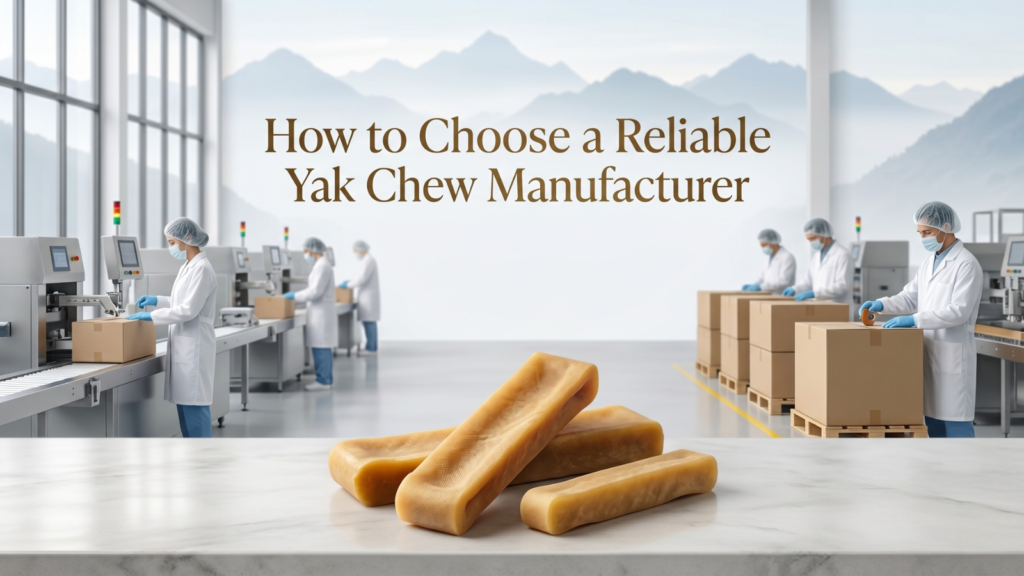
Choosing a reliable yak chew manufacturer is one of the most important decisions for wholesale buyers, importers, distributors, and private-label pet brands entering the growing Himalayan dog chew market. The manufacturer you select directly influences product quality, regulatory compliance, supply chain stability, retail performance, and long-term profitability. Reliable manufacturers consistently deliver authentic Himalayan yak chews produced from high-quality milk, supported by documented quality control systems, food safety certifications, batch traceability, and proven export experience across international markets.
Demand for natural, long-lasting dog chews continues to rise across North America and Europe: according to the ADM 2025 Pet Nutrition Insights Report, 77% of US pet owners say they are willing to pay more for healthier pet food, and 46% of US pet owners aged 18–34 specifically prefer products labeled as all-natural, a purchasing signal with direct implications for wholesale buyers evaluating Himalayan yak chew suppliers. Manufacturing expertise, ingredient sourcing transparency, production capacity, export compliance, packaging capabilities, and customer support all play critical roles in building a dependable supply partnership. This guide explains the key criteria used to assess yak chew manufacturers and helps buyers identify suppliers capable of delivering consistent product quality, regulatory compliance, and scalable wholesale supply.
What Qualities Define a Reliable Yak Chew Manufacturer?
Industry sourcing best practices suggest a reliable yak chew manufacturer demonstrates 4 core attributes: established manufacturing experience (often recognized as 5 or more years), a documented quality control framework, recognized food safety credentials, and a consistent export record across multiple international markets.
Reliability in yak chew manufacturing is not self-declared. It is verified through third-party certifications, batch traceability records, and documented export histories. Buyers who skip this verification step consistently report the 3 most common sourcing problems: product inconsistency between orders, failed customs inspections, and premature product spoilage during transit.
Why Does Manufacturing Experience Matter?
Manufacturing quality-control literature confirms that production experience directly correlates with a producer’s ability to maintain batch-to-batch consistency, the single most important quality metric for wholesale buyers. Newer manufacturers often face a learning curve; those with fewer years of operation are statistically more likely to struggle with uneven drying, inconsistent hardness profiles, and higher moisture retention rates that accelerate mold growth during ocean freight.
Experienced manufacturers have refined 5 critical production variables: milk sourcing protocols, lime juice concentration ratios, drying cycle duration, moisture control benchmarks, and hardness grading standards. Each variable requires iterative calibration over multiple production seasons.
A manufacturer operating for 10 or more years has encountered and resolved edge cases, seasonal milk composition shifts, humidity fluctuations during drying, and altitude-specific curing variations, that newer producers have not yet faced. This experiential knowledge translates directly into product stability for your retail customers.
When evaluating a manufacturer, request documentation of their founding year, their export history by market, and any product line expansions made over their operational history. These 3 data points reveal operational maturity more accurately than any marketing claim.
How Does Industry Reputation Influence Trust?
Standard supplier-audit frameworks recommend measuring industry reputation through 4 specific indicators: buyer testimonials from verifiable retail brands, the number of active export markets served, third-party certification bodies that have audited the facility, and the manufacturer’s track record with customs compliance.
A manufacturer exporting to 20 or more countries demonstrates that customs authorities in North America, Europe, and Asia-Pacific have repeatedly accepted their documentation standards. That acceptance record is a stronger trust signal than any self-reported quality claim.
Request references from existing wholesale clients. Credible manufacturers provide buyer contacts in your target geography. Manufacturers who deflect this request or offer only anonymous testimonials present an elevated sourcing risk.
How Can You Verify Product Quality Standards?
According to the FDA’s Guidance for Industry: Hazard Analysis and Risk-Based Preventive Controls for Food for Animals (PDF), animal food manufacturers supplying the US market must maintain a written food safety plan that includes a hazard analysis, preventive controls, monitoring procedures, corrective action protocols, and recall procedures. Wholesale buyers should also evaluate the manufacturer’s quality control process, batch consistency across three or more production runs, and relevant certifications and credentials before placing an order.
Quality verification is not a one-time check. It is an ongoing assessment that begins with sample evaluation and continues through post-shipment testing at the destination market.
What Quality Control Processes Should a Manufacturer Follow?
Drawing from international pet food safety guidelines, a reliable yak chew manufacturer implements a minimum of 5 documented quality control processes: moisture content testing, hardness grading, visual inspection for surface defects, microbiological screening, and batch traceability logging.
Moisture content testing is the most critical of these 5 processes. Industry laboratory testing indicates that yak chews with moisture levels exceeding the standard 10–12% threshold are at a significantly higher risk of developing mold during standard 30- to 45-day ocean freight timelines. Manufacturers who test moisture content at multiple production stages, post-drying, post-shaping, and pre-packaging, deliver consistently stable products with a proven 24-month shelf life.
Hardness grading separates chews into size-appropriate categories for small, medium, and large dog breeds. Manufacturers without a hardness grading system produce mixed batches that generate high return rates from retail customers reporting inappropriate chew sizes.
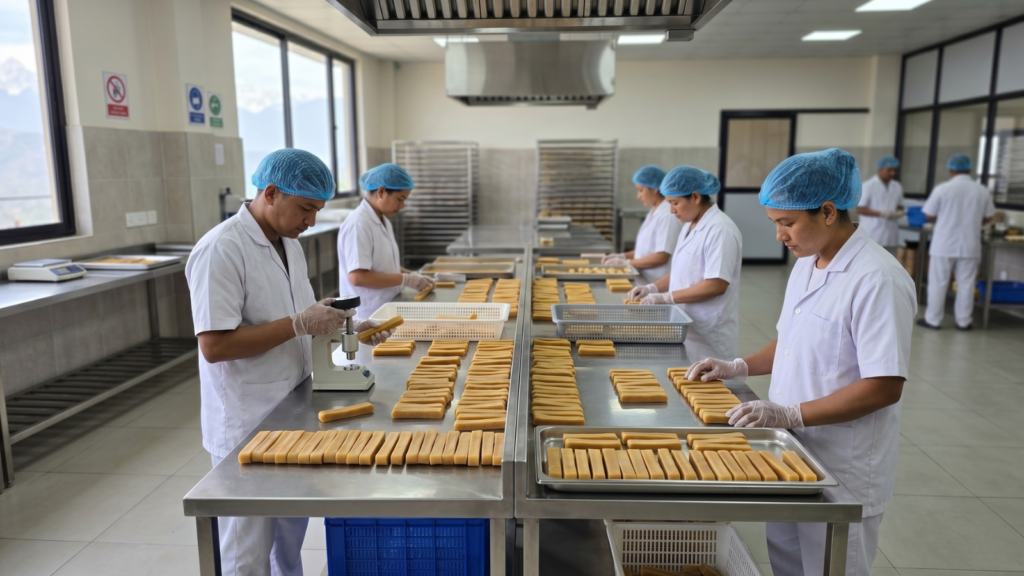
Export-level hygiene controls extend quality control beyond the product itself. Facility hygiene, including staff hygiene training, sanitized processing surfaces, and controlled drying environments, prevents cross-contamination that compromises the natural, preservative-free composition of authentic Himalayan yak chews.
How Can You Assess Consistency in Yak Chew Production?
Standard manufacturing quality-control methodologies suggest assessing production consistency by requesting batch records from 3 consecutive production runs and comparing 4 measurable parameters: weight tolerance ranges, moisture content percentages, hardness ratings, and visual defect rates.
Consistent manufacturers maintain weight tolerance variances of less than 5% across batches. Inconsistent producers show weight fluctuations of 10% to 20%, which creates retail display problems and customer complaints about product sizing.
Request physical samples from different production batches, not samples from a single showcase batch prepared for buyers. Authentic batch variation tests expose quality control weaknesses that curated samples conceal.
Consistent production also depends on supply chain stability. Manufacturers sourcing milk from a diversified network of Himalayan farming communities maintain raw material consistency even during seasonal livestock fluctuations. Manufacturers dependent on a single farming region face higher supply variability, which propagates directly into product inconsistency.
Which Certifications Indicate Product Quality and Safety?
The credentials that most reliably indicate product quality and safety in yak chew manufacturing include HACCP and ISO certifications (which require independent external auditing) and verified compliance with US FDA Facility Registration standards (a mandatory regulatory filing). (Note: While DUNS registration is also crucial, it serves to verify the manufacturer’s legal corporate identity rather than food safety.)
The FDA’s FSMA and Animal Food guidance confirms that animal food facilities, including overseas yak chew manufacturers, must register with the FDA when they manufacture, process, pack, or store animal food intended for the US market, unless an exemption applies. Food facility registrations must be renewed during the October 1 to December 31 renewal period of every even-numbered year. Buyers should verify a supplier’s FDA registration status before placing a wholesale order. HACCP certification demonstrates that the manufacturer has mapped, monitored, and controlled every critical control point in their production process. ISO certification verifies that the manufacturer operates under a documented quality management system subject to external auditing. DUNS registration provides a globally recognized business identification number that confirms legal operational status.
Manufacturers holding all 4 credentials have undergone external audits by 3 or more independent regulatory bodies. For buyers sourcing from a Himalayan dog yak chew manufacturer, this multi-body verification is categorically more reliable than any self-declared quality claim.
Why Is Ingredient Sourcing Important When Choosing a Manufacturer?

As supported by origin-labeling regulations in major markets, ingredient sourcing determines the authenticity, nutritional integrity, and regulatory compliance of the final yak chew product. Manufacturers sourcing milk from verified Himalayan regions above 3,500 meters in altitude produce chews with measurably higher protein concentrations and distinct physical properties that differentiate authentic products from imitations.
Sourcing transparency is the primary differentiator between premium yak chew manufacturers and low-cost imitators who use standard bovine milk with synthetic hardeners to approximate the appearance of genuine Chhurpi (traditional Himalayan hard cheese).
How Can You Confirm the Use of Authentic Himalayan Yak Milk?
Confirming authentic Himalayan yak milk sourcing requires reviewing specific government-issued documentation: Certificates of Origin from the Nepalese Ministry of Agriculture, Veterinary Health Certificates from the Department of Livestock Services, and supplier audit records.
Peer-reviewed compositional data help explain the distinct properties of yak milk: according to a 2023 Open Journal of Animal and Feed Research study, yak milk contains 5.5–7.2% fat and 4.9–5.3% protein, compared with 3.8% fat and 3.3% protein in cow milk. This higher concentration of milk solids contributes to the characteristic density and texture of traditional Himalayan yak chews. This distinct milk composition produces the characteristic hardness, density, and slow-dissolving texture that wholesale buyers and retail pet owners associate with genuine Himalayan yak chews.
Manufacturers who cannot provide origin documentation are almost certainly substituting standard cow milk or using milk powder, both of which produce a visually similar but structurally weaker chew with an inferior protein profile and shorter effective chew duration for dogs.
What Sourcing Practices Support Premium Yak Chews?
Premium yak chew sourcing practices include 4 components: direct farmer relationships, Fair Trade or equivalent ethical sourcing commitments, diversified regional milk supply networks, and zero-waste processing protocols.
Agricultural supply-chain studies demonstrate that direct farmer relationships eliminate intermediary markups that inflate raw material costs and introduce quality variability. Manufacturers who source directly from thousands of Himalayan farming households control both the price and the quality of their primary raw material.
Fair Trade commitments ensure that the farming communities producing the milk receive equitable compensation. This ethical sourcing dimension increasingly matters to Western retail buyers whose customers factor supply chain ethics into purchasing decisions.
Zero-waste processing methods, whereby byproducts from chew production are repurposed rather than discarded, signal operational maturity and environmental responsibility. Manufacturers practicing zero-waste production typically maintain tighter process discipline across all production stages.
According to Nepalese traditional dairy production standards, the authentic Chhurpi manufacturing method uses strictly 3 ingredients: yak milk, lime juice, and salt. Manufacturers adhering strictly to this 3-ingredient formulation produce the most authentic product. Any deviation, adding preservatives, chemical binders, or artificial flavor enhancers, compromises both the product’s natural positioning and its compliance with clean-label pet food standards increasingly required by premium retail chains.
How Can You Evaluate Food Safety and Compliance?

Evaluating food safety and compliance requires confirming that the manufacturer meets the specific import regulations of your destination market, maintains a documented testing protocol for each production batch, and provides complete traceability records linking finished products back to their raw material sources.
Food safety failures in pet product imports result in 3 costly outcomes: customs seizure of the entire shipment, formal import alerts from regulatory agencies, and permanent listing on non-compliant supplier databases that restrict future import permissions.
Which Export Regulations Should a Manufacturer Meet?
According to official customs and border protection agencies, the export regulations a yak chew manufacturer must meet vary by destination market across 4 primary regulatory frameworks:
The United States requires FDA facility registration for all pet food manufacturers and compliance with the Food Safety Modernization Act (FSMA). The full regulatory checklist for importing yak chew into the US is covered in a dedicated guide. For wholesale buyers targeting Europe, the USDA GAIN Report on Exporting Feed and Pet Food to the EU documents the requirements under Regulation (EU) 2017/625: dog chews must be accompanied by an official veterinary health certificate in Chapter 3(C) format, and shipments are subject to documentary, identity, and physical checks at EU border control posts. Manufacturers must meet the applicable EU establishment approval and per-shipment certification requirements before their products can enter the EU market. Australia requires manufacturing facilities of uncanned pet food, including hard Himalayan yak cheese chews, to obtain DAFF Biosecurity approval through an initial desk audit and potentially a physical site audit, in addition to obtaining the required import permit before shipment. Wholesale buyers targeting Canada should note that the CFIA regulates pet chews under the Health of Animals Regulations. For pet food products originating in Nepal and other countries outside the United States, import conditions are assessed case by case and may require individual facility approval before the product can enter Canada.
Manufacturers with active export records to all 4 of these markets have already navigated the most complex and stringent regulatory frameworks globally. Their documentation processes are refined and audit-ready.
Request copies of recent customs clearance records for shipments to your target market. Clearance records are more reliable than certificates alone because they confirm that regulatory authorities in the destination country have accepted the manufacturer’s documentation in practice, not just in theory.
How Do Testing and Traceability Improve Product Safety?
Testing and traceability improve product safety by creating 2 parallel systems: a pre-shipment quality gate and a post-shipment accountability chain.
Pre-shipment testing covers 5 parameters: moisture content, hardness, microbiological contamination, salt concentration, and visual defect rate. Batch traceability connects each finished product lot to its specific raw material batch, production date, quality test results, and shipping documentation. This 2-system approach means that any product quality issue reported in the market can be traced back to a specific production event within hours, not days.
Manufacturers who maintain digital batch traceability logs provide buyers with a searchable quality history. This capability is particularly valuable for large-volume buyers managing multiple concurrent shipments.
What Manufacturing Capabilities Should You Review?
Reviewing manufacturing capabilities requires assessing 3 operational dimensions: the facility’s verified production volume capacity, its ability to handle large wholesale orders without quality compromise, and the range of packaging and private label services available for retail-ready customization.
Capability gaps in any of these 3 dimensions create supply chain vulnerabilities that become critical when your retail business scales.
Can the Manufacturer Handle Large Wholesale Orders?
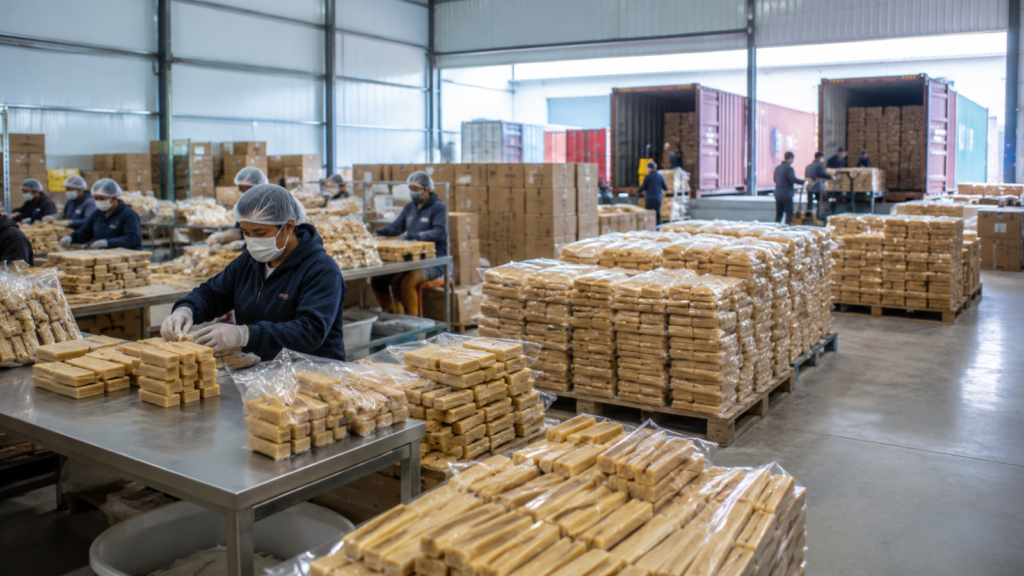
Procurement capacity studies indicate that a manufacturer’s ability to handle large wholesale orders depends on 4 factors: available drying infrastructure, cold storage capacity for raw milk, processing line throughput, and workforce scalability.
Due to the extended 4 to 8 weeks required for traditional air-curing, manufacturing data highlights that drying infrastructure is the primary production bottleneck in yak chew manufacturing. Traditional Himalayan drying methods require 4 to 8 weeks of controlled air-drying to achieve the appropriate moisture levels. Manufacturers with expanded drying facilities running multiple concurrent cycles can fulfill large orders without extending lead times beyond 60 days.
Request facility capacity documentation, not a verbal estimate. Reliable manufacturers provide written production capacity statements that include monthly throughput figures, current lead times, and maximum concurrent order volumes. These 3 data points establish whether a manufacturer can fulfill your initial order volume and scale with your business growth. First-time buyers can also reference this wholesale yak chew guide for a structured overview of ordering minimums, lead time benchmarks, and capacity thresholds to request before committing to a supplier.
How Important Is Production Capacity for Long-Term Supply?
Production capacity is the single most underestimated factor in long-term yak chew sourcing. Wholesale buyers who partner with manufacturers operating at near-maximum capacity from the start of the relationship consistently experience 2 problems: extended lead times during peak demand periods and partial shipments that disrupt retail inventory planning.
A manufacturer with reserve production capacity, defined as a minimum of 20% buffer above your contracted volume, provides supply continuity during demand surges, seasonal milk supply variations, and unexpected order increases from your expanding retail network.
Assess long-term capacity by asking the manufacturer about their facility expansion plans and their current production utilization rate. Manufacturers operating at 60% to 80% of maximum capacity provide a sustainable supply relationship. Manufacturers at 95% or above present immediate lead time risks.
What Packaging and Private Label Options Are Available?
The packaging and private label options that directly affect retail performance cover 5 formats: individual polybag sealing, custom-branded retail cartons, eco-friendly packaging materials, custom weight and size configurations, and bundled multi-product packaging for retail display.
Private label manufacturing, also called OEM production, allows wholesale buyers to source yak chews under their own brand identity without operating a manufacturing facility. Buyers evaluating this model can review what full-service yak chew private labeling typically includes—from custom branding and retail carton formatting to polybag sealing specifications—before comparing supplier proposals. The manufacturer produces the product to the buyer’s specifications and applies the buyer’s branding to the packaging.
Retail-ready packaging requires 4 specific elements: barcode compliance for point-of-sale systems, ingredient labeling that meets destination market regulatory requirements, appropriate weight declarations, and tamper-evident sealing. Manufacturers offering turnkey private label services handle all 4 elements internally, reducing the operational burden on the wholesale buyer and accelerating time-to-shelf.
How Can You Assess Export and Global Distribution Expertise?
Assessing export and global distribution expertise requires reviewing the manufacturer’s active shipping routes, their documented experience with customs documentation specific to your destination market, and their established relationships with international freight forwarding partners.
Export expertise is a distinct competency from manufacturing expertise. A manufacturer producing exceptional yak chews but lacking export knowledge creates expensive customs problems that damage your business relationships with retail partners. Suppliers offering dedicated yak chew export services—covering HS code management, per-shipment veterinary certificates, and freight forwarder coordination—eliminate this risk category entirely.
What Should You Know About International Shipping Experience?
International shipping experience in yak chew export encompasses 4 critical competencies: Harmonized System (HS) code classification accuracy, customs invoice preparation, certificate of origin documentation, and veterinary certificate management.
HS code accuracy matters: USDA FAS data on HS 2309.10 pet food exports show that $296.6 million in dog and cat food moved under HS code 2309.10 in 2024, a 15% year-on-year increase. Himalayan yak chews may be classified under HS 2309.10 or HS 0406 depending on the destination market’s customs interpretation, so manufacturers with documented export experience to the target market provide a stronger classification and compliance signal than self-declared claims. Manufacturers with active export experience to 20 or more countries have correctly classified their products under the appropriate HS codes for each destination market and maintain updated documentation templates for each trade partner.
Veterinary certificates must be issued by the governmental veterinary authority of the export country and authenticated for each destination market. Manufacturers who provide veterinary certificates prepared and authenticated per shipment, rather than using generic templates, deliver shipments with significantly lower customs rejection rates.
How Can Reliable Logistics Reduce Supply Chain Risks?
Freight-industry analyses confirm that reliable logistics partnerships reduce supply chain risks by eliminating 3 categories of disruption: documentation-related customs holds, product damage from inadequate packaging, and delivery timeline failures.
Manufacturers with established relationships with international freight forwarders negotiate preferential cargo handling agreements and access consolidated shipping options that reduce per-unit freight costs for wholesale buyers. These established partnerships also provide contingency routing options when primary shipping lanes experience disruptions.
Request the manufacturer’s average customs clearance time across their 5 largest destination markets. Average clearance times below 5 business days indicate well-prepared documentation. Clearance times above 10 business days signal documentation problems that will consistently delay your inventory receipts.
What Customer Service Factors Should You Consider?
Customer service quality in yak chew manufacturing is measured across 3 dimensions: response time to wholesale inquiries, the depth of pre-sale support provided during the sampling and ordering process, and the reliability of post-shipment communication during customs clearance and delivery.
Customer service gaps become supply chain crises when they occur during active shipments crossing international customs borders.
How Responsive Should a Yak Chew Manufacturer Be?
A responsive yak chew manufacturer replies to wholesale inquiries within 24 hours during standard business days and provides substantive answers, not automated acknowledgments. The 3 response quality indicators to assess during initial contact are: accuracy of product information provided, clarity of pricing structure communicated, and willingness to arrange product samples without extended negotiation.
Test responsiveness before committing to an order. Send an inquiry specifying your destination market, approximate order volume, and packaging requirements. The quality and speed of the manufacturer’s response reveal their operational communication standards more accurately than any claim on their website.
Language capability matters for international wholesale relationships. Manufacturers with English-fluent account managers eliminate the miscommunications that generate incorrect orders, mislabeled packaging, and documentation errors.
What Support Should Wholesale Buyers Expect?
Wholesale buyers sourcing yak chews internationally deserve 5 categories of manufacturer support: pre-shipment sample provision, export documentation preparation, customs clearance guidance for the destination market, post-shipment tracking communication, and responsive handling of any product quality claims.
Pre-shipment samples allow buyers to conduct independent quality verification before committing to full-volume orders. Manufacturers who charge prohibitive sample fees or require minimum sample commitments that mirror wholesale order quantities create unnecessary buyer risk.
Post-shipment support, particularly during customs clearance, requires manufacturers to provide supplementary documentation within 24 to 48 hours when customs authorities in the destination country request additional information. Manufacturers who respond slowly during active customs holds expose wholesale buyers to demurrage charges and storage fees that erode order profitability.
How Can Pricing Help You Identify a Trustworthy Manufacturer?
Supplier-selection research shows that pricing transparency identifies manufacturer trustworthiness through 2 primary signals: the relationship between stated price and verifiable production costs, and the transparency of pricing structure across order volumes. Prices that cannot be reconciled with authentic raw material and processing costs indicate ingredient substitution or undisclosed quality compromises.
Authentic Himalayan yak milk sourced from high-altitude farming communities commands a price premium over standard bovine dairy milk. This premium is non-negotiable in genuine Chhurpi production and is always reflected in the wholesale price of authentic yak chews.
How Do You Balance Cost, Quality, and Reliability?
Balancing cost, quality, and reliability in yak chew sourcing requires applying a total cost of ownership framework across 4 cost categories: unit purchase price, freight and duties, quality rejection and return processing costs, and customs hold and delay expenses.
A manufacturer offering prices significantly below the established market average (e.g., 25% to 40% lower) is highly likely to be producing a product with one or more quality compromises, lower-grade milk sources, incomplete drying cycles, or inadequate packaging, which generate disproportionate downstream costs through higher return rates and customer complaints.
The sustainable price range for authentic, export-certified Himalayan yak chews reflects the actual cost of sourcing genuine yak milk, traditional Chhurpi processing, moisture and hardness testing, ISO and HACCP compliance, and export documentation management. Manufacturers holding FDA, ISO, HACCP, and DUNS certifications operate with verifiable compliance overhead that is reflected in their pricing.
Evaluate pricing against quality and compliance documentation simultaneously. A manufacturer offering competitive pricing alongside full certification documentation, batch traceability, and established export records provides genuine value. A manufacturer offering below-market pricing without corresponding documentation presents an unquantified quality and compliance risk.
What Pricing Red Flags Should You Avoid?
The 4 pricing red flags that identify unreliable yak chew manufacturers are: prices more than 35% below the established market rate without documented explanation, refusal to provide itemized cost breakdowns on request, requirements for 100% upfront payment with no sample provision, and pricing that does not differentiate between authentic yak milk sourcing and standard bovine milk formulations.
Manufacturers who refuse to explain their pricing structure are concealing one of 3 cost-cutting practices: ingredient dilution (substituting cow milk for yak milk), certification falsification (presenting copied certificates from other manufacturers), or production shortcutting (reducing drying cycle times to increase throughput at the cost of moisture control).
The absence of a formal invoice or commercial documentation in pricing communications is a significant operational red flag. Reliable manufacturers provide formal quotations on company letterhead, including product specifications, unit pricing, payment terms, lead times, and documentation inclusions. This documentation standard is the baseline expectation for any legitimate B2B manufacturing relationship.
How Should You Approach Yak Chew Sourcing With a Trusted Manufacturer?
Approaching yak chew sourcing with a trusted manufacturer begins with requesting documentation across 5 verification categories before placing any order: certifications, batch records, sample products, references, and export documentation examples for your destination market. For the references category, wholesale buyer testimonials from verifiable retail brands in your target geography carry the most weight, confirming real-world compliance and fulfillment performance rather than production capability alone.
This 5-document verification sequence takes between 5 and 10 business days and eliminates the most common sourcing risks wholesale buyers encounter when entering the Himalayan dog chew category.
Can Native Nepal Dog Chew Help Meet Wholesale Yak Chew Needs?
Native Nepal Dog Chew, headquartered in Kathmandu, Nepal, manufactures and exports authentic Himalayan yak cheese dog chews to wholesale buyers across 20+ countries, with primary markets in North America and Europe.
Founded in 2016 and operating with a solid decade of production experience, Native Nepal Dog Chew sources raw materials directly and indirectly from thousands of Himalayan farming communities across Nepal. Our yak chews are produced using the traditional Chhurpi method with 3 core ingredients: Himalayan yak milk, lime juice, and salt. No preservatives, no artificial flavors, and no chemical binders enter any product in our catalog.
Our product portfolio covers 5 formats to address different retail segments: Dog Chew Bars (hard, long-lasting traditional chews), Puffed Chew Bars (easily digestible aerated treats), Dog Chew Nuggets (light, low-fat crunchy treats), Puffed Chew Nuggets (protein-rich training rewards), and Dog Cheese Protein Powder (a high-protein meal topper for active dogs).
Native Nepal Dog Chew holds 4 verified certifications: US FDA Facility Registration, DUNS Registration, ISO Certification, and HACCP compliance. Every shipment includes veterinary certificates and origin documentation tailored to the destination market’s specific regulatory requirements, directly addressing the 2 most common customs rejection causes for pet food imports.
Our manufacturing process covers the complete production workflow: milk sourcing, cleaning, shaping, packaging, labeling, lab testing, and export certification. This end-to-end capability eliminates the operational fragmentation that occurs when wholesale buyers source products and packaging from separate suppliers.
For wholesale buyers seeking private label services, Native Nepal Dog Chew provides turnkey OEM production, including custom branding, polybag sealing, retail carton packaging, and eco-friendly packaging formats. Our batch traceability system maintains complete production records, and our documented shelf life of 24 months under dry storage conditions provides the retail inventory flexibility that wholesale distributors require.
Wholesale buyers, importers, pet retail chains, and private-label brand owners seeking a verified manufacturer with 10+ years of Himalayan yak chew production experience and active regulatory compliance across North American and European markets are encouraged to request samples and wholesale pricing directly.
What Are the Key Takeaways for Choosing a Reliable Yak Chew Manufacturer?
Choosing a reliable yak chew manufacturer requires evaluating 8 interconnected criteria rather than relying on any single factor.
The 3 non-negotiable verification requirements are certification documentation (FDA, HACCP, ISO, DUNS), batch traceability records, and export clearance history for your destination market. These 3 requirements confirm regulatory compliance, quality system integrity, and operational export capability simultaneously.
The 4 operational capability requirements are consistent production capacity with a minimum 20% reserve buffer, authentic Himalayan ingredient sourcing with documented farmer relationships, private label and export-ready packaging capabilities, and established logistics partnerships with demonstrated customs clearance performance.
The 1 relationship requirement is responsive communication: a manufacturer who answers substantive wholesale inquiries within 24 hours, provides pre-shipment samples, and delivers active customs support during active shipments is a manufacturer building a long-term supply partnership.
Pricing transparency, aligned with authentic raw material costs and verifiable certification overhead, separates trustworthy manufacturers from low-cost imitators whose below-market pricing reflects quality and compliance compromises rather than operational efficiency.
Recent pet industry market research reports show that the global Himalayan dog chew market continues to grow as pet owners across North America and Europe prioritize natural, single-ingredient treats with clean-label formulations. Wholesale buyers who partner with certified, experienced, and transparent manufacturers access a product with strong retail velocity, low return rates, and a 24-month shelf life that supports efficient inventory management. These outcomes are the direct result of choosing a manufacturer based on verified capability, not price alone.