Yak chews have emerged as one of the fastest-growing categories in the natural dog treat market, driven by increasing consumer demand for clean-label ingredients, long-lasting chewing solutions, and minimally processed pet products. Originally produced in the Himalayan region from traditional Chhurpi cheese, Himalayan yak chews have evolved from a niche specialty treat into a globally traded wholesale product sold through pet stores, distributors, e-commerce brands, subscription box companies, and private label retailers. As competition in the premium pet treat sector continues to grow, businesses are seeking reliable yak chew manufacturers, consistent product quality, regulatory compliance, and profitable sourcing strategies that support long-term retail success.
Understanding the yak chew wholesale market requires more than comparing prices between suppliers. Buyers must evaluate product authenticity, manufacturing standards, certifications, packaging options, export documentation, inventory planning, and consumer purchasing trends that influence category performance. This guide explores how yak chews are manufactured, which products generate the strongest retail demand, how wholesale pricing and minimum order quantities are structured, what quality standards suppliers should meet, and how pet stores can maximize margins through effective sourcing, merchandising, private labeling, and customer education. Whether you operate an independent pet store, distribution business, Amazon brand, or retail chain, the information below provides a practical framework for building a profitable and sustainable yak chew product category.
Why Are Yak Chews Popular in Pet Stores?
Yak chews are popular in pet stores because they typically combine a simple 4-ingredient natural formula (though formulations can vary among brands), a generally longer chew duration, dental health benefits, and a clean label that today’s informed pet owners actively demand. Retail pricing studies indicate pet stores stock them because the category can yield margins ranging from 55% to 75%, often generating reliable repeat purchases across multiple dog demographics.
What Makes Himalayan Yak Cheese Dog Chews Unique?
Historically documented in the high-altitude dairy traditions of the region, Himalayan yak cheese dog chews, also called Chhurpi, originate from Nepal and Tibet. Chhurpi is a hard cheese pressed and dried for several weeks until it reaches a structural density that withstands hours of sustained chewing by medium-to-large dogs. Three attributes separate these chews from every other natural treat format on the market.
Ingredient simplicity is first. Authentic traditional yak chews contain exactly 4 ingredients: yak milk, cow milk, lime juice, and salt, though buyers should note that some modern commercial formulations may vary. No artificial binders, no synthetic preservatives, no chemical additives of any kind. That label reads as clean as any product on the pet store floor.
Chewing duration is the second. While chew times vary significantly based on a dog’s jaw strength and habits, a single medium-sized bar can often occupy a 30-pound dog for 2 to 4 hours. Rawhide and most soft treats do not come close to that engagement window. Long-lasting chewing is a value proposition that sells itself on the shelf.
The microwave nub experience is the third. When a dog chews a yak bar down to a small remnant of roughly 2 inches, owners can microwave it for 45 to 60 seconds to puff it safely (owners should always supervise their dog when feeding). The piece puffs into a crunchy, airy treat, creating zero waste and a memorable second experience. That moment consistently drives return purchases.
Why Do Pet Owners Prefer Natural Dog Chews?

Consumer demand for ingredient transparency has reshaped the pet food sector: the Pet Food Institute’s 2025 Pet Food Production and Ingredient Analysis Report reports $51.7 billion in U.S. pet food sales in 2024 and notes that consumer demand for greater transparency has contributed to the first major pet food label overhaul in more than 40 years, supporting continued interest in clean-label products such as authentic yak chews.
Three specific concerns fuel this preference. The FDA has issued documented recalls concerning specific rawhide products, including the FDA’s United Pet Group rawhide recall, which involved multiple brands manufactured in Mexico, Colombia, and Brazil after a chemical contamination concern was identified. This documented recall highlights why buyers should evaluate manufacturing processes, ingredient controls, and safety documentation when comparing rawhide products with alternative chews such as naturally dried yak chews. Some dogs may also experience digestive issues with certain artificial or highly processed chews. Owners of large or aggressive chewers also seek products that provide durability while remaining appropriate for supervised consumption.
Yak chews address all three concerns directly. The production process uses no chemical processing. Comparative veterinary studies suggest the traditional 4-ingredient list is generally more easily digestible than heavily processed rawhide. The compressed cheese format generally avoids splintering into sharp shards the way processed rawhide can. That alignment with consumer concerns explains why the category experiences reorder rates that exceed most other treat formats.
How Does the Yak Chew Wholesale Market Work?
International trade statistics show the yak chew wholesale market operates largely as a direct manufacturer-to-buyer supply chain originating primarily from Nepal and India, with Nepal-based Chhurpi chews holding the authentic provenance advantage. Bulk buyers place orders directly with manufacturers, receive products packaged with full export documentation, and distribute through retail chains, e-commerce platforms, or their own private label brands.
Who Buys Yak Chews in Bulk?
5 distinct buyer categories purchase yak chews at wholesale volumes: pet retail chains, independent pet stores, Amazon private label sellers, pet product distributors, and subscription box companies.
- Pet retail chains purchase standardized sizes in high volumes to fill planograms across multiple store locations. They prioritize batch consistency and branded retail-ready cartons.
- Independent pet stores purchase smaller quantities with more flexibility in product variety, often stocking 3 to 6 SKUs across sizes.
- Amazon sellers represent the fastest-growing wholesale buyer segment, sourcing private-label yak chews with custom branding to build differentiated product listings.
- Distributors consolidate supply from manufacturers and sell to regional retailers lacking the order volume or logistics capacity to import directly.
- Subscription box companies purchase mixed SKUs monthly to rotate into curated pet boxes, making format variety a purchase requirement.
Each buyer type carries different MOQ expectations, packaging specifications, and certification requirements. Understanding which buyer category applies to your business determines which supplier tier and service model fit best.
What Trends Are Shaping Wholesale Demand?
Three market trends are reshaping how retailers source and stock yak chews in 2026.
- Private label yak chews generate measurably higher margins because they capture the brand premium rather than passing it to a third-party manufacturer’s label. The USDA FAS Pet Food Market Update 2025 documents premium-product dynamics in export markets, where U.S. pet food exports reached $296.6 million in 2024, reflecting continued demand for quality-positioned and traceable pet food products.
- Product format diversification is the second trend. The original hard bar was the entry point for the category. Recent sales figures reflect a format diversification trend, with buyers increasingly asking for puffed bars, nuggets, protein powders, and multi-format variety packs. Manufacturers producing only one format are losing shelf placements to those offering a complete product ecosystem across formats and breed sizes.
- Documentation scrutiny is the third trend. Following recent regulatory updates, customs agencies in the U.S., EU, Canada, and Australia have tightened inspection of animal-origin products at the point of entry. Buyers increasingly disqualify suppliers who cannot provide FDA registration numbers, veterinary health certificates, and origin documentation upfront before a purchase order is issued.
What Types of Yak Chews Should Pet Stores Stock?
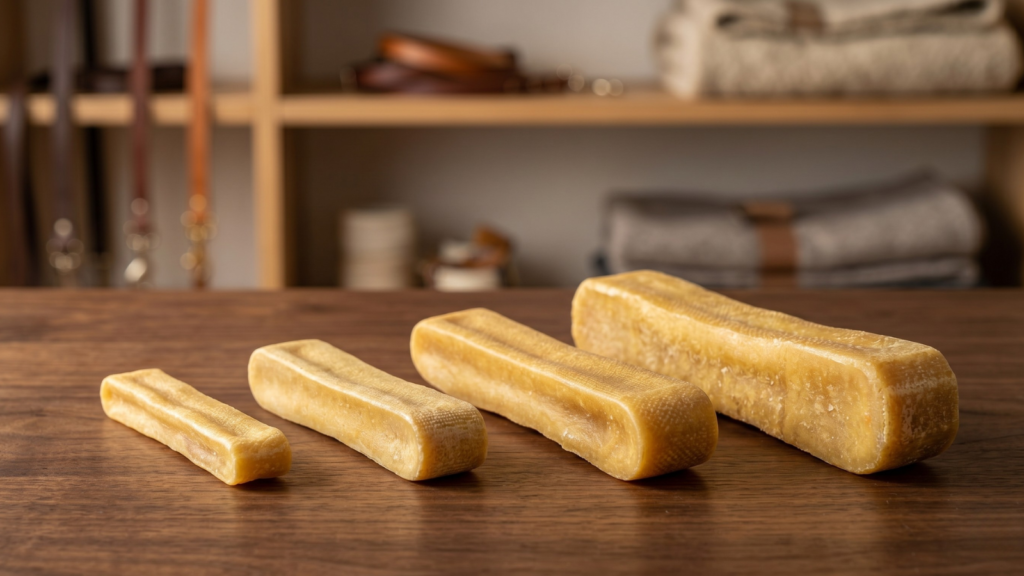
Pet stores maximize sell-through rates by stocking at least 3 size variants (small, medium, and large), at least 2 product formats (hard bars and a puffed or bite-sized option), and a value-pack SKU targeting multi-dog households. Merchandising experts generally advise a 5-SKU assortment as a practical foundation for a competitive shelf set in the natural chew category.
Which Sizes Suit Different Dog Breeds?
Size selection directly affects the repurchase rate. Customers who buy the wrong chew size for their dog’s breed return the product or leave a negative review, neither of which benefits a store’s yak chew category performance.
Small chews under 40 grams suit dogs under 20 pounds, including Chihuahuas, Shih Tzus, Maltese, and similar toy breeds. Medium chews between 40 and 80 grams suit dogs from 20 to 55 pounds, including Beagles, Bulldogs, and Cocker Spaniels. Large chews from 80 to 150 grams suit dogs from 55 to 90 pounds, including Labradors, German Shepherds, and Golden Retrievers. Extra-large chews above 150 grams suit aggressive chewer breeds above 90 pounds, including Mastiffs, Rottweilers, and Great Danes.
Customer data indicates that stores displaying a clear breed-weight size guide report higher first-purchase satisfaction scores and lower return rates than stores that leave size selection to guesswork.
Which Varieties Attract More Customers?
Category statistics indicate hard chew bars typically generate the highest initial sales volume because they are the format customers already recognize from online research before entering a store. Puffed chews attract impulse purchases because the airy, light texture looks visually distinct from a hard bar and appeals specifically to customers shopping for senior dogs or dogs with dental sensitivity.
Nuggets and bite-sized training formats attract multi-dog household buyers and customers wanting a daily reward option rather than a once-a-week long chew session. These customers tend to reorder more frequently, improving category velocity metrics.
Industry tracking suggests dog cheese protein powder is an emerging SKU with strong upsell potential among performance pet owners. It targets the performance pet segment and the raw-feeding community, two buyer groups with high average basket values and strong brand loyalty when a product earns their trust.
A well-structured floor set combines hard bars across 3 size variants, one puffed format, and one bite-sized format. That 5-product assortment covers toy breeds through giant breeds and captures the casual buyer, the active-dog owner, and the health-focused supplement seeker in a single planogram.
How Are Himalayan Yak Chews Made?

Authentic Himalayan yak chews are made by combining yak milk and cow milk with lime juice and salt, pressing the resulting cheese into bars or blocks, then drying the product at controlled temperatures for 3 to 6 weeks, which production sources cite as necessary to achieve the structural hardness required for long-lasting chewing. In traditional production methods, no heat extrusion, chemical processing, or synthetic additives are used at any production stage.
What Ingredients Are Used in Authentic Yak Chews?
The 4 ingredients in an authentic Himalayan yak chew are yak milk, cow milk, lime juice, and salt. Scientific nutritional research confirms that yak milk is substantially richer than standard Holstein cow milk: a 2023 peer-reviewed review of yak milk composition published in Foods documents yak milk fat at 5.6–7.5% and protein at 4.0–5.9%, compared with Holstein cow milk fat at 2.8–4.0% and protein at 2.8–4.0%. Nepal-specific yak milk data reported in the review show fat at 6.5% and protein at 5.4%. This higher nutrient concentration contributes to the dense composition of traditional milk-based yak chews. The traditional processing method, including curd formation, pressing, and extended drying, also contributes to the dense, hard structure and chewing resistance of yak chews. Cow milk is blended into the formula to balance texture and manage production costs while maintaining the product’s protein content.
Lime juice functions as the acidifying agent. The acid causes milk proteins to precipitate and bind into a cohesive solid. Salt serves as a natural preservative and flavoring component. No chemical binders, artificial colors, or synthetic preservatives appear anywhere in the formulation.
For wholesale buyers, this ingredient profile simplifies import compliance. Animal-origin products with minimal processing, no chemical additives, and a 24-month shelf life in dry storage present a manageable customs risk profile in most destination markets, including the U.S. and EU.
How Does Traditional Production Affect Quality?
Traditional Chhurpi production creates structural characteristics that commercial extrusion cannot replicate. The extended drying period builds a hard internal matrix that dogs must work through progressively. That structural resistance is the functional core of the product’s value. Dogs spend hours on a single bar, which is exactly the engagement pet owners pay a premium for.
What most buyers overlook in supplier evaluation is moisture content. As supported by food science literature, moisture control at the production stage largely determines whether a chew molds during ocean freight, softens on the retail shelf, or arrives in the exact condition the buyer specified. Reputable manufacturers perform moisture testing on every production batch before packaging begins. A batch failing moisture tolerance gets pulled before it ships, preventing the return rate problems that define low-quality suppliers.
Traditional production tied to fair-trade sourcing from Himalayan farming communities creates a provenance story with genuine marketing value. Sourcing directly from an established yak chew manufacturer in Nepal gives buyers access to that origin authenticity along with the traceability documentation that supports it. Consumer willingness to pay more for traceable, ethically sourced products is supported by peer-reviewed research on consumer willingness to pay for sustainable products, published in Sustainable Futures in 2024. The study found that willingness to pay is a significant determinant of sustainable product purchase intentions, providing an evidence base for connecting product provenance and production transparency with premium positioning. This positioning can strengthen a brand’s differentiation as consumers increasingly associate transparency with product value.
What Should Pet Stores Look for in a Supplier?
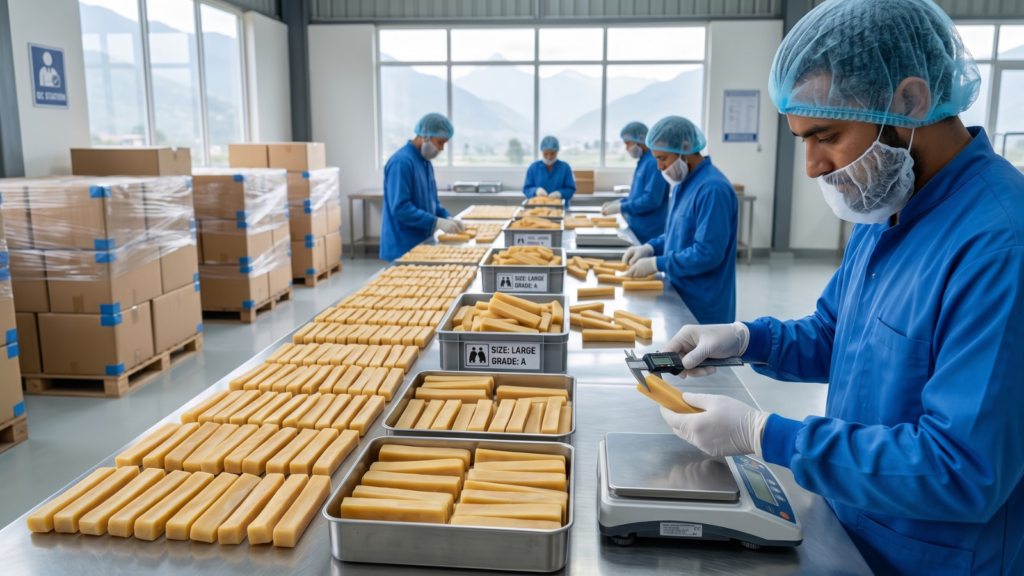
Pet stores evaluate yak chew suppliers on 5 criteria: product certifications (FDA, ISO, HACCP), batch consistency documentation, private label capability, export documentation completeness, and response time for sample requests and order inquiries. Buyers working through this process for the first time will benefit from a structured framework for choosing a reliable yak chew manufacturer before committing to a supply relationship. A supplier missing 2 or more of these criteria introduces significant sourcing risk.
Why Are Quality Standards Important?
A single contaminated or structurally defective batch generates customer complaints, product returns, and potential regulatory attention. Pet treat recalls in the U.S. and EU carry serious consequences for the retailers who stocked the product, not only the manufacturer who produced it.
FDA registration confirms that a manufacturer operates a facility registered with the U.S. Food and Drug Administration, a mandatory requirement for any pet food or treat product entering American commerce. ISO certification verifies that the production facility follows a documented quality management process audited by an independent third party. HACCP (Hazard Analysis and Critical Control Points) certification confirms the manufacturer has identified every food safety risk point in the production chain and installed verified controls at each critical point.
Veterinary health certificates confirm animal-origin documentation accepted by destination country customs authorities. DUNS registration confirms the company exists as a verifiable legal entity in international trade databases, reducing fraud risk for international buyers placing large orders. These 5 certification markers together distinguish a professional export-grade manufacturer from a commodity broker or unregulated producer.
How Can Stores Evaluate Supplier Reliability?
Reliable supplier evaluation follows 4 practical steps that separate capable manufacturers from vendors who create logistical problems after payment.
The first step is requesting a sample. A reliable supplier dispatches a sample batch within 7 to 14 business days and includes a product data sheet, a certificate of analysis, and a copy of their FDA registration number. Suppliers who delay sample fulfillment beyond 3 weeks without a clear explanation consistently exhibit the same behavior with bulk order fulfillment.
The second step is verifying batch-to-batch consistency. Ask for photographs and weight records from 3 consecutive production batches. Size variation, color inconsistency, and texture differences across batches predict future customer complaints. Suppliers who cannot provide batch documentation lack the traceability infrastructure to prevent inconsistency.
The third step is confirming export experience. Ask specifically which markets the supplier currently ships to and request a redacted copy of a past commercial invoice and packing list. A supplier with active shipments to U.S. and EU customers has already solved the customs compliance challenges that consistently create problems for inexperienced importers.
The fourth step is testing response time. Send an inquiry during standard business hours in the supplier’s time zone and then again during off-hours. Response within 24 hours during business hours and within 48 hours off-hours is the benchmark for a B2B manufacturing partner whose communication matches the pace of international commerce.
How Can Pet Stores Order Yak Chews in Bulk?
Bulk yak chew procurement follows a 4-step process: inquiry and sample request, MOQ and pricing confirmation, purchase order submission, and shipping plus documentation coordination. Most manufacturers process bulk orders from confirmed purchase order to dispatch in 3 to 6 weeks, depending on order complexity and packaging requirements.
What Minimum Order Quantities Are Common?
MOQ (Minimum Order Quantity) in the yak chew wholesale market varies significantly by supplier tier and whether the order includes custom packaging or private label services.
Entry-level manufacturers and brokers typically accept MOQs starting at 20 to 50 kilograms per SKU. Mid-tier manufacturers who provide custom packaging and private labeling typically set MOQs at 100 to 300 kilograms per SKU. Direct farm-level manufacturers with full OEM capability often set MOQs at 500 kilograms or above for new buyers, which reduces per-unit cost substantially but requires the buyer to have the storage and sales volume to absorb the inventory.
Most suppliers do not publish specific MOQ figures on their websites. The actual minimum depends on the product variant, the packaging specification, and whether the order includes private label services. Direct inquiry is the only way to obtain an accurate figure for a specific order configuration.
How Are Wholesale Prices Typically Structured?
Yak Chew wholesale pricing follows a tiered volume model. Smaller initial orders carry a higher per-unit cost because setup costs are distributed across fewer units. Larger repeat orders unlock progressively lower per-unit pricing as order volume increases and the commercial relationship stabilizes.
Price components include raw material cost (Himalayan yak and cow milk sourced from farming communities), processing and drying labor, quality testing (moisture, hardness, visual grading), packaging (with significant cost variation between plain bulk polybags and retail-ready private label cartons), and export documentation preparation.
Buyers who consolidate multiple SKUs into a single purchase order typically negotiate stronger per-unit pricing than buyers who place separate orders for each variant. Requesting a full product catalog quote rather than a single SKU price quote almost always yields a more competitive outcome per unit.
What Packaging Options Are Available for Retailers?
Pet store buyers choose from 3 primary packaging formats: bulk packaging in plain polybags for redistribution, standard branded packaging under the manufacturer’s own label, and full private label packaging with the buyer’s custom branding, logo, sizing copy, and retail carton design. Each format carries different cost structures and strategic implications for the buyer’s brand positioning.
Should Stores Choose Private Label Packaging?
Private label packaging is the right choice for 3 buyer types: stores building an in-house product brand, Amazon sellers competing against dozens of similar listings, and regional distributors who want product differentiation from other stockists carrying the same manufacturer’s name. Full-service yak chew private labeling typically includes custom sizing, artwork development, and retail carton design as part of the OEM package, giving buyers a complete branded product without managing multiple vendors.
The commercial case is direct. A yak chew sold under a store’s own brand generates loyalty to that store. When a customer loves the product, they return to that specific retailer. That dynamic does not exist when reselling an established third-party brand, where the customer may purchase the same product from any competing retailer online or in-store.
The trade-off is a minimum order commitment. Private label packaging requires investment in artwork setup, packaging dies, and printed materials. Those setup costs are amortized across the total order quantity, meaning private label becomes cost-effective only at a volume the buyer can realistically move within the shelf life of the inventory.
How Does Packaging Influence Shelf Appeal?
Packaging is the primary conversion tool on a retail shelf. A yak chew inside a plain polybag competes on price alone. The same chew inside a well-designed retail carton with clear ingredient callouts, a breed size guide, and high-quality product photography competes on perceived value.
Specific packaging elements that increase shelf conversion include a transparent product window allowing customers to see the actual chew, a clear size guide matched to dog weight brackets, a prominent 4-ingredient list highlighting the clean formula, and a protein content callout. Eco-friendly and recyclable packaging appeals to a growing segment of buyers: the global environmentally friendly packaging market reached $244.17 billion in 2024 and is growing at 6.8% annually, with the forecast period projecting an accelerated 8.4% CAGR through 2029 as transparency and eco-labeling continue to shape purchase decisions, according to the Environmentally Friendly Packaging Market Report 2025. For yak chew retailers, recyclable carton options position the same product to a buyer segment that actively seeks packaging alignment with their values.
Retail-ready packaging also reduces labor costs at the store level. Products that arrive in display-ready cartons save staff time on shelf preparation and improve the consistency of the in-store product presentation.
How Can Pet Stores Price Yak Chews Profitably?
Retail margins on yak chews range from 55% to 75% depending on supplier pricing tier, product format, and whether the store carries a private label or a third-party branded product. Natural treat categories in specialty pet retail consistently outperform average store margins, making yak chews a high-priority shelf allocation for independent pet retailers.
What Margins Are Common for Yak Chews?
The typical landed cost for a medium yak chew bar (60 to 80 grams) from a Nepal-based manufacturer ranges from $1.80 to $3.20 per unit, depending on order volume, packaging type, and the allocated share of shipping cost. Retail prices for the same product in U.S. specialty pet stores range from $7.99 to $14.99 per unit.
That spread produces gross margins of 55% to 75% at the unit level for well-positioned buyers. Specialty pet retailers face increasing cost pressure, with the Bank of America Institute’s 2025 US Pet Ownership Report reporting that pet services prices were 42% higher in April 2025 than in 2019, compared with a 22% increase for pet food and treats. The yak chew category can therefore provide an opportunity for differentiated, premium-margin products, particularly for independent pet stores competing with big-box retailers on product differentiation rather than price.
Private label yak chews generate an additional 15 to 25 percentage points of margin compared to reselling a manufacturer’s brand, because the buyer captures the brand premium that would otherwise flow to the manufacturer’s label.
How Can Stores Increase Repeat Purchases?
Repeat purchase rate is the defining performance metric for any consumable treat category. Repeat purchases are particularly important in consumable categories. A positive first experience often leads customers to return for additional purchases, making education and proper size recommendations important for long-term category growth.
4 tactics drive repeat purchases in the yak chew category. Here are some of those given below:
- Staff size recommendation accuracy at the point of first sale reduces the probability of a poor first experience, which is the primary reason customers do not return.
- Teaching customers the microwave nub trick at the point of purchase creates a memorable secondary experience that generates word-of-mouth and gives buyers a reason to return and share the outcome.
- Providing a clear chew frequency recommendation (2 to 3 times per week for most dogs) gives customers a concrete repurchase timeline rather than leaving the decision ambiguous.
- Bundle pricing in 3-packs or a simple subscription enrollment option reduces the friction of restocking and increases the average transaction value at the same time.
What Shipping and Export Factors Matter?
International yak chew shipments require 6 core documents: a commercial invoice, a packing list, a veterinary health certificate from Nepal’s Department of Livestock Services, a certificate of origin, FDA facility registration, and a destination country import permit (such as a USDA APHIS permit for U.S.-bound shipments).
How Are Yak Chews Shipped Internationally?
Yak chews ships via ocean freight (FCL or LCL) for large-volume commercial orders and via air freight or international courier for samples and initial trial orders. The standard channel for established wholesale buyers is LCL (Less than Container Load) ocean freight, which places multiple buyers’ consignments inside a single shipping container and significantly reduces per-unit freight costs compared to dedicated FCL shipments.
Transit time from Nepal to U.S. East Coast ports via ocean freight typically runs 45 to 60 days, accounting for overland transit to Indian ports and current global shipping routes. Delivery to EU ports runs 22 to 30 days. Air freight reduces transit to 5 to 10 days but carries a cost premium of 6 to 10 times the equivalent ocean freight rate, making it appropriate for samples and urgent replenishment orders rather than routine bulk shipments.
Moisture control during transit matters as much as moisture control during production. Properly dried yak chews packaged with desiccant inserts and sealed in moisture-barrier polybags consistently arrive within specification across ocean transit times. Buyers confirm the specific packaging protocol with their supplier before the first commercial shipment.
What Documents Are Needed for Exports?
The 6 documents that appear in most yak chew export shipments are: a commercial invoice detailing product description, unit quantity, declared value, and full buyer and seller information; a packing list showing gross and net weights per carton; a certificate of origin issued by the Nepal Chamber of Commerce; a veterinary health certificate from Nepal’s Department of Livestock Services; an FDA facility registration number; and crucially for the U.S. market, a USDA APHIS import permit alongside any destination country’s specific agricultural authority documentation.
The U.S., Canada, Australia, and EU member states each maintain distinct import permit and inspection requirements for animal-origin products. Buyers entering the American market can review a full breakdown of yak chew US import requirements covering USDA APHIS permits, FDA registration numbers, and port-of-entry inspection steps before placing a first commercial order. Buyers importing yak chews for the first time work with a licensed customs broker in their destination country before placing an order. Manufacturers with established export relationships in specific markets maintain ready copies of all standard documentation and provide guidance on country-specific requirements as part of their standard export service.
How Can Pet Stores Market Yak Chews Effectively?
Pet stores achieving the highest yak chew sell-through rates combine 3 consistent elements: staff trained to explain the product’s origin and format, clear point-of-sale materials at the shelf, and an active online presence demonstrating the product in use. The natural chew category rewards education-based selling far more than promotional pricing strategies.
Which In-Store Strategies Boost Sales?
Staff product knowledge is the highest-leverage in-store conversion tool available to a pet store operator. A staff member who explains what Chhurpi is, where the product originates, why the formula uses only 4 ingredients, and how the microwave nub trick works generates 3 to 4 times more first-time conversions than a standard shelf placement without any staff engagement.
Shelf placement at eye level or near the checkout counter can outperform less visible back-of-store positions. 2025 research on eye-level product placement identifies the 4-to-5.5-foot range as a retail “golden zone” and reports that eye-level positioning can enhance product recall and conversion rates. For yak chews, placing products within this high-visibility zone can increase shopper exposure and support first-purchase conversion.
In-store sampling events convert hesitant buyers at high rates. Inviting dogs into the store and offering a small complimentary chew during an event generates observable, real-time product demonstration: the dog settles, engages with the chew for several minutes, and the owner watches the product prove its value without any sales pressure involved.
How Can Online Channels Increase Demand?
E-commerce listings and social media extend a pet store’s yak chew sales volume beyond the physical footprint of the store and its daily foot traffic.
Product descriptions that include specific figures, including chewing duration by breed size, protein content percentage, shelf life in months, and ingredient count, convert at higher rates than descriptions using only subjective language. Customer reviews that reference specific dog breeds, weights, and chewing styles build purchasing confidence for online buyers who have not yet tried the product.
Short video content showing a dog chewing a yak bar over several minutes or demonstrating the microwave nub transformation performs reliably across Instagram Reels, TikTok, and YouTube Shorts. This category has a natural visual advantage: a dog settling into a long chew session generates authentic, compelling content that earns organic reach without paid promotion.
Amazon storefronts benefit from A+ content sections that address sourcing origin, ingredient transparency, breed size matching, and frequently asked safety questions. Those sections reduce pre-purchase questions, lower post-purchase return rates, and improve conversion rates by addressing the buyer’s primary hesitations before checkout.
How Should Pet Stores Approach Yak Chew Sourcing?
Sourcing yak chews at wholesale scale means selecting a manufacturing partner, not simply finding a product vendor. Pet stores and distributors ready to move from small trial orders to consistent volume can explore structured bulk yak chew supply options that consolidate production, export documentation, and retail-ready packaging under a single supplier relationship. The right supplier reduces customs risk, produces consistent product across every production batch, handles retail-ready packaging, and supports the buyer’s business growth rather than constraining it with documentation gaps or communication delays.
Can Native Nepal Dog Chew Help With Wholesale Supply?
Yes, Native Nepal Dog Chew Help with Wholesale Supply, the trade name of Native Nepali Agro Supplies Pvt. Ltd., is a Kathmandu-based manufacturer and exporter founded in 2016, bringing a solid decade of active operation and established export relationships across more than 20 countries in North America and Europe.
The company manufactures 5 product formats from a single raw material base: hard chew bars, puffed chew bars, chew nuggets, puffed chew nuggets, and dog cheese protein powder. All products contain 4 ingredients: Himalayan yak milk, cow milk, lime juice, and salt. No preservatives, no chemical additives, and no artificial binders are used in any format.
Active certifications include FDA registration, ISO certification, HACCP compliance, and DUNS registration. Every commercial shipment includes veterinary health certificates and origin documentation prepared for the specific destination market. Batch traceability logs and moisture testing records are maintained for every production run, and records are available to buyers on request.
For buyers building a private label brand or expanding an existing natural treat line, Native Nepal Dog Chew provides full OEM services: custom sizing, packaging design support, polybag and carton formats, and eco-friendly packaging options. The end-to-end service model means buyers receive retail-ready, compliant product without coordinating packaging, testing, and documentation with separate vendors.
Pet stores, distributors, and private label buyers interested in wholesale pricing, sample requests, or OEM inquiries can contact Native Nepal Dog Chew directly at nativenepaliagro@gmail.com or through the inquiry form on nativenepali.com.
What Are the Key Takeaways From This Guide?
This guide covers 10 core decisions every pet store buyer faces when entering the yak chew wholesale market.
- Margins run 55% to 75% in specialty retail, making yak chews one of the highest-margin natural treat categories available to independent pet stores.
- Authentic Chhurpi contains 4 ingredients and no chemical additives, which drives the consumer preference that sustains demand at the retail level.
- A 5-SKU assortment covering small, medium, and large sizes with at least 2 format variants gives a store a competitive shelf set that serves breeds from Chihuahuas to Great Danes.
- Supplier certification across FDA, ISO, and HACCP is non-negotiable for products that clear customs and stay on shelves without recall risk.
- Private label packaging generates 10 to 20 additional margin points over reselling a third-party brand and builds customer loyalty to the store rather than to a manufacturer’s name.
- Moisture testing at the production stage is the single most important quality checkpoint to verify with any supplier, as it determines transit integrity and shelf life.
- Export documentation requirements vary by destination country and must be confirmed before placing a first commercial order.
- Staff education and in-store demonstration are the two highest-return selling investments for this category.
- Online product descriptions with specific data and short-form video content generate demand beyond physical store traffic.
- The right wholesale supplier functions as a long-term manufacturing partner, not a transaction-based product source, and that distinction determines whether a pet store’s yak chew category compounds over time or stalls.
Pet stores that combine smart sourcing decisions, consistent staff training, and clear online positioning build durable yak chew businesses that improve with every reorder cycle.